How to Turn Teamtailor Into a High-Signal Hiring Engine in 2026
If you work in recruitment today, you probably do not have a sourcing problem — you have a screening problem. You are getting applications…
How to Turn Teamtailor Into a High-Signal Hiring Engine in 2026
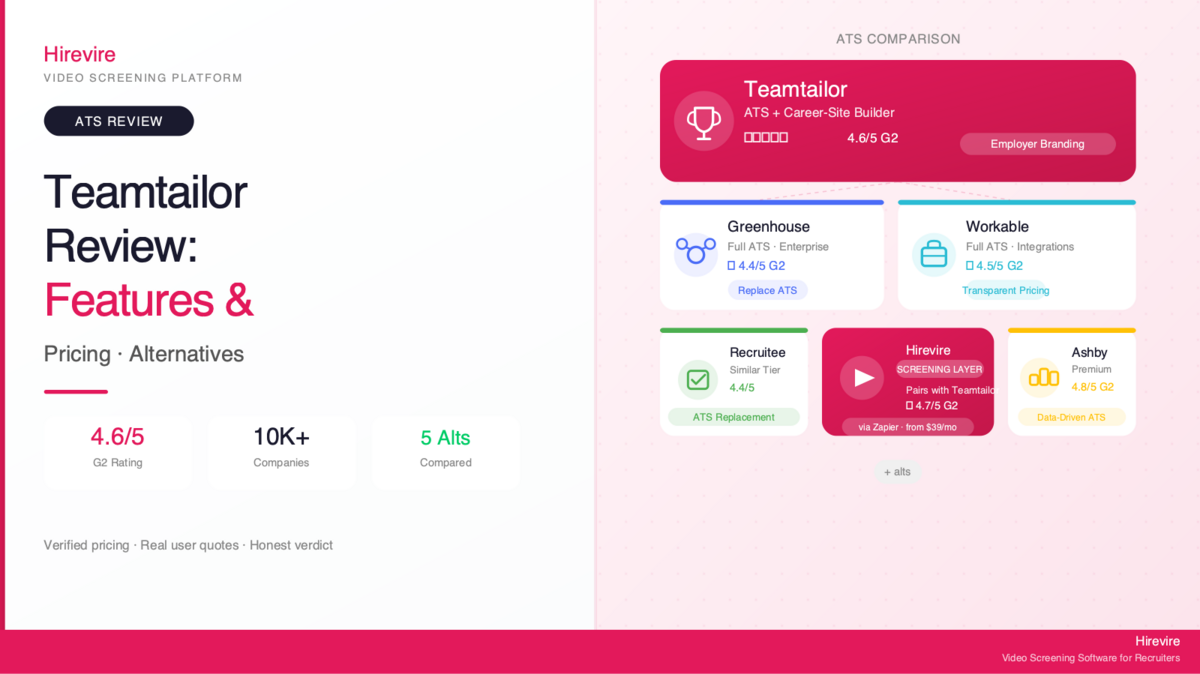
If you work in recruitment today, you probably do not have a sourcing problem — you have a screening problem. You are getting applications, but turning that volume into a high-quality shortlist without burning out your team is a different story.
Tools like Teamtailor have made it dramatically easier to attract talent and present a polished employer brand online. The trouble begins after candidates click “Apply.”
Most HR teams and recruitment agencies now sit in the same paradox. The career site looks fantastic, the pipeline stages are clearly defined, and hiring managers enjoy a clean interface. Yet your recruiters are still spending evenings skimming résumés and running 20–30 minute phone screens that do not always reveal the truth about communication skills, motivation, and culture fit. In 2026, that is no longer a sustainable model — especially in markets where each role pulls in 200+ applicants.
In this article, we will look at how to keep the parts of Teamtailor that are working — particularly employer branding and career-site experience — while fixing the real bottleneck: pre-screening. Along the way, you will see how layering Hirevire on top of Teamtailor gives you structured, async screening without forcing a risky ATS migration.
Why Teamtailor Won the Employer Branding Battle
Teamtailor has carved out a clear niche as the ATS for brand-forward employers. It offers one of the cleanest career-site builders in the market, with a drag-and-drop editor, custom colors and typography, and space for visuals and employee testimonials — without needing a developer on standby. For mid-market companies and scaleups, that “marketing-grade” careers page has become a real competitive edge.
Recruiters and hiring managers also like Teamtailor’s day-to-day usability. The interface is simple enough that managers can log in, review candidates, leave feedback, and move people across stages without weeks of training. The AI Co‑pilot layer helps draft job descriptions and sort CVs, trimming some of the admin overhead that slows down hiring teams.
For many HR leaders, this is exactly why they chose Teamtailor in the first place. It looks good, is relatively easy to roll out across multiple locations, and makes your company feel “put together” in the eyes of candidates. That matters in a world where 73% of talent professionals say candidate experience directly affects their ability to attract top talent.
Where the Pipeline Starts to Crack
The challenge comes once applications start flowing in.
Recruiters quickly discover that Teamtailor, for all its strengths, offers limited depth in structured pre-screening. You can collect résumés and application form data, but you cannot natively capture async video answers, audio responses, or multi-step questionnaires with conditional logic that really stress-test a candidate. The CV review experience itself can be clunky, often forcing recruiters to download documents rather than scan them inline.
In practical terms, this means your pipeline still depends heavily on manual triage. For a role that receives 200 applications, a recruiter might:
- Filter by keywords in CVs
- Quickly scan work histories
- Schedule 15–20 exploratory calls
Those calls are where you finally discover who can actually communicate, think on their feet, and align with your team’s values. But that is also where you burn the most hours for the least predictable return. The ATS is doing its job of organizing the funnel, yet it is not doing enough to help you decide who truly deserves an interview.
The Cost of Staying in a Low-Signal Loop
For in-house HR teams, the cost shows up as recruiter burnout and a “permanent backlog” of candidates who have applied but not yet been meaningfully assessed. For agencies, it translates into slower submittal times and missed opportunities to present top candidates before competitors do.
This low-signal loop has three common symptoms:
- Reactive hiring: Recruiters are always catching up, rarely curating talent pools for future roles.
- Inconsistent evaluation: Without structured screening questions, each recruiter runs a different version of the same call.
- Wasted brand equity: Your polished careers page brings in strong applicants, but the experience sours when they wait weeks for feedback because your team is overloaded.
Switching ATS platforms is one response, but it is an expensive, disruptive move. You have to rebuild your careers site, migrate data, retrain every stakeholder, and deal with 4–8 weeks of transition at minimum. Many teams do not have the appetite for that, especially if they like most of what Teamtailor offers.
The Smarter Option: Keep Teamtailor, Fix Screening
Instead of ripping out your ATS, a more strategic move is to strengthen the layer that Teamtailor does not cover deeply: structured, async pre‑screening. This is exactly where Hirevire slots into your stack.
Hirevire is built as a screening companion that runs alongside any ATS — including Teamtailor — rather than a replacement. The idea is simple:
- Teamtailor keeps doing what it does best: powering your careers site, handling job postings, and managing core stages.
- Hirevire becomes the dedicated pre-screening step between “application received” and “recruiter review.”
Candidates still discover roles on your Teamtailor-powered careers page and submit applications as usual. The difference is what happens next. Through a simple integration (via Zapier or webhooks), applicants are automatically invited to complete a structured Hirevire screening: a curated set of video, audio, text, or file-upload questions tailored to that role.
Recruiters now review rich responses asynchronously, rate and comment inside Hirevire, and only move shortlisted candidates back into the Teamtailor pipeline. You have effectively inserted a “high-signal filter” into your process without changing your ATS.
How Async Screening Changes the Day-to-Day for Recruiters
For HR teams and agencies accustomed to synchronous phone screens, async screening with Hirevire changes the feel of the work week.
- You see and hear candidates before you commit calendar time
Instead of booking 30 calls just to find the 5 candidates worth a full interview, you give everyone the same structured questions and let them respond in their own time. You can then watch, listen, or skim transcripts on your schedule.
2. You standardize what “good” looks like
Because every candidate answers the same core questions, it becomes easier to compare across the pool. Recruiters and hiring managers can align on what a strong response sounds like before reviewing, which raises consistency across your team.
3. You move faster without sacrificing depth
Teams report that with async screening, they can reduce the number of live calls dramatically while still feeling more confident about the shortlist. That speed matters when multiple agencies are vying for the same high-demand profiles.
4. You create a better experience for serious candidates
For applicants, a well-designed async flow can feel more respectful than a rushed phone screen. They have time to think, record, and present their best self — often outside office hours — without playing calendar Tetris.
Why This Combo Works Especially Well for Agencies
Recruitment agencies operate under sharper commercial pressure: you win when you submit strong candidates faster than competitors. The Teamtailor + Hirevire combo directly supports that reality.
- Volume handling: Agencies often run multiple roles for multiple clients simultaneously. Teamtailor gives you a stable ATS backbone, while Hirevire lets you process high application volumes without scaling your recruiter headcount linearly.
- Client transparency: With Hirevire, you can share candidate responses with clients so they see and hear shortlisted talent directly, not just through your notes. That makes your shortlist more persuasive and your value-add more visible.
- Repeatable shortlisting playbooks: For recurring roles — say, SDRs or customer support — your team can reuse proven Hirevire templates. Over time, you build a proprietary “shortlisting engine” that becomes a competitive differentiator.
Agencies that already rely on Teamtailor do not lose that investment. Instead, they upgrade how they use it by inserting a higher-fidelity screening layer.
What About Pricing and Integration Complexity?
From a budgeting standpoint, this model is simpler than a full ATS migration. Teamtailor already runs on a job-slot-based annual contract, with ranges starting around a few thousand dollars per year and increasing significantly for higher volumes of concurrent roles.
Adding a specialized screening tool like Hirevire starts from a fixed, transparent monthly fee with no per-interview charges inside the plan.
Technically, the integration is straightforward. Teamtailor already supports Zapier and webhooks, which means you can automate the flow:
- Candidate applies via Teamtailor
- Zapier sends the candidate to the right Hirevire screening
- Completed responses trigger an update back into the Teamtailor pipeline
You avoid custom engineering work while still getting a unified, automated experience across tools.
Designing Your First High-Signal Screening Flow
If you are considering this approach, start by picking one role where screening pain is most acute. For example: a high-volume customer support role or a mid-level sales position.
- Clarify the top 4–6 signals that matter
Is it spoken communication, empathy, technical understanding, languages, or problem-solving? Decide what you really want to hear or see before investing live time.
2. Build a short, mixed-media questionnaire
Combine 2–3 video questions with 1–2 written prompts and, where relevant, a file upload (such as a portfolio or sample work). Keep the overall time under 20–25 minutes to avoid candidate fatigue.
3. Align with hiring managers on evaluation criteria
Before you invite candidates, sit with your hiring manager and define what a “strong,” “average,” and “weak” response looks like for each question. That alignment will pay off later when you move quickly on offers.
4. Automate and test with a small batch
Connect Teamtailor and Hirevire via Zapier, then pilot the flow with a limited number of applicants. Ask both candidates and recruiters for feedback, refine, and then scale the model across similar roles.
From Brand-First to Brand + Signal
Teamtailor is a strong choice for teams that care deeply about how their employer brand shows up in the market and want a clean, collaborative ATS. Its weaknesses — especially around structured pre-screening — are real, but they are not fatal. With the right screening layer, you can keep the platform and still transform your time-to-shortlist and quality-of-hire.
If you are an HR leader or agency owner already running on Teamtailor, the opportunity is to shift your mindset from “Which ATS should we switch to?” to “How do we turn the ATS we already have into a high-signal hiring engine?” A dedicated tool like Hirevire answers that question by giving you async, multi-format screening, AI-powered transcription in dozens of languages, and collaborative evaluation in one place — all while your careers site continues to shine on Teamtailor.
If you want to go deeper into how Teamtailor is performing in 2026 and where it stands against other ATS platforms, you can read the full review here:
**Read more about Teamtailor’s pricing, strengths, and alternatives.**
메타데이터
- post_id
- 04aea6bb52cd
- slug
- how-to-turn-teamtailor-into-a-high-signal-hiring-engine-in-2026-04aea6bb52cd
- url
- https://medium.com/hirevire/how-to-turn-teamtailor-into-a-high-signal-hiring-engine-in-2026-04aea6bb52cd
- canonical_url
- https://medium.com/hirevire/how-to-turn-teamtailor-into-a-high-signal-hiring-engine-in-2026-04aea6bb52cd
- author_url
- https://medium.com/@hsanat
- status
- ok
- fetched_at
- 2026-06-11 10:13:20