AI in Flood Early Warning Systems
Flood early warning sounds like a straightforward prediction problem: measure rainfall, estimate river response, and issue a warning in…
AI in Flood Early Warning Systems
Flood early warning sounds like a straightforward prediction problem: measure rainfall, estimate river response, and issue a warning in time. In practice, it is one of the hardest operational forecasting problems there is. Rainfall is uncertain, water takes time to move through a catchment area, sensors are sparse, land use changes over time, and the most important events (floods) are also the rarest. That means both physics-based models and Artificial Intelligence (AI) models have to operate under large uncertainty.
In the past few months, I investigated whether AI can contribute to flood early warning systems. In this blog, I focus on two ways it can help: first, by improving the accuracy of timeseries forecasts such as discharge or water level predictions, and second, by speeding up raster or grid-based models through surrogate versions of expensive simulations. In other words, AI is useful both as a forecasting tool and as a compression tool.
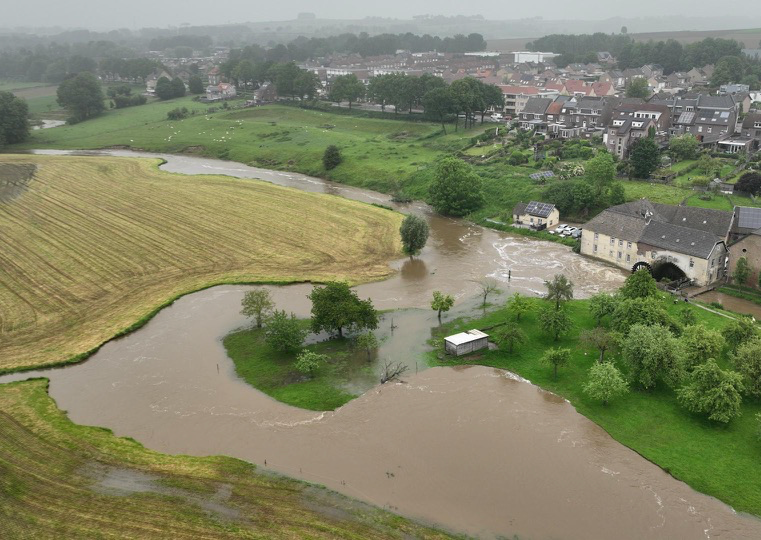
Footage of high water levels in Limburg
From Numerical Models to AI
Historically, flood modelling has moved through a few distinct approaches. Numerical models try to represent the laws of nature directly. Their strength is physical realism. Their weakness is that they are computationally expensive and depend on detailed environmental data that is often incomplete. In an operational early warning setting, that can lead to false precision: outputs that seem accurate, but rest on uncertain inputs.
Conceptual models take a more pragmatic route. Instead of describing every process in full detail, they simplify the landscape into abstractions such as storage, routing, roughness, and inertia. This makes them faster and therefore more suitable for real-time forecasting. But the simplification comes at a cost. These models are often only indirectly linked to what we actually measure, such as flow and water level, so calibration becomes a major part of the work.
AI models enter the picture because we now have far more historical measurements than were available in previous decades. Rather than manually simplifying equations, we can let a model learn patterns directly from observed inputs and outcomes. That does not make physics irrelevant, but it does shift the emphasis from hand-crafted formulas to data-driven learning.
Why AI Is Promising
For timeseries forecasting, AI can learn relationships that are difficult to encode explicitly. Models such as XGBoost, LSTM, and TiDE can ingest historical rainfall, discharge, water level, and meteorological forecasts to predict short-term future conditions. In catchments with sufficient measured data, this can improve predictive accuracy, especially when relationships are nonlinear or change with season and hydrologic event type.
For grid and inundation forecasting, the opportunity is different. Here the main bottleneck is often runtime. Two-dimensional hydraulic models can be too slow for operational use, especially when you want to test multiple scenarios quickly. At the same time, real grid-based inundation data is usually scarce or unavailable. Unlike water level or discharge data at measuring stations, detailed flood extent maps are not recorded consistently for every event, and when they do exist they are often incomplete or difficult to use for training.
That is why surrogate models are so helpful: these models are trained on large sets of numerical simulations and then approximate those simulation outputs much faster during inference. Think of it as compressing an image that keeps its details, but takes less memory. This moves the computational cost upfront: training takes time, but deployment is fast.
The Real Constraint: Data
The main limitation of AI is not model architecture but data quality. Flood datasets are usually imbalanced. Normal flow conditions are common, while extreme events are rare. Some extreme precipitation events occur only once every 100 years, or even less frequently. If you train naively, the model will become very good at predicting ordinary days and much less useful during the rare extremes that actually matter most for early warning.
That is why a data balancing strategy matters. It is not enough to collect more data, the dataset also needs to represent all possible events we care about. Balancing across categories such as summer baseflow, winter flow, and extreme events helps ensure the model learns across the full operating range rather than optimizing for the average case.
Adding Guardrails
A fully data-driven model is not automatically a safe operational model. Flood forecasting is not just about minimizing prediction error; it is also about maintaining physical plausibility and trust. Concepts such as mass conservation, bounded corrections, or hybrid modelling are therefore important guardrails.
This is why I think hybrid models are especially promising. Instead of replacing physics entirely, AI can be used to correct, accelerate, or complement physically based models. That gives you part of the flexibility of machine learning without giving up all physical structure.
Final Thoughts
AI should not be viewed as a standalone solution to flood early warning. The core challenges remain: uncertain rainfall, sparse observations, changing landscapes, and a limited number of extreme events on which to train and evaluate models. However, AI can still provide substantial value when applied carefully. In timeseries forecasting, it can improve predictive skill. In raster forecasting, it can make inundation modelling fast enough for operational use.
The most promising direction is therefore not a choice between pure AI and pure physics, but the development of hybrid systems that combine both: data-driven approaches where adaptive learning offers clear advantages, and physics-based approaches where measured data is sparse but reliable geographic information is available.
메타데이터
- post_id
- 04c3e6d7c87e
- slug
- ai-in-flood-early-warning-systems-04c3e6d7c87e
- url
- https://medium.com/ordina-data/ai-in-flood-early-warning-systems-04c3e6d7c87e
- canonical_url
- https://medium.com/ordina-data/ai-in-flood-early-warning-systems-04c3e6d7c87e
- author_url
- https://medium.com/@bobleynse96
- status
- ok
- fetched_at
- 2026-06-11 10:13:20