Angus McLean Tells us Why he wrote “Cop It Write” — a Kiwi police book
Crime writers really do need to get their facts right
Angus McLean Tells us Why he wrote “Cop It Write” — a Kiwi police book
Crime writers really do need to get their facts right
- Tell us about your police career.
I joined in 1995 and spent 27 years in the Police. Ever since I was very small it’s all I ever wanted to be. I grew up in a Police family and although my parents never pushed me that way, there was never any question that it was what I’d do. After the first several years in uniform, I joined the CIB (Criminal Investigation Branch) and spent the next 20 years investigating serious crime — homicides, child abuse, GBH, sex crimes etc. I worked on more operations than I can remember. I spent 13 years as a Detective Sergeant. All of my CIB experience was in Counties Manukau, the biggest, busiest and most violent district in the country.
- Why did you decide to write Cop It Write? Did you get tired of reading novels with lots of errors in them, or were there other reasons?
Cop It Write was the culmination of two things — a desire to help other writers and a desire to save myself time. I was answering a lot of queries from other writers, which I’m more than happy to do, but I found I was getting the same questions repeatedly. Rather than copying and pasting previous emails it was easier to do a book. It was also frustrating reading basic errors in books that were otherwise good — writers using the wrong terminology or procedures, wrong ranks, wrong squads etc etc — things that could have been done right with a few basic questions. We don’t know what we don’t know, but there’s no excuse for laziness. If the book helps my fellow writers get their basics right and makes their books better, then it’s done its job.
- What are some of the biggest errors you see in novels or on the TV screen?
So many things…but a lot that “normal” people wouldn’t notice. Commonly it’s one cop doing everything — a DI running a homicide, doing the scene, interviewing the witnesses and catching the bad guy. So not true! The DI should be there for the briefings, involved in some strategic decisions and other than that, stay out of the way and shout the pizzas when the detectives are working late. Terminology’s another big one — writers or screenwriters will have a uniformed cop call a detective or a Detective Sergeant “sir” — Sir or Ma’am is a commissioned officer, ie Inspector or above. Or there’s a crime scene with everyone kitted out in zoot suits (paper overalls, booties etc) then a detective rocks up with a coffee in hand and no protective gear on, and struts around the scene touching things. They need to be arrested (the detective and the writer; they can share a cell).
- How did you decide what to include in the book? What did you have to leave out, if anything?
I started with the problems I saw, added things that I thought could add detail but which I hadn’t seen in a book before, then asked a couple of online crime writing communities what they wanted to know. Mashed that all together, added a bit more and there it was.
- What are some of the main ways in which NZ Police differs from other countries? How does that affect the stories you see in fiction and on TV? (eg police in NZ don’t routinely carry guns on them like Australian police do)
NZ has a national Police service, which is quite unique. There are no jurisdictional issues; you can drive from one city to another and still arrest someone. We are not routinely armed, which influences the way that Police operate here (we don’t rely on the threat or use of force as easily as some other places). Our systems are actually quite up to date, for example the IT systems used by the Aussie states are not as good as ours, surprisingly. We are funded by central Government, not local municipalities, so staff can be moved pretty freely around the country when needed.
- You are now working as a private investigator — what kinds of work does that entail?
PIs do all kinds of work — the image of a rye-swilling, fedora-and-trenchcoat-wearing private eye with a .45 under his arm tailing a cheating husband is a trope, not a reality. Infidelity issues still come up, but PIs also do insurance investigations, employment matters, custody issues, find missing persons, locate debtors, work on civil cases, and investigate crime for defence lawyers. I mostly do criminal defence work now, similar to what I did in the Police. Still looking for facts and finding witnesses. Sometimes it adds to the case against the defendant, sometimes it adds a different perspective, and sometimes it shows that they actually didn’t do it.It’s interesting and challenging, and I don’t need a fedora or .45 to do it.
- You mentioned Cisco (in the Mickey Haller novels by Michael Connolly) as one of the most accurate depictions of a PI in fiction. What are a couple of the best depictions of homicide detectives you have read or seen?
For TV, NYPD Blue is the gold standard as far as I’m concerned. They had a serving NYPD veteran detective as a consultant on the show and it really shows. NZ’s own Shark in the Park from the nineties is similar in that regard; they nailed it. In books it would be Michael Connelly’s Bosch and Ballard series’, plus Peter James’ Roy Grace series. Both authors use good consultants and it lifts them above their peers. Anything where the detective tampers with evidence, breaks the law, shoots someone and is back at work the same day, or tricks a suspect into a confession just doesn’t cut it. Entertaining, yes. Accurate, no.
-
- Any favourite authors or TV shows?
My favourite TV shows are mostly old ones — Magnum, PI, The Rockford Files, Simon and Simon, Hunter — I didn’t say they were accurate, but they’re definitely entertaining! Castle is another; a best selling crime novelist shadowing a NYPD homicide detective? Funny and entertaining. Connelly is my favourite author, alongside Gregg Hurwitz, Anthony Horowitz, Stephen J. Cannell, Robert Crais, Michael Koryta — all great crime and thriller writers. Damien Lewis for some fantastic WW2 stuff. I have a low tolerance so am happy to put a book aside if it’s not hitting the mark for me.
Thank you, Angus!
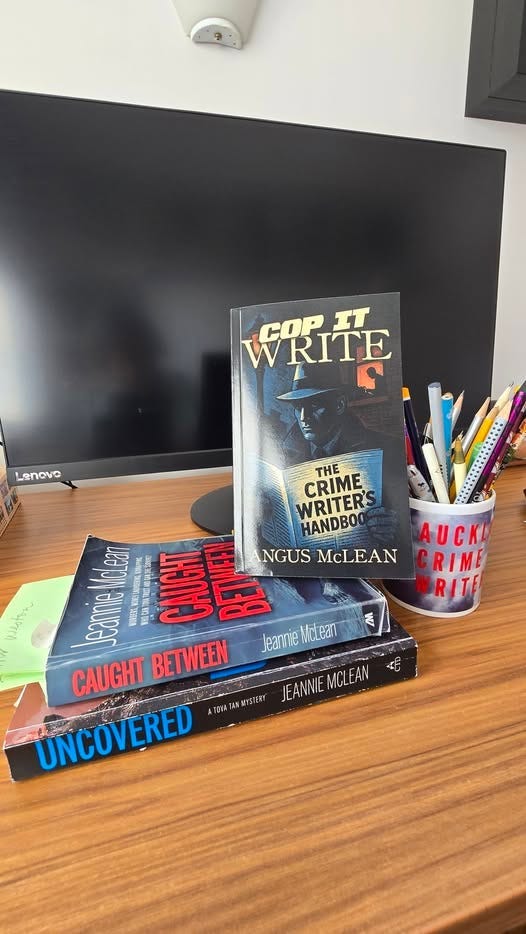
Cop It Write is available now for all aspiring Kiwi crime writers.
메타데이터
- post_id
- 0553b8f834e6
- slug
- angus-mclean-tells-us-why-he-wrote-cop-it-write-a-kiwi-police-book-0553b8f834e6
- url
- https://medium.com/@sherrylclark/angus-mclean-tells-us-why-he-wrote-cop-it-write-a-kiwi-police-book-0553b8f834e6
- canonical_url
- https://medium.com/@sherrylclark/angus-mclean-tells-us-why-he-wrote-cop-it-write-a-kiwi-police-book-0553b8f834e6
- author_url
- https://medium.com/@sherrylclark
- status
- ok
- fetched_at
- 2026-06-09 15:37:30