From Cloud to Device: How WebLLM Makes AI Personal and Private
Most people experience large language models through cloud services such as GPT, Gemini, or Claude. These platforms make advanced AI…
From Cloud to Device: How WebLLM Makes AI Personal and Private
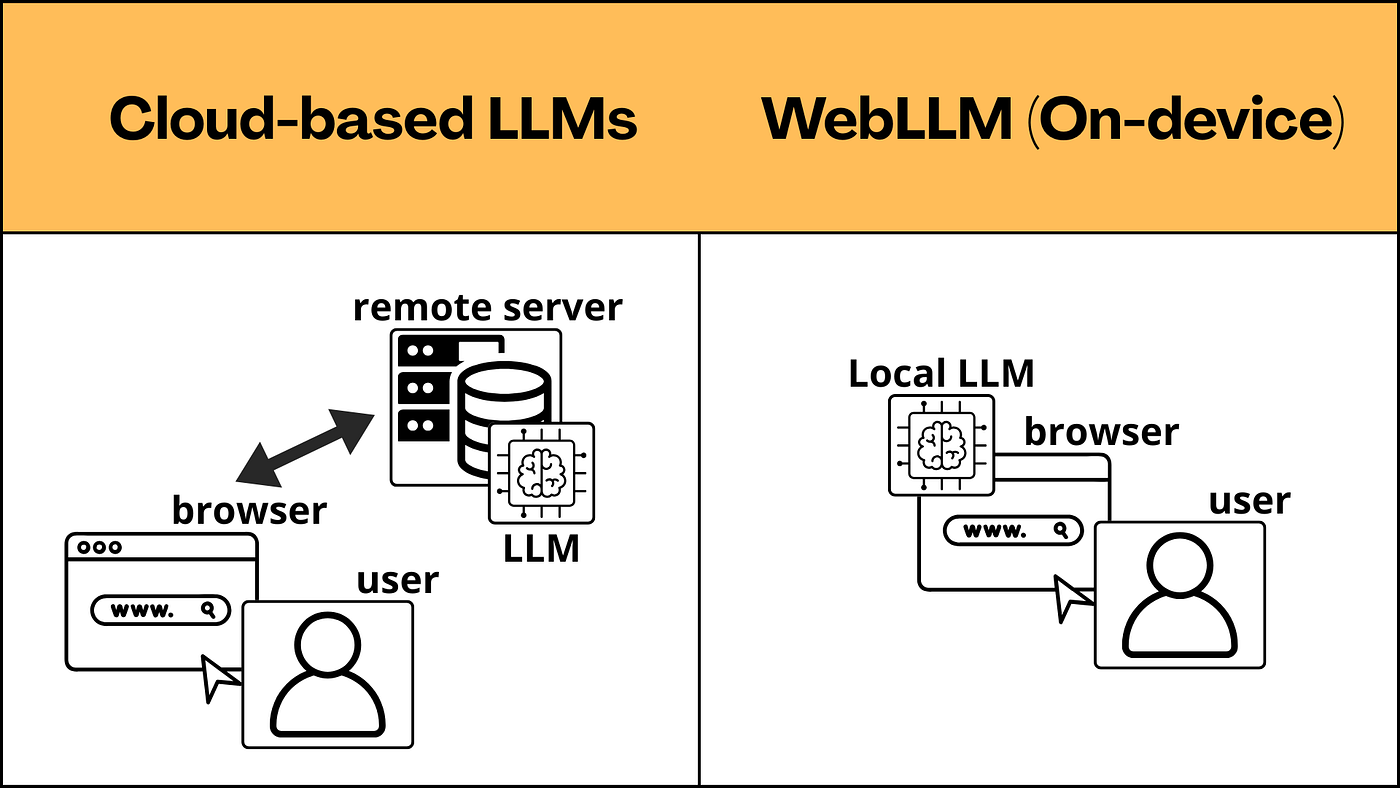
Most people experience large language models through cloud services such as GPT, Gemini, or Claude. These platforms make advanced AI accessible to everyone, but they also come with trade-offs including slower response times, privacy concerns, dependence on an internet connection, and significant operational costs.
That paradigm is now changing. A new generation of technology is emerging that promises to bring the intelligence of LLMs directly to your device — no servers, no data transmission, no subscription walls. At the center of this transformation is **WebLLM**, an open-source initiative that enables large language models to run natively in your web browser.
What Is WebLLM?
WebLLM is an open-source project developed by the team behind MLC (Machine Learning Compilation), with the ambitious goal of running modern AI models fully inside the browser using WebGPU. Instead of sending data to remote servers, WebLLM executes computations directly on your local GPU or CPU through Chrome, Edge, or Firefox.
Why It Matters
Running LLMs in the browser is not just a technical curiosity. It represents a fundamental shift in how we think about AI accessibility, privacy, and scalability.
- True Data Privacy : Since no data leaves your device, user interactions remain fully local. This eliminates one of the most significant barriers to AI adoption in sensitive industries such as healthcare, finance, and education.
- Offline Intelligence : WebLLM allows AI to function without a permanent internet connection. Once the model is downloaded, it can respond even when offline — an essential feature for edge computing, mobile applications, and regions with limited connectivity.
- Cost Efficiency : Cloud inference is expensive and scales poorly for consumer-facing applications. Local inference removes that burden, enabling developers to build powerful AI tools without recurring server costs.
- Performance Evolution : Thanks to GPU acceleration via WebGPU, performance continues to improve with every browser update. What once required a datacenter can now fit into the compute power of a laptop or high-end tablet.
How Developers Can Use It
WebLLM opens new possibilities for web developers and one of the most exciting aspects of WebLLM is how accessible it is for developers. There’s no backend infrastructure to manage, no API keys, and no costly inference servers. If you can build a basic web page, you can integrate a local LLM that runs directly in your user’s browser.
import * as webllm from "https://esm.run/webllm";

// Initialize the WebLLM engine
async function main() {
  // Create a new chat session with a specific model
  const engine = await webllm.createEngine("Llama-3-8B-Instruct-q4f16_1");

  // Send a message to the model
  const response = await engine.chat.completions.create({
    messages: [
      { role: "system", content: "You are a helpful assistant." },
      { role: "user", content: "Explain quantum computing in simple terms." }
    ],
  });

  console.log(response.message.content);
}

main();
This code initializes the WebLLM engine, which automatically uses your browser’s WebGPU backend. It loads a model such as Llama 3, Mistral 7B, or any supported quantized model, and runs inference locally for the prompt “Explain quantum computing in simple terms.”.
You can also create chat interfaces or agent-like experiences that run entirely on the client side. Here is a minimal example :
// Example: interactive chat UI
const chatInput = document.querySelector("#prompt");
const chatOutput = document.querySelector("#output");

chatInput.addEventListener("keydown", async (e) => {
  if (e.key === "Enter") {
    const userInput = chatInput.value;
    chatOutput.textContent += `\nYou: ${userInput}`;

    const reply = await engine.chat.completions.create({
      messages: [{ role: "user", content: userInput }],
    });

    chatOutput.textContent += `\nAI: ${reply.message.content}`;
    chatInput.value = "";
  }
});
Once the model weights are downloaded, they’re cached in your browser, so future sessions start almost instantly.
A Turning Point for AI
The shift from cloud to client‑side computation mirrors previous revolutions in computing. One of the key enablers of this transition is model quantization. Quantization is a technique that reduces the precision of a model’s weights (for example converting 16‑bit floating‑point numbers to 8‑bit integers) without significantly affecting its performance. This enables large language models to run efficiently on consumer hardware without needing massive GPU clusters.
Today, on‑device AI is not just an academic novelty. The global on‑device AI market was estimated at US$ 8.60 billion in 2024 and is projected to grow to about US$ 36.64 billion by 2030, a compound annual growth rate of approximately 27.8% according to Grand View Research. These numbers reflect the mounting demand for real‑time, private, and low‑latency AI that lives on the device rather than in the cloud.
Quantization is increasingly emerging as a standard practice in AI deployment. As developers and companies strive to deliver AI experiences that are fast, private, and lightweight, quantized models allow the benefits of LLMs to be brought directly to user devices. What was once a trade-off between model size and usability is now mitigated: smaller, quantized models can deliver excellent performance, real-time inference, and low memory usage, making them ideal for on-device execution.
Smaller and highly optimized models with fewer parameters than large cloud-only models, enhanced through quantization, deliver key benefits such as fast responses, low memory usage, and the ability to run entirely in the browser.
They have the potential to redefine what “AI access” truly means. Instead of relying on remote servers, you’ll carry your own lightweight, private, and always available AI model. This approach not only ensures security and speed but also opens the door to greater customization, allowing AI to adapt to your personal preferences, workflows, and unique needs. This is more than just another step in AI’s evolution; it signals the beginning of a new architecture for digital intelligence, one that is personal, flexible, and fully under your control.
The future of AI may no longer live in the cloud. It will live in your browser.
메타데이터
- post_id
- 055a9c00a145
- slug
- from-cloud-to-device-how-webllm-makes-ai-personal-and-private-055a9c00a145
- url
- https://medium.com/@orion.extensions/from-cloud-to-device-how-webllm-makes-ai-personal-and-private-055a9c00a145
- canonical_url
- https://medium.com/@orion.extensions/from-cloud-to-device-how-webllm-makes-ai-personal-and-private-055a9c00a145
- author_url
- https://medium.com/@orion.extensions
- status
- ok
- fetched_at
- 2026-07-15 16:58:55