How to Create Custom Product Forms for Custom Soil Blends and Mixes: Mix It Right Every Time
Introduction
How to Create Custom Product Forms for Custom Soil Blends and Mixes: Mix It Right Every Time
How to Create Custom Product Forms for Custom Soil Blends and Mixes: Mix It Right Every Time
Introduction
Every growing operation has unique requirements. A nursery producing ornamental container plants needs a completely different growing medium from a professional landscaper establishing turf on a compacted clay site. A cannabis cultivator demands precise pore space ratios and pH buffering capacity that a market gardener growing salad crops in raised beds would never specify. A rooftop green roof engineer specifies substrate weight, drainage capacity, and minimum depth that has nothing in common with a forest school’s woodland composting project.
Custom soil blends are by definition bespoke products. The value they deliver comes precisely from their customization — from the careful calibration of ingredients, ratios, and performance characteristics to match the specific application, the specific growing conditions, and the specific customer requirement.
But here is the operational challenge that every custom soil blender faces: how do you capture, record, manage, and price an essentially infinite variety of custom specifications in a way that is consistent, accurate, auditable, and commercially effective?
For most businesses, the answer has been manual. A specification sheet filled in by hand. An email exchange confirming ingredient ratios. A spreadsheet formula calculating component costs. A job note describing the blend for production. And somewhere in that manual chain, errors creep in. Specifications get misread. Ratios get transcribed incorrectly. Pricing calculations use outdated component costs. And the blend that goes into the bag does not quite match what the customer discussed.
**InventreeFY** gives custom soil blend manufacturers, growing media producers, horticultural suppliers, and landscaping material businesses the custom product form platform that brings structure, accuracy, and commercial control to every bespoke blend specification — from first customer inquiry through to production, dispatch, and reorder.
This article covers every tool, every approach, and every practical application that makes InventreeFY the definitive platform for custom soil blend and mix product form management.
Why Custom Soil Blend Businesses Need Purpose-Built Product Forms
Standard product forms work for standard products. A fixed-specification bag of multi-purpose compost has a product name, a product code, a price per bag, and a stock level. Managing it is straightforward.
A custom soil blend is none of these things. It is a dynamic product specification that may change between orders, between customers, or even between seasonal applications for the same customer. Managing it with tools designed for standard products creates operational chaos that directly affects product quality, customer satisfaction, and business profitability.
Ingredient Ratios Are Critical and Variable
The performance of a growing medium is determined by the precise ratio of its constituent ingredients. The difference between 30% perlite and 35% perlite in a professional plug plant medium can mean the difference between optimal air-filled porosity and over-drainage that stresses seedlings at the critical germination stage.
A custom product form for soil blends must capture ingredient ratios with a level of precision that generic order forms cannot provide. It must validate that those ratios sum correctly. It must prevent impossible combinations from being specified. And it must carry those precise ratios through to production instructions that plant operators can follow without ambiguity.
Performance Parameters Drive Customer Specification
Professional customers do not always specify their blend by ingredient ratios. They specify by performance outcomes. They want a pH between 5.8 and 6.2. They want a minimum air-filled porosity of 25% at field capacity. They want an EC below 0.8 mS/cm for sensitive seedlings. They want a minimum water-holding capacity of 40% by volume.
A custom product form platform must be able to capture these performance specifications alongside ingredient specifications — and ideally to validate whether the specified ingredient combination is likely to achieve the required performance parameters.
Pricing Complexity Requires Accurate Real-Time Calculation
Custom soil blend pricing is a multi-variable calculation. Ingredient costs fluctuate with seasonal availability, transport costs, and bulk purchasing arrangements. Blend ratios determine how much of each ingredient appears in every cubic meter of finished product. Batch size affects production efficiency and cost per unit. Bagging or bulk delivery affects logistics cost.
An operator quoting a custom blend without a system that calculates all of these variables from current costs and the specified ratios will either quote incorrectly — losing margin — or add excessive contingency to compensate for uncertainty — losing the job.
Traceability Requirements Are Growing
From organic certification to carbon footprint declarations to country-of-origin labeling for peat-free inputs, the traceability requirements attached to custom growing media are increasing consistently. A custom product form platform that does not capture ingredient provenance cannot support the compliance declarations that professional customers increasingly require.
The Architecture of Custom Product Forms for Soil Blends in InventreeFY
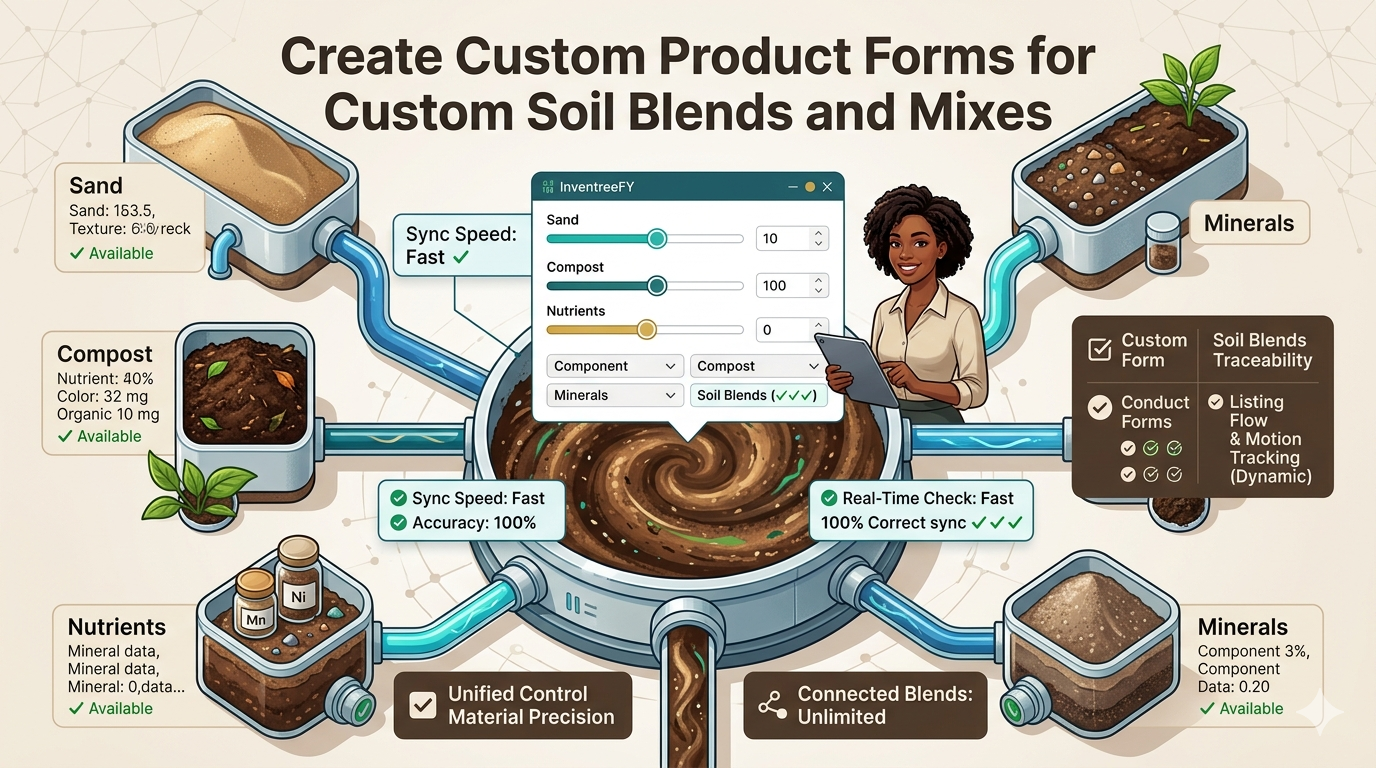
**InventreeFY’s **custom form builder creates structured digital forms that capture every dimension of a custom soil blend specification — from ingredient selection and ratio definition through performance parameter recording, pricing calculation, and production instruction generation.
The platform treats every custom blend as a structured data object — not a text description. Every ingredient is a linked product record with its own cost, density, and provenance data. Every ratio is a numeric field validated against the total. Every performance parameter is a measurable value that the system can compare against specification requirements. And every completed form is the authoritative source document for production, pricing, and customer communication.
How to Structure Custom Product Forms for Soil Blends
Structure 1: The Ingredient-Led Specification Form
Some customers know exactly what they want. They specify ingredients and ratios precisely — often because they have refined a successful formula over years of production. Their form is fundamentally an ingredient list with percentage or volume ratios.
For this customer type, the form structure begins with ingredient selection and ratio entry — with validation logic ensuring ratios sum to 100% and flagging any combinations that are known to be incompatible or technically problematic.
Structure 2: The Performance-Led Specification Form
Other customers start from performance requirements. They know the end specification — the pH range, the air-filled porosity target, the EC limit, the minimum nutrient content — and need the form to help them work backward to an ingredient combination that achieves those targets.
For this customer type, the form begins with performance parameter entry — the system then suggests ingredient combinations that are likely to meet the specified performance targets, based on the stored performance data for each ingredient in your catalog.
Structure 3: The Application-Led Specification Form
A third customer type starts from the application. They specify the crop type, the growing system — rockwool, coir, peat-free, bark-based — the container type and size, and the production environment. The form uses this application data to suggest appropriate base specifications that can then be customized.
For this customer type, the form begins with application profile entry — selecting from a library of application types that the system uses to generate an initial starting specification for the customer’s review and refinement.
The Complete InventreeFY Tool Suite for Custom Soil Blend Product Forms
Tool 1: Custom Form Builder with Soil Blend Field Types
InventreeFY’s custom form builder creates product specification forms with field types specifically suited to the complexity of soil blend and growing media customization. Every field captures structured data — not free text — ensuring that every specification is consistently formatted, machine-readable, and usable by downstream production and pricing systems.
Soil Blend-Specific Form Field Types in InventreeFY
Ingredient Selection Fields
- Single ingredient selector — choosing one ingredient from your cataloged raw material library
- Multi-ingredient panel — selecting multiple ingredients simultaneously with individual ratio entry
- Ingredient family selector — selecting from within a defined ingredient category
- Optional ingredient toggle — specifying that an ingredient may be included at customer’s discretion
Ratio and Proportion Fields
- Percentage ratio entry — inputting ingredient proportions as percentages
- Volume ratio entry — inputting proportions as parts by volume
- Weight ratio entry — inputting proportions as parts by weight
- Ratio validation display — real-time sum display confirming ratios total correctly
Performance Parameter Fields
- pH target range — minimum and maximum pH values
- EC target range — electrical conductivity specification in mS/cm
- Air-filled porosity target — minimum % AFP at field capacity
- Water-holding capacity specification — minimum % WHC by volume
- Bulk density target — desired bulk density in kg/m³ or g/l
- Particle size distribution — specifying fine, medium, or coarse particle profile
- CEC specification — cation exchange capacity for specialty applications
- Organic matter content — percentage target for specific applications
Quantity and Format Fields
- Batch quantity — cubic meters, tonnes, or number of bags
- Bag size selector — bag configuration if applicable
- Bulk delivery selector — loose load, dumpy bag, or tipper
- Production timing — required production date and lead time confirmation
Application Profile Fields
- Crop type selector — from your library of crop and application types
- Growing system selector — container, open ground, hydroponics, or media bed
- Container size and type — specifying pot volume and material
- Production environment — heated glasshouse, polytunnel, outdoor, or controlled environment
Certification and Compliance Fields
- Organic certification status — specifying if the blend must meet organic production standards
- Peat-free confirmation — mandatory confirmation for peat-free specification compliance
- Country-of-origin requirements — specifying origin restrictions for any ingredient category
- Carbon footprint declaration requirement — flagging if a product carbon footprint is required
Tool 2: Ingredient Catalog and Raw Material Library
Every ingredient available for inclusion in your custom blends gets a complete structured record in InventreeFY’s raw material library. These records store not just the ingredient’s description but its technical performance data — the data that the form system uses for performance parameter validation and the pricing engine uses for blend cost calculation.
Raw Material Record Fields in InventreeFY
Material Identity
- Material name and trade designation
- Supplier name and supplier product code
- Category — peat, bark, coir, composted material, mineral amendment, or biological additive
- Grade or particle size designation
- Country of origin and origin certification
Technical Performance Data
- Typical pH range — minimum and maximum for the material
- Typical EC — electrical conductivity contribution
- Approximate air-filled porosity contribution — % AFP at standard moisture
- Approximate water-holding capacity — % WHC by volume
- Bulk density — typical range in kg/m³
- Organic matter content — percentage by dry weight
- CEC contribution — cation exchange capacity in cmol/kg
- Wettability characteristics — hydrophobic risk and rewetting behavior
Compatibility Data
- Known incompatibilities — materials that should not be combined with this ingredient
- pH sensitivity — whether this ingredient affects blend pH significantly
- EC sensitivity — significant EC contribution at standard inclusion rates
- Interaction notes — any special considerations when combining with specific other materials
Commercial Data
- Current purchase price per tonne or per m³
- Minimum order quantity for this material
- Typical lead time for replenishment
- Seasonal availability status — noting materials with seasonal supply constraints
- Current stock holding in your yard or storage facility
Certification Data
- Organic approved status — listing approving certification bodies
- Peat-free confirmation — whether this material is derived from peat
- Carbon footprint — declared kg CO₂e per tonne or per m³ where available
- Chain-of-custody certification — FSC, PEFC, or equivalent for wood-derived materials
- Composting standard compliance — PAS 100, BSI, or equivalent for composted materials
Tool 3: Ratio Validation and Blend Logic Engine
InventreeFY’s validation engine runs continuously as a customer or specification manager builds a blend specification — catching impossible ratios, flagging incompatible ingredient combinations, and providing real-time feedback on whether the specified blend is physically achievable with the stated ratios.
Validation Checks in InventreeFY’s Blend Logic Engine
Mathematical Validation
- Ratio sum checking — confirming that all ingredient percentages total 100%
- Minimum inclusion rate enforcement — flagging when an ingredient is below a meaningful inclusion rate
- Maximum inclusion rate enforcement — flagging when a single ingredient exceeds recommended limits
- Integer or decimal precision control — ensuring ratios are entered at the required decimal precision
Compatibility Validation
- Known incompatibility detection — flagging pairs of ingredients with known adverse interactions
- pH conflict detection — alerting when ingredient combination creates likely pH extremes
- EC accumulation warning — flagging when multiple high-EC ingredients combine to create potentially harmful EC levels
- Hydrophobicity risk flag — alerting when ingredient combinations create rewetting risk
Performance Estimation Feedback
- Estimated pH range — calculating the likely pH range of the specified blend from ingredient data
- Estimated AFP — projecting likely air-filled porosity from ingredient performance data
- Estimated WHC — projecting water-holding capacity from ingredient data
- Estimated bulk density — calculating approximate density from ingredient bulk density data and ratios
- Performance parameter comparison — displaying estimated blend performance against stated specification targets
Tool 4: Real-Time Blend Pricing Calculator
InventreeFY’s pricing calculator computes the cost of any custom blend specification in real time — using current raw material prices, the specified ingredient ratios, the batch quantity, and your configured margin and overhead structure.
Every change to an ingredient ratio immediately recalculates the blend cost. Every quantity change recalculates unit economics. Every update to a raw material price propagates automatically to every blend specification that includes that ingredient — so your pricing always reflects current input costs without manual recalculation.
Pricing Calculation Components in InventreeFY
Material Cost Calculation
- Quantity of each ingredient required per m³ or per tonne of finished blend
- Current purchase cost per unit of each ingredient
- Total material cost per m³ or per tonne of finished product
Production Cost Allocation
- Blending labour cost — configured rate per m³ or per batch
- Equipment usage cost — allocated machinery cost per batch
- Quality control cost — testing and analytical cost where applicable
- Bagging cost — per-bag packaging cost for bagged product formats
Delivery and Logistics Cost
- Packaging cost for bagged products — bag cost per unit
- Pallet cost for palletized delivery
- Haulage rate by delivery distance — configured rate per km or per delivery zone
- Loading and handling cost per batch
Margin and Pricing Configuration
- Gross margin percentage by customer tier
- Fixed overhead allocation per m³ of production
- Minimum batch charge — ensuring small batches carry minimum viable revenue
- Customer-specific margin adjustment for key accounts
- Promotional pricing configuration for seasonal campaigns
Pricing Output Formats
- Price per cubic meter — standard pricing unit for growing media
- Price per tonne — weight-based pricing for landscape substrates
- Price per bag — unit pricing for bagged retail and trade formats
- Price per batch — total batch pricing for fixed-quantity production runs
- Price with and without delivery — ex-works and delivered pricing displayed simultaneously
- Margin display — showing gross margin and gross margin percentage alongside the customer price
Tool 5: Performance Parameter Specification and Validation Module
For customers specifying by performance rather than by ingredient, InventreeFY’s performance specification module captures target parameter values and uses them in two ways: first, to validate whether the proposed ingredient combination is likely to meet the specified targets; and second, to document the agreed performance specification against which actual batch testing results will be compared.
Performance Parameter Management Features
- Target pH range entry with red/amber/green validation against estimated blend pH
- Target AFP entry with comparison against estimated blend AFP from ingredient data
- Target WHC entry with comparison against estimated WHC from ingredient data
- Target bulk density entry with comparison against estimated bulk density
- Target EC range entry with comparison against estimated EC contribution
- Specification tolerance configuration — defining acceptable variance from target values
- Parameter priority flagging — marking which parameters are critical and which are advisory
- Testing requirement generation — automatically creating a testing schedule from the specified parameters
- Results-to-specification comparison — attaching actual batch test results alongside specification targets
Tool 6: Production Instruction Generator
When a custom blend specification is confirmed and an order is placed, InventreeFY’s production instruction generator converts the specification form into a formatted production document — ready for plant operators to follow without needing to interpret the original specification form.
The production instruction includes every ingredient with its required quantity for the batch, the mixing sequence where relevant, any special preparation instructions for specific ingredients, the target performance parameters for quality checking, and the packaging and labeling instructions for the finished product.
Production Instruction Document Elements
- Batch identification — unique batch reference linked to the customer order
- Finished product specification — blend name and customer specification reference
- Ingredient schedule — every ingredient with required quantity per m³ and for the total batch
- Weighing and measurement instructions — specifying the measurement unit and accuracy required
- Mixing sequence — ordered sequence for ingredient addition where sequence matters
- Special preparation notes — any pre-blending preparation required for specific ingredients
- Moisture content adjustment — target moisture range and adjustment method
- Quality check parameters — the parameters to test and their acceptable ranges
- Sampling instruction — when and how to take samples for quality assessment
- Bagging or bulk dispatch instructions — quantity per bag or bulk format and labeling requirements
- Batch sign-off requirement — the authorizations required before batch is released for dispatch
Tool 7: Customer Specification History and Reorder Management
Repeat customers with established blend specifications do not want to re-specify from scratch at every reorder. InventreeFY’s specification history system stores every confirmed custom blend specification against the customer account that ordered it — making reordering as simple as selecting a previous specification, confirming current requirements have not changed, and initiating the new order.
Customer Specification History Features
- Specification library per customer account — every confirmed custom blend stored and retrievable
- Specification comparison view — displaying how the current order differs from the previous
- Quick reorder capability — initiating a new order from a previous specification with one action
- Specification modification tracking — recording any customer-initiated changes from the previous version
- Seasonal variation management — storing summer and winter variants of recurring specifications
- Specification approval record — retaining the customer sign-off from the original specification confirmation
- Price change notification — alerting the customer when a reorder price differs from the previous due to ingredient cost changes
- Specification expiry management — flagging specifications that are more than a defined period old for review before reordering
Tool 8: Quality Control and Batch Testing Integration
Custom growing media requires quality assurance. Batch testing confirms that the finished product meets the specification’s performance parameters. InventreeFY’s quality control integration connects batch testing results directly to the specification form — creating a complete quality record for every custom blend produced.
Quality Control Integration Features
- Testing parameter schedule generation — creating a test plan from the specification’s performance parameters
- Laboratory request generation — creating formatted testing requests for internal or external laboratories
- Results data entry — recording test results against each tested parameter
- Specification compliance comparison — displaying results alongside specification targets with pass/fail flags
- Out-of-specification alert — flagging batches where any result falls outside the specified tolerance
- Remediation workflow — structured process for addressing out-of-specification batches
- Certificate of Analysis generation — creating formatted quality certificates from test results for customer supply
- Historical quality data analysis — tracking quality performance trends across batches of recurring specifications
Tool 9: Certification and Compliance Documentation Manager
Custom growing media sold to professional growers increasingly requires certification documentation — organic production approval, peat-free content verification, carbon footprint declarations, and growing media standard compliance. InventreeFY’s documentation manager attaches every relevant certification to the blend specification and generates the documentation required for specific customer or market requirements.
Certification Documentation Features
- Organic certification management — tracking which ingredient sources are certified organic
- Blend-level organic status determination — confirming whether a blend’s ingredient sourcing qualifies for organic labeling
- Peat content declaration — calculating and declaring peat content percentage for labeling compliance
- Peat-free verification — confirming all ingredients meet peat-free criteria where required
- Carbon footprint calculation — calculating blend-level carbon footprint from ingredient EPD data
- Growing media standard compliance — recording compliance with BSI PAS 100 or equivalent standards
- Certificate of compliance generation — creating formatted compliance declarations for customer supply
- Regulatory update monitoring — alerting when regulatory changes affect ingredient or blend compliance status
Tool 10: Multi-Format Output and Client Presentation Tools
Custom soil blend specifications need to be communicated effectively to multiple audiences — production teams need technical batch instructions, customers need clear specification confirmations, commercial staff need pricing summaries, and marketing teams need product descriptions for catalog presentation.
**InventreeFY **generates different formatted outputs from the same underlying specification data — ensuring every audience receives the information they need in the format most useful to them.
Output Format Options in InventreeFY
- Customer specification confirmation — a clearly formatted summary of the agreed specification for client sign-off
- Formal quotation document — a priced quotation with specification details, quantity, and validity period
- Production batch instruction — a complete production document for plant operators
- Certificate of Analysis template — a pre-formatted document for batch quality result recording
- Catalog product sheet — a formatted product description for recurring blends listed in the catalog
- Ingredient declaration — a complete ingredient list for labeling and regulatory compliance
- Carbon footprint declaration — a formatted emissions declaration where required by customer or market
- Order confirmation — a complete order summary linking specification, quantity, price, and delivery
Tool 11: Seasonal Availability and Ingredient Substitution Manager
Growing media ingredients are subject to seasonal availability constraints. Bark fines are tightest in late spring as nursery season peaks. Composted green waste availability varies with composting plant throughput and weather conditions. Certain peat-free alternatives see supply constraints as demand exceeds production capacity.
InventreeFY’s availability management system monitors your raw material stock levels and alerts your specification team when a preferred ingredient is becoming constrained — enabling proactive customer communication about potential specification adjustments before a shortage creates a production failure.
Availability Management Features
- Current stock level display for every ingredient in your raw material library
- Low stock alerts — configurable per ingredient for advance warning of potential constraints
- Ingredient availability calendar — seasonal availability flags for materials with predictable supply patterns
- Substitution recommendation — suggesting compatible alternative ingredients when preferred materials are constrained
- Substitution impact assessment — calculating the performance and cost impact of substituting an ingredient
- Customer communication trigger — automatically drafting a customer notification when a specification ingredient becomes constrained
- Alternative specification generation — creating a revised specification using the substitute ingredient for customer approval
Tool 12: Analytics and Business Intelligence Dashboard
InventreeFY’s analytics engine generates strategic intelligence from your custom blend specification and production data — identifying your most requested ingredient combinations, your most popular performance specifications, your highest-margin blend types, and the customer segments that value custom blending most.
Analytics Reports Available in InventreeFY for Custom Soil Blend Businesses:
- Custom Blend Volume Report — Total production volumes by blend type and customer segment
- Ingredient Consumption Analysis — Quantities of each raw material used across all custom blends
- Customer Specification Frequency Report — Most recurring blend specifications and their order frequency
- Margin by Blend Type Report — Gross margin comparison across custom blend categories
- Performance Parameter Distribution — Most common pH, AFP, and WHC targets across your specification portfolio
- Reorder Rate Report — Percentage of custom specifications that generate repeat orders
- Ingredient Cost Variance Report — How ingredient cost changes have affected blend pricing over time
- Quality Compliance Report — Batch-level pass rates against specification parameters
- Certification Request Analysis — Most frequently requested certifications and compliance declarations
- Seasonal Demand Pattern Report — Monthly blend production volumes across rolling seasons
- New Specification Inquiry Report — Volume and conversion rate of new custom blend inquiries
- Ingredient Substitution Impact Report — Quality and cost outcomes when ingredient substitutions were made
- Customer Specification Diversity Report — Number of unique specifications per customer account
- Production Efficiency Report — Cost per m³ by batch size and blend complexity
- Custom Report Builder — Any combination of specification, production, and commercial data fields
Use Cases: InventreeFY Custom Product Forms Across Different Soil Blend Operations
Use Case 1: The Professional Growing Media Manufacturer
A professional growing media manufacturer supplying nurseries, glasshouse growers, and horticultural distributors produced over 200 distinct custom blend specifications annually for their professional client base. Each specification required precise ingredient ratios, documented performance parameters, and a Certificate of Analysis for every batch.
Before InventreeFY, specification management was a complex manual process involving phone calls, email confirmations, hand-completed production sheets, and spreadsheet pricing. Specification errors occurred regularly — particularly when a returning customer’s specification was incorrectly transcribed from a previous order note.
After implementing InventreeFY, every custom specification was captured in a structured form with validation logic preventing impossible ratios and flagging potential pH or EC conflicts. Batch pricing calculated automatically from current ingredient costs. Certificates of Analysis generated directly from the quality data entry module. Customer reorders accessed from their specification history — with a clear notification whenever the price had changed due to ingredient cost movements.
Use Case 2: The Landscape Substrate Specialist
A specialist landscape substrate supplier serving local authorities, sports construction contractors, and green roof installers managed specifications requiring precise drainage capacity, structural loading compliance, and specific particle size distributions. Their product specifications were highly technical and varied substantially between projects.
InventreeFY’s performance parameter specification module captured the drainage performance, bulk density, and particle size requirements for each project. The ingredient catalog stored the performance data for each mineral and organic ingredient — enabling the system to validate whether a proposed mix was likely to meet a project’s drainage capacity requirements before the specification was confirmed.
The production instruction generator converted every confirmed specification into a precise plant instruction — with each ingredient quantity calculated for the specific batch volume required by each project’s delivery schedule.
Use Case 3: The Compost and Organic Growing Media Producer
An organic growing media producer supplying certified organic growers, home garden retailers, and local authority allotment projects needed to manage organic certification status at both the ingredient and blend level.
InventreeFY’s certification documentation manager tracked the organic certification status of every ingredient in the raw material library. The blend-level organic status determination flagged automatically when any ingredient in a blend specification was not certified organic — preventing inadvertent supply of non-compliant blends to organic growers.
The carbon footprint calculation module used ingredient-level EPD data to calculate and declare the carbon footprint of every blend — supporting the increasing customer demand for environmental performance declarations from retail and local authority buyers.
Use Case 4: The Controlled Environment Agriculture Substrate Specialist
A specialist supplier serving vertical farms, indoor herb producers, and cannabis cultivation operations supplied highly engineered substrates where pH buffering capacity, CEC, and precise porosity specifications were critical to crop performance and yield consistency.
InventreeFY’s performance parameter fields captured the tight tolerance specifications that controlled environment customers demanded — pH targets specified to ±0.2 units, AFP targets within ±3%, and EC specifications within ±0.1 mS/cm. The quality control integration compared every batch test result against these tight specifications — flagging any batch that fell outside tolerance before it left the facility.
Customer specification history stored each client’s approved formula — with the signed electronic specification confirmation archived against each version. When an ingredient supply constraint required a substitution, the substitution impact assessment confirmed that the alternative ingredient would maintain the performance parameters within specification before the customer was contacted for approval.
Use Case 5: The Garden Centre and Retail Blend Producer
A garden centre and retail brand producer developing own-label growing media for consumer and amateur horticultural markets used InventreeFY to manage product development specifications alongside production quality data.
The application-led specification form created draft specifications from application profiles — generating starting points for potting composts, seed composts, ericaceous blends, raised bed mixes, and specialist orchid media from stored application library templates. Technical staff refined these starting points into production specifications that were then validated against performance data before being approved for manufacture.
The multi-format output tools generated professional specification confirmation documents for retail buyer meetings, formatted ingredient declarations for packaging labels, and production batch instructions for the manufacturing plant — all from the same underlying specification data.
The Business Benefits of Custom Product Forms in InventreeFY
Error Elimination Through Structured Specification Capture
When every custom blend specification is captured in a validated, structured form — rather than a free-text description or a hand-completed sheet — the transcription errors that cause production failures disappear. The validated form ensures that the specification going to production is exactly what the customer and specification team agreed.
Faster Quotation Through Automated Pricing
A custom blend pricing calculation that previously required a specification manager to manually look up five ingredient costs, calculate required quantities at different ratios, and add margin through a separate spreadsheet — can now happen in real time as the specification form is completed. Every pricing decision draws from current data. No manual arithmetic. No forgotten cost updates. No margin errors from stale price lists.
Customer Confidence Through Professional Documentation
When every custom specification generates a professionally formatted customer confirmation, every order produces a Certificate of Analysis, and every ingredient carries its certification documentation — customers receive the level of documentation that professional growing operations expect from a serious supplier. That professionalism builds the client relationships that sustain premium pricing and reduce customer churn.
Operational Scalability Without Proportional Team Growth
A custom blend operation that can only manage 50 distinct specifications because each requires manual management across multiple systems does not have a growth ceiling set by customer demand. It has a growth ceiling set by operational capacity. InventreeFY’s structured form management scales the number of active specifications your team can manage without proportional headcount growth — because the system handles the information management that people were previously doing manually.
Why InventreeFY Is the Right Platform for Custom Soil Blend Product Forms
InventreeFY combines the specification depth, validation intelligence, pricing automation, and compliance management that custom soil blend businesses genuinely require — in one platform that serves operations from boutique specialist producers to large-scale commercial growing media manufacturers.
Here is the complete summary of what InventreeFY delivers:
- Custom form builder with soil blend-specific field types including ingredient panels, ratio validation, and performance parameter entry
- Three form structure options — ingredient-led, performance-led, and application-led specification approaches
- Raw material ingredient library with technical performance data, compatibility information, and commercial pricing
- Blend logic and ratio validation engine with mathematical, compatibility, and performance estimation checks
- Real-time pricing calculator with ingredient cost, production cost, logistics cost, and margin components
- Performance parameter specification module with target entry and estimated blend performance comparison
- Production instruction generator converting specifications to plant-ready batch documents
- Customer specification history with reorder capability and price change notification
- Quality control integration with batch testing, results recording, and Certificate of Analysis generation
- Certification and compliance documentation manager covering organic, peat-free, carbon, and standards compliance
- Multi-format output tools serving production teams, customers, and commercial staff simultaneously
- Seasonal availability and substitution manager with constraint alerts and impact assessment
- 15-report analytics suite covering production volume, margin, quality, and customer behavior
Conclusion
Custom soil blends are products of precision. Their value lies in the accuracy of their specification, the consistency of their production, and the reliability with which they deliver the performance their customers’ crops depend on. Managing that precision through manual processes is both an operational risk and a growth limiter.
InventreeFY gives custom soil blend and growing media businesses the product form platform to manage every specification with the rigor it deserves. Its structured ingredient capture, ratio validation, performance parameter management, automated pricing, production instruction generation, and comprehensive quality documentation combine into the most complete custom soil blend product form solution available.
Whether you produce 20 custom specifications per season or 2,000, whether your customers are professional nurseries or home garden retailers, whether your blends are simple compost products or precision controlled environment substrates — InventreeFY gives your business the operational infrastructure to capture every specification accurately, price every blend correctly, produce every batch consistently, and document every outcome professionally.
Your customers trust your blends to grow their crops. Give them a specification management system as reliable as the growing media you supply.
InventreeFY makes that standard achievable — starting from the very first custom form you create.
Ready to bring precision, consistency, and commercial control to every custom soil blend and mix you produce? Discover how **InventreeFY **transforms custom product form management for growing media businesses — starting today.
Contact:
Visit: www.inventreefy.com
Mail: sales@inventreefy.com
Call: +91–7374966966
메타데이터
- post_id
- 0562fa2d65e0
- slug
- how-to-create-custom-product-forms-for-custom-soil-blends-and-mixes-mix-it-right-every-time-0562fa2d65e0
- url
- https://medium.com/@Deepak--Sir/how-to-create-custom-product-forms-for-custom-soil-blends-and-mixes-mix-it-right-every-time-0562fa2d65e0
- canonical_url
- https://medium.com/@Deepak--Sir/how-to-create-custom-product-forms-for-custom-soil-blends-and-mixes-mix-it-right-every-time-0562fa2d65e0
- author_url
- https://medium.com/@Deepak--Sir
- status
- ok
- fetched_at
- 2026-06-29 01:02:39