The Case for a $25 Minimum Wage
The Pitch: Economic Update for Thursday, July 2nd, 2026
The Case for a $25 Minimum Wage
The Pitch: Economic Update for Thursday, July 2nd, 2026
Friends,
This week, we’re analyzing today’s jobs report, exploring why America is falling behind in clean energy, unspooling a price-fixing scheme that raised the price of eggs, and looking at the toll rising prices are taking on American families.
But first, let’s start with some great news: Yesterday, more than a third of a million American workers received raises when Oregon, Alaska, and Washington D.C.’s minimum wages increased, along with 14 cities and counties around the nation. The Economic Policy Institute has determined that those 361,000 workers collectively will receive an annual $221 million boost to their paychecks.
EPI also offers a clearer picture of exactly who these workers are. More than half of them are women, and a disproportionate share are Black and Latino workers. As opposed to the common trickle-down sentiment that only teenagers earn the minimum wage, over 90 percent of the workers who earned a raise yesterday are older than 20. And more than half of the affected workers are in full-time jobs.
Unlike your standard CEO bonus or stock buyback, those workers are not going to hoard their pay raises. Instead, they’re going to spend them in their local communities, creating jobs with their increased consumer demand.
And plenty of economic research has found that when the minimum wage goes up, workers who earn more than the minimum wage also get raises. One study has found that the entire bottom fifth of wage earners tend to see bumps in their paychecks after minimum wage increases:

The Washington Center for Equitable Growth offers a brief summary of those reports, including one which found a large retailer raised the wage for 30 to 40 percent of their workforce after a minimum-wage increase, even though only 5 percent of its workforce was directly impacted by the increase.
So we know that raising the minimum wage is great for the economy, it’s important for Black, Latino, and women workers who have traditionally been left behind, and it benefits way more workers than just those at the very bottom of the wage scale.
The question that remains is: How the hell is the federal minimum wage still stuck at $7.25 an hour? That’s where the wage has remained since its last bump up in 2009. Anyone who has seen the price increases of the last four years can understand that if your paycheck doesn’t increase every year, it’s actively shrinking. In fact, EPI estimates that the $7.25 hourly minimum wage now goes 30% less far than it did in 2009, meaning that it’s lost nearly a third of its value.
That’s why it’s important that last Thursday, Senator Chris Murphy introduced a bill that would raise the federal minimum wage to $25 per hour. “A minimum wage in America should be a living wage,” Murphy said in his speech, pointing out that “if wages had just kept up with the increase in worker productivity,” the minimum wage in America would already be $25.
[embed]
The Living Wage for All Act would immediately raise the federal minimum wage from $7.25 to $12 in its first year, and then the wage would increase every year until 2032, when it would hit $25 for businesses that employ more than 500 workers. Eventually, all employers would be required to pay a $25 minimum by 2039. After that, the minimum wage would be tied to two-thirds of the national median wage, meaning that the floor will rise as other workers see raises. The bill also gradually eliminates the national tipped minimum wage, which currently stands at $2.13 per hour.
This is a big deal. Currently, 45% of the American workforce earns less than $25 per hour. When you consider the upstream effects of raising the wage, helping workers who earn slightly more than the minimum, that means the Living Wage for All Act would essentially renegotiate paychecks for roughly two-thirds of the American workforce. It’s an important step toward grabbing back the $32,000 the wealthiest one percent suck out of every American worker’s paycheck every year.
Since the minimum wage has stayed fixed at $7.25 for 17 years, that means a generation of workers in the 20 states that are at the federal minimum wage have lost spending power at a remarkable rate. There are tens of millions of workers who have only seen their paychecks lose value, year after year. Imagine the prosperity that would grow when those millions of workers are finally paid something resembling the actual value of the work that they produce — and then they spend that money in their communities.
The $25 minimum wage should be a litmus test in the coming midterm elections. If Democrats win back both houses of Congress, they should promise to pass it and send it to President Trump’s desk. And if Trump vetoes the bill, that should set up a larger question for the 2028 elections.
No issue delineates the economic lines like the minimum wage. Either you’re on the side of the wealthiest few who have sucked $80 trillion out of the paychecks of working Americans for 50 years, or you’re on the side of workers. In the coming months and years, the Living Wage for All Act should force every politician in America to explain exactly which side they’re on, and why.
The Latest Economic News and Updates
Labor Market Returns to Weakening in the Latest Jobs Report
This morning, the Bureau of Labor Statistics released the June employment report a day early due to the long July 4th weekend. The report was unexpectedly weak, and it showed signs that the last two months of stronger job gains may have been, at least in part, a mirage.
“Payrolls rose 57,000 last month, about half of what was expected, and the prior two months of job gains were revised down by 74,000,” Jared Bernstein wrote in today’s edition of his indispensable Substack. “The unemployment rate ticked down to 4.2% but wholly due to a large decline in the labor force, i.e., fewer people looking for work vs. more people getting jobs.”
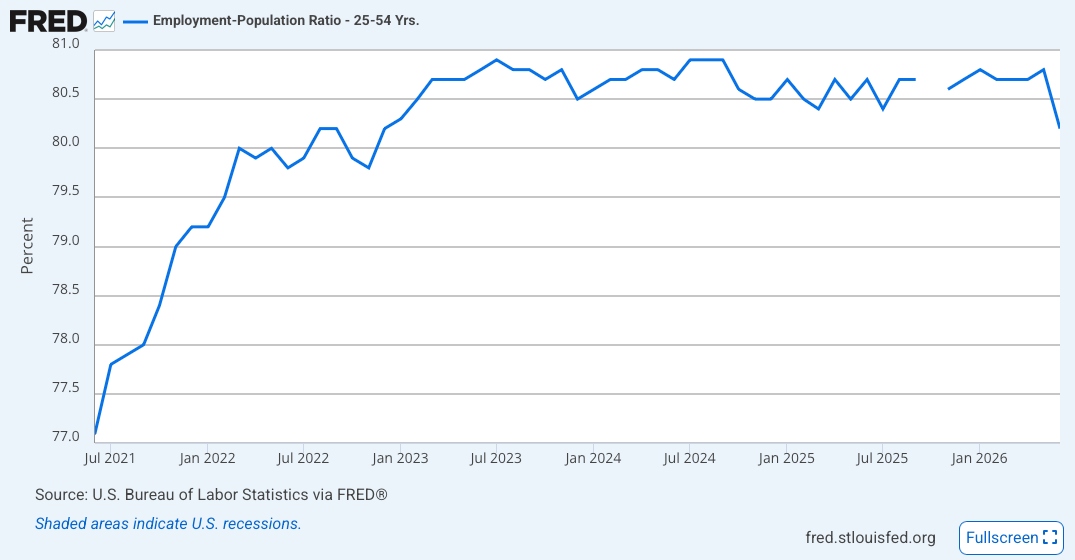
Everywhere you look in the report you can find negative signals. The prime-age employment ratio, which shows the number of core employment-age adults (which economists determine to be 25 to 52 years of age) participating in the market, declined by 0.6%. That’s the steepest drop since widespread pandemic lockdowns ended in 2022.
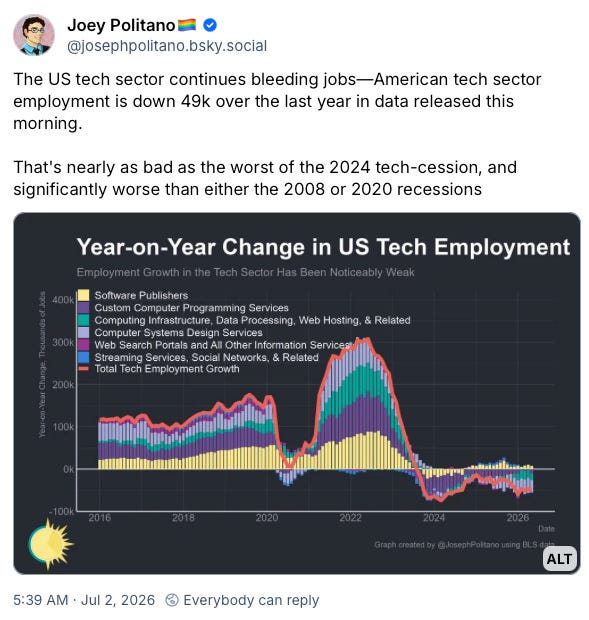
Economist Joey Politano notes that the tech sector continues to lose jobs at a very steady and very large clip:
The expected hiring boom in the hospitality sector for the World Cup celebrations happening around the nation hasn’t seemed to materialize. Glassdoor chief economist Daniel Zhao notes that the leisure and hospitality sector actually lost 61,000 jobs last month.
And as was the case for most of the last year and a half, the vast majority of the job gains last month were in the healthcare sector, which needs plenty of workers to care for America’s aging population of baby boomers.
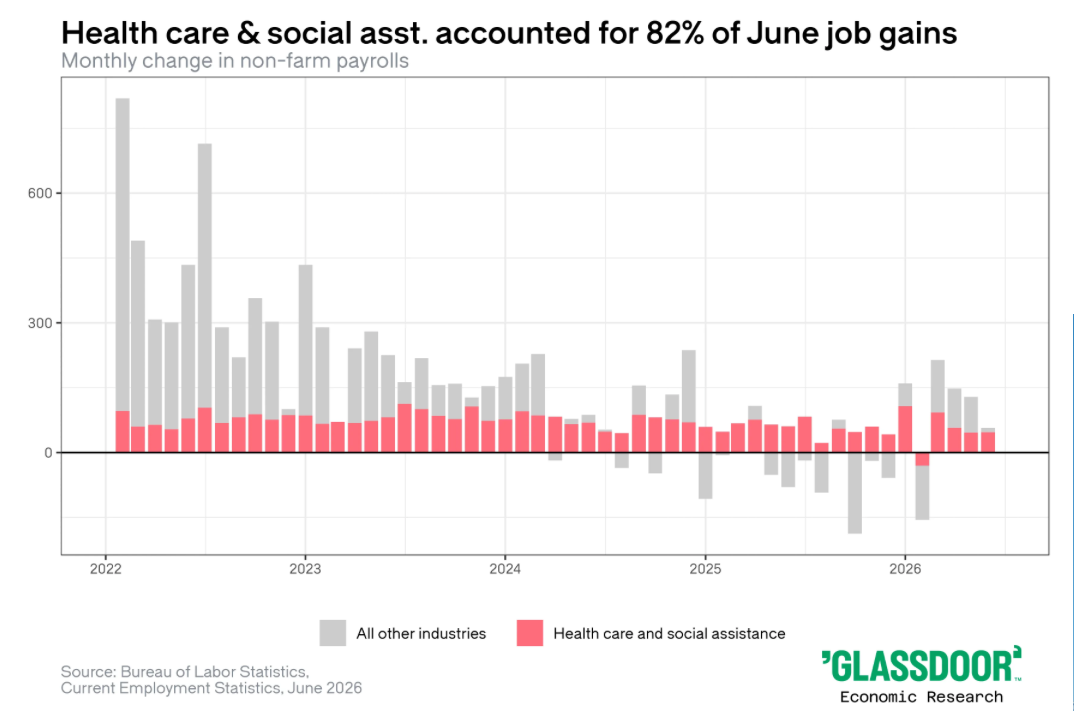
As is always the case, these numbers are often adjusted up and down in coming months as the Bureau of Labor Statistics collects more detailed information. But after two months of big job gains that were adjusted down, this month representsa return to the job market that we’ve seen for the last year and a half — one in which job creation is slowly flagging in all but a few industries, and wages are failing to keep up with the price increases of inflation.
Killing Clean Energy Isn’t Just Wasteful — It Harms the Economy
“The Trump administration on Monday said it would pay Duke Energy $129 million to abandon its plans to build an offshore wind farm off North Carolina,” reports Maxine Joselow at the New York Times, adding, “It was the fourth such deal struck by the administration to throttle the development of offshore wind power.”
Let’s put this another way: The Trump administration spent more than a hundred million dollars of your tax money to pay an energy firm not to build something it was supposed to build.
That doesn’t just rob the people of North Carolina of an affordable, clean source of energy — it also killed the construction jobs that would have built the wind farm and the maintenance jobs that would have overseen the farm once it was constructed. There’s no way to calculate the loss to the local economy, but your best guess is probably not an overstatement.
And this is only one-fourth the damage done. In total, Joselow writes, “the government has so far committed to spend more than $2.5 billion to get companies to terminate their offshore wind leases.”
This is not the only way the Trump administration has unplugged potential sources of affordable clean energy. In fact, behind the scenes, reporter David Roberts writes, “Trump is succeeding in stifling America’s clean energy boom. Absolutely ceding the field to China.”
JP Morgan’s latest report on clean energy projects in the United States shows the clear difference between Biden-era clean energy investments versus both Trump Administrations. Much of the second Trump term has been devoted to undoing the massive green-energy investments made throughout the Biden Administration:

Even before Trump returned to office, China was spending more than twice as much as the United States on clean energy investments like electric transport, renewable energy, and power grids. At the same time, the EU was spending slightly more than us.
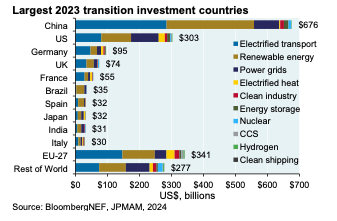
JP Morgan’s latest report warns that China is “dominating” renewable energy supply chains — the manufacture and distribution of clean energy parts like solar cells, wind power, and batteries. It’s a loss that could leave the United States decades and trillions of dollars behind on the international stage.
Even with the Trump administration’s attempts to turn back our energy infrastructure to the 1980s, the transition to clean energy is still happening here at home. Solar power generated more energy in the United States than coal for the first time in history last month. “Solar also became the third-largest source of electricity in the US in May, behind natural gas and nuclear,” the *Guardian* reports.
“Wind and solar combined have overtaken coal in the past, and wind power alone has outpaced coal during spring months when wind speeds pick up,” the Guardian continues. “Renewables will become the largest global energy source, used for almost 45% of electricity generation by 2030, according to the International Energy Agency.”
At the same time, last month the Trump administration “announced a plan to boost the struggling US coal industry byspending nearly $700m to support coal-fired power plants and coal exports,” even though coal consumption droppedin both India and China this year for the first time in over 50 years.
This doesn’t just matter in the fight against climate change — though the deadly heat wave smothering the eastern half of the United States is certainly a reminder that climate change is getting worse — but it’s also killing good-paying blue-collar jobs in clean energy manufacturing and installation. Even a trickle-downer who doesn’t believe that climate change is real should see the intrinsic value in clean energy investments and the economic growth that follows.
The trickle-down plan to destroy clean energy investments isn’t good climate policy — and it turns out it’s not even good economic policy. Doubling-down on coal and oil at a time when the global thirst for clean energy is rapidly growing only makes sense when you realize the goal of Trump’s energy policy isn’t to set up America for success, lowering energy bills for Americans and creating a supply chain that could create local jobs in states around the nation for decades to come. Instead, the goal is to enrich a few wealthy corporations and CEOs at the expense of everyone else. And when looking at the Trump administration’s policies through that lens, it is succeeding in a big way.
Egg Producers Pay to Settle Price-Fixing Charges
Remember the egg price crisis that started in 2022? For about three years, the high cost of eggs stood in as a symbol for out-of-control grocery prices at large.
“Average U.S. egg prices soared to a record high of about $6.23 per dozen in March 2025,” notes Wyatte Grantham-Phillips at the Associated Press. I wrote about these price increases three years ago here in the newsletter. Egg producers raised prices by more than 100% and blamed those price increases on bird flu, even as the quarterly profits of the biggest egg producers rose from $92 million to $318 million in less than a year.
Now, we have an even better look inside the conspiracy to raise the price of eggs on American consumers. Grantham-Phillips explains, “The U.S. Justice Department and 17 states reached settlement agreements with three major egg producers this week to resolve allegations that the companies illegally colluded for years to raise prices.”
Specifically, the suit “accused Cal-Maine Foods, Versova and Hickman’s Egg Ranch of a behind-the-scenes arrangement” to coordinate the bids they submitted to “Urner Barry Publications, a company that runs an index key to determining how much grocery stores, restaurants and others pay for billions of eggs each year.”
The egg producers inflated their figures in sync, which drove up the market price and the price that consumers paid for eggs, and then they pocketed the difference in skyrocketing profit margins. Tellingly, those coordinated bids “dropped significantly” after the egg producers “learned of the Justice Department’s investigation and were instructed to preserve documents in March 2025,” Grantham-Phillips writes. They were caught red-handed, and the price of eggs immediately dropped.
Unfortunately, the consequences of that price-fixing collusion aren’t especially harsh. The three big egg producers “will collectively be on the hook for $3.3 million and 53 million eggs,” Grantham-Phillips writes. “Those eggs would be donated by the companies and make their way to food banks and nonprofits. The money will be distributed to the states.”
Ideally, that $3.3 million shared settlement would have had an extra couple of zeroes, or even a comma, added to it. It’s hard to imagine any CEO who thinks a one-million-dollar settlement isn’t worth the cost in exchange for hundreds of millions of dollars in profits.
One of the conditions of the settlement is that the egg producers must adopt “antitrust compliance programs” and ban “communicating with competitors on pricing and bidding strategies.” But it’s hard not to recall that those regulations were mostly in place before they committed the price-fixing scheme, too.
What’s most maddening here is that the many tens of millions of American families who paid more than double for their eggs over the course of a few years will not see a single penny of those expenditures refunded to them. This might not be a win for the competition-killing egg producers, but it’s hard to read it as anything but a total loss for American consumers.
It should be clear to anyone paying attention that America desperately needs to reform its antitrust laws. Any businesses that collude with their supposed competitors to raise prices for American consumers should have to face immediate and painful consequences, and the American people should be made whole for their losses.
That concept of repaying victims of corporate price-fixing scams might have been impossible during the Progressive era of the 1890s, when the United States first broke up big businesses and price-fixing on behalf of the American people. But here in the 21st century, we can easily distribute funds to an infinite number of people. Doing so would remind Americans that the government is fighting on their behalf against outsized corporate power — in other words, the exact thing that government is supposed to do.
This Week in Trickle-Down
- On the first anniversary of the passage of the Trump administration’s tax bill, the Center for American Progresslooks at how those tax cuts have impacted Americans who get their health insurance on the Affordable Care Act exchanges. “Average monthly net premium costs among marketplace enrollees increased by 58 percent — from $113 in 2025 to $178 in 2026,” CAP notes, and over a million people lost their health insurance this year.
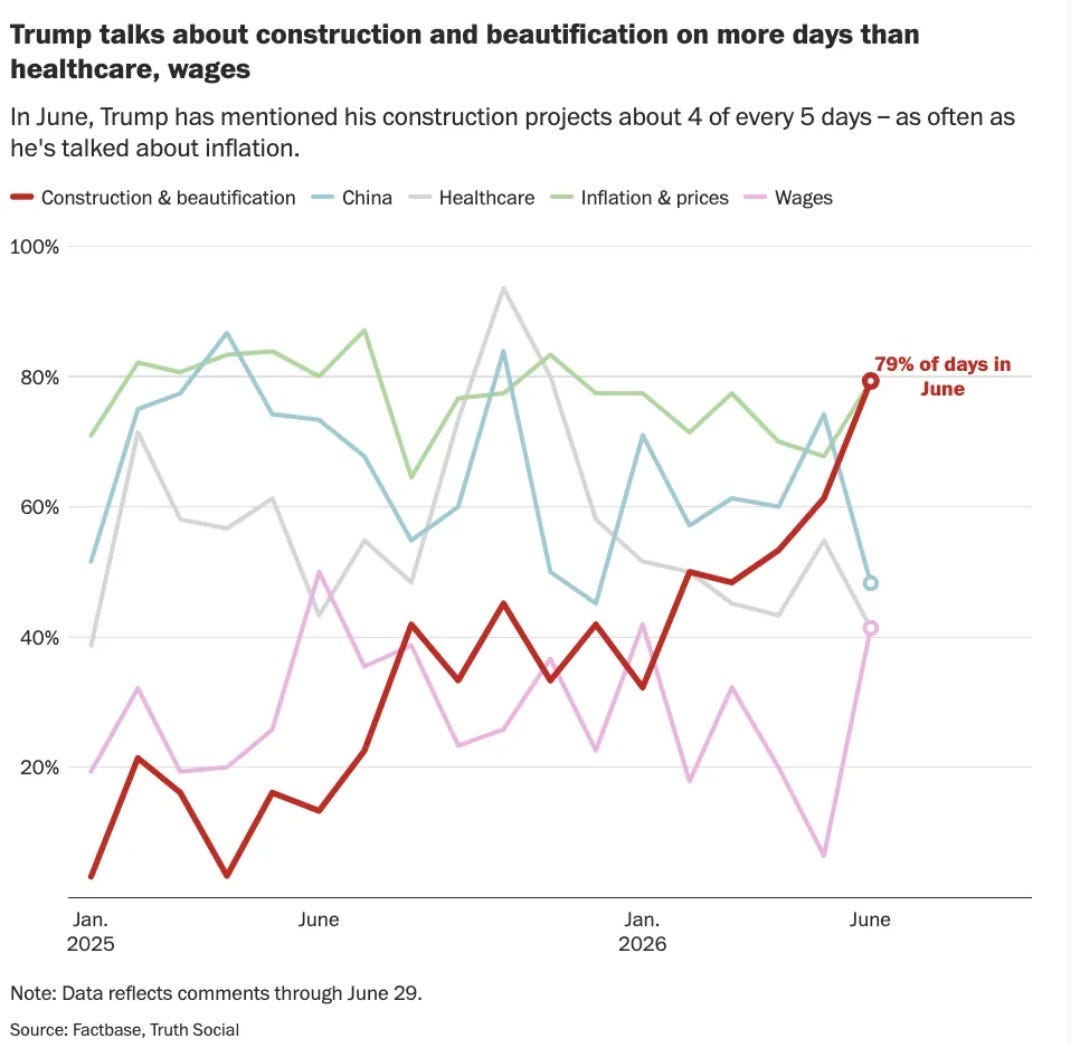
- The *Washington Post *crunched the numbers and determined that President Trump talked about his construction projects in Washington, D.C., as often as he talked about inflation in public comments last month. He discussed the White House construction and his proposed arch far more often than he’s discussed raising wages for workers or making healthcare more affordable.
This Week in Middle-Out
The Center for American Progress put out a report explaining that the majority of business income now comes from pass-through “partnerships,” rather than the standard C corporation you probably think of when you think of American businesses. The tax code hasn’t kept up with this change in business culture. CAP explains how we can rewrite the tax code to fully address this shift. “Research shows that pass-throughs pay less tax per dollar of income than C corporations because pass-through business owners’ profits face one tax rate of 29.6 percent, while owners of C corporations can pay a maximum of 36.8 percent,” CAP notes.
Real-Time Economic Analysis from Civic Ventures
As part of the summer series exploring the central myths of trickle-down economics, we’re revisiting a conversation with William Lazonick and Lenore Palladino about how shareholder value became the all-consuming goal for corporate America, above every other metric including sustainable growth, customer satisfaction, and research and development.
[embed]
Closing Thoughts
“Consumer confidence fell to 91.2 in June,” economic commentator Steve Rattner writes, adding that “the Conference Board’s index has now sat below its 1985 benchmark of 100 for 16 straight months.”

He continues, “Americans were far more optimistic at the 2024 election (113) and when Trump took office (105). The mood keeps sliding.”
Naturally, as Americans continue to report feeling bad about the economy, the media has responded with another round of stories about how the “vibes are off” among American consumers, even as the topline economic metrics like GDP are good.
“The big-picture indicators of the U.S. economy — GDP, unemployment and so on — are doing fine while public opinion on economic conditions is at rock bottom,” writes Neil Irwin at *Axios*.
Irwin reports that a collection of Biden administration economic thinkers, including Lael Brainard and Rohit Chopra, have put together a new self-described “policy pop-up” called the Kitchen Table Project that will advise Democrats on how to address these issues. He explains that the Project believes the bad feelings about the economy are “the result of not just the elevated prices reflected in macroeconomic data, but higher and more volatile prices for the specific items that dominate Americans’ day-to-day living expenses.”
The Kitchen Table Project “conducted survey work and modeled how a family of four with a median income has been affected by a slew of economic shifts of recent years, including changes in food, gas and health care prices.” After pulling together all that research, the team concluded that “even as overall inflation has slowed in the last few years, many of the most salient goods and services people buy are more unaffordable than ever, and that rising wages and tax cuts haven’t been enough to offset it.”
“”People are extremely worried about unexpected expenses, and how they will handle it,” Brainard told Irwin. “Things that people pay for frequently, like food, groceries, gas, really are top of mind when it comes to their sense of ‘am I doing OK?’”
The best quote from Brainard: “What we learned is that people are feeling squeezed because they are squeezed.” In short, she concludes, “their monthly budgets just aren’t going as far as they used to.”
This probably doesn’t sound like news to you. But the thing is, it actually is news to certain members of the media — this is why we’re now in something like the sixth round of “why are people so unhappy with the economy?” stories — and it’s certainly news to the people who are in charge of economic policy in the White House right now.
When it comes to bringing prices down, the Project promises to “find the best policy ideas across the board and develop new ones to tackle the costs that matter most to Americans.”
If I may make a suggestion, one of the most important policy solutions can actually be found front and center in the introduction of this email — raising the federal minimum wage to $25 an hour. As Civic Ventures founder Nick Hanauer pointed out in a recent video, it makes no sense to focus on bringing prices down for American consumers without also talking about growing worker wages:
[embed]
The fact is that American workers are making about $32,000 less on average per year than the same workers made 50 years ago. Restoring that $32,000 to paychecks would address the affordability crisis virtually overnight, and then some.
Obviously, there’s a lot more that our leaders need to do in order to bring down the biggest pricing pressures — housing, childcare, and healthcare are all way too expensive, and most other developed countries have already devised solutions to most of those problems. Monopolies need to be broken up, and competition needs to be restored to the marketplace. Those are all important policies that would directly bring down prices for consumers.
But as Nick says in the video, “I’m not saying prices aren’t high. They are. I’m not saying you’re wrong to feel squeezed. You’re not. What I am saying is that the people who spent 50 years rigging the economy against working Americans are thrilled to talk about the price side of affordability.”
He adds, “here’s the trick: As long as you’re focused on prices, you’re not focused on wages. And wages are where the real heist is happening.”
So let’s remember going forward, as we enter the inevitable seventh and eighth cycles of stories pondering why ordinary Americans are unhappy with the economy, that we won’t be able to get out of the pricing hole we’re in without raising wages for all American workers. That’s how we will make everything more affordable while also growing the economy for everyone.
I hope you have a great Independence Day weekend. Please try to make some time to remember the things that make this country worth fighting for, and to reflect on the things you can do to make it a better place in the months and years ahead.
Zach
메타데이터
- post_id
- 056812e3e81b
- slug
- the-case-for-a-25-minimum-wage-056812e3e81b
- url
- https://medium.com/civic-skunk-works/the-case-for-a-25-minimum-wage-056812e3e81b
- canonical_url
- https://medium.com/civic-skunk-works/the-case-for-a-25-minimum-wage-056812e3e81b
- author_url
- https://medium.com/@civicventures
- status
- ok
- fetched_at
- 2026-07-09 05:26:43