Modern Enterprise Data Architecture
A Strategic Enterprise Perspective for Future-Ready Organizations
Modern Enterprise Data Architecture
A Strategic Enterprise Perspective for Future-Ready Organizations
Introduction
In today’s digital era, enterprises generate and consume vast amounts of data across multiple systems and platforms. Traditional data architectures, characterized by centralized control and rigid structures are no longer sufficient to support the dynamic needs of modern businesses. A modern data architecture enables enterprises to harness the full potential of their data by ensuring scalability, flexibility, and resilience.
For organizations operating at scale, establishing a forward-thinking data strategy is crucial for regulatory compliance, analytics-driven decision-making, and unlocking new business models. At KPMG, we provide a structured methodology through our Modern Data Platform (MDP), leveraging cloud-based solutions, AI/ML capabilities, and governance frameworks to help enterprises successfully navigate their data modernization journey.
Enterprise Capability Model
The Enterprise Capability Model provides a comprehensive framework that outlines the critical capabilities required to effectively implement, govern, and evolve Enterprise Architecture (EA) within an organization.
This model ensures that strategic alignment, architectural development, operational governance, and foundational enablement are all cohesively integrated to support business transformation and IT excellence.
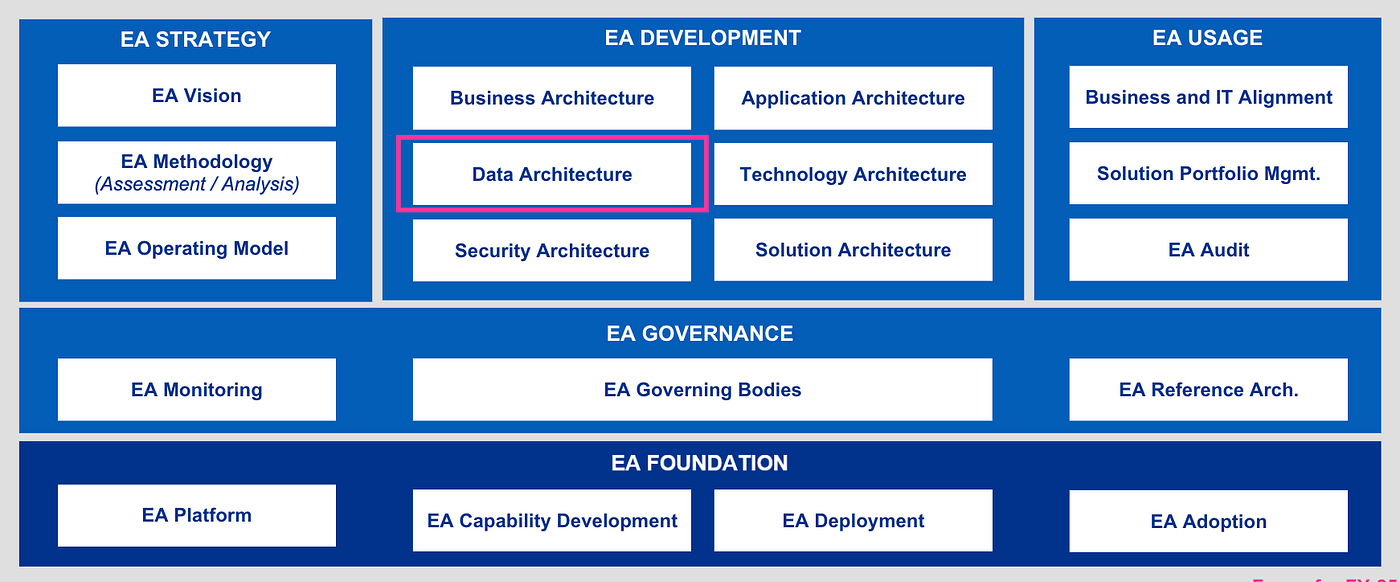
Enterprise Capability Model
🔍 Data Architecture — Foundation for Enterprise Intelligence
Data Architecture serves as the backbone of enterprise transformation. It ensures that structured, semi-structured, and unstructured data is organized, governed, and made accessible across the organization.
As depicted in the Enterprise Capability Model, it integrates closely with business, application, technology, and security architectures to enable data-driven decision-making.
Key Principles of Modern Data Architecture
1. Data as a Product
Treating data as a product involves recognizing it as a valuable business asset, shifting from centralized ownership to domain-driven responsibility. This approach ensures that data is curated, maintained, and readily available for consumption, similar to any other product offered by the organization.
Use Case: A retail company implemented a data-as-a-product strategy by assigning dedicated teams to manage customer data, sales data, and inventory data. This shift led to improved data quality and accessibility, enabling more accurate demand forecasting and personalized marketing campaigns.
[embed]The Future of IT — Data as an Asset
2. Decentralized Data Ownership & Governance
Adopting Data Mesh principles empowers domain teams with end-to-end responsibility for their data, promoting a decentralized approach to data management. Federated governance ensures consistency and compliance across distributed datasets without imposing centralized control.
Use Case: A multinational corporation transitioned to a decentralized data ownership model, allowing regional offices to manage their data while adhering to global governance standards. This approach enhanced data relevance and compliance with local regulations.
3. Scalability, Elasticity, and Resilience
Leveraging cloud-native architectures allows organizations to dynamically scale data storage and processing capabilities. Event-driven architectures facilitate real-time data processing and analytics, ensuring the system can adapt to varying workloads and recover from failures efficiently.
Use Case: A financial services firm adopted a cloud-native, event-driven architecture to handle real-time transaction processing, enabling rapid scaling during peak trading hours and ensuring system resilience.
4. Interoperability & Integration
Ensuring seamless integration across hybrid and multi-cloud environments is essential for modern enterprises. Utilizing APIs, data pipelines, and data virtualization techniques enables cross-platform data access, fostering interoperability between disparate systems.
Use Case: A healthcare provider integrated data from various electronic health record (EHR) systems across multiple hospitals using data virtualization, providing a unified view of patient information without physically consolidating data sources.
Enterprise Data Strategy & Architecture Considerations
Cloud Data Strategy
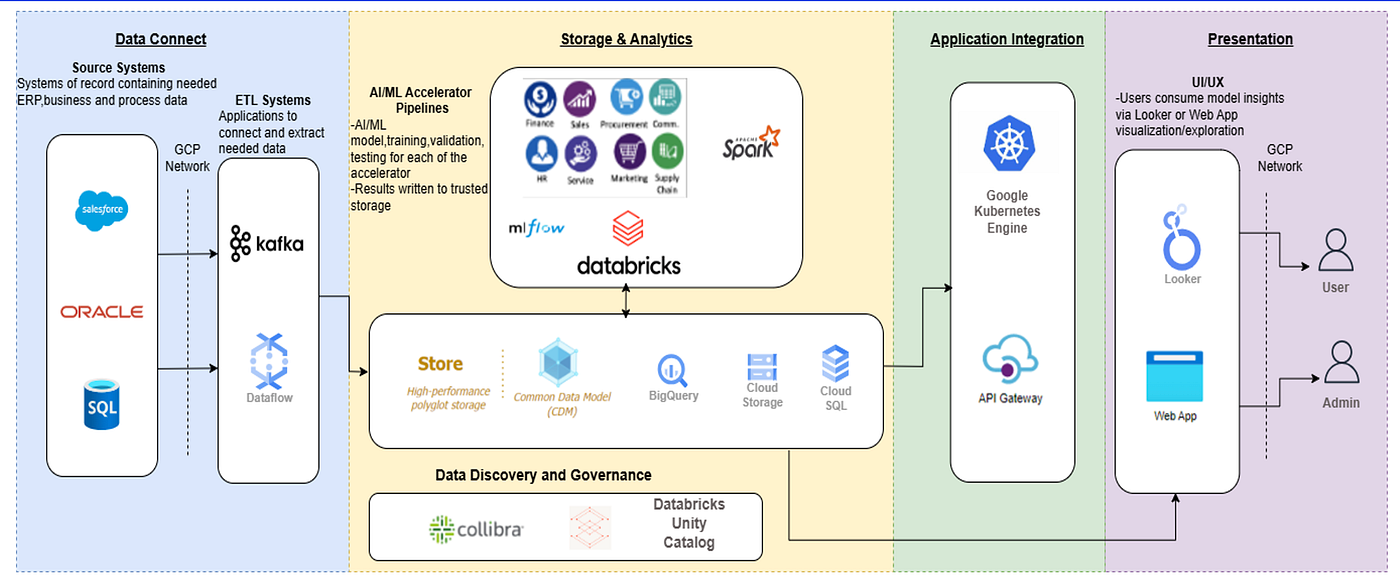
Modern Data Platform
KPMG’s Modern Data Platform integrates with leading cloud platforms such as Google Cloud, AWS, and Azure, enabling clients to transition to hybrid and multi-cloud architectures. Our approach provides:
- Pre-built cloud accelerators to speed up migration and reduce cost inefficiencies. — add 2 line for few acelerators
- **Data landing zones** to ensure secure, scalable environments for cloud-native data management.
- **Seamless data governance and security** built into cloud architecture.
A real-world use case involves a leading global financial institution that engaged KPMG to implement a big-data architecture in a hybrid cloud, enhancing customer experience and improving revenue streams.
AI/ML-Driven Solutions
KPMG integrates AI and machine learning (ML) capabilities into enterprise data platforms through:
- **KPMG Ignite**, an AI platform for predictive modeling and automation.
- **KPMG Signals**, an insights engine that transforms unstructured data into real-time business signals.
- AI-driven risk assessment and compliance analytics to streamline governance.
For example, a leading U.S. investment management firm leveraged KPMG’s Modern Data Platform to build a sales intelligence system, reducing the sales call-to-action time from weeks to a single day.
Compliance and Risk Management Offerings
KPMG ensures compliance and governance at every step of data modernization. We provide:
- Regulatory compliance frameworks (GDPR, CCPA, HIPAA, PCI-DSS) integrated into cloud data strategies.
- Data governance models to manage structured and unstructured data efficiently.
- Automated risk management solutions, such as KPMG’s Trusted AI framework, ensuring fair and transparent AI adoption.
A major investment management firm partnered with KPMG to create a trusted data publishing solution, where 80% of the firm’s data was automatically checked for quality and compliance, reducing reporting errors and improving trust in decision-making.
How KPMG Can Help
Now operationalizing modern data architecture requires a structured approach that balances scalability, security, and compliance while optimizing cost efficiency. KPMG can help enterprises in the following ways:
Enterprise Data Strategy Development
a. Crafting a roadmap for modernizing legacy data architectures.
b. Implementing governance frameworks tailored to industry regulations.
Cloud-Native Data Modernization
a. Enabling hybrid and multi-cloud data platforms with cost-efficient designs.
b. Implementing data lakes, warehouses, and lakehouses at scale.
AI & Automation for Data Management
a. Automating metadata management, anomaly detection, and data governance.
b. Implementing ML-driven data processing and decision automation.
Risk & Compliance Management
a. Ensuring regulatory compliance, privacy protection, and cybersecurity.
b. Implementing automated auditing and real-time risk assessment frameworks.
By leveraging proven methodologies and industry best practices, KPMG can help enterprises navigate their data modernization journey with a structured and risk-mitigated approach.
Key Takeaways
- The data landscape is rapidly evolving, and enterprises must adopt scalable, flexible, and secure data architectures.
- Organizations must invest in modern data governance and AI-powered analytics to stay competitive.
- The future lies in self-service data platforms, automated compliance, and real-time decision-making.
Call to Action
Organizations must assess their data architecture maturity and implement strategies that align with business goals, regulatory requirements, and emerging technologies.
A robust data governance framework is no longer optional — it is essential. This includes:
- Defining data ownership and stewardship roles across business units to ensure accountability.
- Establishing data policies and standards for quality, security, retention, and usage.
- Implementing metadata management for visibility, traceability, and discoverability of enterprise data assets.
- Ensuring regulatory compliance (e.g., GDPR, HIPAA, CCPA) through data classification, masking, and consent management.
- Deploying data lineage and audit capabilities to track data flows, transformations, and access history.
Investing in a future-proof enterprise data architecture, underpinned by strong governance, not only reduces risk and operational inefficiencies but also unlocks trusted insights, accelerates AI adoption, and creates sustainable competitive advantage.
Now is the time to elevate data to a first-class enterprise asset — governed, secure, and aligned to deliver measurable business value.
For more details, visit:
References
[embed]
Please feel free to reach out to learn more…

메타데이터
- post_id
- 057fac65d5fb
- slug
- modern-enterprise-data-architecture-057fac65d5fb
- url
- https://medium.com/kpmg-uk-engineering/modern-enterprise-data-architecture-057fac65d5fb
- canonical_url
- https://medium.com/kpmg-uk-engineering/modern-enterprise-data-architecture-057fac65d5fb
- author_url
- https://medium.com/@jitu028
- status
- ok
- fetched_at
- 2026-06-14 11:28:49