I Reviewed Hundreds of AI Formulas — These Are the 20 You Should Learn First
Introduction
I Reviewed Hundreds of AI Formulas — These Are the 20 You Should Learn First
Introduction
Artificial intelligence is transforming industries, reshaping careers, and changing the way we solve problems. Yet many people assume that learning AI requires mastering highly advanced mathematics before they can even begin.
The reality is far more encouraging.
While modern AI draws from many branches of mathematics, a relatively small set of equations forms the foundation of machine learning, data science, neural networks, and intelligent systems. Understanding these core formulas can dramatically improve your ability to learn AI concepts, build predictive models, and understand how algorithms make decisions.
One of the things I like about AI mathematics is how it helps us:
- Understand how algorithms learn
- Make better predictions from data
- Solve real-world problems systematically
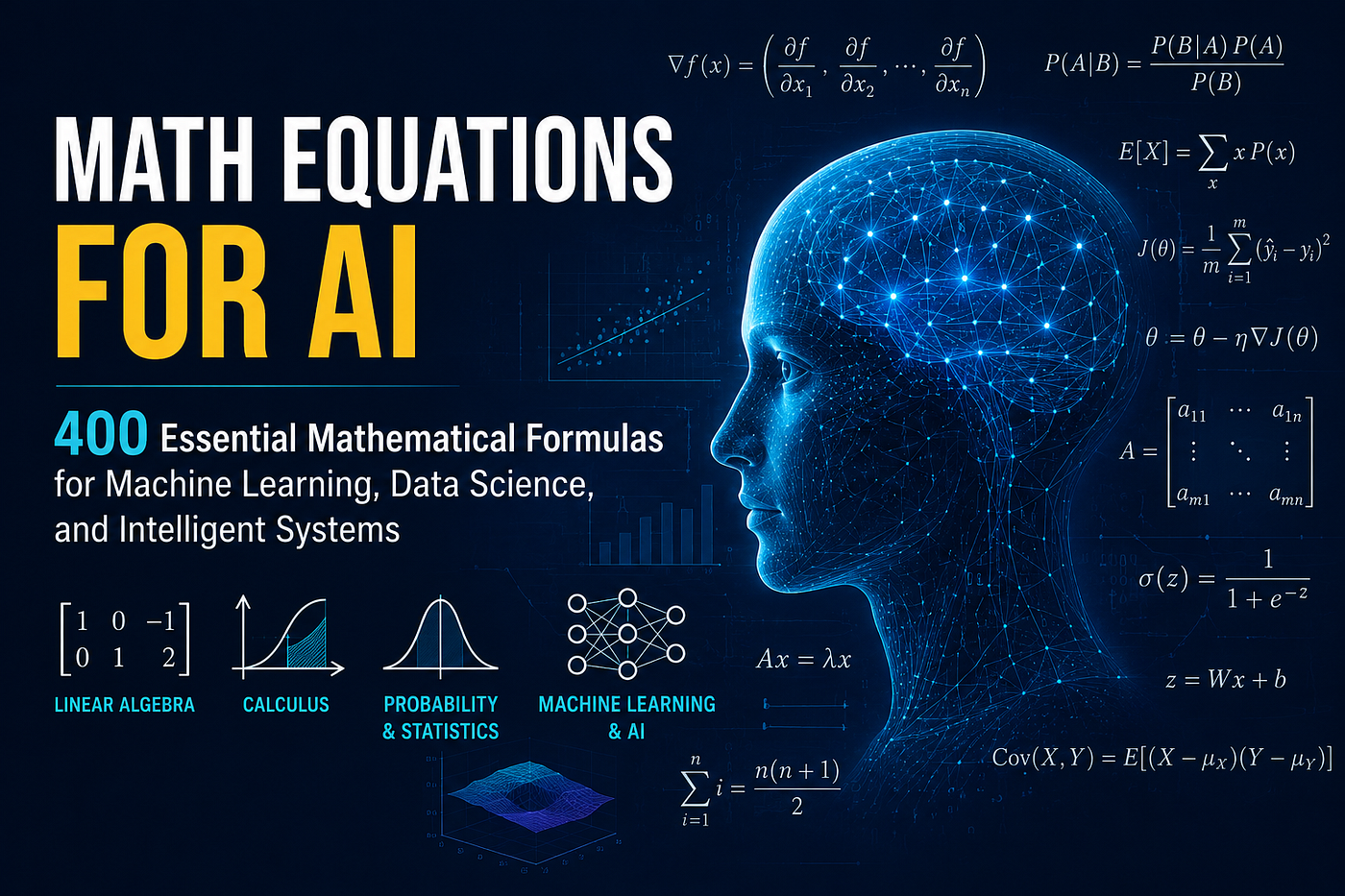
Recently, I worked on a collection titled Math Equations for AI: 400 Essential Mathematical Formulas for Machine Learning, Data Science, and Intelligent Systems, bringing together the most important mathematical tools used throughout artificial intelligence.
Whether you are a student, educator, engineer, data scientist, or AI practitioner, these formulas provide a roadmap to understanding the mathematical foundations of intelligent systems.
Why Mathematics Matters in AI
Artificial intelligence is often viewed as a field dominated by programming languages and software tools.
However, beneath every machine learning model lies mathematics.
Think of programming as the vehicle and mathematics as the engine. Without understanding the engine, you may be able to drive the car, but diagnosing problems or improving performance becomes much more difficult.
Mathematics allows us to:
- Represent information numerically
- Measure uncertainty
- Optimize decisions
- Learn patterns from data
- Build predictive models
- Evaluate performance
The better your mathematical foundation, the deeper your understanding of AI becomes.
The Four Pillars of AI Mathematics
Most AI equations originate from four major mathematical disciplines.
1. Linear Algebra
Linear algebra is the language of machine learning.
AI systems represent data using vectors, matrices, and tensors. Images, text embeddings, and neural network weights are all examples of mathematical structures studied in linear algebra.
Key topics include:
- Vectors
- Matrices
- Matrix multiplication
- Eigenvalues
- Eigenvectors
- Singular Value Decomposition (SVD)
Real-Life Example
When facial recognition software identifies a person in a photograph, the image is converted into large matrices of numbers. Linear algebra operations help extract meaningful patterns from those matrices.
2. Calculus
Calculus helps AI systems learn.
Training a machine learning model requires adjusting parameters to minimize errors. This process relies heavily on derivatives and gradients.
Important concepts include:
- Derivatives
- Partial derivatives
- Gradient vectors
- Chain rule
- Optimization
Real-Life Example
Imagine climbing down a mountain in dense fog. You cannot see the entire landscape, but you can determine which direction slopes downward most steeply. Gradients work in a similar way, guiding machine learning algorithms toward better solutions.
3. Probability
Probability helps AI reason under uncertainty.
Real-world data is often noisy, incomplete, or unpredictable. Probability provides tools for making informed decisions despite uncertainty.
Key topics include:
- Conditional probability
- Bayes’ theorem
- Probability distributions
- Expected values
Real-Life Example
Email spam filters estimate the probability that a message is spam based on its contents. These estimates are grounded in probability theory.
A foundational relationship is:
genui{“math_block_widget_always_prefetch_v4”:{“content”:”P(A|B)=\frac{P(B|A)P(A)}{P(B)}}” }
This simple equation lies at the heart of many AI classification systems.
4. Statistics
Statistics allows AI practitioners to understand and interpret data.
Before building intelligent systems, we must first understand the information being analyzed.
Important statistical concepts include:
- Mean
- Variance
- Standard deviation
- Correlation
- Hypothesis testing
Real-Life Example
A healthcare AI model predicting disease risk depends on statistical analysis of patient data before any machine learning algorithm is applied.
Twenty AI Equations Worth Learning First
If you are beginning your AI journey, focus on these categories first:
Linear Algebra
- Vector magnitude
- Dot product
- Matrix multiplication
- Eigenvalue equation
- Singular value decomposition
Calculus
- Derivative definition
- Partial derivatives
- Chain rule
- Gradient vector
- Gradient descent update rule
Probability
- Conditional probability
- Bayes’ theorem
- Joint probabilitydependence rule
- Expected value
Statistics
- Mean
- Variance
- Standard deviation
- Covariance
- Correlation coefficient
Mastering these formulas will provide a strong foundation for studying machine learning, deep learning, and data science.
From Formulas to Intelligent Systems
Many students ask:
“Do I really need mathematics if modern AI software does most of the calculations automatically?”
The answer is yes.
Using AI without understanding the mathematics is similar to using a calculator without understanding arithmetic. You may obtain answers, but understanding why those answers occur is what distinguishes practitioners from users.
The most successful AI professionals often possess strong mathematical intuition that helps them:
- Select appropriate algorithms
- Interpret model behavior
- Diagnose training problems
- Improve predictive performance
- Communicate technical ideas effectively
Why I Compiled 400 Essential AI Formulas
One challenge facing students and professionals is that AI mathematics is scattered across countless textbooks, research papers, lecture notes, and online resources.
Finding the right equation at the right time can be frustrating.
That challenge inspired the creation of Math Equations for AI: 400 Essential Mathematical Formulas for Machine Learning, Data Science, and Intelligent Systems.
The goal is simple:
- Gather the most important AI formulas in one place
- Present them in an organized and accessible format
- Create a practical reference for students and professionals
- Bridge the gap between mathematics and artificial intelligence
The result is a comprehensive collection covering linear algebra, calculus, probability, statistics, optimization, machine learning, neural networks, deep learning, data science, and intelligent systems.
Final Thoughts
Artificial intelligence may appear complex, but its mathematical foundations are built upon a set of powerful and interconnected ideas. By learning the most important formulas first, students and professionals can develop a deeper understanding of how intelligent systems learn, predict, optimize, and adapt.
Whether you are studying AI for the first time, teaching machine learning, conducting research, or developing intelligent applications, investing time in understanding the mathematics behind AI is one of the most valuable decisions you can make.
Curious — which mathematical topic do you find most challenging: calculus, linear algebra, probability, or statistics? Let us know in the comments.
Learn More
📥 [Download a sample chapter] 🛒 [Buy the book on Amazon] 🛒 [Buy the book on [Ingramspark](https://shop.ingramspark.com/b/084?params=VCouPj3vVWkAY5cOkKbFGnoCz9C6fMb61zCMIiOSJsg)] 🛒 [Buy the book on Gumroad] 🛒 [Buy the book on Payship]
📬 Subscribe to our newsletter for free and be the first to receive exciting updates.
메타데이터
- post_id
- 05a8a0e789a5
- slug
- i-reviewed-hundreds-of-ai-formulas-these-are-the-20-you-should-learn-first-05a8a0e789a5
- url
- https://medium.com/@nicolakattan/i-reviewed-hundreds-of-ai-formulas-these-are-the-20-you-should-learn-first-05a8a0e789a5
- canonical_url
- https://medium.com/@nicolakattan/i-reviewed-hundreds-of-ai-formulas-these-are-the-20-you-should-learn-first-05a8a0e789a5
- author_url
- https://medium.com/@nicolakattan
- status
- ok
- fetched_at
- 2026-06-09 14:34:10