She Was Born Twice, Burned Twice
Mahabharata Still Owes Her an Apology
She Was Born Twice, Burned Twice — and the Mahabharata Still Owes Her an Apology
The forgotten past lives of Draupadi, the unfinished grief of Amba, and what two women across lifetimes teach us about justice, desire, and the price of being a woman in a man’s war.
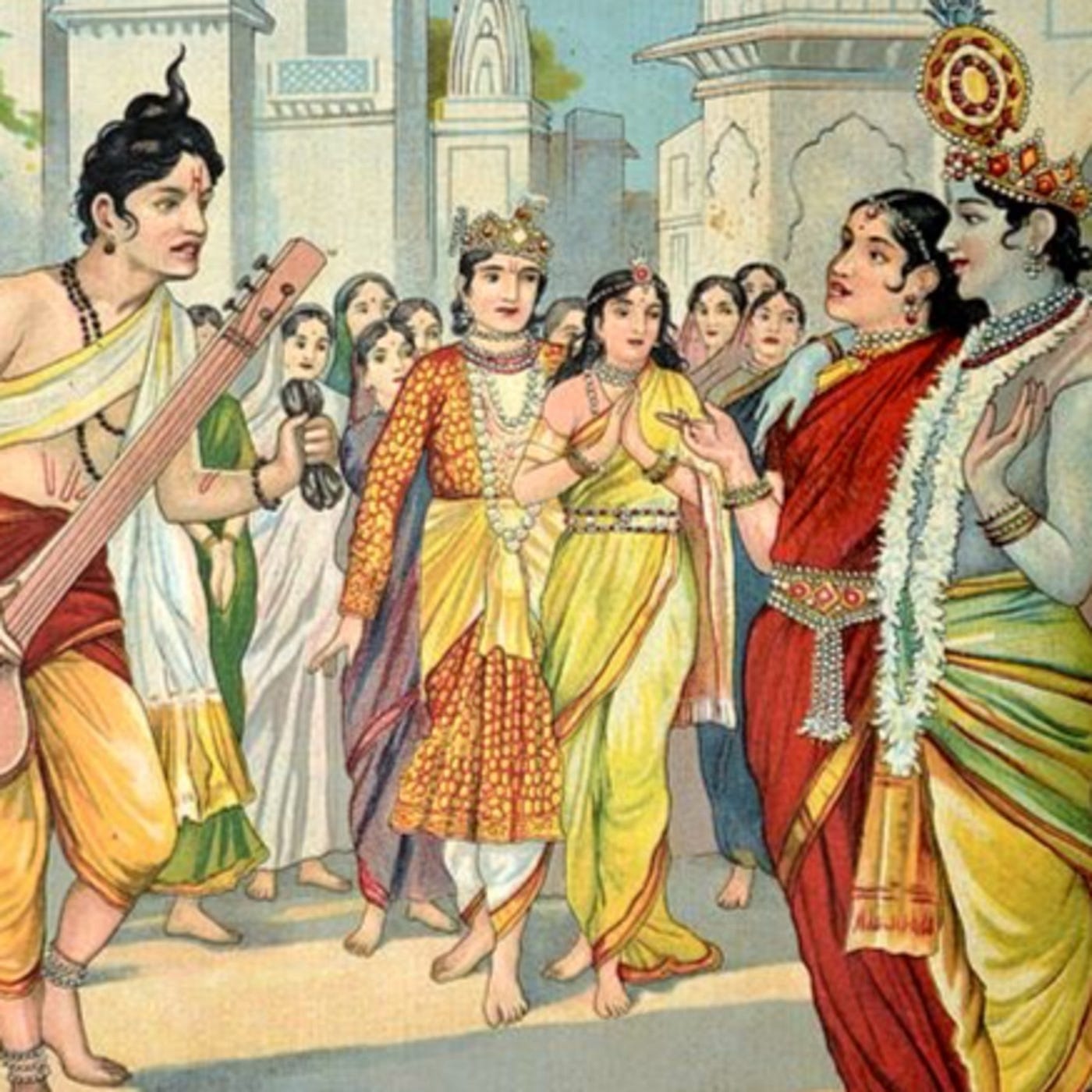
Source Public Internet
There is a moment in the Mahabharata that most retellings rush past. The war is over. The Pandavas have won. Bhishma lies on his bed of arrows, his death a slow, voluntary exhale. And Draupadi — the woman whose humiliation in a royal court sparked eighteen days of slaughter — watches it all from a distance.
She never gets a conversation with him. She never gets a clean apology. History moves on.
But here’s the thing about the Mahabharata that Western readers sometimes miss: nothing in this epic happens just once. Every character is carrying the weight of a previous life. Every wound has a root older than the wound itself. And Draupadi — fierce, polyandrous, fire born Draupadi — is not exempt from this cosmic accounting.
Who Was Draupadi Before She Was Draupadi?
In the Adi Parva of the Mahabharata, the sage Vyasa offers Yudhishthira an explanation for something that confounds everyone around them: how can one woman have five husbands and remain dharmic? The answer, Vyasa says, begins in a previous life.
Draupadi was once Nalayani, the devoted wife of the irascible sage Maudgalya. She served him with a kind of love that had no conditions attached — she bathed him, fed him, cleaned his wounds, bore his mood swings with equanimity that bordered on the inhuman. At the end of a life of extraordinary devotion, Shiva appeared before her and offered her a boon.
She asked for a husband. A good one. A husband who was strong, wise, righteous, skilled, and handsome.
She asked five times.
Shiva, amused or perhaps literal-minded in the way gods tend to be, told her: “In your next birth, you will have all five — but they will be five different men.”
She did not understand the consequence of her longing. She had asked for the ideal man and, because no single man could hold all those qualities, she would be given five instead.
This is the story the Mahabharata uses to explain Draupadi’s unusual marriage. But read it slower and something else emerges — something more uncomfortable. Draupadi’s “fate” was essentially a punishment for wanting too much. For not being satisfied with one flawed man, she is reborn into a life of unbelievable complexity, shared between five brothers, queen of a household she did not choose, and eventually stripped in a court while those five husbands sat in silence.
The karmic wheel in this epic is not gentle. It is, in many ways, deeply unfair to the women it processes.
The Other Daughter of Drupada — And the Rage That Crossed Lifetimes
To understand Draupadi fully, you have to know who her sibling was. King Drupada of Panchala had another child — Shikhandi. And Shikhandi was, in a previous life, a princess named Amba.
Amba’s story is one of the most heartbreaking in all of Indian mythology, and it begins with a man who meant well.
Bhishma — the grand patriarch, the noble celibate, the warrior who could choose the hour of his own death — abducted three princesses from Kashi for his half-brother Vichitravirya. This was, in the customs of the time, an accepted (if brutal) practice. He took Amba, Ambika, and Ambalika. He did not ask them.
When Amba told Bhishma she was already in love with King Shalva and had mentally accepted him as her husband, Bhishma, to his credit, let her go. But Shalva rejected her — she had been touched by another man’s hands, he said, carried in another man’s chariot. She was returned goods.
She went back to Bhishma. You took me. Now marry me.
He refused. His vow of celibacy was absolute.
She appealed to Parashurama, Bhishma’s own teacher, who fought his former student on her behalf for twenty-three days in a battle that ended in a stalemate. The cosmos itself could not give her justice.
So Amba did the only thing left. She went to the forest, performed severe austerities, and stood before Shiva with a demand rather than a prayer. I want to be the cause of Bhishma’s death.
Shiva granted it.
She was reborn as Shikhandini, daughter of Drupada — sister to Draupadi — and through a complex sequence involving a Yaksha named Sthunakarna, eventually became Shikhandi, a male warrior. On the eighteenth day of Kurukshetra, it was Shikhandi standing before Arjuna that caused Bhishma to lower his bow. He would not fight someone who had once been a woman. And so Arjuna’s arrows, fired from behind Shikhandi’s shield, pierced Bhishma’s body and put him on that famous bed of arrows.
Amba — across two lifetimes — finally got what she came for.
Was the Revenge Justified? Let’s Be Honest About Bhishma.
This is where the epic gets genuinely uncomfortable if you’re willing to sit with it.
Bhishma is revered. He is Pitamaha — the grandfather, the anchor of the Kuru dynasty. His celibacy is framed as noble sacrifice. His wisdom, delivered in long discourses from his deathbed in the Shanti Parva, is considered some of the most profound philosophy in Indian literature.
But Bhishma abducted Amba. He removed her from the life she had chosen. And when she came to him for repair, he hid behind his vow. He chose the sanctity of his oath over the life of a human being standing in front of him. His celibacy — taken originally to secure his father’s desire for a fisherman’s daughter — became a weapon that destroyed an innocent woman’s future.
The dharma he was so careful to protect did not protect her.
Amba’s revenge, filtered through lifetimes of waiting, was not the revenge of a villain. It was the revenge of someone the system failed completely. Bhishma was not evil. He was something more dangerous: a good man who would not bend his principles even when those principles were crushing someone. The Mahabharata, to its eternal credit, does not let him off the hook entirely. He dies knowing what he caused. He dies slowly, by choice, on arrows — which feels, mythologically, like the universe insisting he sit with it.
What Two Women Across Lifetimes Actually Teach Us
Both Draupadi and Amba (as Shikhandi) end up in the same story. Both are daughters of Drupada. Both are defined, at least in part, by what men did to them or failed to do for them. But neither of them is passive.
Draupadi’s rage after the dice game is one of the most politically alive moments in the epic — she argues dharma in a court full of armed men. Amba’s austerities and her two-lifetime pursuit of justice is one of the most sustained acts of defiance in all of world literature.
What they teach us is not simply “revenge is cathartic” — the Mahabharata is too smart for that. What they teach us is that grief deferred does not dissolve. That injustice, when it is systemic and dressed in the language of duty and tradition, costs real people real lives. And that sometimes the people who cause that injustice are genuinely good people who simply chose their vows over you.
That, more than any battle strategy, is the Mahabharata’s most enduring lesson.
Sources & Further Reading
- The Mahabharata — Translated by Kisari Mohan Ganguli (complete English translation, 1883–1896). Specifically: Adi Parva (Draupadi’s birth and past-life explanation), Udyoga Parva (Amba’s full story), Bhishma Parva (Shikhandi at Kurukshetra), Shanti Parva (Bhishma’s deathbed discourses).
- The Mahabharata, Vol. 1–3 — Translated by J.A.B. van Buitenen, University of Chicago Press.
- Bori Critical Edition of the Mahabharata — Bhandarkar Oriental Research Institute, Pune.
- The Great Epic of India — E. Washburn Hopkins (1901).
- Draupadi — Mahasweta Devi (short story, 1978).
- The Palace of Illusions — Chitra Banerjee Divakaruni (2008).
- Women in the Mahabharata — Shakuntala Rao Shastri.
This article is based on the original Sanskrit text and its established English translations. Interpretations vary across regional traditions and folk retellings — that multiplicity is itself part of what makes the Mahabharata inexhaustible.
메타데이터
- post_id
- 05a8f3e2ee0d
- slug
- she-was-born-twice-burned-twice-05a8f3e2ee0d
- url
- https://medium.com/the-pillionaire-diaries/she-was-born-twice-burned-twice-05a8f3e2ee0d
- canonical_url
- https://medium.com/the-pillionaire-diaries/she-was-born-twice-burned-twice-05a8f3e2ee0d
- author_url
- https://medium.com/@ecothinker1993
- status
- ok
- fetched_at
- 2026-06-24 16:30:55