When Vesuvius Hits
Exploring virtual reality
When Vesuvius Hits
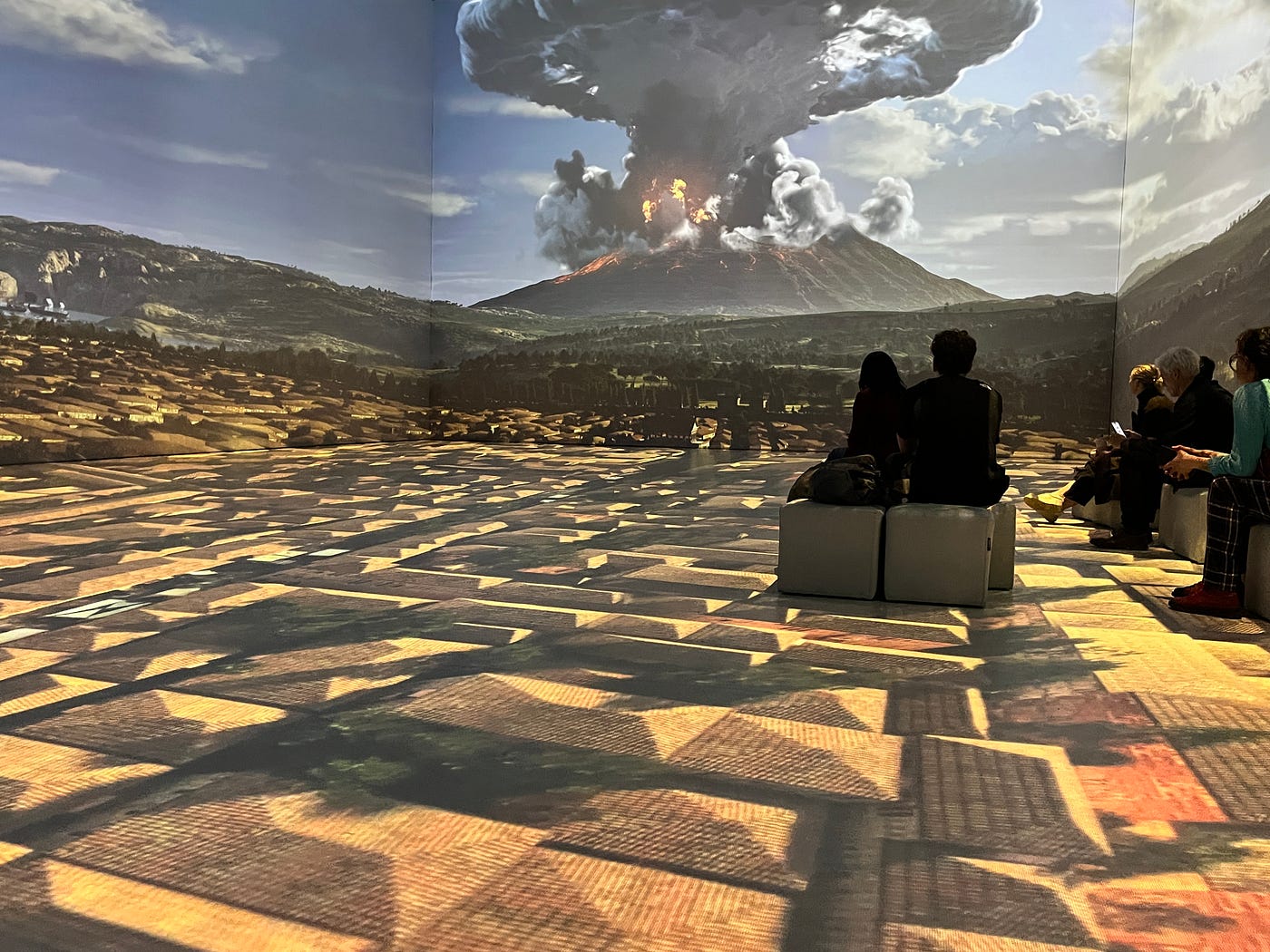
Watching Mount Vesuvius erupt, from the rooftops of Pompeii
Exploring virtual reality
A few years ago, I started trying to finally get my head around virtual reality (VR). My intention was to finally develop a better understanding of VR as a medium and embark on an exploration of its potential as an educational technology. This was prompted by investment in some facilities at the institution where I work. I was curious to understand how my team and I could more effectively support and enable the affordances and possibilities that VR could bring to learning in higher education, given that we now had access to professional-grade facilities or equipment and an emergent interest in immersive technologies for supporting teaching and learning.
As I delved further into this still emerging medium, my exploration expanded into looking at the broader categories of 3D or immersive media and how the various forms — including virtual and augmented reality, 360 video, 3D scanning, or motion capture — can be effective in bringing a sense of ‘experience’ to learning in ways that listening to a lecture, reading a book or watching a 2D video (which all, obviously, have their place) simply cannot.
A pattern seems to have taken shape with my own investigations into immersive media whereby I go through some kind of mediated experience for the first time and my understanding of things such as the contours of that particular medium, how storytelling is conveyed in such a form, the technicalities of it or the implications for learning are subsequently edged a little further forward, increment by increment. I lay out a few examples of this, such as my first experience of video-based VR which was set in a Borneo rainforest or of ‘time travel’ to a future Europe where all pollinating insects have gone extinct, in a chapter in a forthcoming book titled ‘Postdigital Learning Journeys’, due to be published by Springer later this year.
Because the chapter only addresses my explorations of VR, I don’t cover forms like experiences in video-based or auditory immersive spaces that don’t involve wearing a head-mounted display (HMD). I intend to write more in future about immersive spaces, but for now, all I have managed to publish online is a collection of photographs on Flickr from a handful of immersive exhibits/experiences I have been to.
I recently had another one of those increments where I took my own understanding to another level, with a visit to ‘The Last Days Of Pompeii’ at Immerse LDN near London’s ExCel centre. There were a couple of days to go before it closed and given that I also had a recommendation from a colleague to go along, I realised that there was a narrow window to take advantage of. I crammed it in as a midweek evening event and rushed over from a conference I was in the middle of attending.
The experience did not disappoint.
Heading into the last days of Pompeii

Pompeii at the water cooler
Immerse LDN is a warehouse-sized space in London’s Royal Docks area that, for this exhibition, had a variety of temporary-looking subdivided spaces (‘interactive galleries’) that gave visitors a journey to work their ways through. The Pompeii experience began with large wall-hung pictures of, for example, an erupting volcano, along the entrance corridors that set the scene. So far, so ‘art gallery’. This walkway opened up into a selection of fairly conventional museum-style exhibitions. My companion and I discussed what we knew about the story of Pompeii, realising that we actually knew surprisingly little in the way of specifics. Detail tends to get lost for the uninitiated once a story passes into myth.
Through a series of interlinked rooms, we found various replica exhibits under glass cases and a selection of informational backlit panels. Some of the exhibits had been purposefully 3D printed, such as copies of the plaster casts of the bodies that had been captured unawares by the volcanic eruption and that had been frozen in time, mid-movement. It was the first time that I’d observed an object in a museum that had been purposefully 3D-printed to comprise part of the exhibition. Definitely a good use use of the technology, for sure, for when it is better not to put the actual artefacts on display.
The panels covered the myth of Pompeii, an overview of what life beneath the volcano was like, and stories of the man who led the excavation of the site and who pioneered a technique for recovering the bodies via plaster casts. They also explained some of the geological nature of Mount Vesuvius, which seems to have been largely mistaken for a mountain by the residents at the time, as well as the deadly eruption that buried the nearby city.
Some of the rooms showed Roman life as it would have been before the eruption. It was noticeable that there seemed to be only one thing that really differed to these Western eyes between facets of Roman life and life today, as least as presented in these exhibits. This was the absence of forks, as they had not been invented by humans at that point. Much else had though, from the working week and what was eaten for breakfast to sanitation systems and rigorous class divides, were strikingly familiar.

Facing the VR wall from comfy chairs
In the next room, a low lit space full of comfortable swivel chairs in rows, we encountered our first moment in VR. A member of staff gave us a set of instructions on the practicalities and risks of the headset and the experience to come, similar to the ones I now give students before a VR session but in a more condensed way. We sat down and donned an early generation Pico HMD. This was to be a ‘three-degrees-of-freedom’ (3DoF) experience, where we could move our heads from side-to-side and up and down, but couldn’t move around within the virtual space. The swivel chairs themselves provided a noticeable enhancement to a 3DoF encounter as it gave us a little more physicality to our movements.
Hitched to the back of a Roman chariot led by horses, we hurtled towards an amphitheatre in order to then stand in close proximity to two gladiators as they engaged in combat. Being so close to the intimacy and intensity of the action between the two fighters felt surprisingly intrusive, as if being witness to an assassination that we were powerless to prevent. The digital gladiators fought until one of them killed the other, and the victor was then set upon by an angry tiger.
As the victorious gladiator managed to overcome his feline attacker, pushing the tiger into a hole in the arena floor, he collapsed into the dirt. A rising swell of water from somewhere then flooded the arena and we saw two ships emerge and collide above us, bringing a nautical element to gladiatorial combat that I’d never heard of. As one of the ships sank the other, we slowly rose, first up through the waters and then above the arena. From this vantage point, we could see the eruptions of the nearby volcano as smoke billowed out and it began to spit fiery rocks in our direction.
The whole experience lasted just 7 minutes, but it was highly visceral and pretty intense. From a sensory point of view, it certainly gave a slight flavour of what it must have been like to be a Roman gladiator.
Witnessing the eruptions
Following our short taster of Gladiator VR, we entered the Immersion Room, which would take things to another level. Here, a 26-minute long movie divided into eight chapters played out on a continuous loop across the four walls and floor of a vast cuboid space. These chapters covered things like the discovery of Pompeii, a theatrical play about life and death, depictions of life in the city before the eruption, and reconstructions of the eruption itself, from the point of view of somebody advancing into the volcanic onslaught.
Having visited three immersive exhibition shows at London’s Lightroom and one at the Natural History Museum, I knew what to expect from a space like this. The scale of the room seemed larger than both of those spaces though, which seemed to make it all the more captivating an experience. At Lightroom, I entered into David Hockney’s paintings, sat on the surface of the Moon, and observed dinosaurs in their natural habitats long prior to their extinction, all of which were somewhat more…well, gentle in comparison to this.

Facing the onslaught
Watching the fiery rocks of Vesuvius destroying a Pompeiian street had such a visceral quality, my mind turned to what it must be like today for the people of Tehran, Beirut, Gaza or Kyiv, as they witness the bombing of their own dwellings and cities. As the clouds of ash poured down from the mountain through Pompeii’s streets, I sensed the dust collecting in the back of my throat, despite actually being in a clinically clean and windless room in London.
Some of the walls conveyed impressive sequences that seemed like abstract art, including dancing lighting bolts, waves of fiery and sparking larval flows, or clouds of dust and ash. The walls also displayed animated Roman mosaic sequences, which was novel to me as I don’t think I’d ever seen mosaic styles used as an animation technique before. There was a hypnotic beauty to some of these sequences. Once the film loop has circled back round again to our point of entrance, we moved on.

A face emerges through the pumice ash
In the next room, we were back on fairly familiar museum-style territory, with a series of interactive exhibits depicting various different aspects of life in Pompeii and its story of destruction, albeit more hi-tech than many of the more common mechanical style ‘press a button and something happens’ style common in many more established heritage institutions. One object particularly stood out and that was a tabletop exhibit that was seemingly covered in a coating of digital volcanic ash. By wiping my hand over key locations on the table, various objects buried underneath were gradually revealed, along with information about that particular object. An odd sensation, for sure.
All of these experiences thus far were impressive enough and made me wonder what could be left that would top them all off. As I exited the interaction room, I was faced with what would become another one of those groundbreaking experiences that would inch my understanding of immersive media and its capabilities yet further.
Crossing a virtual rubicon
The backlit panel that greeted us described the ‘Grand Tours’ that would become available to wealthy young Europeans in the 18th Century. As the panel stated, ‘inspired by the belief that knowledge came from direct experience, (the Grand Tour) offered aristocrats, artists and scholars the chance to complete their studies by travelling across the continent’. The new excavations at Pompeii would become a compulsory stop on these excursions, and they left a rich legacy of impressions and images from the journals, memoirs, watercolours, engravings and illustrations that were made at the time, later to also be joined by photographs.
We were then invited us in to ‘one of the most impressive houses in Pompeii: The Villa of the Mysteries’. Just like at the entrance to Gladiator VR, another member of staff was waiting to usher us in to the next experience and to give us some general terms-of-engagement instructions. Before I put on another HMD, this time a more all-encompassing HTC Vive headset, I looked at what was little more than big empty warehouse space. There were multicoloured abstract patterned posters on the walls and floors that didn’t really register as I was putting on my headset. Had I thought for a moment, I might have recalled the small studio on a Chiswick industrial estate I visited in 2024 that had a similar array, which also moved my understanding of VR and immersive media forward.

Roaming around the virtual villa
This was described as a ‘Metaverse area’ and it involved walking through virtual facsimiles of six different rooms. My companion and I put our headsets on and we now saw each other as identical fluorescent Roman statue heads and shoulders, identifiable only by a different number underneath the floating head. We could speak and hear each other still in the physical world of the empty room, but as far as we could see, we were standing in an outside area of a Roman villa waiting to enter. A disembodied invisible voice in the headset told us what to expect and we entered the first room.
Each room followed a similar pattern — at first it was a darkened and abandoned space, as it might have looked when coated in volcanic ash, only for a full transition to sweep the digital room and wipe across our field of vision, revealing an invigorated space designed to be as it might have looked when in use at the time. Other floating statue heads joined us in each room, as lost in the wonder of what they could see as we were. I recall in the kitchen kneeling down on the floor to interact with some domestic chickens kept in a cage and standing up to look out of the kitchen window at the bustling city life outside.
Walking through each room in the villa, whether the rooms appeared in their post or pre-eruption phases, with strangers’ heads for company whilst physically in a large empty warehouse space was breathtaking an experience. For starters, it felt so profoundly real, even where the graphics might have been less than photorealistic and the statue heads was quite a surreal component. Suspension of disbelief was pretty immediate.
Perhaps most importantly though, and unlike any VR experience I’d yet had, was the ability to naturally move around a physical space using my actual body rather than just the perception of movement like in my Chiswick cloudscape or from teleporting via joysticks. It seemed so likely that not being able to actually see other people as I walked around would inevitably mean bumping into them, but this did not happen. Perhaps this fact of physical movement would have also dealt with the typical sensation of motion sickness that can happen when perceptually moving in VR without actually moving.
Headsets off and at the end of the experience, we found ourselves quite stunned by what we’d both been through. It felt like a rubicon had been crossed in our understandings of the possibilities of these technologies.
In the final two rooms of the exhibition, before the gift shop inevitably loomed into view, were a graffiti wall and a collection of AI photo booths. Graffiti, it seems, was surprisingly common in Roman times, so as visitors, we also got to make our marks on the place before we left. In the final room, I sat on a stool and looked into a camera only to see an images of myself dressed as a Roman gladiator and soldier appear in front of me.
While this is the sort of thing that is not that uncommon at certain high tech attractions, it nevertheless felt like a fitting personalised end to the journey. By scanning a QR code displayed on that same screen, I could download the images directly to my phone without having to get them printed out and paid for. I therefore left with an easily-captured souvenir of my trip back in time to the Roman era.
Learning from Pompeii
What does all this have to do with teaching and learning? Two key things spring to mind from my excursion to ‘The Last Days of Pompeii’.
The first is thinking of the overall aggregation of a variety of visceral forms of experiential media as a concentrated hit of learning. Pompeii felt like a richer, more embodied form of learning about a historical subject than would have been possible via many other forms of educational materials or approaches. From the conventional museum and art gallery-like beginnings that set the scene, through an accelerating array of immersive experiences, to something contributory and personal at the end — all condensed into around 90 minutes — it very effectively demonstrated the power of a well-designed and effectively choreographed educational journey through a particular narrative.
Obviously the scale and fidelity of such as experience would not be possible for a school, college or university to develop in an equivalent way, given the resourcing implications. However, taking the principles of a time-bound, multimodal series of immersive and experiential learning opportunities on board, I’m sure that there is much that an institution could do by taking similar approaches.
As with all things in learning design, one would need to start with identifying intended learning objectives. Such an approach would then need to be resourced appropriately, including having the equipment to make and deliver such an experience, staffing with the skills to design and create the assets as well as run the experience(s), and propensities towards educational innovation and pedagogic storytelling within the institution. However, if approaches like this could also be deployed in support of meeting learning outcomes in addition to more established teaching approaches, the potential for developing profound learning experiences is pretty mindblowing.

Screenshot from the ‘Airships XR’ presentation at Digifest 2026
One example of how this might work was shared at Digifest 2026, in the same week as my visit to Pompeii. Dr Atif Ghani from the Royal College of Art shared a story of a project he’d been working on called ‘Airships XR’. With this project, he combined immersive storytelling, AR/VR gameplay, regular 2D video and historical contexts to create a transformative approach to aviation learning. Using archive, digital and 3D assets in a multiplicity of ways, ‘Airships’ XR deployed these different mixed-media approaches to build story-based understandings of engineering principles within the context of the British Imperial fleet of airships and the crash of the R101 in October 1930.
Ghani described ‘Airships XR’ as demonstrating a strong educational, cultural, and emotional impact across a wide demographic. He reported that learners had consistently described the installation as innovative, ambitious, unlike anything they had experienced before, and that the data showed high learning outcomes. I certainly came out of the Pompeii experience feeling that I had learned a lot about the disaster, the discovery of the city’s remains and of ordinary Roman life.
The second thing that I am drawn to was the Pompeii ‘Metaverse area’ itself. As interesting and well designed as the other pieces all were, it was this experience that stood out the most. This was one of those rare encounters that tipped me over the threshold of my existing understandings into something new and led me down all sorts of pathways of possibility, given that such a thing was evidently technically possible to do.
To be able to take a large open indoor space, fill it with virtual environments to stimulate the imagination, and enable leaners to be able to navigate their own way around within such an environments, in the company of others and perhaps even with tasks to achieve…well, that sounds like a very powerful learning experience to me.
Time to start tinkering back at the day job to see what we can come up with.
메타데이터
- post_id
- 05abaf50a376
- slug
- when-vesuvius-hits-05abaf50a376
- url
- https://medium.com/@dompates/when-vesuvius-hits-05abaf50a376
- canonical_url
- https://medium.com/@dompates/when-vesuvius-hits-05abaf50a376
- author_url
- https://medium.com/@dompates
- status
- ok
- fetched_at
- 2026-06-09 15:37:30