What Impressed Me about APJ Abdul Kalam’s Book
When stories of ordinary people achieve extraordinary things
What Impressed Me about APJ Abdul Kalam’s Book
When stories of ordinary people achieve extraordinary things
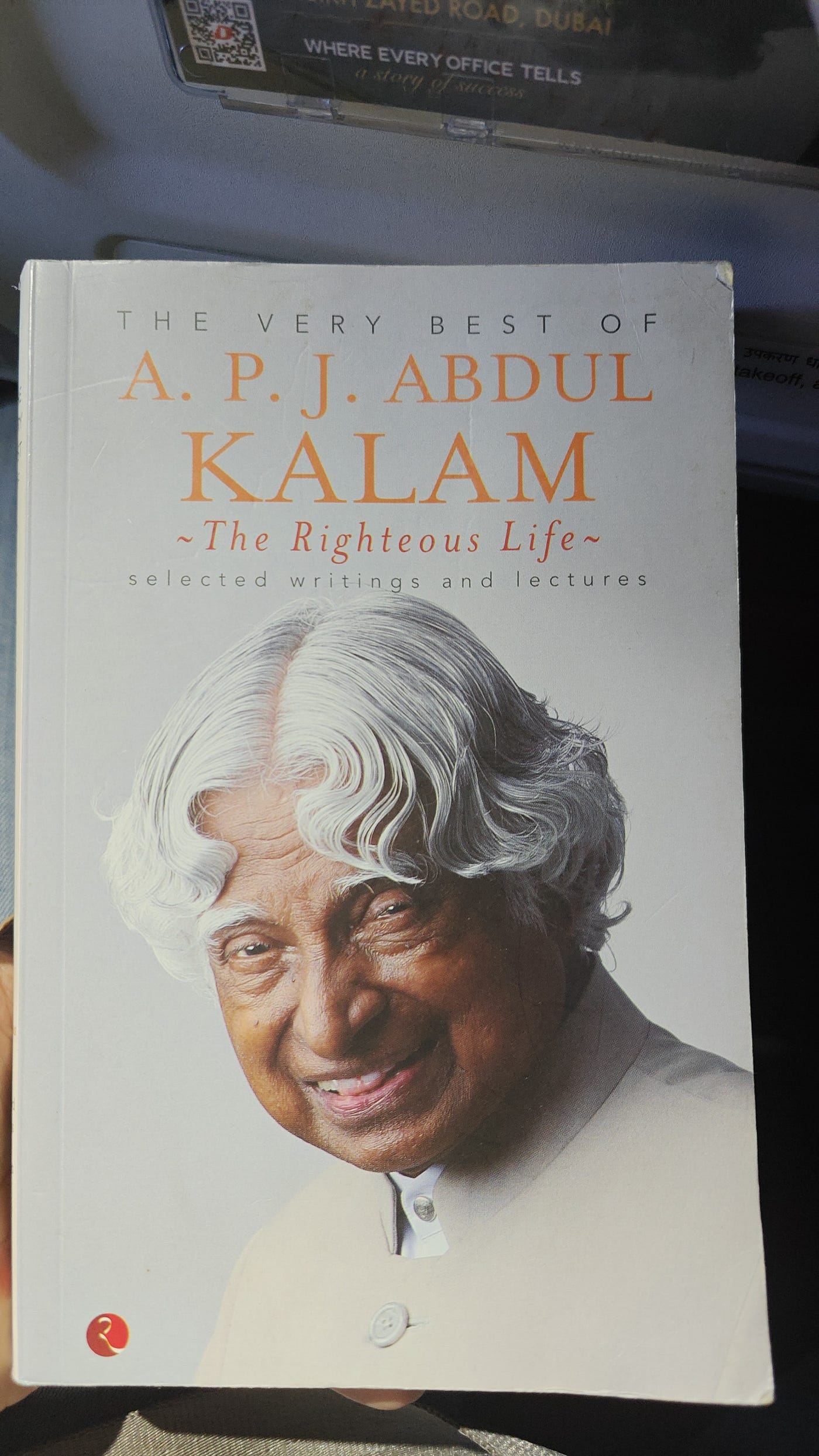
Book Cover by the Author
There’s something deeply moving about reading A.P.J. Abdul Kalam’s reflections on human potential and perseverance.
A Righteous Life isn’t just another autobiography; it’s a carefully curated collection of stories that reveal what the former President of India truly valued: the quiet determination of people who refuse to accept limitations.
What Makes This Book Special
What strikes you immediately is Kalam’s choice of stories. He doesn’t fill pages with his own achievements.
Instead, he turns his spotlight on people you’ve probably never heard of, a village boy from West Bengal who revolutionised laser technology, a driver who became a professor, a family that refused to believe their son would never speak.
The book reads like a conversation with a mentor who’s seen the best in people and wants you to see it too.
Stories That Stay With You
Dr Mani Bhaumik’s journey from a village in West Bengal to becoming a pioneering laser scientist is told with genuine admiration.
Kalam shares how Bhaumik’s work on carbon dioxide lasers was so groundbreaking that even Edward Teller — the “Father of the H-Bomb” — stopped a seminar to use the restroom and asked Bhaumik to pause until he returned.
A Soviet scientist later acknowledged there wasn’t much left to explore in CO laser technology after Bhaumik’s contributions. His research eventually enabled LASIK eye surgery, transforming millions of lives.
Steven’s story, drawn from Stephen R. Covey’s Everyday Greatness, is perhaps the most emotionally powerful section.
When doctors declared that eighteen-month-old Steven would never walk or talk due to an underdeveloped brain area, his thirteen-year-old sister Trudi simply refused to believe it.
What follows is a testament to family love and determination, reading to him nightly, using peanut butter exercises to strengthen his mouth muscles, and playing piano music while he listened from underneath.
The moment Steven finally spoke his first clear word — “Twenty!” — answering a math question nobody knew he’d learned, feels like a shared victory.
By 1990, he was attending mainstream school.
V. Kathiresan’s transformation is equally remarkable. Kalam recalls his own driver who constantly read during spare moments.
When asked why, Kathiresan explained that his children asked many questions and that he wanted to provide correct answers.
Kalam encouraged him to pursue formal education. Over the years, while still working, Kathiresan earned his B.A., M.A., B.Ed., M.Ed., and finally his PhD in 2001.
When they met again in 2011, the former driver was an assistant professor at a government college in Madurai.
The Philosophy Behind the Stories
What emerges from these narratives is Kalam’s deeper worldview about human capability and social responsibility. He’s not just sharing inspiring anecdotes — he’s making an argument about how societies should function.
The Power of Belief: Each story centres on someone who believed when belief seemed irrational.
- Bhaumik believed a village boy could contribute to cutting-edge science.
- Trudi believed her brother could overcome medical impossibility. Kathiresan believed education was possible alongside manual labour.
- Kalam himself believed a driver deserved the same opportunities as anyone else.
The message is clear: belief isn’t naive optimism — it’s the foundation of transformation.
Education as Liberation: Running through every narrative is the transformative power of learning.
- Bhaumik escaped poverty through physics. Steven’s family used books and music as therapy.
- Kathiresan used education to completely reinvent his life trajectory.
- Kalam seems to be arguing that education isn’t just about careers — it’s about human dignity and self-actualisation.
The Role of Enablers: Kalam quietly emphasises that individual determination needs support structures.
- Northrop Corporation gave Bhaumik research facilities.
- Louise Bogart’s Montessori school gave Steven a chance when others rejected him.
- Kalam himself gave Kathiresan time and encouragement.
Success isn’t purely individual; it requires people in positions of influence who choose to open doors rather than guard them.
Collective Determination:
- Steven’s story particularly illustrates what Kalam calls “the power of collective determination.”
- His mother Geri, sisters Trudi and Jennifer, and father Lindy all participated in his development — reading, exercising, and encouraging. Nobody gave up.
Kalam seems to suggest that families, communities, and societies achieve great things when they commit collectively to nurturing potential.
Redefining “Normal”: All three stories challenge conventional definitions of success and ability.
- Bhaumik succeeded despite rural poverty. Steven succeeded despite neurological differences.
- Kathiresan succeeded despite starting as a driver with limited formal education.
- Kalam is arguing against the narrow boxes society creates, showing that potential exists in unexpected places and forms.
The book title itself — A Righteous Life — takes on a deeper meaning here.
Righteousness isn’t about religious piety; it’s about living with integrity, recognising human worth, and enabling others’ growth. Kalam lived this philosophy, and these stories are his evidence.
What Could Be Better
The excerpted nature of this text makes it feel somewhat fragmented — we jump from one story to another without a deeper exploration of Kalam’s own reflections connecting them.
I wish he’d shared more about why these particular stories mattered to him, what they taught him during his own difficult moments.
Who Should Read This
This book is for anyone who feels stuck or doubts their potential. It’s for parents raising children with challenges and for adults considering returning to school.
It’s also for anyone who’s been told they can’t achieve something.
It’s also for those of us who need reminding that extraordinary things happen quietly, every day, when people refuse to give up.
Final Thoughts
A Righteous Life isn’t about providing a roadmap to success — it’s about igniting something inside you. Kalam believed in the power of inspiration, in learning from others’ journeys, in the quiet dignity of persistent effort.
Reading these stories, you understand why a nation called him “The People’s President.” He genuinely saw greatness in ordinary individuals and wanted them to see it too.
The book leaves you with one clear message: your circumstances don’t determine your destination. Your determination does.
Rating: 4.5/5
A humble, inspiring collection that proves the best leadership isn’t about showcasing your own achievements — it’s about celebrating and enabling others to discover theirs.
메타데이터
- post_id
- 05b1596b400a
- slug
- what-left-me-impressed-about-apj-abdul-kalams-book-05b1596b400a
- url
- https://baos.pub/what-left-me-impressed-about-apj-abdul-kalams-book-05b1596b400a
- canonical_url
- https://baos.pub/what-left-me-impressed-about-apj-abdul-kalams-book-05b1596b400a
- author_url
- https://medium.com/@hetal.sonpal
- status
- ok
- fetched_at
- 2026-07-17 01:39:05