The Smartest Girl in My Class Never Opened a Textbook. I Finally Asked Her Why.
Her answer made me rethink everything I thought I knew about studying.
The Smartest Girl in My Class Never Opened a Textbook. I Finally Asked Her Why.
Her answer made me rethink everything I thought I knew about studying.
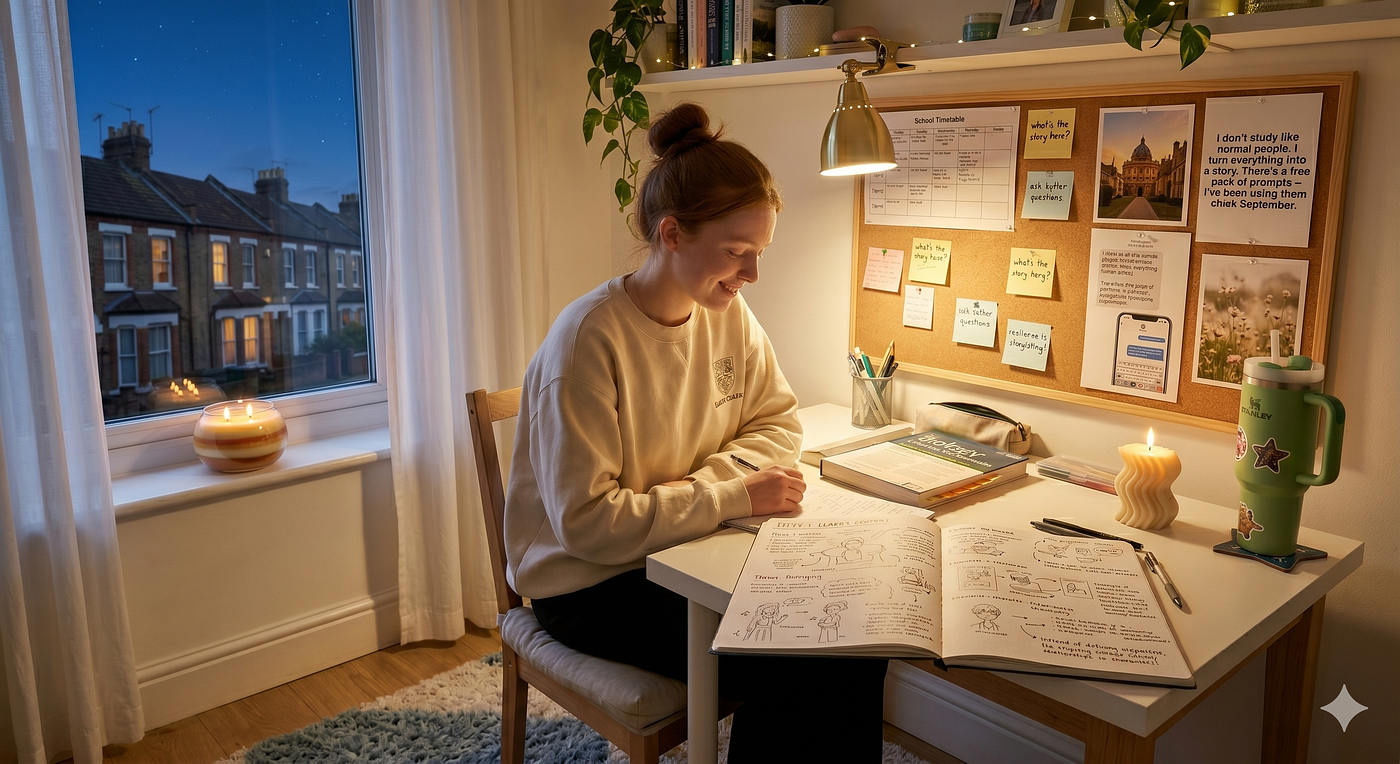
I still remember the exact moment the panic set in. It was a Tuesday afternoon, third week of Year 12 and I was staring at a biology textbook page about the electron transport chain. I had read it four times. I had highlighted it in three different colours. I had even copied the diagram neatly into my notes.
I understood absolutely nothing.
This was new for me. At GCSE, I’d coasted. Top marks, head girl, the one everyone assumed would breeze through A-levels. Teachers smiled at me in the corridors. My mum told her friends I was going to be a doctor.
Three weeks into sixth form, I was drowning. Not in the obvious way, I still showed up, still sat in the front row, still took immaculate notes but when I closed my books at night, my mind was a blank wall. The words had stopped meaning anything. The diagrams looked like abstract art. I started waking up at 3 a.m. with my heart pounding, convinced I was going to fail everything and disappoint everyone.
Did you know?
A 2025 study on academic transition found that high-achieving GCSE students experience a 43% drop in academic self-efficacy in their first term of A-levels, primarily because the independent study skills required are radically different from the guided learning they’re used to. (Source: British Journal of Educational Psychology, “Self-Efficacy and the Post-16 Transition,” 2025)
At the time, I didn’t know that. I just thought I’d peaked at sixteen.
The Girl Who Didn’t Need a Textbook
Her name was Alice. She sat in the back row of our biology class, earbuds in, doodling in a notebook that never seemed to contain any actual notes. She never raised her hand. She never looked stressed. She never even seemed to open the textbook.
I assumed she was coasting too, just in a different way. Maybe she was naturally brilliant and didn’t need to try. Maybe she had a tutor at home. Maybe she’d given up entirely.
Then our first big assessment came back. I got a C. My first C in my entire life. I sat in the girls’ toilets during lunch and cried.
Alice got an A*. I saw it on the list pinned to the noticeboard. Top mark in the class.
The Question I Finally Worked Up the Courage to Ask
A few days later, I found myself sitting next to Alice in the common room. She was eating a packet of salt and vinegar crisps and scrolling through something on her phone. I didn’t have a plan. I just sat down and said, “How are you doing this?”
She looked up. “Doing what?”
“Everything. Biology. You never seem to study. You never take notes. You never even open the textbook and you got the highest mark in the class.”
She put her phone down.
“You’re going to think it’s weird,” she said.
“I already think I’m failing. Weird is fine.”
“I don’t study like normal people,” she said. “I don’t read the textbook and try to memorise it. I turn everything into a story. I ask myself questions that make me actually want to know the answer.”
She showed me her phone again. The article was from a page called PromptToLearnNow. She’d found it, she said, because her older brother sent her a link after she’d had a panic attack during her mocks the year before.
“It’s just prompts,” she said. “Questions you ask yourself or an AI that turn whatever you’re learning into something your brain actually wants to keep. There’s a free pack of fifty. I’ve been using them since September.”
What I Found When I Looked
That evening, I opened the link Alice forwarded me. The page was simple. No complicated system, no paid course, no flashy promises. Just post after post about one idea: the brain wasn’t built for textbooks. It was built for stories.
Did you know?
A 2025 study on narrative comprehension found that information delivered as part of a story is recalled 22% more accurately than the same facts presented in a neutral, expository format. (Source: Memory & Cognition, “The Narrative Advantage in Factual Recall,” 2025)**
The free 50 Simple Study Prompts pack was right there. I downloaded it. That night, I opened my biology textbook to the chapter on respiration, the one that had made me cry in the toilets and instead of reading it, I typed one of the prompts into my phone:
“Tell me the story of the electron transport chain like a relay race. Who’s passing the baton? Where does the energy come from? Who crosses the finish line?”
What came back wasn’t a textbook paragraph. It was a race. Electrons were the runners, sprinting from one protein complex to the next, handing off energy like a baton. Oxygen was the final runner, waiting at the finish line to catch the exhausted electron and turn it into water. ATP was the crowd going wild.
I read it once. Then I closed my phone and explained the whole thing to my empty bedroom. I got almost everything right.
What Alice Had Been Doing All Along
When I told Alice what I’d tried, she smiled. “That’s the starter pack,” she said. “Wait until you see the full story ones.”
She told me about a larger collection she’d eventually bought, the 100 Story-Driven Learning Prompts, organised into five different storytelling engines depending on what kind of subject you were tackling.
I found it on the same page. It grouped prompts into engines: the Epic Storytelling Engine for big narratives, the Rivalry & Scandal Engine for human drama, the “Ohhh!” Moment Engine for mind-blowing connections, the Crystal-Clear Simplicity Engine for stripping things down and the Testing & Memory Engine for locking everything in.
I started using them everywhere.
For my history module on the Cold War, I used the Rivalry Engine and asked: “Tell me the story of the USA and USSR like two neighbours who hate each other. What are they fighting over? Who starts the arguments? Who builds the bigger fence?”
For English literature, I used the Origin Story Engine and asked about the Brontë sisters. I learned about their imaginary childhood worlds, the deaths that haunted them, the male pseudonyms they used because no one would publish women. Reading Jane Eyre felt completely different once I knew the human story behind it.
For chemistry, I used the Accident Engine and asked what was discovered by complete mistake. I learned about the chemist who spilled nitric acid on his wife’s apron, dissolving the cotton but leaving the pattern intact — and accidentally inventing the first synthetic dye. Mauve. Queen Victoria wore it to her daughter’s wedding.
Did you know? The personification effect — giving human traits to abstract concepts — has been shown to improve understanding and retention by 27%, especially for learners who struggle with traditional STEM formats. (Source: Journal of Educational Psychology, “Personification and Conceptual Understanding,” 2024)
What I Know Now
It’s been a year since that C. I’m still at the same sixth form. I still sit in the front row but my notes look completely different now, less colour-coding, more story maps. Less transcription, more conversation.
Alice is still in the back row. She still doodles. She still gets A*s. We’re friends now, properly, not just people who share a biology class. She told me once that the prompts didn’t just save her grades; they saved her from thinking she was broken.
“I thought I was just bad at learning,” she said. “Turns out I was just using the wrong tools.”
I think about that a lot.
📦 Study Tools & Prompts
👉 Download the 50 Simple Study Prompt Packs, FREE this month only The same free pack Alice’s brother sent her. https://learniverse7448.gumroad.com/l/pdbfv
💡 Turn Every Subject Into a Story Worth Following 100 prompts. Five storytelling engines. For anyone who’s ever stared at a textbook and felt nothing. 👉 Get the 100 Story-Driven Learning Prompts: https://learniverse7448.gumroad.com/l/100Story-DrivenLearningPrompts
🚀 Get the Complete System (Mega Bundle): All learning styles. All storytelling engines. 850+ prompts total. https://learniverse7448.gumroad.com/l/ixjuaa
👏 Medium Engagement
Enjoyed this?
If you’ve ever hit a wall after coasting through school, smash the clap button, hold it down. You’re not broken. You just need different tools.
💬 Comment below: What’s one subject that suddenly got harder when you moved up a level? How did you cope?
🔁 Share this with someone who’s quietly struggling. They might not know how to ask for help.
📧 Want more study strategies that actually feel human? Subscribe and get new posts straight to your inbox.
📣 Work With Me + Support This Project
📘 Contact for Project Management
- Email: ikpenaomi3887@yahoo.com
- Subject line: “I Want To Manage A Project”
📗 Book
- “The Doer’s Roadmap” — available now on Amazon.
- https://amzn.to/4a28zEO
☕ Support: buymeacoffee.com/lookattheant 🧠 Follow: @prompttolearnnow
Follow @The Clarity Hub for more educative posts like this one.
메타데이터
- post_id
- 06129d2ebea4
- slug
- the-smartest-girl-in-my-class-never-opened-a-textbook-i-finally-asked-her-why-06129d2ebea4
- url
- https://medium.com/activated-thinker/the-smartest-girl-in-my-class-never-opened-a-textbook-i-finally-asked-her-why-06129d2ebea4
- canonical_url
- https://medium.com/activated-thinker/the-smartest-girl-in-my-class-never-opened-a-textbook-i-finally-asked-her-why-06129d2ebea4
- author_url
- https://medium.com/@PromptToLearnNow
- status
- ok
- fetched_at
- 2026-06-14 11:28:49