The Overlooked Reason EV Charger Installations Get Expensive
Electric vehicle adoption is accelerating faster than most people expected. Sales have been climbing steadily year over year, and with more…
The Overlooked Reason EV Charger Installations Get Expensive
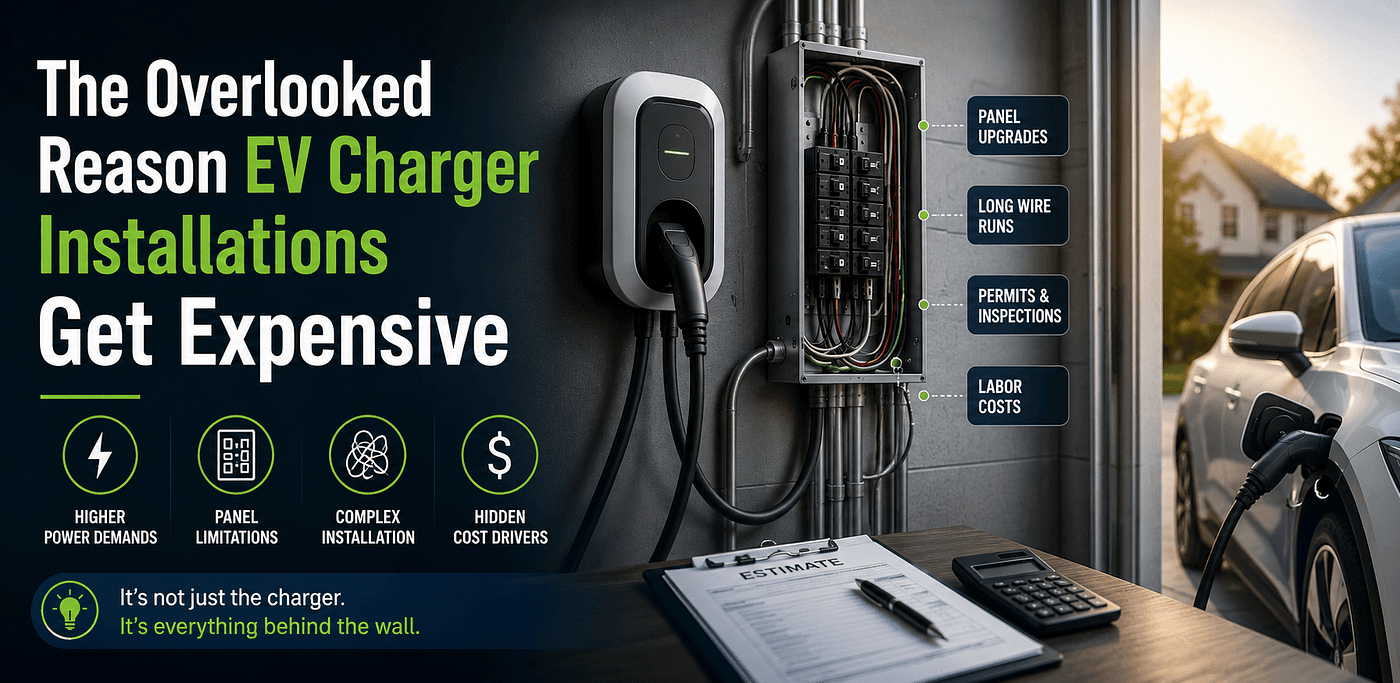
Electric vehicle adoption is accelerating faster than most people expected. Sales have been climbing steadily year over year, and with more automakers committing to all-electric lineups, the question of home charging infrastructure is no longer a niche concern. It’s something millions of households are actively dealing with right now.
Yet one part of the home EV charging conversation rarely gets the attention it deserves: why installations cost so much more than buyers expect, and what’s actually driving that gap between the quote you anticipated and the one sitting in your inbox.
This piece is about that gap.
The Sticker Price Everyone Sees
When someone buys a Level 2 home charger, the hardware cost is usually the first number they focus on. A decent unit runs anywhere from $300 to $800 depending on the brand, amperage output, and smart features. That’s a manageable number for most buyers, and it creates a mental anchor for what the whole project should cost.
The electrician’s labor to install it typically adds another $200 to $500 for a straightforward job. So in the best case, you’re looking at somewhere between $500 and $1,300 total. That’s the number people budget for.
Then they call an electrician.
What the Quote Actually Says
For a meaningful portion of homeowners, especially those in homes built before the 1990s, the quote that comes back looks nothing like that estimate. Numbers like $4,000, $7,000, or even $12,000 are not unusual. The reason almost always comes down to the same thing: the home’s electrical panel doesn’t have enough capacity to support a new 240V circuit without an upgrade.
This isn’t the electrician padding the bill. It’s a genuine infrastructure constraint that catches buyers off guard because nobody in the EV sales process mentions it. The dealership doesn’t bring it up. The charger manufacturer’s website doesn’t address it prominently. And by the time the buyer is ready to install, they’re already committed to the car.
A standard Level 2 charger requires a dedicated 40 to 50 amp circuit. In a home with a 100-amp main panel that’s already running a central air conditioner, electric water heater, washer, dryer, and kitchen appliances, that capacity often simply isn’t there.
Understanding the Panel Upgrade Problem
A panel upgrade, also called a service upgrade or service entrance upgrade, involves replacing the main electrical panel with a higher-capacity unit, usually stepping from 100A or 150A service up to 200A or 400A. In theory it sounds straightforward. In practice it involves coordinating with your local utility company, pulling permits, scheduling inspections, and sometimes running new wire from the utility’s connection point to your home.
That coordination is where the cost and the timeline balloon. Utility companies set their own schedules, and in areas with high demand for EV-related electrical work, waits of three to six months are not unheard of. Some utilities have backlogs even longer than that.
The financial burden is also unevenly distributed. Homeowners in older urban neighborhoods, rural areas with aging infrastructure, or regions with particularly active building departments face costs at the high end of the range. A homeowner in a newer suburb with 200A service already in place might pay $600 for their charger installation. A homeowner in a 1960s-era house two miles away might face a $9,000 upgrade before the charger conversation even begins.
Why This Doesn’t Get Talked About Enough
Part of the reason this issue stays under the radar is that the EV industry has a natural incentive to make the ownership experience sound as frictionless as possible. Highlighting electrical infrastructure costs at the point of sale creates hesitation. So it tends to get glossed over, or mentioned only in fine print.
The other reason is that the problem doesn’t affect everyone. Homes with modern 200A panels and available breaker capacity can often add a charger circuit with minimal work. For those buyers, the experience really is simple. Their reviews and testimonials dominate the online conversation, which skews the perception of how common installation complications actually are.
The actual rate of panel-related complications varies significantly by region and housing stock, but in markets with older homes, industry electricians report that a substantial portion of residential EV charger jobs involve some form of panel-related challenge.
The Load Management Alternative
What doesn’t get covered nearly enough in mainstream EV coverage is that a panel upgrade isn’t always the only technical solution available.
A category of devices exists specifically to address the capacity gap without requiring a service upgrade. These are sometimes called load management systems or power sharing devices, and they work by actively monitoring the total electrical load on a panel and dynamically adjusting how much power is available to the EV charger at any given moment.
The logic is straightforward. A home’s peak electrical demand rarely occurs all at once. The air conditioner, the oven, the dryer, and the EV charger are almost never all running at full draw simultaneously for extended periods. A load management device takes advantage of that reality by throttling the charger’s output during high-demand periods and restoring it when capacity frees up. The EV still charges overnight, just more intelligently.
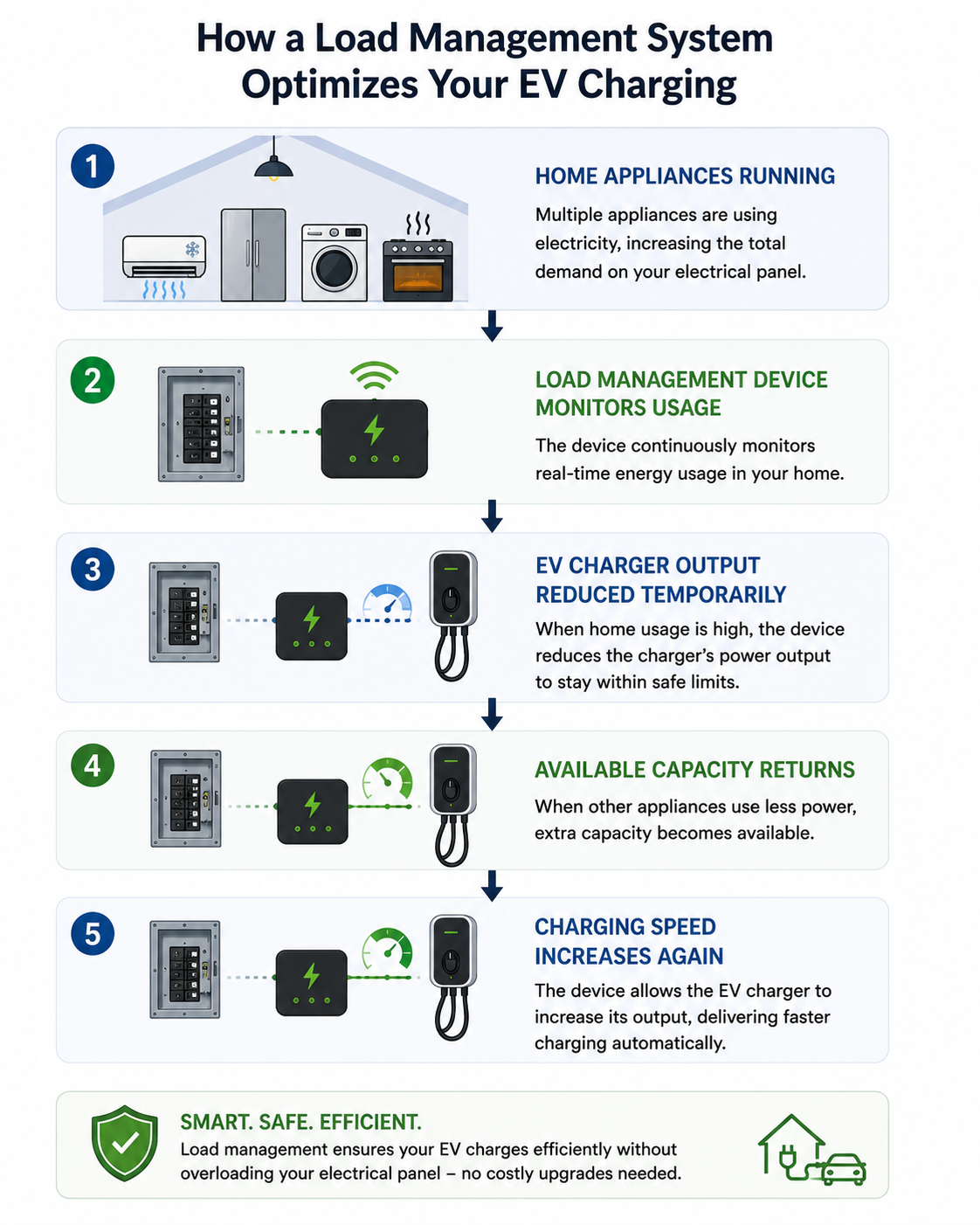
For homeowners whose panels are close to capacity but not severely undersized, this approach can eliminate the need for a service upgrade entirely. The device installs between the panel and the charger, typically in a few hours, without requiring utility coordination or extended permits. Anyone researching whether their situation qualifies for this kind of solution can get a clearer sense of the technical criteria by looking at how automatic load sharing systems are evaluated for residential EV installations.
The cost differential is significant. A load management device typically runs a few hundred to around $800 dollars depending on the unit, compared to thousands for a panel upgrade. For the right home, it’s a substantially better economic outcome.
When a Panel Upgrade Is Actually Necessary
It’s worth being clear that load management devices aren’t a universal substitute for a panel upgrade. There are situations where the service upgrade is genuinely the right call.
If a home has a 60A or severely undersized panel, there isn’t enough headroom for even a throttled EV charger circuit without posing real safety risks. If a household plans to install two or more high-amperage chargers, or is simultaneously adding other large electrical loads like a heat pump or induction range, the math may not work without additional capacity. And some older homes have wiring conditions beyond just the panel that require remediation regardless of the charger approach.
The point isn’t that panel upgrades are always avoidable. It’s that they aren’t always unavoidable either, and the default assumption that an undersized panel automatically means a $10,000 project isn’t always accurate.
What Buyers Should Actually Do Before Installation
The most useful thing a prospective EV buyer can do before getting installer quotes is to find out exactly what they’re working with electrically. That means:
Getting the panel capacity in writing. Look at the main breaker and note the amperage. If the panel is original to the home and the home was built before 1990, flag that specifically when calling electricians.
Asking for a load calculation, not just a visual inspection. A proper load calculation tells you what your actual peak draw is versus your panel’s rated capacity. That’s the number that determines whether a load management approach is viable or whether a panel upgrade is genuinely necessary.
Getting multiple quotes and asking each electrician directly whether load management alternatives have been considered. Not all electricians are familiar with or willing to recommend these systems, but the question alone signals that you’ve done your research and aren’t going to simply accept the most expensive path without discussion.
Checking for rebates before committing to anything. Federal, state, and utility incentives can meaningfully offset costs, but some programs are equipment-specific or require pre-approval. Knowing this upfront shapes which solution makes the most financial sense for your situation.
The Bigger Picture
Home EV charging infrastructure is going to be one of the defining residential electrical challenges of the next decade. Tens of millions of households across the country will eventually need to solve this problem, and the solutions available are evolving faster than most buyers realize.
The panel upgrade will remain the right answer in many cases. But the assumption that it’s the only answer has cost homeowners a significant amount of money that didn’t need to be spent, and delayed installations that could have been completed weeks or months earlier.
Understanding the full range of options before committing to a path is the single most useful thing any buyer can do. The cost difference between the most expensive solution and the most appropriate one can be substantial, and it starts with knowing the right questions to ask.
메타데이터
- post_id
- 0624f874ca33
- slug
- why-ev-charger-installations-are-expensive-0624f874ca33
- url
- https://medium.com/@info_80009/why-ev-charger-installations-are-expensive-0624f874ca33
- canonical_url
- https://medium.com/@info_80009/why-ev-charger-installations-are-expensive-0624f874ca33
- author_url
- https://medium.com/@info_80009
- status
- ok
- fetched_at
- 2026-07-13 06:23:13