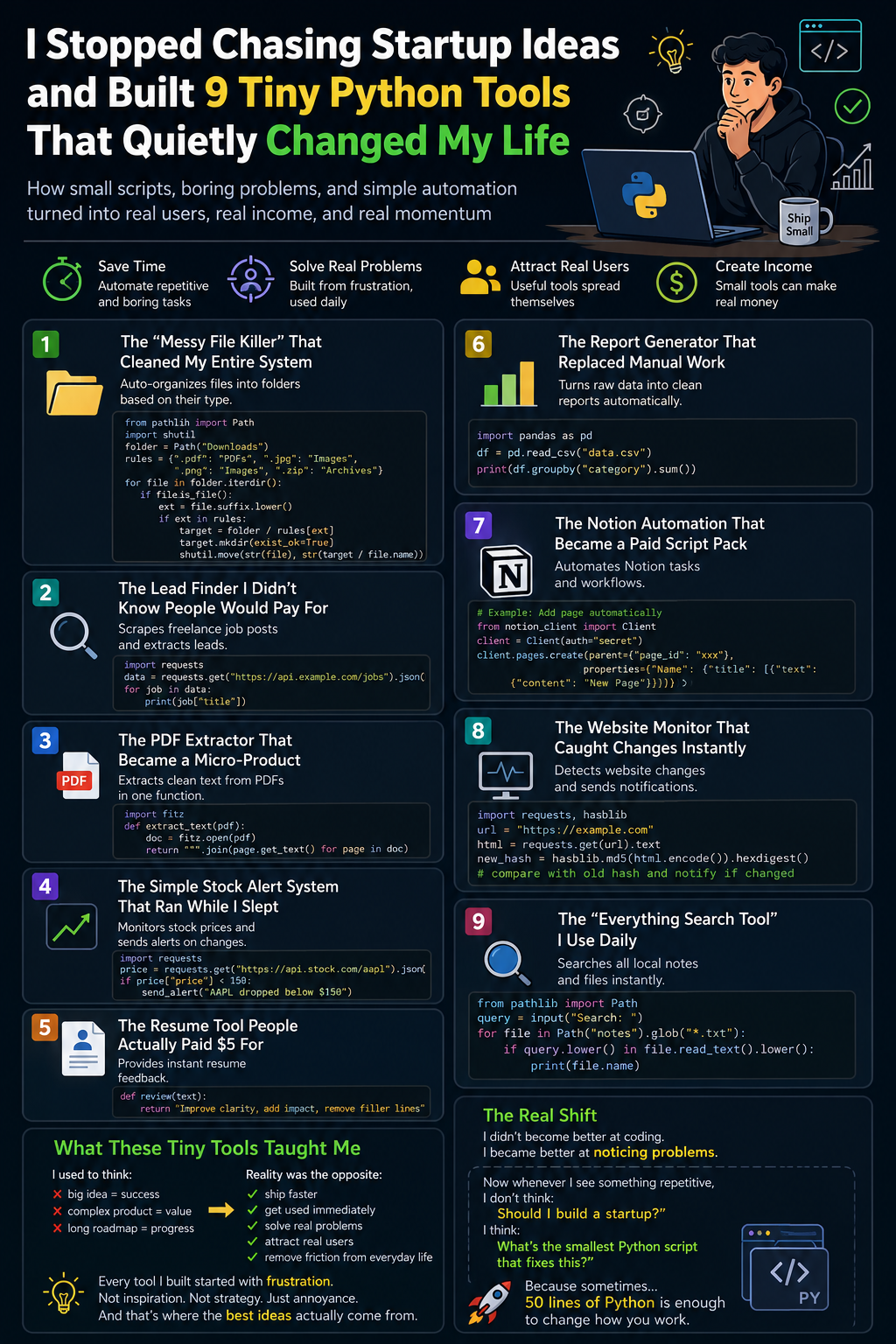
I Stopped Chasing Startup Ideas and Built 9 Tiny Python Tools That Quietly Changed My Life
How small scripts, boring problems, and simple automation turned into real users, real income, and real momentum
I Stopped Chasing Startup Ideas and Built 9 Tiny Python Tools That Quietly Changed My Life
How small scripts, boring problems, and simple automation turned into real users, real income, and real momentum
A few years ago, I thought success meant building something big.
A full SaaS.
A polished startup.
A complex AI platform.
Something that would “look impressive” on GitHub.
So I kept planning.
And planning.
And planning.
But I wasn’t shipping anything.
Most of my ideas died inside folders with names like:
final_project_v12_really_final
Meanwhile, something strange was happening.
Every time I wrote a small Python script for myself… it actually worked.
It solved a problem instantly.
It saved time immediately.
And sometimes… other people wanted it too.
That’s when everything changed.
I stopped chasing big ideas.
And started building tiny Python tools that solve real problems.
Some of them took a few hours.
Some took a single night.
But together, they completely changed how I think about software, money, and building products.
Here are 9 of them.
1. The “Messy File Killer” That Cleaned My Entire System
My Downloads folder was chaos.
PDFs, images, ZIP files, random notes — everything mixed together.
So I wrote a simple script.
from pathlib import Path
import shutil
folder = Path("Downloads")
rules = {
    ".pdf": "PDFs",
    ".jpg": "Images",
    ".png": "Images",
    ".zip": "Archives"
}
for file in folder.iterdir():
    if file.is_file():
        ext = file.suffix.lower()
        if ext in rules:
            target = folder / rules[ext]
            target.mkdir(exist_ok=True)
            shutil.move(str(file), str(target / file.name))
It took 20 minutes to build.
But it saved me years of manual cleanup.
2. The Lead Finder I Didn’t Know People Would Pay For
I built a script that scrapes freelance job posts.
Just for myself.
import requests
data = requests.get("https://api.example.com/jobs").json()
for job in data:
    print(job["title"])
Then a friend asked:
“Can I use this too?”
Then another.
Then someone offered to pay.
That was the first time I realized:
Useful tools don’t need marketing They spread themselves
3. The PDF Extractor That Became a Micro-Product
People constantly needed text from PDFs.
So I built a tiny API.
import fitz
def extract_text(pdf):
    doc = fitz.open(pdf)
    return "".join(page.get_text() for page in doc)
What started as a utility became a paid tool for:
- writers
- researchers
- agencies
4. The Simple Stock Alert System That Ran While I Slept
I didn’t want to check prices manually.
So I automated it.
import requests
price = requests.get("https://api.stock.com/aapl").json()
If price drops → alert sent.
That’s it.
No dashboards. No complexity.
Just signal → action.
5. The Resume Tool People Actually Paid $5 For
I built a resume checker in one night.
def review(text):
    return "Improve clarity, add impact, remove filler lines"
Nothing fancy.
But people didn’t care.
They just wanted quick feedback.
6. The Report Generator That Replaced Manual Work
I got tired of weekly reporting.
So I automated it.
import pandas as pd
df = pd.read_csv("data.csv")
print(df.groupby("category").sum())
Now it runs automatically every week.
No effort. No reminders.
7. The Notion Automation That Became a Paid Script Pack
I automated my own workspace.
Then others wanted it.
So I packaged it.
No UI.
No SaaS.
Just scripts.
And people still bought it.
8. The Website Monitor That Caught Changes Instantly
Some websites matter only when they change.
So I built a checker.
import requests
html = requests.get("https://example.com").text
If something changes → I get notified.
Simple monitoring.
High value.
9. The “Everything Search Tool” I Use Daily
This one changed everything.
I built a local search tool for files and notes.
from pathlib import Path
query = input("Search: ")
for file in Path("notes").glob("*.txt"):
    if query in file.read_text():
        print(file.name)
Now I don’t “look for files” anymore.
I just find them.
What These Tiny Tools Taught Me
The biggest lesson wasn’t technical.
It was mental.
I used to think:
- big idea = success
- complex product = value
- long roadmap = progress
But reality was the opposite.
Small tools:
✔ ship faster ✔ get used immediately ✔ solve real problems ✔ attract real users
And most importantly:
They remove friction from everyday life
Every tool I built started with frustration.
Not inspiration.
Not strategy.
Just annoyance.
And that’s where the best ideas actually come from.
The Real Shift
I didn’t become better at coding.
I became better at noticing problems.
Now whenever I see something repetitive, I don’t think:
“Should I build a startup?”
I think:
“What’s the smallest Python script that fixes this?”
Because sometimes…
50 lines of Python is enough to change how you work.
메타데이터
- post_id
- 062fe354b1e2
- slug
- i-stopped-chasing-startup-ideas-and-built-9-tiny-python-tools-that-quietly-changed-my-life-062fe354b1e2
- url
- https://blog.stackademic.com/i-stopped-chasing-startup-ideas-and-built-9-tiny-python-tools-that-quietly-changed-my-life-062fe354b1e2
- canonical_url
- https://blog.stackademic.com/i-stopped-chasing-startup-ideas-and-built-9-tiny-python-tools-that-quietly-changed-my-life-062fe354b1e2
- author_url
- https://medium.com/@sa82912045
- status
- ok
- fetched_at
- 2026-06-14 11:28:49