AI-Driven Roads
AI-Driven Roads
The Future of Smart Infrastructure
AI is transforming how we build, monitor, and maintain roads, making them smarter, safer, and longer lasting. From AI-powered pavement inspection to autonomous repair robots and integration with self-driving cars, these innovations promise to cut costs, extend pavement life, and reduce congestion and emissions.
How Is AI Revolutionising Road Infrastructure for a Smarter Future?
If you’ve ever driven over a pothole or cracked road surface, you know how frustrating and dangerous poor road conditions can be. So, how exactly is AI changing the way roads are designed, maintained, and integrated with modern transport systems? Simply put, AI is enabling continuous, real-time monitoring of road surfaces, predicting when repairs are needed, and even automating those repairs — all while supporting the rise of autonomous vehicles and smart traffic management.
I remember a time a few years ago when I was stuck on a motorway detour caused by emergency roadworks. The delay was hours long, and the potholes on the alternative route were terrible. It made me wonder: could technology help prevent such disruptions? Since then, I’ve followed the rapid advances in AI-driven road infrastructure, witnessing how these technologies are moving from labs into real-world use. The promise is huge — fewer road failures, safer journeys, and smarter highways that communicate with vehicles.
This blog will take you through my journey exploring AI’s role in roads — from pavement inspection using cameras and LiDAR, to predictive maintenance models, robotic repair vehicles, and the integration with autonomous cars. Along the way, I’ll share insights, challenges, and the exciting future ahead for smart infrastructure.
Have you ever encountered a pothole that seemed to appear overnight? Drop a comment below — I read and respond to every one.
Laying the Groundwork: Understanding AI’s Role in Road Monitoring and Maintenance
To appreciate how AI is reshaping roads, it helps to understand the traditional challenges. Road maintenance has long relied on periodic manual inspections — often infrequent and labour intensive — which means defects like cracks or potholes can go unnoticed until they worsen. This reactive approach leads to costly repairs and safety risks.
Enter AI-powered pavement inspection. Using high-resolution cameras and LiDAR sensors mounted on maintenance vehicles, AI systems scan road surfaces continuously as they drive. These systems detect cracks, potholes, rutting, and subtle surface deterioration in real time. For example, the ARRES Eye system developed in the UK combines these sensors with machine learning models to identify defects automatically, generating work orders before problems escalate.
This shift from periodic surveys to continuous monitoring is a game changer. It means road agencies can spot issues early, plan maintenance proactively, and extend pavement life. It also reduces the need for manual inspections in hazardous traffic conditions, improving worker safety.
On a personal note, I recall visiting a road maintenance depot where technicians showed me how these AI systems work. Seeing the live defect maps generated from sensor data was eye-opening — it felt like the roads were finally “speaking” to us, telling us exactly where they needed help.
When Roads Break: Facing the Challenge of Timely Repairs
Despite advances in detection, the real challenge lies in timely and effective repairs. Roads are exposed to heavy traffic, weather extremes, and ageing materials, all of which accelerate deterioration. If small cracks or surface fretting aren’t fixed early, they can quickly develop into dangerous potholes, causing accidents and costly reconstructions.
I once spoke with a road engineer who described how traditional patching often happens too late, after defects have grown large. This reactive maintenance not only costs more but also disrupts traffic for longer periods. The problem is compounded by limited budgets and workforce shortages.
Statistics back this up: studies show that early intervention can reduce repair costs by up to 70%, yet many agencies still rely on scheduled inspections that miss early signs. This gap is where AI-driven predictive maintenance comes in — by analysing continuous condition data, AI models forecast how defects will evolve and recommend the optimal time for repairs.
Quick poll: Have you noticed potholes appearing faster than before on your local roads? Let me know in the comments!
AI-Powered Pavement Inspection: Seeing Roads Like Never Before
One of the most exciting developments is the use of computer vision and deep learning to detect pavement defects. Cameras capture images while LiDAR sensors provide 3D surface data, allowing AI models to distinguish between shallow surface wear and deep cracks.
For instance, Toshiba’s weakly supervised learning approach trains AI to detect potholes using only simple labels (“pothole” or “no pothole”) rather than detailed annotations. This reduces the time and cost of preparing training data by up to 100 times, making it easier to deploy across diverse road types.
In practice, these AI systems run on maintenance vans or patrol vehicles, scanning roads as they go. The data is processed in real time, flagging defects and updating digital maps. This continuous monitoring means road agencies can prioritise repairs based on severity and location, improving efficiency.
When I first saw a demo of this technology, I was amazed at how quickly the AI could spot tiny cracks invisible to the naked eye. It felt like giving roads a high-tech health check-up, enabling early diagnosis and treatment.
Predictive Maintenance and Digital Twins: Planning Repairs Before Problems Grow
Detecting defects is only half the story. The next step is predicting how these defects will develop over time. AI models use historical data, environmental conditions, traffic loads, and material properties to forecast pavement deterioration.
Digital twins — virtual replicas of road networks — combine sensor data with machine learning to simulate pavement performance under different scenarios. This allows agencies to test maintenance strategies, materials, and climate impacts before applying them in the real world.
For example, the ARRES Eye system feeds continuous inspection data into predictive models that estimate when cracks will expand or potholes will form. This helps schedule maintenance just in time, avoiding costly emergency repairs.
I remember discussing digital twins with a researcher who explained how these models can simulate decades of wear in minutes, helping design more resilient roads. It’s like having a crystal ball for infrastructure health.
Autonomous Road Repair Robots: Fixing Roads While You Sleep
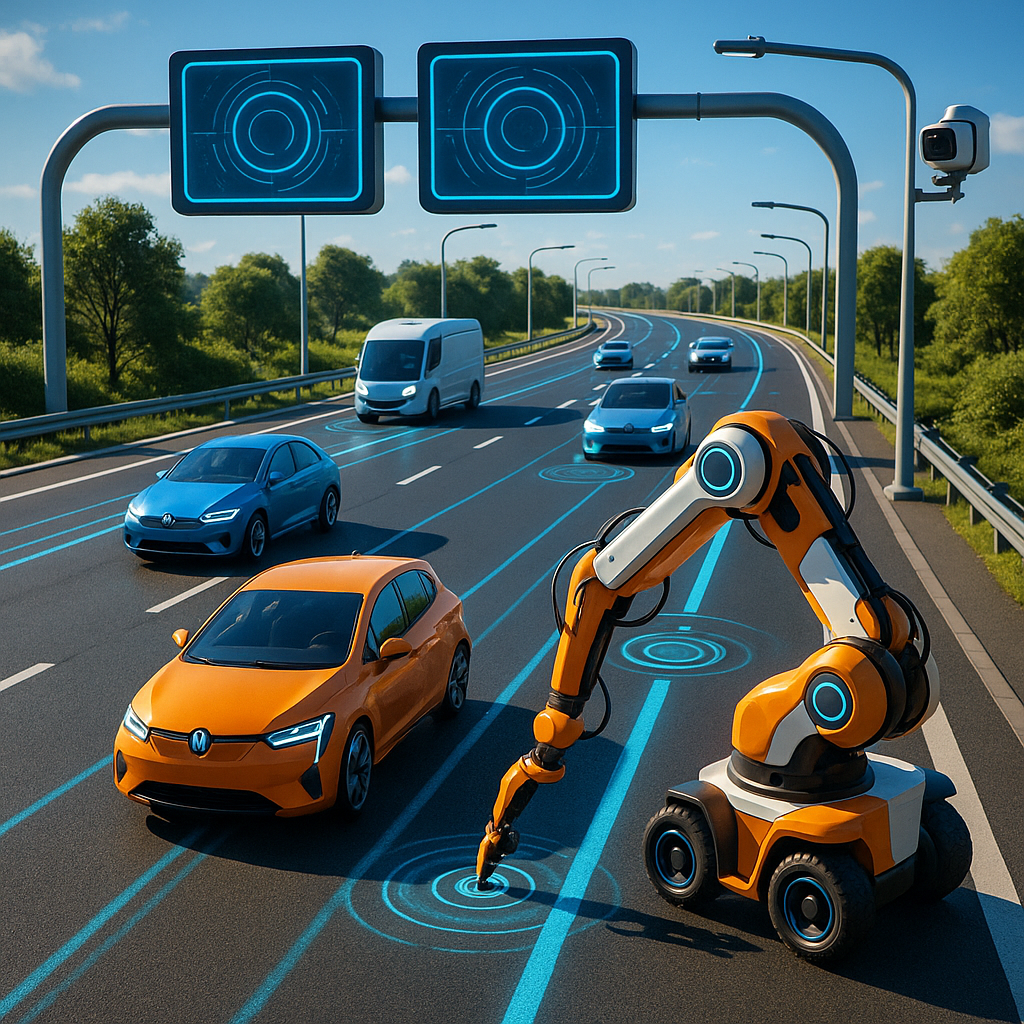
Perhaps the most futuristic aspect is the rise of autonomous repair robots. These AI-driven machines patrol roads, locate defects, and apply sealants or patches without human intervention.
In 2023, a prototype robot was unveiled that uses cameras and 3D scanners to map cracks and potholes, then deploys a robotic arm to fill them precisely. Operating mostly at night or during low traffic periods, these robots reduce worker exposure to hazards and ensure consistent repair quality.
I had the chance to visit a pilot site where such a robot was tested on campus roads. Watching it autonomously seal cracks was like seeing science fiction come to life. The potential to scale this technology could revolutionise road maintenance, cutting costs and improving safety.
AI in Road Construction: Smarter Materials and Greener Logistics
AI’s impact isn’t limited to maintenance. It’s also transforming how roads are built. Companies like Cemex use AI to optimise cement and concrete production, improving efficiency by around 10%. AI controls kiln temperatures and mix compositions dynamically, ensuring consistent quality and reducing waste.
Digital platforms connect pavers, rollers, and trucks with sensors and GPS, tracking every step of the paving process. This integration helps maintain quality, monitor environmental impact, and reduce CO2 emissions.
Logistics also benefit: AI schedules deliveries to avoid peak traffic, reducing truck idling and fuel consumption. These seemingly small changes add up to greener, more sustainable road construction.
The AI-Connected Highway: Supporting Autonomous Vehicles and Smart Mobility
The future of roads is inseparable from autonomous vehicles (AVs) and smart traffic systems. AVs rely on AI for perception and planning, using LiDAR, cameras, and high-definition maps. Meanwhile, smart highways equipped with sensors and V2X (vehicle-to-everything) communication broadcast real-time information about hazards, work zones, and weather.
Chinese companies like Haomo AI and Baidu are investing heavily in AI models that integrate road infrastructure data with AV systems, creating ecosystems where roads and vehicles co-evolve.
I recall reading about pilot projects where AVs themselves collect road condition data as they drive, feeding back into AI maintenance systems. This symbiosis promises safer, smoother journeys and more efficient traffic flow.
Still with me? Drop a 👋 in the comments so I know you made it this far!
The Game Changer: My Personal Discovery of AI’s Hidden Potential in Road Maintenance
While exploring these technologies, one insight stood out: the power of weakly supervised learning in reducing the data annotation bottleneck for AI models. Initially, I assumed AI needed vast, meticulously labelled datasets to work well. But Toshiba’s approach showed that even simple labels can train effective models, slashing costs and speeding deployment.
This discovery changed how I viewed AI’s scalability in infrastructure. It means smaller agencies or developing regions can adopt AI inspection without prohibitive data preparation costs.
In practice, this approach enabled a Japanese highway operator to detect potholes accurately across diverse road conditions with minimal manual labelling. The result? Faster, cheaper inspections and earlier repairs.
This tip is a reminder that sometimes, the best solutions come from simplifying complexity — a lesson I’ve applied beyond roads in other AI projects.
Expert Voices: What Industry Leaders Say About AI in Roads
Joel Gassalini, VP at Cemex, highlights that AI-driven mill optimisation has already delivered about 10% efficiency gains, with potential for more as data grows. He emphasises AI’s role in rethinking logistics, linking truck dispatch to both cost and carbon footprint.
Q Point representatives stress the importance of visualising every paving step — from mix temperature to roller passes — to maintain quality and track environmental impact. Their work exemplifies the rise of full digital integration in road construction.
These insights resonate with my experience, validating the transformative potential of AI across the road lifecycle.
The Payoff: Safer, Smarter Roads and Reduced Costs
After following these developments, the benefits are clear. Continuous AI-driven monitoring means defects are caught early, enabling smaller, cheaper repairs. Autonomous repair robots reduce worker risk and improve repair consistency. Smarter construction and logistics cut emissions and improve quality. And integration with AVs and smart traffic systems promises safer, more efficient travel.
In my conversations with road engineers and researchers, many expressed optimism that AI will help meet the growing demands of ageing infrastructure, climate change, and increasing traffic volumes.
For me, this journey has shifted my perspective — roads are no longer passive surfaces but active, intelligent systems that communicate, adapt, and self-heal.
Your Questions Answered: AI and Smart Roads FAQs
Q1: How accurate are AI systems at detecting road defects? Modern AI models using combined camera and LiDAR data achieve high accuracy in controlled trials, often exceeding 90% for pothole detection. However, performance varies with lighting, weather, and road types, so ongoing validation is essential.
Q2: Can autonomous repair robots handle all types of road damage? Currently, robots focus on small cracks and minor surface defects. Large-scale repairs still require human crews. But as technology advances, multi-robot fleets may tackle more complex tasks.
Q3: How does AI reduce emissions in road construction? AI optimises material mixes, plant operations, and logistics to reduce energy use and waste. Scheduling deliveries to avoid peak traffic cuts fuel consumption. Together, these reduce the carbon footprint of road projects.
Q4: What are the privacy concerns with continuous road imaging? Road imaging can capture identifiable information like licence plates or nearby properties. Agencies must implement data anonymisation, secure storage, and comply with privacy regulations to protect individuals.
Q5: How will AI impact jobs in road maintenance? Automation may reduce manual inspection and patching roles but increase demand for technicians, data scientists, and robotics specialists. Training and transition programs are vital to support workers.
Closing the Loop: From Frustration to Innovation on Our Roads
Reflecting on my early frustration with potholes and road delays, it’s inspiring to see how AI is turning those problems into opportunities. Roads are becoming living systems — sensing, predicting, and repairing themselves with minimal human intervention.
The lessons I’ve learned show that embracing AI in infrastructure requires not just technology but collaboration between engineers, data scientists, policymakers, and communities. Together, we can build smarter, safer roads that serve us better.
What’s your experience with road conditions or smart infrastructure? Are you excited or cautious about AI’s role? I’d love to hear your thoughts — let’s keep the conversation rolling.
If you found this story valuable, please clap 👏 and follow me on LinkedIn, Twitter, and YouTube for more insights. Feel free to share this post with anyone interested in the future of roads and AI.
Relevant Reference URLs:
메타데이터
- post_id
- 066ca83ea53c
- slug
- ai-driven-roads-066ca83ea53c
- url
- https://medium.com/ai-simplified-in-plain-english/ai-driven-roads-066ca83ea53c
- canonical_url
- https://medium.com/ai-simplified-in-plain-english/ai-driven-roads-066ca83ea53c
- author_url
- https://medium.com/@meisshaily
- status
- ok
- fetched_at
- 2026-07-13 06:23:13