The Prettier Your AI Prototype, the Deeper Your Design Debt
After 20 years in IT, I’ve watched the same crisis play out in slow motion. AI tools have hit fast-forward.
The Prettier Your AI Prototype, the Deeper Your Design Debt
After 20 years in IT, I’ve watched the same crisis play out in slow motion. AI tools have hit fast-forward.
I‘ve sat in enough product reviews to recognise the pattern.
The roadmap is healthy. Velocity is good. The design looks polished — genuinely polished, especially now that AI tools are in the workflow. And somewhere in the back half of the deck, there’s a line item: “UX cleanup / design inconsistencies.” Underfunded. Unscheduled. Quietly moved to next quarter.
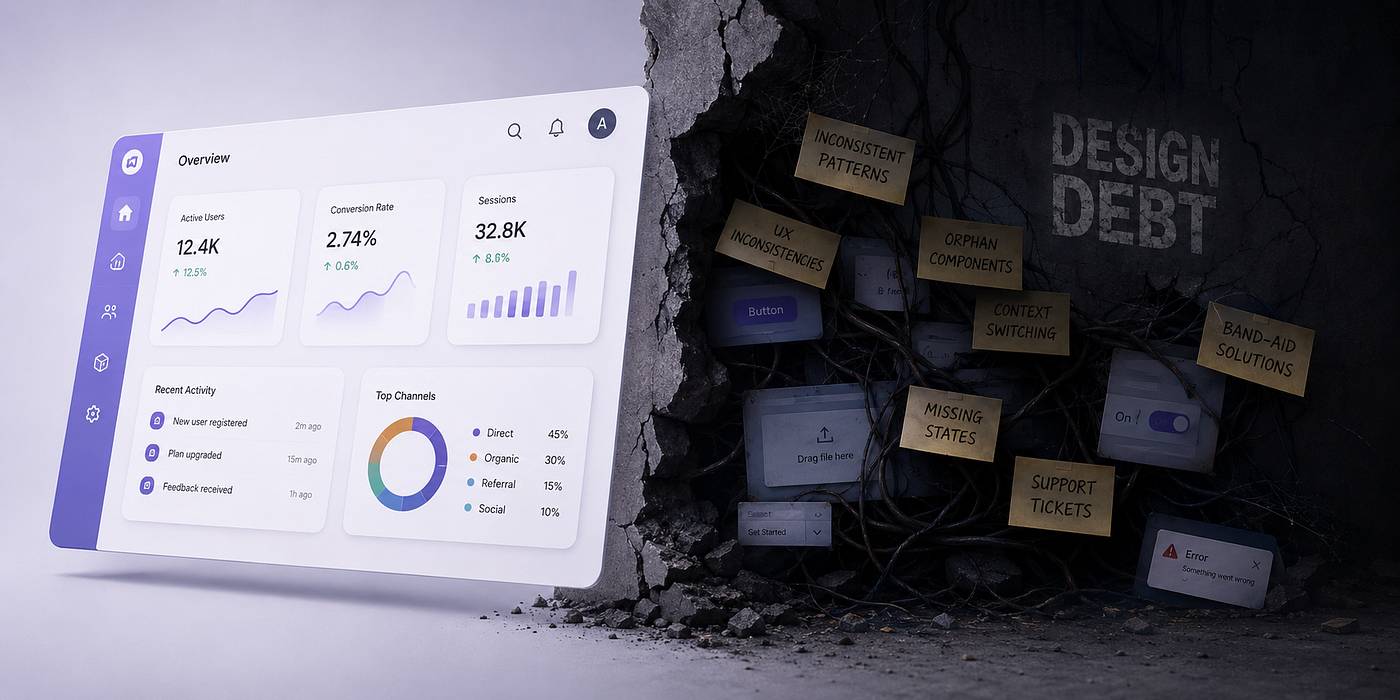
That line item is design debt. And unlike the technical kind, it doesn’t throw errors. It doesn’t break a build. It just sits there, compounding — in the friction your users experience, in the support tickets you attribute to other causes, in the churn you blame on pricing.
I gave a talk on this at UXINDIA 2023. What I didn’t fully anticipate then was how dramatically AI tools would change the speed at which design debt accumulates — and how much harder they’d make it to see.
First, what design debt actually is
The term borrows from technical debt — the implied cost of rework when shortcuts taken now create constraints later. But design debt is structurally different, and that difference matters.
Technical debt is legible. A poorly written function will eventually break something measurable. Design debt manifests as friction — a checkout flow that requires one extra confirmation, a dashboard that forces users to build a mental model before they can act, a navigation pattern that’s almost right but not quite. None of these trigger incident reports. They just quietly erode conversion, retention, and trust.
The cost isn’t borne in your sprint cycles. It’s borne in your user behaviour — in every moment someone pauses, backtracks, or gives up and calls support instead.
There are several ways design debt enters a product: rushed decisions, unenforced design systems, features added without restructuring the information architecture underneath them. But the source that makes all the others worse is the one that’s hardest to fix — the absence of a feedback loop between what users actually do and what the design team knows. Without that loop, debt is invisible by definition. You can’t measure what you’re not looking for. And you can’t fix what you never see accumulating.
The false confidence problem comes first
Before we talk about AI as an accelerant, we need to talk about why design debt was already hard to escalate — because AI has made this underlying problem significantly worse.
Design risk has always had a visibility problem. In a well-run organisation, rough artefacts signal open questions. A wireframe with annotations that say “this flow is unvalidated” or “user research pending” creates room for the right conversation. Stakeholders know to push back. Designers know to flag uncertainty.
AI-generated outputs short-circuit that signal entirely.
A product manager presented with a polished AI-generated prototype feels differently about proceeding to development than they would looking at a rough wireframe. The prototype looks resolved. It implies that design problems have been solved. The visual quality communicates completeness even when the underlying user insight is absent.
AI-generated design artefacts are increasingly indistinguishable from research-validated ones — to everyone except the users who have to use them.
The escalation signals that would previously flag design risk — rough artefacts, visible uncertainty, explicit annotation of open questions — are being replaced by outputs that communicate false resolution. Stakeholders who approve work based on visual quality are systematically underestimating the unvalidated assumptions embedded in what they’re approving.
The downstream effect: products ship with confident, beautiful interfaces built on unverified assumptions about how users think, what they prioritise, what language they use. When those assumptions are wrong — and without research, some percentage of them always will be — the cost of correction is substantially higher than validation would have been at the discovery stage. How much higher depends on your product, your user base, and how deeply the wrong decision has been embedded. But every practitioner who has managed a significant product rework knows the ratio is painful.
AI as accelerant: the mechanism
Generative design tools have genuinely changed what a small team can produce in a week. That’s the pitch, and it’s not wrong.
But velocity applied without direction is how you build a highway to the wrong city.
AI tools are optimised for output generation — screens, components, copy variants, motion specs. They are not, by nature, optimised for validating whether that output solves the right problem for the right user. The practical consequence, from what I’ve observed across audits: teams using AI-assisted design produce significantly more screens in the same time — but each additional screen represents an additional unvalidated design decision. The output scales. The insight doesn’t.
When I review products from teams that adopted AI tooling aggressively without adjusting their research process, I see the same pattern: beautiful interfaces, inconsistent mental models. Individual screens that look production-ready. User journeys that collapse at the third step because nobody stress-tested the handoffs between them. Design debt that is cosmetically invisible but behaviourally catastrophic.
Early in my career, working on a 10,000-page website redesign for a major airline — integrating booking, check-in, and frequent flier systems into a coherent user experience — the sheer scale of the work forced a discipline that AI now makes it easy to bypass. You couldn’t generate your way through information architecture that complex. You had to understand how users moved through it, where they got lost, what they actually needed at each decision point. Slowness was a forcing function for rigour.
AI removes that forcing function. The debt accumulates faster precisely because production friction — the thing that used to make you think before you made something — is gone.
The double-edged sword: AI can also surface debt
This is not an argument against AI tools in design. It’s an argument for using them with clear-eyed awareness of what they can and cannot do.
Used deliberately, AI tooling is genuinely useful for identifying existing design debt. Consistency checking at scale — flagging when components deviate from the design system, surfacing accessibility violations, identifying where language patterns break down across a product — is something AI can assist with faster than manual audit. Tools like Stark have moved accessibility checking from a periodic review into a continuous layer. Design system governance tools are beginning to flag drift between what’s in the library and what’s actually shipped. These are real capabilities, even if they’re still maturing.
The distinction is in how teams frame AI’s role.
AI as production accelerator only: You go from brief to deliverable faster. Debt accumulates faster and quieter, because the review rigour hasn’t scaled with the output velocity.
AI also as audit layer: You use it to continuously check what has been produced against established standards — design system compliance, accessibility, content consistency. Debt gets caught earlier, when it’s still cheap to fix.
Most teams are doing the first almost exclusively. The economic incentive is obvious — faster output is immediately legible as productivity. Systematic audit doesn’t show up on a velocity dashboard. So it gets deprioritised, then dropped, then forgotten until a redesign project surfaces what’s been quietly accumulating for eighteen months.
What actually works
The answer isn’t to slow down. It’s to make sure speed is applied to the right things.
Research precedes generation — even a little research. The temptation with AI tools is to go from brief to prototype in hours. The problem isn’t the speed; it’s skipping the step that determines whether you’re building the right thing. Research doesn’t have to be exhaustive to be directional. In my experience, even three to five qualitative sessions with real users will surface the two or three assumptions most likely to be wrong — the ones that, if unchecked, become the expensive design decisions you’re living with two years later. AI-generated screens built on a validated problem definition are significantly more durable than those built on a brief alone.
Design systems are the debt firewall — but only if they’re enforced. A maintained design system is one of the highest-leverage investments a product organisation can make against design debt. The problem is that AI generation tools don’t automatically respect your system. Teams using AI to produce components that then get manually reconciled with the design system are doing double work. The governance question — how does AI-generated output get reviewed for system compliance before it moves to development? — needs an explicit answer, not an implicit assumption that someone will catch it.
Treating “teams that do research” and “teams that use AI” as the same population. The practitioners I’ve seen navigate this well aren’t choosing between research and AI — they’re using AI to make research more efficient. Synthesis, pattern identification across interview transcripts, generating hypotheses from behavioural data. That’s the compounding advantage: AI applied where it adds rigour, not just where it adds speed.
Making validation status visible on every artefact. The false confidence problem is partly a communication problem. If every design artefact that enters a review carries an explicit note on its validation status — what has been tested, what assumptions remain open, what research it’s based on — stakeholders can’t mistake polish for proof. This sounds administrative. In practice, it’s one of the more effective ways to keep the right conversations happening at the right time.
The question that matters
Design debt is ultimately a risk management issue, not a design team issue. The decisions that create it — timelines that compress research, roadmaps that don’t budget for debt retirement, adoption of AI tooling without governance frameworks — are made at the leadership level.
The cost structure is asymmetric. Validation at the discovery stage is the cheapest intervention in the design process. Correction after development is substantially more expensive. Correction after a product has shipped and trained a user base to work around its failures is more expensive still — not just in engineering time, but in the retraining cost, the support overhead, and the trust you’ve spent with users who expected something better.
AI tools have shifted the economics of design debt in a direction that demands more leadership attention, not less. The barrier to producing designed artefacts has dropped to near zero. The barrier to producing artefacts that reliably serve real users has not moved.
That gap — between production velocity and research rigour — is where design debt lives. It’s always been there. It’s just growing faster now, and looking more convincing while it does it.
The question isn’t whether your product has design debt. Every product does. The question is whether you’re managing it — or waiting to be surprised by it.
메타데이터
- post_id
- 067367e1abf3
- slug
- the-prettier-your-ai-prototype-the-deeper-your-design-debt-067367e1abf3
- url
- https://medium.com/design-bootcamp/the-prettier-your-ai-prototype-the-deeper-your-design-debt-067367e1abf3
- canonical_url
- https://medium.com/design-bootcamp/the-prettier-your-ai-prototype-the-deeper-your-design-debt-067367e1abf3
- author_url
- https://medium.com/@bijith08
- status
- ok
- fetched_at
- 2026-06-09 15:37:30