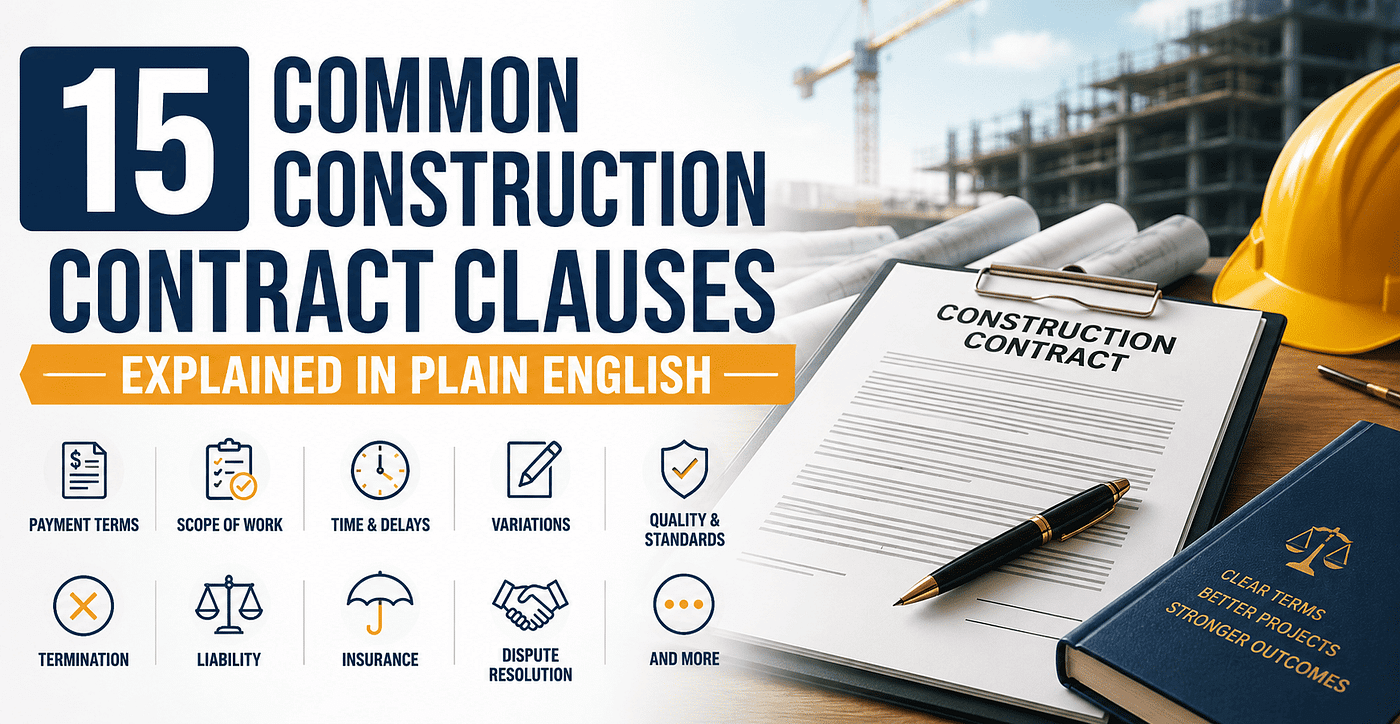
15 Common Construction Contract Clauses Explained in Plain English
Most building contracts are written for lawyers, not for the people signing them. That’s a problem, because the clauses that cause the…
15 Common Construction Contract Clauses Explained in Plain English
Most building contracts are written for lawyers, not for the people signing them. That’s a problem, because the clauses that cause the biggest arguments, variations, delays, defects, are usually the ones skimmed over at the kitchen table.
Here are 15 clauses you’ll see in almost every NSW building contract, and what each one actually means for you.
1. Scope of works
This says exactly what the builder has agreed to build. If it isn’t described here (or in the attached plans and specifications), it isn’t included, and asking for it later becomes a variation you pay for. Vague scopes are the single most common cause of disputes.
2. Contract price
The total you’ve agreed to pay. Read this alongside the clauses on variations, provisional sums and rise and fall, because those are the three ways the “fixed” price stops being fixed.
3. Progress payments
Sets out when money is due, usually at stages like slab, frame, lock-up and completion. Under the **Home Building Act**, the deposit on residential work is capped at 10%, and you shouldn’t be paying ahead of work actually done.
4. Variations
Any change to the scope after signing. In NSW, residential variations should be in writing and signed before the work happens. Verbal variations are where thousands of dollars quietly disappear.
5. Provisional sums
An estimate for work that can’t be priced yet, such as **excavation** before the soil is tested. If the real cost comes in higher, you pay the difference, plus the builder’s margin. Provisional sums aren’t a fixed price, treat them as a warning light.
6. Prime cost items
An allowance for a product not yet chosen, like tapware or tiles. Pick something dearer than the allowance and you pay the gap. Pick something cheaper and you should get a credit.
7. Extension of time (EOT)
Lets the builder claim extra time for delays outside their control, wet weather, material shortages, changes you requested. Look for the notice period: if the builder must claim within, say, 10 business days, late claims can be refused.
8. Liquidated damages
A pre-agreed amount you can deduct for every day the build runs past the completion date. It’s a genuine estimate of your loss, not a penalty. If the figure is $0 per week, and it often is, you have no practical remedy for delay.
9. Practical completion
The point where the home is reasonably fit to live in, even if minor items remain. It matters because it usually triggers the final payment, the start of the defects liability period, and the end of liquidated damages.
10. Defects liability period
A set window after handover (commonly 13 weeks to 12 months) where the builder must return and fix defects. Importantly, this doesn’t replace your statutory warranties, it sits alongside them.
11. Statutory warranties
Implied by the Home Building Act into every residential contract, and they can’t be contracted out of. You get six years for major defects and two years for everything else, running from completion. Any clause that tries to shorten this is unenforceable.
12. Retention and security
Allows a portion of the contract sum (often 5%) to be held back, or a bank guarantee to be provided, as protection against defects. Check when it’s released, money held indefinitely is money you’re unlikely to see.
13. Insurance and home warranty
The builder must hold public liability and contract works insurance, and for residential work over $20,000, provide **Home Building Compensation** cover before taking your deposit. No certificate, no deposit.
14. Suspension and termination
Sets out when either party can pause or walk away, usually non-payment, or a serious breach that isn’t remedied after notice. Terminating without following this clause exactly can turn you into the party in breach.
15. Dispute resolution
The agreed path when things go wrong: notice, negotiation, mediation, then NCAT or court. Follow the steps in order. Skipping straight to a claim can get it thrown out or cost you on costs.
What to do before you sign
A few practical habits prevent most disputes:
- Read the scope twice. If it’s not written down, it’s not included.
- Add up the provisional sums and prime cost items. That’s your real price risk.
- Check the liquidated damages figure. If it’s zero, ask why.
- Never sign a blank or undated variation.
- Keep every email. Contemporaneous records win building disputes.
A contract review costs far less than resolving a dispute later. If any part of your building contract seems unclear, one-sided, or includes variations you didn’t agree to, it’s worth having an **experienced construction lawyer** review it before you sign or proceed.
메타데이터
- post_id
- 067b35a43cd0
- slug
- 15-common-construction-contract-clauses-explained-in-plain-english-067b35a43cd0
- url
- https://medium.com/@michaelbirchlawyer/15-common-construction-contract-clauses-explained-in-plain-english-067b35a43cd0
- canonical_url
- https://medium.com/@michaelbirchlawyer/15-common-construction-contract-clauses-explained-in-plain-english-067b35a43cd0
- author_url
- https://medium.com/@michaelbirchlawyer
- status
- ok
- fetched_at
- 2026-08-04 00:32:11