How D2C Brands Use Social Commerce & SMM Automation to Drive Ecommerce Sales
The landscape of direct-to-consumer (D2C) retail has undergone a major shift. Consumers no longer wait to be advertised to. They discover…
How D2C Brands Use Social Commerce & SMM Automation to Drive Ecommerce Sales
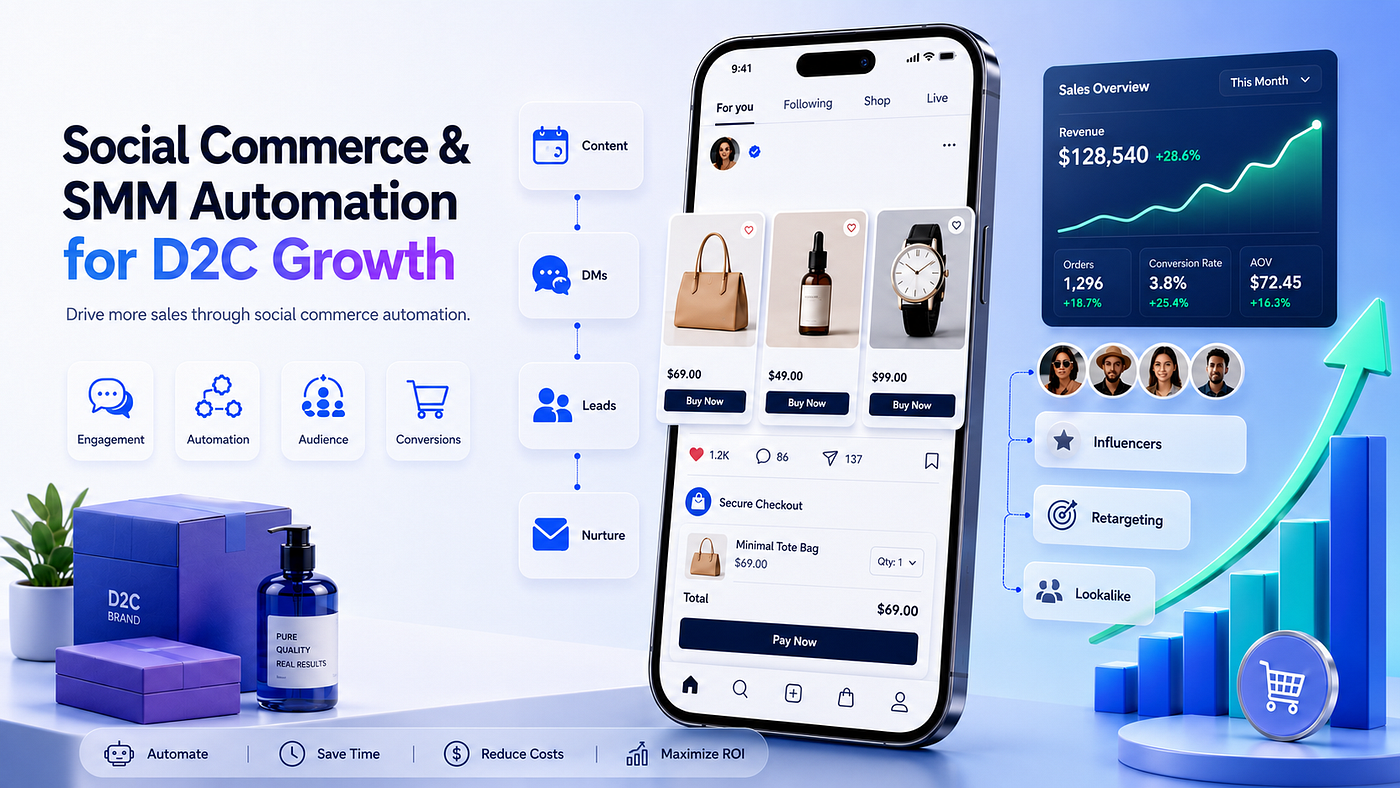
The landscape of direct-to-consumer (D2C) retail has undergone a major shift. Consumers no longer wait to be advertised to. They discover, evaluate, and purchase products directly within the social media platforms they already use every day.
This convergence of content and commerce is what defines social commerce, and it has become one of the most powerful growth levers for modern D2C brands.
For D2C brands, this is not simply a trend. It is a fundamental shift in how sales happen, how customers are nurtured, and how brand loyalty is built. When ecommerce automation and social media automation tools are added to this equation, brands can create a scalable growth engine that works around the clock without requiring a much larger team.
What Is Social Commerce and Why It Matters for D2C Brands
Social commerce refers to the use of social media platforms such as Instagram, TikTok, Pinterest, Facebook, and YouTube as direct sales channels. Consumers can discover products, engage with brand content, and complete a purchase without leaving the platform.
Unlike traditional e-commerce advertising, which redirects users to a separate website, social commerce reduces the gap between discovery and conversion. This reduces friction, shortens purchase cycles, and increases impulse buying.
For D2C brands, this model is especially powerful. It reduces dependency on marketplaces, helps brands own the customer relationship, and creates immersive brand experiences that build lasting loyalty.
The Core Platforms Powering Social Commerce Today
Instagram Shops and Shoppable Reels have changed how brands showcase products with in-feed purchase options. TikTok Shop has grown quickly, especially among younger audiences, by combining viral content with in-app checkout.
Pinterest continues to be a strong discovery platform where users actively search for products before buying. Facebook Shops still help brands reach broad demographic segments, especially for higher-ticket purchases.
SMM Automation: The Backbone of Scalable Social Commerce
Running social commerce at scale is operationally demanding. Brands need to publish content across platforms, respond to comments and DMs, schedule promotional posts, analyse performance data, and manage ad campaigns at the same time.
This is where social media automation tools become valuable.
Tools like Hootsuite, Buffer, Sprout Social, ManyChat, and Metricool allow D2C brands to automate repetitive workflows, centralise content management, and maintain a consistent publishing schedule without overwhelming their marketing teams.
Key Automation Workflows D2C Brands Are Using
Post scheduling and multi-platform publishing are among the most common use cases. Brands can schedule weeks of content across Instagram, TikTok, Facebook, and Pinterest, helping them stay active even during weekends, holidays, and product launches.
Automated DM sequences and chatbots are another high-impact use case. Tools like ManyChat allow brands to create rule-based conversational flows triggered by comments or messages. For example, when a user comments on a product post, they can automatically receive product details and a purchase link.
This turns passive engagement into active social media lead generation.
Performance analytics and reporting automation also help brands track engagement, clicks, conversions, and audience growth in one place. This gives marketing teams faster insights and helps them make better decisions.
How Automation Amplifies Social Commerce Revenue
When automation handles repetitive tasks, marketing teams can focus more on strategy, creative direction, and community building.
The result is a compounding effect. Automation maintains consistency and volume, while human creativity improves quality and emotional connection.
This combination helps D2C brands build stronger campaigns, respond faster, and convert more engaged audiences into customers.
Social Media Lead Generation Before the Sale
One of the most important parts of D2C social strategy is using social platforms as lead generation engines.
Unlike paid search, which captures existing demand, social platforms create demand. They introduce products to people who may not have been actively searching for them.
Content plays a major role here. A skincare D2C brand can publish ingredient-education Reels to build trust. A fashion brand can use styling videos. A food brand can use recipe content, customer stories, and product demos.
By the time the audience sees a product recommendation, the trust barrier is already lower.
Giveaways, lead magnets, and creator partnerships also support social media lead generation. When these are combined with automated follow-up messages, they become strong systems for building warm audiences.
Ecommerce Advertising Within Social Commerce
Organic social commerce builds long-term value, but ecommerce advertising helps brands scale faster.
D2C brands use Instagram and Facebook Dynamic Product Ads to retarget users who viewed or added products to cart. TikTok Spark Ads help amplify high-performing organic content. Pinterest Shopping Ads reach users with buying intent, while YouTube Shopping Ads combine video storytelling with product links.
When paid ads, organic content, and automation work together, brands can build stronger ecommerce growth systems.
Building a Holistic Ecommerce Growth Strategy
Social commerce and SMM automation should not work separately. The most successful D2C brands connect them into a complete ecommerce growth strategy.
The first pillar is discovery and awareness through organic content, paid ads, and creator partnerships.
The second pillar is consideration and trust building through reviews, user-generated content, and behind-the-scenes storytelling.
The third pillar is conversion using shoppable posts, automated DM links, in-app checkout, and retargeting ads.
The fourth pillar is retention and advocacy through thank-you messages, loyalty programs, referrals, and post-purchase engagement.
Ecommerce Automation Beyond Social Media
D2C brands are also extending ecommerce automation beyond social platforms.
Order management, inventory syncing, email sequences, customer support chatbots, and loyalty workflows can all be automated. Platforms like Klaviyo, Shopify Flow, and Zapier help connect social commerce touchpoints with backend systems.
This creates a smoother customer journey across marketing, sales, fulfillment, and support.
Real-World Examples of D2C Brands Winning With Social Commerce
Gymshark grew from a garage startup into a major fitness apparel brand through social-first marketing, influencer partnerships, and community-led content.
Glossier built its D2C beauty brand through user-generated content, community engagement, and social-first product launches.
These examples show that social commerce success is not only about budget. It depends on strategy, consistency, and the smart use of ecommerce automation.
Key Metrics D2C Brands Should Track
A strong ecommerce growth strategy needs the right metrics.
D2C brands should track social conversion rate, cost per acquisition, return on ad spend, average order value from social commerce buyers, social media lead generation rate, and customer lifetime value.
These numbers help brands understand what is working, where to invest, and which content formats are driving revenue.
Conclusion:
The Competitive Advantage of Social Commerce Mastery
The D2C brands that will grow faster in the coming years are the ones that treat social commerce as a core business channel, not just a marketing tactic.
When combined with social media automation tools, social media lead generation, ecommerce advertising, and a strong ecommerce growth strategy, social commerce becomes a powerful growth engine.
The barrier to entry in D2C retail is lower than ever, but the margin for weak execution is also smaller. Brands that invest in social commerce infrastructure today will build an advantage that slower competitors may struggle to match.
Moving Forward
Social commerce and SMM automation are no longer optional for D2C brands. They are becoming essential for brands that want to reach customers faster, improve engagement, and drive consistent ecommerce sales.
Learn more: https://trilliantdigital.com/
To read the complete blog with all details, visit: https://trilliantdigital.com/blogs/how-d2c-brands-use-social-commerce-smm-automation-to-drive-ecommerce-sales/
메타데이터
- post_id
- 06cce9217cb2
- slug
- how-d2c-brands-use-social-commerce-smm-automation-to-drive-ecommerce-sales-06cce9217cb2
- url
- https://medium.com/@trilliantdigital/how-d2c-brands-use-social-commerce-smm-automation-to-drive-ecommerce-sales-06cce9217cb2
- canonical_url
- https://medium.com/@trilliantdigital/how-d2c-brands-use-social-commerce-smm-automation-to-drive-ecommerce-sales-06cce9217cb2
- author_url
- https://medium.com/@trilliantdigital
- status
- ok
- fetched_at
- 2026-07-13 11:49:26



