The Engineering Metrics Leaders Need in the AI Development Era
A practical framework for separating real productivity from activity inflation
The Engineering Metrics Leaders Need in the AI Development Era
A practical framework for separating real productivity from activity inflation
The easiest thing to measure in the AI era may be the least useful thing to measure.
- Lines of code.
- Pull requests.
- Commits.
- Prompt usage.
- AI-generated code percentage.
- Story points completed.
These numbers are easy to collect. They are also easy to misread.
AI can increase engineering activity without improving engineering outcomes. In many organizations, AI is accelerating the visible parts of engineering while increasing the hidden burden of review, validation, governance, architecture alignment, and operational ownership.
That creates a new leadership problem.
Engineering activity is now easier to inflate, but engineering capability is still hard to measure.
A team can generate more code and still become slower.
A team can create more tests and still miss critical risks.
A team can use AI heavily and still increase review burden, rework, and technical debt.
This is why AI-era engineering metrics must move beyond output and measure the full engineering system.
The real question is not:
Are teams producing more?
The better question is:
Are teams delivering more valuable, reliable, maintainable, and well-governed software with less friction?
That is the measurement shift engineering leaders need to make.
Traditional Metrics Are Not Dead. They Are Incomplete.
DORA and SPACE remain essential. They measure delivery performance and developer effectiveness better than most engineering dashboards.
The challenge is that neither framework was designed for a world where software can be generated in seconds.
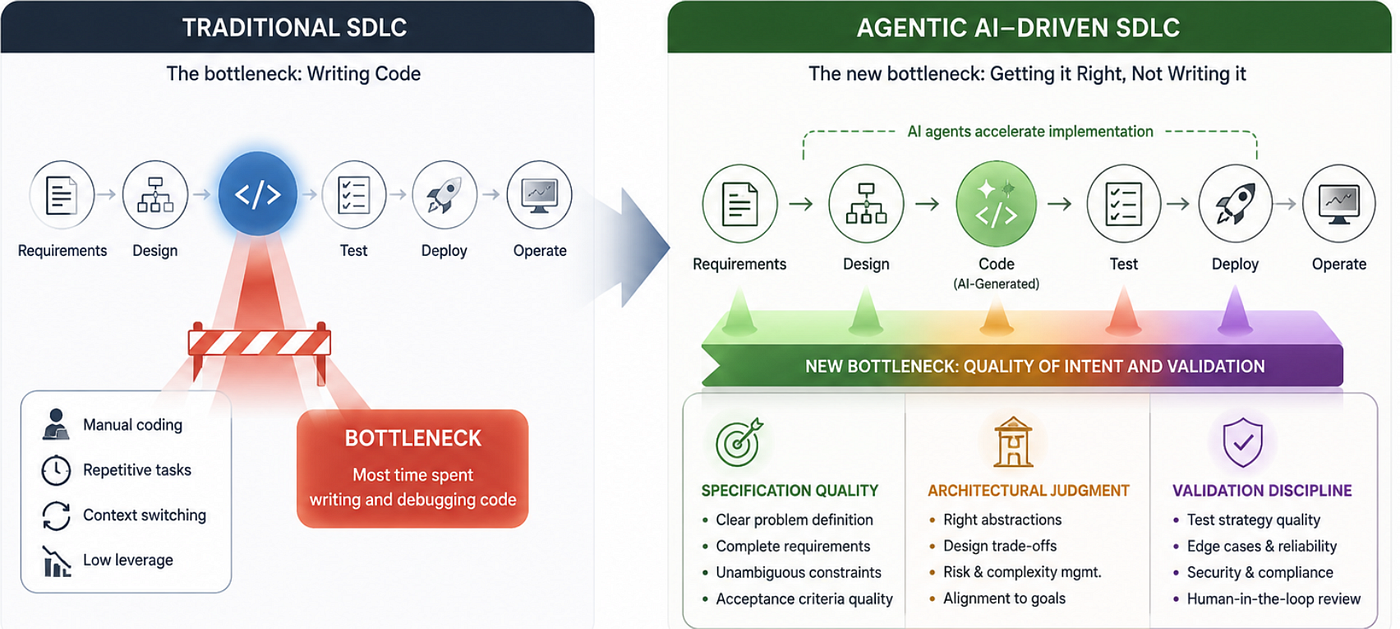
AI has shifted the primary bottleneck from code creation to problem definition, architectural judgment, validation, governance, and operational ownership.
Traditional metrics still tell us how efficiently software moves through the delivery pipeline. They tell us far less about whether AI is improving the engineering system itself.
In this article, I use a mix of established industry metrics and proposed AI-era leadership indicators. The goal is not to create another activity dashboard. The goal is to help engineering leaders see whether AI is improving the full engineering system: flow, quality, sustainability, decision-making, cognitive load, and governance.
An Enterprise Example: When AI Increased Activity but Exposed System Bottlenecks
Consider a large enterprise platform organization that introduced AI coding assistants across multiple product teams.
Within the first few months, adoption looked strong.
Developers reported faster code generation, faster unit test creation, and quicker first drafts of documentation. Prompt usage increased. AI-assisted pull requests increased. Managers saw more visible activity.
On the surface, productivity appeared to improve.
But the delivery system told a different story.
Review queues became longer because senior engineers had to spend more time validating generated code. Security teams found inconsistent handling of secrets, dependencies, and configuration. Platform teams noticed that some teams were bypassing approved templates and golden paths. Incident reviews showed that some AI-assisted changes were technically correct in isolation but poorly aligned with the broader architecture.
Coding became faster.
But problem specification, validation, review, governance, and architectural alignment became the new bottlenecks.
The organization eventually learned a critical lesson:
AI productivity cannot be measured only at the developer workstation. It must be measured across the full path from idea to production.
That is the purpose of an AI-era engineering metrics dashboard.
SDLC Impact
The AI-Era Engineering Metrics Dashboard
The purpose of this dashboard is not to measure AI adoption.
It is to help engineering leaders answer one question:
Is AI strengthening the engineering system or simply increasing engineering activity?
The framework evaluates seven dimensions that collectively determine long-term engineering capability and whether AI is making the engineering organization more capable.

7 dimensions of measurement
- Delivery Flow: Is Value Moving Faster Through the System?
AI can generate code faster, but software is only valuable when it reaches production safely and reliably. True delivery flow measures how efficiently work moves from idea to production — not how quickly code is written.
The leadership question is:
Are teams moving valuable changes to production faster while maintaining or improving reliability?
Suggested Metrics
- Change Lead Time: Time taken for a change to move from development to production.
- Deployment Frequency: How frequently teams deploy successfully to production.
- Change Failure Rate: Percentage of deployments that result in production incidents or require remediation.
- Mean Time to Restore (MTTR): How quickly services recover after a failed deployment or incident.
- Deployment Rework Rate: Frequency of rollbacks, hotfixes, failed releases, or repeated deployment attempts.
Warning sign
Coding output increases, but release speed, production stability, or recovery time does not improve.
Leadership interpretation
If AI increases coding speed without improving delivery flow, the bottleneck has shifted elsewhere in the software delivery lifecycle.
Rather than focusing on developer productivity alone, leaders should examine downstream constraints such as code reviews, testing, security validation, release automation, platform capabilities, and deployment governance.
AI should accelerate the entire delivery system — not just code generation. If only one stage becomes faster while the rest of the pipeline remains constrained, engineering activity increases, but business outcomes do not.
2. Human-AI Leverage: Is AI Reducing Friction or Creating Rework?
AI should reduce the effort required to deliver high-quality software — not shift that effort to reviewers, testers, or operations teams.
Human-AI leverage measures whether AI helps engineers deliver secure, maintainable, and production-ready software with less effort across the entire delivery lifecycle. The goal is not simply faster code generation, but faster delivery with lower review effort, less rework, and higher confidence.
Leadership Question
Is AI amplifying engineering capability, or simply increasing engineering activity?
Suggested metrics
- AI-assisted cycle time improvement Reduction in end-to-end cycle time for AI-assisted work compared to similar non-AI work.
- Rework rate for AI-assisted changes Frequency of AI-generated changes requiring modification after code review, testing, or production deployment.
- Review effort for AI-assisted changes Time and effort reviewers spend validating AI-assisted code compared to manually written code.
- AI acceptance rate with quality guardrails Percentage of AI-generated recommendations accepted without significant modification or later correction.
Warning sign
AI usage increases, but reviewers are overloaded and rework rises.
Leadership interpretation
High AI adoption does not necessarily indicate high productivity.
If review effort, rework, or production issues increase alongside AI usage, the underlying problem is rarely the AI tool itself. More often, it reflects weak engineering practices, such as poor requirements, insufficient architectural guidance, inconsistent prompting standards, inadequate validation, or ineffective review processes.
The measure of AI success is not how often engineers use AI — it is whether AI reduces friction from idea to production while maintaining quality, security, and reliability.
3. Technical Debt Sustainability: Is AI Creating Code Faster Than Teams Can Own It?
AI reduces the cost of code creation.
It does not reduce the cost of code ownership.
Every line of code still needs to be understood, tested, secured, operated, maintained, and eventually retired. This creates a new risk: if code becomes easier to generate, technical debt can accumulate faster than teams can detect or remove it.
Leadership Question
Are we delivering software faster while keeping technical debt under control, or are we accelerating future maintenance costs?
Suggested metrics
- New technical debt added vs resolved: Whether the technical debt backlog is growing or shrinking over time.
- Complexity trend: Whether systems are becoming easier or harder to understand, test, and modify.
- Vulnerable or outdated dependency count: The number of libraries or components introducing security or maintenance risk.
- Code ownership coverage: Whether every service, repository, or critical component has a clearly accountable owner.
Warning sign
Code volume grows faster than technical debt is reduced. Complexity, duplication, and dependency risks continue to increase.
Leadership interpretation
AI can accelerate implementation, but it cannot reduce the long-term cost of owning software.
If code generation outpaces simplification, refactoring, and governance, today’s productivity gains become tomorrow’s maintenance burden. The result is slower delivery, higher operational costs, and reduced engineering agility.
The real measure of AI success is not how quickly teams generate code — it is whether they can confidently operate, evolve, and maintain the systems they create.
4. Architecture Sustainability: Are Systems Becoming Easier or Harder to Evolve?
Some leaders assume architecture matters less when AI can generate code faster.
In reality, architecture matters more.
When implementation speeds up, architecture decisions spread faster too. Good patterns scale faster. Bad patterns also scale faster.
Local shortcuts, inconsistent abstractions, duplicated services, and one-off integrations can multiply across teams if there are no clear architectural boundaries.
Architecture sustainability measures whether systems remain reliable, understandable, operable, and adaptable as delivery speed increases.
Leadership Question
Are teams delivering software faster while keeping the architecture resilient, consistent, and easy to evolve?
Suggested metrics
- SLO attainment: Whether services consistently meet their reliability objectives.
- Service dependency and coupling trend: Whether services are becoming more loosely or tightly coupled over time.
- Golden path adoption rate: Adoption of approved platform templates, deployment pipelines, and reference architectures.
- Observability coverage: Whether critical services provide standardized logs, metrics, traces, alerts, and dashboards.
- Architecture exception rate: Frequency and rationale for deviations from approved architectural standards.
- Reuse vs duplication trend: Whether teams reuse shared capabilities or build overlapping solutions independently.
Warning sign
Teams move faster locally but bypass standards, duplicate patterns, and create systems that are harder to operate.
Leadership interpretation
Architecture is no longer a gatekeeping function — it is a scalability strategy.
As AI accelerates software creation, platform standards and golden paths become increasingly important. AI-generated services, infrastructure, deployment pipelines, and API implementations should align with approved architectural patterns by default.
When the easiest path is also the right path, engineering teams move faster without increasing architectural fragmentation.
The goal of architecture is not to slow delivery — it is to enable sustainable velocity by making the preferred engineering practices the easiest to adopt.
In the AI era, architecture becomes the multiplier of engineering productivity. AI can accelerate implementation, but only sound architecture allows that speed to compound into long-term business value.
5. Decision Quality: Are Teams Accelerating the Right Decisions?
AAI has significantly reduced the time it takes to turn ideas into working software. As execution becomes faster, the quality of decisions made before implementation becomes even more important.
A poorly defined requirement, incorrect business assumption, or flawed architectural decision can now reach production much faster than before. AI doesn’t improve decision quality — it accelerates the execution of the decisions teams make.
Decision quality measures whether teams are solving the right problems, making informed technical and product decisions, and delivering outcomes that align with business objectives.
Leadership Question
Are teams accelerating the right decisions, or simply executing faster?
Suggested metrics
- Requirement churn rate: Frequency of requirement changes after development has started.
- Reopened story rate: Percentage of completed work reopened due to incomplete or incorrect understanding.
- Planned vs delivered outcome alignment Did the delivered work achieve the intended business or customer outcome?
Warning sign
Teams deliver faster, but requirement churn, reopened work, and decision reversals increase.
Leadership interpretation
Faster execution cannot compensate for poor decisions.
If requirement churn, reopened work, and decision reversals increase, the issue is rarely engineering productivity. More often, it reflects weaknesses in product discovery, stakeholder alignment, domain understanding, or technical decision-making.
Decision reversals are not inherently bad — they often reflect learning and adaptation. The concern is when they become frequent because problems were poorly understood or assumptions were never validated.
In the AI era, the quality of problem framing becomes a competitive advantage. AI can implement solutions in minutes, but it cannot determine whether the organization is solving the right problem.
6. Engineering Cognitive Load: Is the System Becoming Easier to Work In?
Modern engineering carries a high cognitive load.
Engineers need to understand codebases, architecture, cloud platforms, security rules, CI/CD pipelines, observability, incident processes, compliance constraints, business context, and now AI-assisted workflows.
AI can reduce this burden when it is embedded into well-designed platforms and engineering workflows.
But AI can also increase the burden if it adds more tools, more outputs to validate, more uncertainty, and more context switching.
Leadership Question
Is AI reducing the mental effort required to deliver software, or simply shifting that effort elsewhere?
Suggested metrics
- Developer satisfaction score: This measures how engineers feel about their ability to get work done effectively. The goal is not to ask whether engineers “like AI.” The better question is whether the overall engineering system helps them do high-quality work with less friction.
- Review complexity: The effort required to review and validate AI-assisted changes for correctness, security, performance, and architectural alignment.
- Onboarding friction: Time required for new engineers to become productive within the engineering environment.
- Context Switching: Frequency with which engineers move between tools, environments, and workflows to complete a task.
Warning sign
Engineers spend more time reviewing AI-generated output than solving customer problems. AI adoption increases, but onboarding and delivery remain difficult. Developer satisfaction declines despite increased AI usage.
Leadership interpretation
If AI adoption increases cognitive load, the organization may be adding tools without improving the engineering system.
For leaders, the goal should not be “more AI tools.” The goal should be fewer unnecessary decisions, clearer workflows, better defaults, stronger platforms, and easier paths to production.
AI should reduce friction.
It should not become another layer of complexity.
7. AI Governance: Can the Organization Trust AI-Assisted Delivery?
As AI becomes part of everyday software development, governance is no longer just a compliance responsibility — it is an engineering capability.
AI now influences code, tests, documentation, infrastructure, configurations, design decisions, dependency updates, and operational workflows. Without appropriate visibility and controls, organizations risk introducing security vulnerabilities, quality issues, compliance gaps, and operational instability at scale.
AI governance measures whether AI-assisted delivery is transparent, accountable, secure, and trustworthy throughout the software development lifecycle.
Leadership Question
Can the organization confidently trust AI-assisted changes before they reach production?
Suggested metrics
- AI validation coverage: Percentage of AI-assisted changes that complete required reviews, testing, security validation, and policy checks before deployment.
- AI-Assisted Defect & Policy Violation Rate: Frequency of production defects, security issues, compliance violations, or operational incidents linked to AI-assisted changes.
- Traceability of AI-assisted changes: Ability to identify where AI contributed to code, tests, documentation, infrastructure, or technical decisions throughout the delivery lifecycle.
- Policy Compliance Rate: Percentage of AI-assisted changes that comply with organizational engineering, security, and governance standards.
Warning sign
AI usage grows without traceability, review discipline, validation rigor, or clear ownership.
Leadership interpretation
AI governance should not be designed as bureaucracy.
It should be designed as trust infrastructure.
Engineering leaders need enough visibility to answer basic questions:
- Where is AI being used?
- What work did AI influence?
- Who reviewed it?
- What validation was performed?
- What risks were introduced?
- Who owns the outcome?
Without this visibility, AI-assisted delivery becomes difficult to govern, audit, and improve.
How Leaders Should Use This Dashboard
The AI-era engineering metrics dashboard should not become another reporting burden.
It should become a leadership conversation about system health.
Use it monthly or quarterly to ask:
- Where is AI improving delivery flow?
- Where is AI increasing review, rework, or validation burden?
- Are we generating code faster than we can own it?
- Are teams following approved architecture and platform paths?
- Are decision quality and requirement clarity improving?
- Is cognitive load going down or up?
- Can we trace and trust AI-assisted work?
The dashboard should combine quantitative metrics with engineering judgment.
Conclusion
The AI development era requires a new engineering measurement system.
Not because traditional metrics are useless.
Because they are incomplete.
Velocity, commits, pull requests, story points, and AI usage metrics can show activity. They cannot show whether the engineering system is becoming more reliable, sustainable, understandable, and trusted.
The next generation of engineering metrics must measure the full system:
- Flow
- Human-AI leverage
- Technical debt sustainability
- Architecture sustainability
- Decision quality
- Cognitive load
- AI governance
The leadership review should not ask only:
How much AI are we using?
It should ask:
Where is AI improving the system? Where is it creating hidden drag? What evidence do we have?
That is the measurement discipline the AI era requires.
References
- ***DORA Metrics* — for software delivery performance metrics such as lead time, deployment frequency, change failure rate, and recovery time.
- ***SPACE Framework* — for measuring developer productivity beyond activity, including satisfaction, performance, activity, collaboration, and flow.
- ***McKinsey on GenAI Developer Productivity* — for evidence that GenAI can accelerate some software development tasks when used with context, review, and judgment.
- ***GitHub Copilot productivity study* — for controlled research showing faster completion of selected coding tasks with AI assistance.
메타데이터
- post_id
- 06d0198cee96
- slug
- the-engineering-metrics-leaders-need-in-the-ai-development-era-06d0198cee96
- url
- https://medium.com/@manishg2015/the-engineering-metrics-leaders-need-in-the-ai-development-era-06d0198cee96
- canonical_url
- https://medium.com/@manishg2015/the-engineering-metrics-leaders-need-in-the-ai-development-era-06d0198cee96
- author_url
- https://medium.com/@manishg2015
- status
- ok
- fetched_at
- 2026-07-19 13:58:12