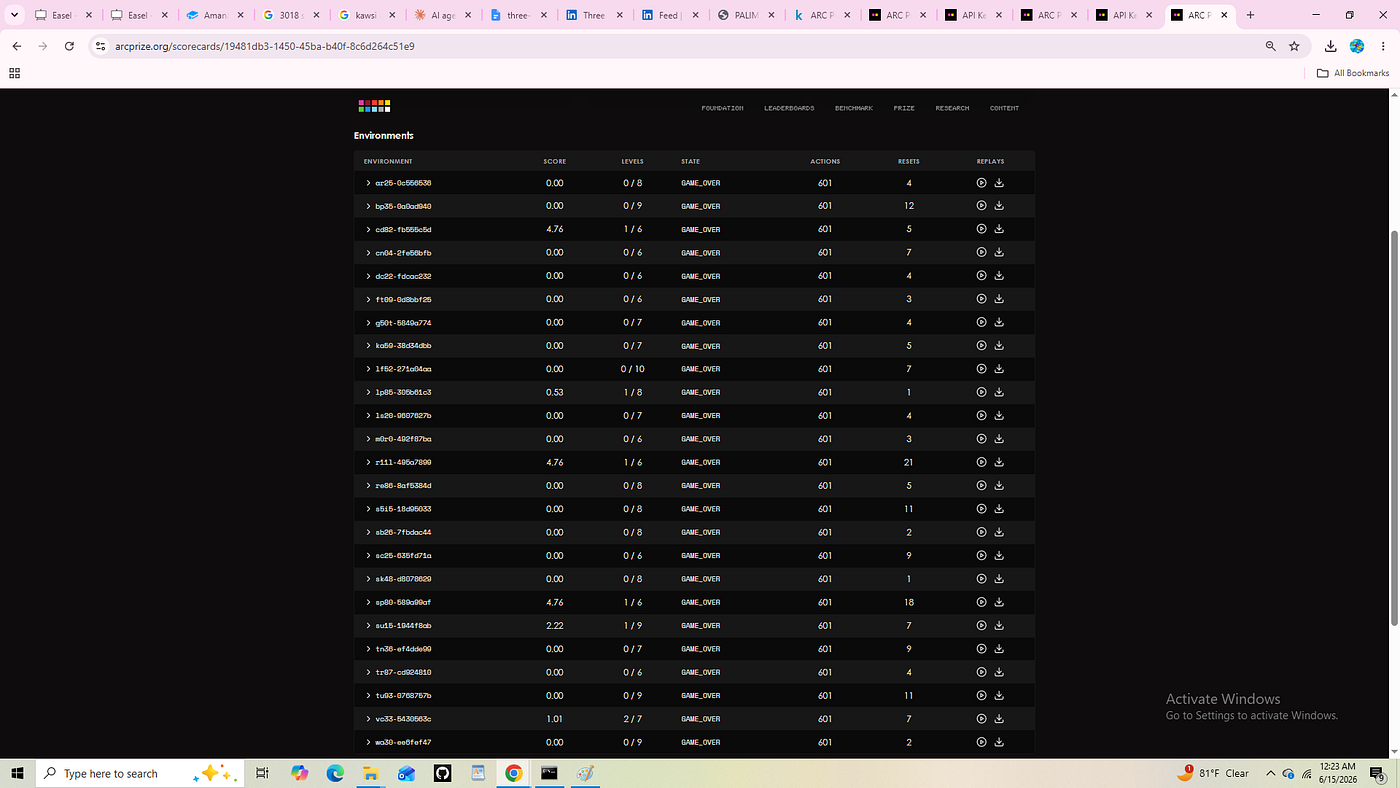
the official live leaderboard for the ARC-AGI-3 machine learning competition hosted on Kaggle (part…
The people and teams listed are artificial intelligence researchers, software engineers, and data scientists competing to solve François…
the official live leaderboard for the ARC-AGI-3 machine learning competition hosted on Kaggle (part of the ARC Prize 2026).
The people and teams listed are artificial intelligence researchers, software engineers, and data scientists competing to solve François Chollet’s Abstraction and Reasoning Corpus (ARC-AGI-3) benchmark. This specific version tests an AI agent’s ability to interactively explore novel grid-based environments, figure out rules, and solve them with human-like efficiency.
The leaderboard can be broadly divided into three distinct background types, each tackling the ARC puzzles with a different philosophy:
the official live leaderboard for the ARC-AGI-3 machine learning competition hosted on Kaggle (part of the ARC Prize 2026).
The people and teams listed are artificial intelligence researchers, software engineers, and data scientists competing to solve François Chollet’s Abstraction and Reasoning Corpus (ARC-AGI-3) benchmark. This specific version tests an AI agent’s ability to interactively explore novel grid-based environments, figure out rules, and solve them with human-like efficiency.
What the Data Columns Mean
- Rank (1, 2, 3…): The competitor’s current position in the global standings.
- Competitor Name: The username or team name (e.g., Tufa Labs — a prominent AI lab focused on ARC solvers, or Kamado Tanjiro — a popular pop-culture handle).
- Score (1.18, 0.68…): The team’s best performance evaluation metric.
- Entries (47, 20…): The total number of separate code submissions they have uploaded to test against the hidden evaluation set.
- Last Submission Time (2d, 1mo, 8h…): How long ago they last submitted code (e.g.,
2d= 2 days ago,1mo= 1 month ago).
Notable Competitors on this List
- Tufa Labs (Rank 1): An AI research lab explicitly dedicated to crack the ARC general intelligence benchmarks. They previously placed 3rd in the ARC Prize 2025 global competition and are leading this current leaderboard phase.
- StochasticGoose_v7_final (Rank 30): This is likely a submission variant by Tufa Labs or a related developer, as “StochasticGoose” is the designated code name for their reinforcement learning agent framework.
- Independent Researchers & Fun Usernames: Names like Winner Winner, BBQ Dinner, ARC-gasm, or [a-z A-Z] [1–9] are common Kaggle handles used by solo engineers or small groups entering the competition anonymously.
The notable names can be broken down into top AI research labs, legendary Kaggle competitors, and recognizable community members:
1. Top AI Labs & Research Institutions
- Tufa Labs (Rank 1): The current leader. They are a highly specialized AI research lab completely dedicated to solving general intelligence benchmarks (specifically the Abstraction and Reasoning Corpus). They are the creators of the StochasticGoose framework.
- 骐骥驰骋CreateAMind (Rank 18): A prominent Chinese AI research group/organization focused on AGI frameworks, cognitive architectures, and model reasoning.
2. Famous Kaggle Competitors & Grandmasters
- Yusaku Muroya (Rank 13): A legendary Japanese Kaggle Grandmaster. He is incredibly well-known in the data science community for dominating highly complex tabular, optimization, and reinforcement learning competitions.
- adakoda (Rank 41): Another highly active and seasoned Japanese developer and AI engineer with a long history of building specialized tools and competing on reasoning tasks.
3. Highly Active ARC Community Researchers
Several of these names are “regulars” who consistently rank near the top of the ARC-AGI-2 and ARC-AGI-3 tracks because they study the specific logic patterns required for these puzzles:
- Sanjay Dutt (Rank 12): A top-tier competitor across multiple ARC competition iterations, consistently holding a top spot on both the ARC-2 and ARC-3 leaderboards.
- Junhua Yang (Rank 42): A heavy-hitter in reasoning competitions, known for making an immense number of submissions (
74entries on this list) to meticulously iterate and fine-tune their reasoning engines. - Barada Sahu (Rank 3): Currently holding a podium spot with a very high efficiency rate (only 28 entries to hit a 0.66 score).
- . Mixed in among the company names and pop-culture handles are the real names of active software engineers, data scientists, and prominent AI researchers who choose to compete under their actual identity.
- Several notable real individuals on your list include:
1. Highlighted AI Leaders & Researchers
- Barada Sahu (Rank 3): A prominent tech entrepreneur and product leader based in Bengaluru, India. He is the CTO/CPO and co-founder of Mason (an AI-powered e-commerce shopping engine) and has a deep background in building enterprise-scale architectures.
- Halla Yang (Rank 213): A brilliant Machine Learning Researcher and Kaggle Grandmaster. He is highly active in cutting-edge AI breakthroughs and reasoning challenges, having placed at the top of the Vesuvius Challenge (using ML to read ancient carbonized scrolls) and Stanford’s RNA 3D Folding challenges. He actively publishes research on AI reasoning engines and quantitative finance.
2. Other Verified Real Engineers on this List
- Kevin E R Miller (Rank 4): A professional software engineer and AI practitioner.
- Matthew Philip Poetker (Rank 6): A data engineer who specializes in building custom algorithmic pipelines.
- Dhanashree Chavan (Rank 11): An Indian AI engineer and technical writer who frequently blogs about the evolution of the AI market and neural network techniques.
- Yusaku Muroya (Rank 13): As mentioned earlier, a prominent Japanese data scientist and legendary Kaggle elite.
- Sergei Fironov (Rank 15): An experienced algorithmic developer and engineer who specializes in machine learning optimization.
- Sumit Pandey (Rank 24): A data scientist and machine learning software engineer.
- Marius Heuser (Rank 215): A dedicated AI researcher heavily involved in the Kaggle logic-puzzle space. He is highly active on the ARC-AGI-3 forums helping other developers debug their reinforcement learning setups.
Many of these individuals are using this exact leaderboard to showcase their engineering skills to top tech firms, as cracking ARC is widely considered one of the hardest milestones in modern AI.
Iconic Anime & Pop-Culture Monikers
Kaggle leaderboards are famous for top-tier engineers hiding behind joke names. On this specific snippet, you have:
- Kamado Tanjiro (Rank 8): Named after the main protagonist of the anime Demon Slayer.
- Winner Winner, BBQ Dinner (Rank 9): A play on the classic gaming phrase “Winner Winner, Chicken Dinner.”
- ARC-gasm (Rank 23): A humorous community pun on the “ARC” competition name.
The Pure Pragmatists & Kaggle Elite (e.g., Yusaku Muroya, Halla Yang)
- Their Background: Heavyweight data scientists, competitive coders, and Kaggle Grandmasters.
- Their Approach: They excel at extreme optimization, feature engineering, and hyperparameter tuning. They treat the leaderboard as an engineering problem — using fast, proven machine learning techniques, extensive cross-validation, and massive computational setups to iterate quickly (evident by teams with 50+ to 70+ submission entries).
- The Contrast: While these elite competitors focus on maximizing what currently works in standard machine learning to climb the ranks, independent researchers like Crow focus on building entirely new, unorthodox model architectures from scratch.
The Specialized AI Research Labs (e.g., Tufa Labs)
- Their Background: Well-funded, specialized corporate research teams.
- Their Approach: They throw dedicated infrastructure, reinforcement learning pipelines (like their StochasticGoose framework), and large team collaborations at the problem. They focus heavily on Test-Time Training (TTT) — forcing an AI model to learn “how to learn” the logic rules of a grid after it sees the test puzzle.
The Contrast: Tufa Labs relies on corporate-backed engineering pipelines and a team-based brute-force iteration strategy to keep their #1 spot.
Then we have (Christopher Athans Crow)
As a Systems Theorist Crow, an independent researcher, who operates as a solo architect. there are many different types of competitors on this leaderboard, that is why Christopher Athans Crow’s background stands out the most because he approaches the problem from a highly theoretical, interdisciplinary angle compared to the other top-tier players.
His Background: An independent AI architect and systems theorist who focuses on unconventional, frontier-level neural design. Rather than relying purely on standard deep learning, his work heavily integrates neuroscience, physics, topology, and distributed systems.
His Approach: He is known for designing highly complex, custom frameworks (such as physics-regularized temporal networks, holographic memory systems, and high-dimensional learning models). He heavily advocates for “Agentic AI” — building tools like custom Model Context Protocol (MCP) servers to give AI agents real-time contextual data so they can reason dynamically rather than relying on static training.
Why (0.30 Baseline): In competitions like ARC, highly experimental, theoretical architectures often take massive amounts of baseline tuning just to get them to output valid answers. While the pragmatic Kagglers use highly optimized, established code to squeeze out immediate high scores, architects like Crow use the leaderboard as a live testing ground for experimental AI frameworks to see if their theories hold up under strict, general intelligence constraints.
For a deeper dive into how this specific benchmark was developed and what it aims to solve, you can check out this ARC Prize 2025 Top Score Interview with MindsAI @ Tufa Labs. This video features the top engineers from Tufa Labs discussing the exact kind of test-time training pipelines and agent architectures used to top leaderboards
메타데이터
- post_id
- 06dbe491c8dc
- slug
- the-official-live-leaderboard-for-the-arc-agi-3-machine-learning-competition-hosted-on-kaggle-part-06dbe491c8dc
- url
- https://medium.com/@ccro8990/the-official-live-leaderboard-for-the-arc-agi-3-machine-learning-competition-hosted-on-kaggle-part-06dbe491c8dc
- canonical_url
- https://medium.com/@ccro8990/the-official-live-leaderboard-for-the-arc-agi-3-machine-learning-competition-hosted-on-kaggle-part-06dbe491c8dc
- author_url
- https://medium.com/@ccro8990
- status
- ok
- fetched_at
- 2026-06-17 14:59:50