POWER DOES NOT GOVERN: IT PRODUCES CONTENT
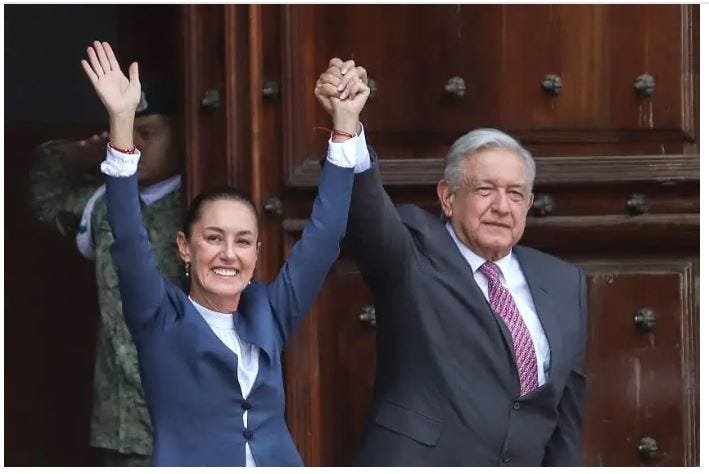
On February 13, 2026, Mexico National Palace ceased to function as the seat of the Executive Branch. It became a set.
POWER DOES NOT GOVERN: IT PRODUCES CONTENT
On February 13, 2026, Mexico National Palace ceased to function as the seat of the Executive Branch. It became a set.
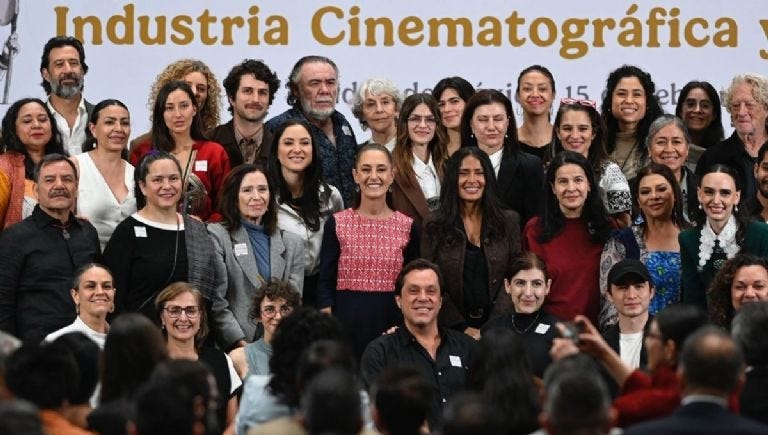
The scene was impeccable: President Claudia Sheinbaum and actress Salma Hayek announcing “Cinema in the City,” part of the Comprehensive Plan to Support National Cinema. There was no journalistic confrontation, no uncomfortable questions. There was framing, narrative, and lighting. There was a photograph designed to circulate.
The event can be read as cultural diplomacy. But observed through the contemporary logic of media power, it was something more precise: the production of political content.
Because power understood something fundamental: if you cannot govern, produce a narrative.
The Global Manual: Reuters 2026
What happened at the Palace is neither an isolated case nor a local extravagance. It is part of a mutation documented by the Reuters Institute’s Digital News Report 2026.
The report describes what it calls the “Trump 2.0 playbook”: a strategy replicated globally in which politicians, business leaders, and celebrities conclude they can bypass traditional media and communicate directly with their audiences through their own or allied channels.
The bypass is no longer the exception; it is the model.
The report notes that the combination of low trust in traditional media and declining engagement has led many leaders to opt for interviews with sympathetic podcasters, YouTubers, or celebrities rather than press conferences subjected to scrutiny. In parallel, narratives that discredit journalism — labeling it “fake news” — erode the role of mediation.
The data is staggering:
- 70% of editors are concerned that creators and influencers are capturing time and attention that previously belonged to the media.
- 39% fear losing editorial talent to the creator ecosystem.
- 76% say they will try to make their journalists behave more like creators.
- 50% plan to partner with creators to distribute content.
- 31% consider hiring them directly.
Trust is migrating from institutions to personalities. In this context, the question is not “Why Salma?” The correct question is: How is legitimacy transferred in the era of the creator economy?
Celebrity as a Strategic Asset
Celebrity is no longer a guest. It is an infrastructure of legitimation. When a figure with global emotional capital appears alongside a head of state, a silent transfer occurs:
- Transfer of trust.
- Transfer of prestige.
- Transfer of authenticity.
An audience that distrusts institutions may not trust a politician, but they do trust an actress they have admired for decades. That is the operation.
Power no longer governs. It produces emotional content. In the Palace photo, public policy wasn’t being reported; a message was being manufactured — designed to circulate without friction on social networks, replicable, shareable, and visually pleasant. In the terms of Reuters 2026, it is the consolidation of political “owned media”: the control of the frame, the tone, and the channel.
Glamour replaces accountability.
Artwashing: When Culture Softens Power
Artwashing: the use of culture and artistic prestige to displace uncomfortable narratives or soften critical perceptions. It is not about claiming that supporting cinema is illegitimate. It is about observing the political function of the spectacle.
While the country faces persistent violence figures, budgetary tensions, and transparency issues, the image in circulation is that of a “love letter to Mexico.” A vague, emotional phrase, difficult to object to. Culture, in this model, is not just artistic promotion. It is a reputational management device.
And this operation is reciprocal. For the government, Salma Hayek’s presence brings instant symbolic capital. For the celebrity, the return to the Palace updates her narrative of social commitment and connection to the country.
But when one observes the money framework, the romanticism disappears.
From the Frame to the Contracts
The relationship of the Hayek family with economic power structures in Mexico is not a social media rumor; it has been documented by journalistic investigations, including those of National Journalism Award winner Edgar Hernández.
According to these investigations, the family group linked to the Hayeks and their allies — including the Quintanilla clan — has seen a 1,958% growth in recent years in projects related to public infrastructure.
The examples are concrete:
- In Dos Bocas, the company Grupo Huerta Madre, linked to Arturo Quintanilla Hayek, received contracts worth nearly 5 billion pesos for the conditioning of the refinery.
- In Salina Cruz, Gravas del Sureste obtained 305 million pesos for the reinforcement of commercial docks.
- Companies associated with this network have been flagged and even debarred in contractual contexts during the pandemic.
Here, the analysis changes tone. The photograph is no longer just culture. It is environment. When active economic networks exist between business families and the major projects of the administration, the joint public appearance takes on another dimension. It does not prove automatic guilt, but it does show a convergence of material and symbolic interests.
The spectacle does not replace the contract. It accompanies it.
Structural Mutation
What we saw at the Palace is a Mexican version of a global trend: leaders who strengthen their direct presence on social networks, create podcasts, build their own platforms, and minimize the role of the traditional press.
Reuters warns that it could even be a matter of time before heads of state consolidate their own regular digital shows to communicate without filters. The logic is clear: less mediation, more narrative control.
The problem is not the technology. It is the asymmetry. When power controls the channel, the frame, and the emotional capital of the celebrity, oversight becomes peripheral.
We are not facing the end of journalism. We are facing the expansion of power as a cultural producer. And therein lies the fundamental point: contemporary politics does not only manage budgets. It manages attention.
The Scenarios of the “New Elitist Cinema”
The new cinema law and tax incentives are not the future of Mexican art; they are the institutionalization of this exchange of favors. If this Artwashing trend continues, the future holds two alarming scenarios:
- The “Cultural Services Cartel”: Tax incentives will stop being for the filmmaker shooting in the mountains with bare hands. They will become a financial engineering mechanism so that production companies linked to construction and energy giants (the usual families) can return capital under the guise of “industry promotion.” Cinema will be the laundry for steel and concrete.
- Tenders by Glamour: A standard will be normalized where obtaining strategic contracts (pipelines, ports, refineries) includes an unwritten clause of “image management.” Beneficiary families will act as propaganda ambassadors, shielding corruption scandals behind a curtain of gala events and free screenings.
2026 and the Laboratory of the Spectacle
The model that combines the State, celebrity, and direct content production is not anecdotal. It is the dominant architecture of current media power.
And 2026 will be a fertile year to observe it amplified on major global stages where spectacle and authority merge without friction. The question is no longer whether power uses culture. That has always happened.
The question is: who audits the spectacle when the spectacle replaces debate? Because when power becomes a content producer, democracy competes against an algorithm.
And in that competition, the perfect photo usually beats the uncomfortable question.
메타데이터
- post_id
- 06ddb7223813
- slug
- power-does-not-govern-it-produces-content-06ddb7223813
- url
- https://medium.com/@afbp26/power-does-not-govern-it-produces-content-06ddb7223813
- canonical_url
- https://medium.com/@afbp26/power-does-not-govern-it-produces-content-06ddb7223813
- author_url
- https://medium.com/@afbp26
- status
- ok
- fetched_at
- 2026-06-23 03:48:11