AI-Augmented Test Automation: Turning QA Data into Intelligent Test Decisions
Traditional test automation was built to execute predefined scripts and validate expected outcomes. While this approach improved speed and…
AI-Augmented Test Automation: Turning QA Data into Intelligent Test Decisions
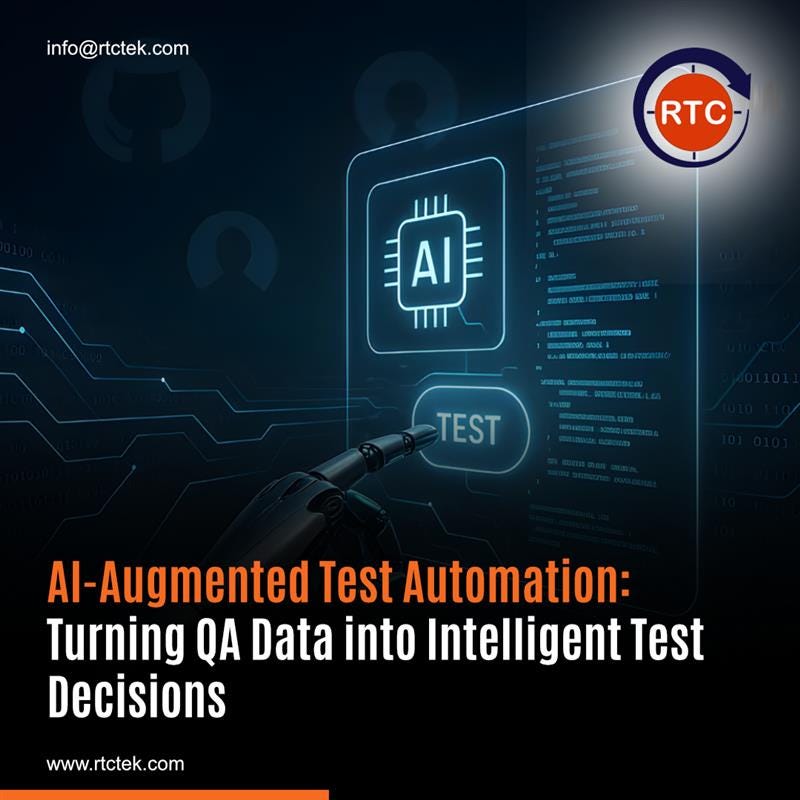
AI-Augmented Test Automation: Turning QA Data into Intelligent Test Decisions
Traditional test automation was built to execute predefined scripts and validate expected outcomes. While this approach improved speed and consistency, it failed to adapt to the growing complexity of modern digital systems. Today’s applications are cloud-native, API-driven, microservices-based, and released continuously. In this environment, static automation alone is no longer sufficient.
Enter AI-augmented test automation a paradigm shift that transforms raw QA data into actionable intelligence. Instead of merely executing tests, AI-enabled systems analyze historical data, learn from patterns, predict risk, and guide testing decisions. This evolution marks the transition from automation as a tool to quality engineering as an intelligent system.
Why Traditional Test Automation Is Reaching Its Limits
Before understanding the value of AI augmentation, it is important to recognize the limitations of conventional test automation.
Script-based automation relies heavily on:
- Fixed test cases
- Hard-coded assertions
- Manual prioritization
- Reactive defect detection
As applications change frequently, automation suites become brittle, expensive to maintain, and increasingly disconnected from real risk. Test teams often execute thousands of tests without clarity on which ones actually protect the business.
AI-augmented automation addresses this gap by using QA data to guide what to test, when to test, and how deeply to test.
Understanding AI-Augmented Test Automation
AI-augmented test automation does not replace testers or traditional frameworks. Instead, it enhances them by applying machine learning, analytics, and pattern recognition to testing data.
The goal is to convert large volumes of QA signals — test results, defect history, code changes, production issues — into insights that improve test effectiveness. AI becomes a decision-support layer that continuously learns from the system under test and its quality outcomes.
This approach enables testing to become:
- Predictive instead of reactive
- Risk-driven instead of exhaustive
- Adaptive instead of static
QA Data: The Untapped Asset in Testing Organizations
Most QA teams already generate massive amounts of data, but very little of it is used strategically.
Common QA data sources include:
- Test execution logs
- Pass/fail trends
- Defect density and severity
- Code change history
- Requirements volatility
- Production incidents
- Performance and monitoring data
Without intelligence, this data remains fragmented and underutilized. AI-augmented testing turns these signals into context-aware insights that guide test planning and execution.
Intelligent Test Case Prioritization
One of the most impactful applications of AI in test automation is test prioritization.
Instead of running all tests for every release, AI models analyze historical patterns to identify:
- Tests that frequently fail
- Areas with high defect density
- Modules impacted by recent code changes
- Features linked to production issues
Based on this analysis, tests are dynamically prioritized to maximize risk coverage within limited execution windows. This significantly reduces test cycle time while increasing confidence in release quality.
Predictive Defect Detection and Risk Forecasting
AI-augmented test automation enables teams to predict where defects are likely to occur before they are discovered.
By correlating test failures, defect trends, and code changes, AI models can:
- Flag high-risk modules
- Predict defect-prone components
- Highlight unstable integrations
- Recommend deeper testing for specific features
This predictive capability allows QA teams to focus effort where it matters most, rather than spreading resources evenly across low-risk areas.
Self-Healing Test Automation
Automation maintenance is one of the biggest challenges in traditional test frameworks. Minor UI changes often break dozens of tests, leading to wasted effort and reduced trust in automation.
AI-powered self-healing automation addresses this problem by:
- Detecting changes in locators and UI elements
- Automatically updating test scripts
- Learning alternative element identification strategies
This reduces false failures, lowers maintenance costs, and keeps automation suites reliable even in fast-changing environments.
Intelligent Test Data Management
Test data is critical to automation success, yet it is often static, incomplete, or unrealistic.
AI-augmented testing improves test data management by:
- Generating realistic test data based on production patterns
- Identifying data gaps that reduce coverage
- Masking sensitive information intelligently
- Recommending data variations based on risk
Smarter test data leads to more meaningful test outcomes and fewer surprises in production.
AI-Driven Exploratory and Autonomous Testing
Beyond scripted automation, AI enables autonomous exploratory testing.
AI agents can:
- Navigate applications dynamically
- Discover new workflows
- Identify unexpected behavior
- Learn from application responses
This approach complements human exploratory testing by continuously probing the system for anomalies, especially in complex or highly dynamic applications.
Integrating AI-Augmented Testing into CI/CD Pipelines
For AI-augmented test automation to deliver real value, it must be embedded into continuous delivery pipelines.
In CI/CD environments, AI helps by:
- Deciding which tests to run per commit
- Adjusting coverage based on risk signals
- Providing real-time feedback to developers
- Preventing high-risk builds from progressing
Testing becomes an adaptive quality gate rather than a fixed checklist.
From Test Results to Intelligent Test Decisions
The true power of AI-augmented automation lies in decision-making.
Instead of asking: “Did the tests pass?”
Teams begin asking:
- Is this build safe to release?
- Where is the highest quality risk?
- What should be tested next?
- How confident are we in production stability?
AI transforms test execution data into strategic insights that support release decisions at scale.
Governance, Trust, and Human Oversight
AI in testing must be transparent and explainable. Blind automation without human oversight introduces new risks.
Successful adoption requires:
- Clear governance models
- Human validation of AI recommendations
- Continuous model tuning
- Ethical and responsible AI usage
AI augments human expertise it does not replace it.
Business Benefits of AI-Augmented Test Automation
Organizations adopting AI-augmented testing experience:
- Faster release cycles
- Reduced test execution time
- Lower automation maintenance costs
- Improved defect prevention
- Higher release confidence
- Better alignment between QA and business risk
Quality becomes proactive, data-driven, and scalable.
How Round The Clock Technologies Helps Deliver AI-Augmented Test Automation
Round The Clock Technologies helps organizations transition from traditional automation to intelligent, AI-augmented quality engineering.
Engagements begin with an assessment of existing automation maturity, QA data availability, and release of challenges. AI-driven analytics are introduced to identify patterns in test execution, defect trends, and production issues.
Round The Clock Technologies integrates AI-augmented capabilities such as:
- Intelligent test prioritization
- Predictive risk analysis
- Self-healing automation frameworks
- AI-assisted test data generation
These capabilities are seamlessly embedded into CI/CD pipelines to support continuous delivery at scale.
In addition to tooling, teams receive guidance on governance, model validation, and operational adoption ensuring AI enhances trust rather than introducing uncertainty.
The focus remains on turning QA data into actionable intelligence that improves release of confidence and long-term quality outcomes.
Conclusion
AI-augmented test automation represents the next evolution of quality engineering. By transforming QA data into intelligent test decisions, organizations move from reactive defect detection to proactive quality assurance.
In an era of rapid releases and complex systems, intelligence not execution volume defines testing success.
메타데이터
- post_id
- 07029bffe35f
- slug
- ai-augmented-test-automation-turning-qa-data-into-intelligent-test-decisions-07029bffe35f
- url
- https://medium.com/@rtctek_/ai-augmented-test-automation-turning-qa-data-into-intelligent-test-decisions-07029bffe35f
- canonical_url
- https://medium.com/@rtctek_/ai-augmented-test-automation-turning-qa-data-into-intelligent-test-decisions-07029bffe35f
- author_url
- https://medium.com/@rtctek_
- status
- ok
- fetched_at
- 2026-06-22 05:41:33