10 Common SEO Myths Business Owners Must Stop Believing
Search engine optimization has been around for years, yet confusion around it is still everywhere. Business owners often hear mixed…
10 Common SEO Myths Business Owners Must Stop Believing
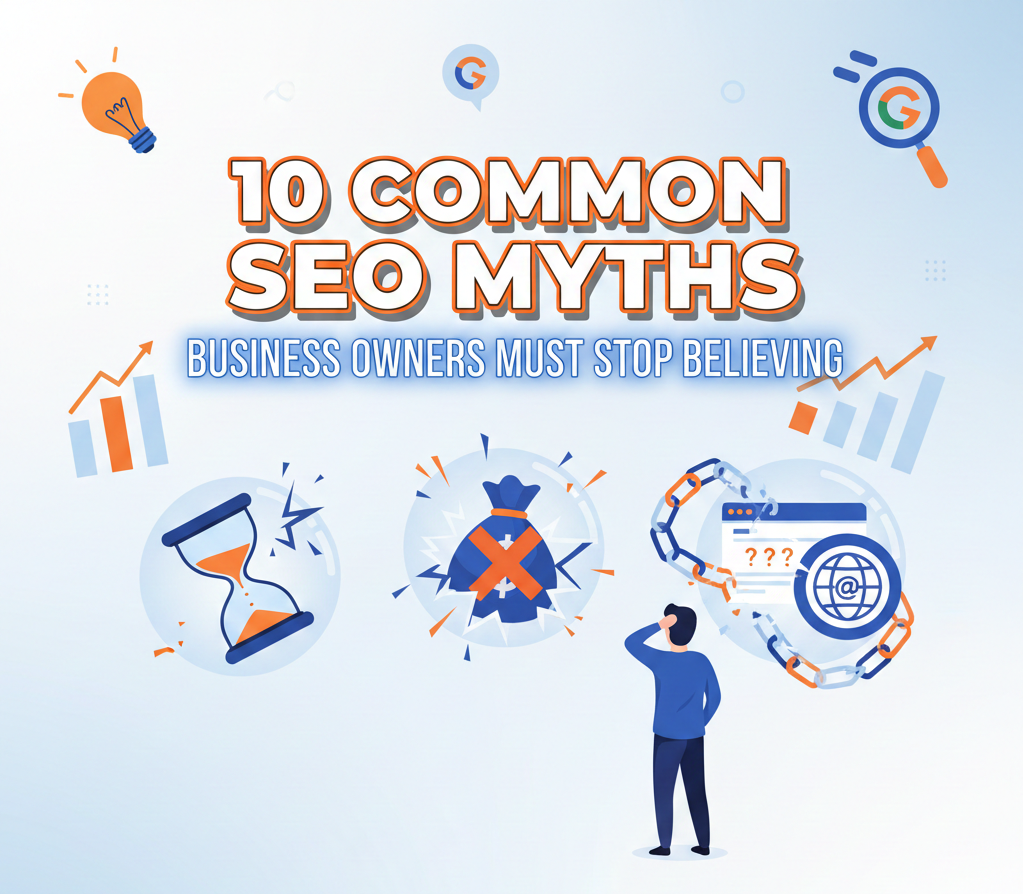
Vibrant illustration debunking 10 common SEO myths business owners must stop believing, featuring exploding icons like time, cost, and chains.
Search engine optimization has been around for years, yet confusion around it is still everywhere. Business owners often hear mixed opinions. One person says SEO is dead. Another says it is all about keywords. Someone else promises instant rankings for a low price. Over time, these ideas turn into myths that quietly shape decisions and slow down real growth.
SEO today is not mysterious or magical. It is practical, user-focused, and closely tied to how people search and make decisions online. When myths guide strategy, businesses either overpay, underinvest, or expect results that were never realistic in the first place.
This article breaks down the most common SEO myths that business owners still believe and explains what actually works today in simple language. Let us start with the biggest misunderstanding of them all.
Why SEO Myths Still Exist And Why They Are Costly
SEO has been around long enough that most business owners have heard of it, but not long enough for everyone to truly understand how it works today. This gap is exactly why SEO misconceptions continue to spread and quietly influence decisions that affect visibility, traffic, and revenue.
The Internet Is Full of Outdated Advice
A major reason SEO myths still exist is that old information never really disappears online. Blog posts written years ago still rank. Videos based on outdated tactics still get views. Advice that once worked gets repeated without context.
Search engines change faster than public understanding
Search engines evolve constantly, but most people do not track those changes closely. When something worked in the past, it often gets treated as a permanent rule. Over time, these rules turn into myths, even though search behavior and ranking systems have moved on.
Quick Wins Sound More Appealing Than Long-Term Strategy
SEO myths often promise shortcuts. Faster rankings. Guaranteed results. Minimal effort. These ideas are attractive, especially to busy business owners who want clarity and certainty.
Why oversimplified SEO advice spreads so easily
SEO is nuanced, but myths make it sound simple. Phrases like just add keywords or links do all the work feel easy to understand. Unfortunately, oversimplified advice usually leaves out the parts that actually matter, like user intent, content quality, and consistency.
The Real Cost of Believing SEO Myths
The biggest issue with SEO misconceptions is not confusion. It is the cost of acting on them.
When SEO is misunderstood, businesses may invest in tactics that do nothing. They may stop too early because results take time. Some may chase cheap solutions that lead to penalties or wasted effort. Others may avoid SEO altogether, assuming it no longer works.
The cost is not just financial. It shows up as lost traffic, missed opportunities, and slower growth compared to competitors who follow realistic strategies.
Understanding why these myths exist makes it easier to challenge them. And once those myths are questioned, it becomes clear why the next one is so common: the belief that SEO is only about keywords.
Myth 1: SEO is a one-time setup
One of the most common beliefs is that SEO is something you do once and then forget about. Many business owners assume that after optimizing a website, adding keywords, and publishing a few pages, the job is done. Rankings should just stay there on their own.
Search engines are constantly updating how they rank content. Competitors keep publishing new pages. User behavior changes over time. What worked six months ago may not work as well today. That is why SEO is an ongoing SEO process, not a one-time task.
Think of SEO like maintaining a storefront. You do not clean it once and expect it to look good forever. You adjust displays, update signs, and respond to customer behavior. A website works the same way. Content needs updates. Pages need improvements. Technical issues appear and need fixing.
Another reason this myth exists is that early SEO tactics were much simpler. Years ago, adding keywords and getting a few links could move rankings quickly. Today, search engines look at content quality, user experience, page performance, and how helpful your site actually is.
When SEO is treated as a one-time setup, results usually fade. Rankings slip slowly, traffic declines, and it becomes harder to recover later. Businesses then assume SEO stopped working, when in reality it was simply left unattended.
A steady approach does not mean constant major changes. It means checking performance, improving content when needed, and staying aligned with how people search. This mindset sets the foundation for understanding why many other SEO myths exist, including the belief that keywords alone drive success.
Myth 2: SEO Is Only About Keywords
For a long time, SEO was treated as a keyword game. Find the right phrases, place them on a page, and expect rankings to follow. While keywords still matter, this approach no longer reflects how search engines work today.
Why Keywords Alone Are Not Enough
Search engines do not rank pages just because certain words appear on them. They rank pages based on whether the content actually matches what people are trying to find.
Search intent matters more than exact wording
Search intent refers to the reason behind a search. Someone may use a keyword, but what they really want is an answer, guidance, or a solution. Pages that understand and meet that intent tend to perform better than pages that simply repeat phrases.
Content Quality Plays a Bigger Role
Helpful, well-written content keeps people engaged and builds trust. If a page feels forced or written only for rankings, users leave quickly, and search engines notice.
Keywords should guide the topic, not control the message. Once that distinction is clear, it becomes easier to see why many people mistakenly believe that SEO no longer works at all, which leads directly into the next myth.
Myth 3: SEO Is No Longer Relevant
Every few years, someone declares that SEO is no longer relevant. This usually happens after a major algorithm update or the rise of a new marketing trend. The truth is simpler. SEO did not disappear. It changed.
Why People Think SEO No Longer Works
Search results look different today. Ads appear more often. Social platforms compete for attention. This makes it feel like organic visibility is shrinking, even though organic search traffic still drives a large share of website visits.
SEO evolved; it did not stop
Modern SEO focuses less on tricks and more on usefulness. Pages that answer real questions, load well, and feel trustworthy continue to perform. Businesses that adapt to these changes usually see steady growth over time.
SEO is not dead. Outdated SEO tactics are. And that misunderstanding often leads to the next myth, the idea that more traffic always means better results.
Myth 4: More Traffic Means Better SEO
Traffic looks impressive in reports, but not all traffic is valuable. Thousands of visits mean little if no one takes action.
Quality Traffic Over Volume
SEO works best when it attracts the right people. A smaller audience that converts is more valuable than a large numbers that leave quickly.
Search engines measure engagement. Pages that satisfy users tend to perform better. Focusing only on traffic often leads to content that ranks briefly but delivers no real return.
This misunderstanding leads many to expect guaranteed rankings, which is the next myth.
Myth 5: SEO Guarantees Number One Rankings
Some believe SEO comes with certainty. Do the work and rankings will be guaranteed. This is not how search engines operate.
Why Rankings Cannot Be Promised
Search results depend on many factors outside any single control. Algorithms change. Competitors improve. User behavior shifts.
SEO increases visibility and opportunity, not certainty. Real success is measured through growth in relevant traffic, engagement, and conversions, not a single position.
When expectations are unclear, businesses often compare SEO to ads, leading to another myth.
Myth 6: Paid Ads Are Better Than SEO
Paid advertising often feels more appealing than SEO because results appear immediately. You launch a campaign, traffic shows up the same day, and it feels predictable. This leads many business owners to assume paid ads are simply better than SEO.
Why Ads Feel More Reliable at First
Ads provide control. You choose the budget, targeting, and messaging. As long as money is being spent, visibility continues. This makes ads seem safer, especially for short-term goals.
The downside of relying only on ads
The moment ad spend stops, traffic disappears. There is no residual benefit. Every click has a cost, and over time, those costs often increase due to competition.
How SEO Supports Long-Term Growth
SEO focuses on building long-term visibility. When a page ranks well, it can attract visitors for months or even years without ongoing ad spend. This makes SEO a strong foundation rather than a quick fix.
SEO and ads are not competitors. They serve different roles. Ads support immediate needs, while SEO builds trust and consistency. Confusing the two often leads to frustration, especially when cost becomes the next concern.
Myth 7: SEO Is Too Expensive for Small Businesses
SEO is often labeled as expensive because pricing varies widely. Without context, it can feel unclear or even intimidating for smaller businesses.
Understanding What SEO Costs Actually Cover
SEO pricing depends on competition, scope, and goals. It includes research, content creation, technical improvements, and ongoing optimization. These are not one-time efforts.
How much does it cost to do SEO
Many small businesses invest anywhere from 500 to 3000 USD per month, depending on their needs. Some require less. Others need more. The key factor is alignment with business goals, not the lowest price.
If you are trying to understand **how much it costs to do SEO**, the answer usually depends on your goals, competition, and how much ongoing work your website actually needs.
SEO as an Investment, Not an Expense
Unlike one-time marketing costs, SEO builds value over time. Pages improve. Authority grows. Traffic becomes more consistent. When viewed this way, SEO becomes less about cost and more about return.
This misunderstanding often pushes businesses toward cheap alternatives, which brings us to the next myth.
Myth 8: Cheap SEO Services Deliver the Same Results
Cheap SEO often promises fast results, guaranteed rankings, or large numbers of links. These offers sound appealing, especially when budgets are tight.
Why Cheap SEO Often Fails
Low-cost services usually rely on shortcuts. Automated content, weak links, or outdated tactics may create short spikes but rarely last.
The hidden cost of low-quality SEO
Search engines are good at identifying manipulation. When shortcuts are used, rankings drop or disappear. Fixing the damage later often costs more than doing SEO correctly from the start.
Sustainable SEO Takes Time and Care
Good SEO focuses on relevance, clarity, and usefulness. It builds slowly but lasts longer. Cheap SEO focuses on speed, not stability.
Backlinks are often the focus of cheap strategies, which leads to another common myth.
Myth 9: Backlinks No Longer Matter
Some believe backlinks are no longer important. Others think more links always mean better rankings. Both views miss the real point.
Why Backlinks Still Matter
Backlinks act as trust signals. When credible sites reference your content, it shows search engines that your page has value.
Quality matters more than quantity
A few relevant, meaningful links can outperform dozens of low-quality ones. Links should make sense within content, not exist just to manipulate rankings.
Links Support Content, They Do Not Replace It
Backlinks cannot compensate for weak content. They work best when paired with pages that are genuinely useful.
When backlinks are misunderstood, businesses often believe SEO can be paused once rankings improve, which leads to the final myth.
Myth 10: Once SEO Works, You Can Stop
When rankings improve and traffic increases, it is tempting to pause SEO efforts. Many business owners assume success means the work is done.
Why SEO Results Do Not Last Forever
Search behavior changes. Competitors improve. Content becomes outdated. Without ongoing attention, rankings slowly decline.
What happens when SEO stops
Pages lose relevance. Technical issues go unnoticed. New competitors take space in search results. The drop is often gradual, which makes it easy to miss until traffic falls significantly.
Consistency Is What Protects Growth
SEO maintenance does not mean constant changes. It means reviewing performance, updating content when needed, and staying aligned with how users search.
SEO works best when treated as a long-term strategy. Understanding this brings clarity to every myth discussed and ties the entire approach together.
How to Approach SEO the Right Way as a Business Owner
After clearing away common SEO myths, the next step is understanding how to approach SEO with the right mindset. SEO works best when it is treated as a business strategy, not a shortcut or a checklist.
Setting Realistic SEO Expectations
SEO does not produce overnight results, and it does not follow a fixed timeline. Some improvements appear within weeks, while others take months, depending on competition, industry, and existing website strength.
Realistic expectations focus on progress rather than instant wins. Early signs of success often include better engagement, improved visibility for relevant searches, and gradual traffic growth. Rankings and conversions usually follow later.
When SEO is approached with patience and consistency, it becomes easier to measure success accurately and avoid disappointment caused by unrealistic promises.
Choosing the Right SEO Partner or Strategy
There is no single right way to do SEO. Some businesses handle it internally, others work with specialists, and many use a mix of both. What matters is clarity around the approach being used.
A good SEO strategy is transparent. It explains what is being done, why it matters, and how progress is tracked. Whether work is done in house or externally, SEO should feel understandable, not confusing or hidden behind vague reports.
When the strategy makes sense, it becomes easier to stay consistent and avoid falling back into common myths.
Aligning SEO With Business Goals
SEO should never exist on its own. It should support real business goals such as lead generation, sales, brand visibility, or customer education.
Content, keywords, and optimization efforts work best when they reflect what the business actually wants to achieve. Traffic alone is not the goal. The right traffic that takes action is.
When SEO aligns with business goals, results feel more meaningful and easier to evaluate over time. This alignment also helps protect against chasing trends or tactics that do not serve long-term growth.
Conclusion
SEO myths continue to exist because SEO itself has changed. Many ideas that once worked no longer apply, yet they are still repeated without context. When business owners rely on these myths, they often misjudge timelines, costs, and results.
The reality is simpler. SEO works when it focuses on people, not tricks. It rewards consistency, clarity, and usefulness. It grows gradually, but the results tend to last.
By understanding what SEO really is and what it is not, businesses can make smarter decisions, set better expectations, and build visibility that supports long-term success rather than short-lived wins.
메타데이터
- post_id
- 0722ea4f25af
- slug
- common-seo-myths-business-owners-0722ea4f25af
- url
- https://medium.com/@webyking/common-seo-myths-business-owners-0722ea4f25af
- canonical_url
- https://medium.com/@webyking/common-seo-myths-business-owners-0722ea4f25af
- author_url
- https://medium.com/@webyking
- status
- ok
- fetched_at
- 2026-07-15 09:55:02