Toxic Tides: When Ocean Warming Reaches Your Plate
Red and green tides respond to a warming ocean in opposite ways, and the poison that reaches your plate shifts with them.
Toxic Tides: When Ocean Warming Reaches Your Plate
Red and green tides respond to a warming ocean in opposite ways, and the poison that reaches your plate shifts with them.
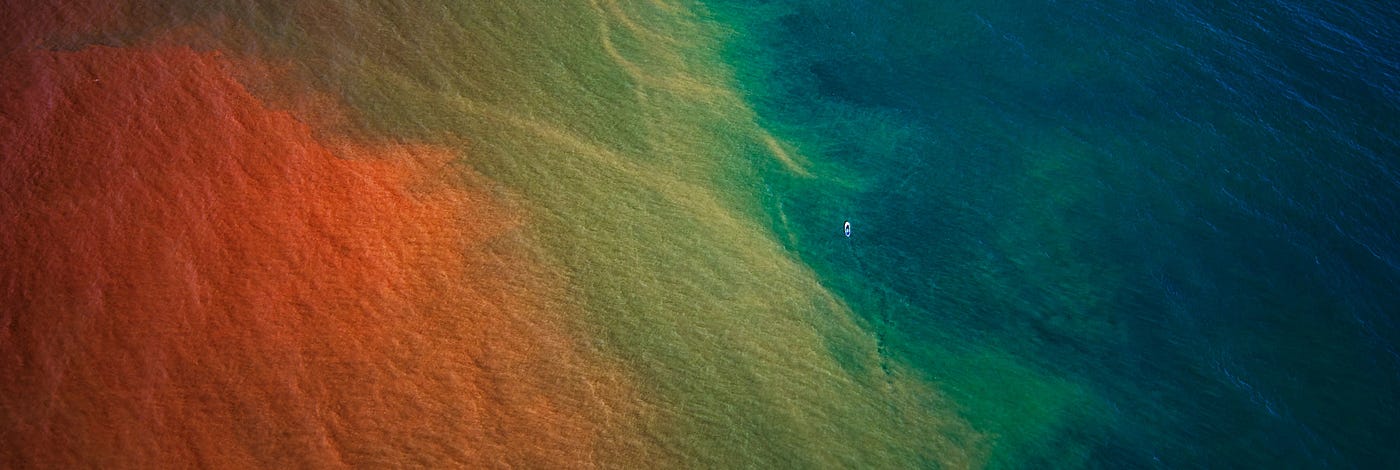
Photo by Red Zeppelin on Pexels.
On 18 August 1961, a little before three in the morning, the people of Capitola woke to a sound like hail on the roof. It was not hail. Thousands of sooty shearwaters, seabirds that spend almost their whole lives gliding far out over the Pacific, were dropping out of the fog and slamming into the houses along the shore east of Santa Cruz. They broke windows, lurched through the streets, and threw up anchovies on the lawns. By dawn the roads were strewn with dead and stunned birds.
A film director who happened to be staying nearby read the account in the Santa Cruz Sentinel and rang the paper for more. Two years later, Alfred Hitchcock released The Birds.
For half a century nobody could say what had driven the shearwaters out of their minds. The answer arrived in 2012, when Sibel Bargu and her colleagues reached back into archived plankton samples collected in Monterey Bay during those same weeks of 1961 and found that toxin-producing diatoms, microscopic algae, made up most of what the local food web had been feeding on. The birds had gorged on anchovies laced with domoic acid, a neurotoxin that scrambles the nervous system.
They weren’t hell-bent on revenge. They had simply been poisoned. But the horror Hitchcock filmed had a chemical author, and it climbs the same food chain that ends on a dinner plate.
From the birds to us
The diatom behind the Capitola deaths belongs to a loose company of organisms we file under ‘harmful algal blooms’; the population explosions of microscopic algae when the water suits them. Most algae are harmless and feed half the ocean. A few build toxins, and when those few multiply fast enough, the poison piles up inside anything that filters seawater for a living, shellfish most of all.
The toxins sort into a handful of families, each named for what it does to a human nervous system. Paralytic poisoning, from the genus Alexandrium, can shut down the muscles you breathe with. Diarrhetic poisoning, from Dinophysis, empties you out for a day or two. Amnesic poisoning, the domoic acid that felled the shearwaters, wipes short-term memory and, in the worst cases, kills. It earned its name in 1987, when Canadians who had eaten contaminated mussels fell ill, a few died, and some survivors never got their memory back.
None of this is rare. Somewhere on a temperate coast, in most years, a monitoring lab counts too many of the wrong cells and the mussel harvest closes. The water looks the same as it did the week before. The mussel is not.

A beach sign on Florida’s Gulf coast during a red tide, the kind of notice that goes up when a bloom turns toxic and the shellfish stop being safe to eat. Photo by Florida-Guidebook.com on Unsplash.
The Blob
The clearest modern warning came from the very coast that handed Hitchcock his monster. Between 2014 and 2016 a huge patch of abnormally warm water, one of the largest marine heatwaves ever recorded, sat over the northeast Pacific, nicknamed the Blob. Beneath it, a diatom called Pseudo-nitzschia australis bloomed from central California to the Aleutians in the largest toxic event the West Coast had recorded in at least fifteen years.
The diatom pushed far north of its usual range and bloomed the length of the coast. By late May 2015 a sea lion was found convulsing on a Washington beach with domoic acid in its gut, something the state had never recorded before, and stranded marine mammals turned up all along the western seaboard, their brains scarred by a toxin that gives them a form of epilepsy. Ryan McCabe and his coauthors later tied the whole event, the largest domoic acid outbreak ever measured on the North American west coast, to the anomalous warmth itself.
The human cost came as closures. Crab boats stayed moored up for months. The Dungeness crab fishery, the region’s most valuable, lost around 97 million dollars in a single season, razor clam closures cost some 24 million more, and the damage ran deep enough to bring federal disaster declarations.
The story seemed to write itself. As the ocean warms, toxic algae spread. The year before the Blob, Christopher Gobler and his coauthors had shown that since 1982 the warming Atlantic had widened the window in which Alexandrium and Dinophysis can grow, nudging their range north across the band between roughly 40 and 60 degrees of latitude. The most recent assessment from the Intergovernmental Panel on Climate Change folds blooms into the same neat account of ranges sliding poleward and seasons stretching longer. Warmer sea, more poison. That is the kind of sentence that survives the trip from a journal to a headline intact. The Blob itself was natural variability rather than a fingerprint of warming, but it rehearsed the pattern, and the rehearsal is what makes the simple story so easy to tell.
When the warming and the poison stopped agreeing
A study led by Edson Silva at the Nansen Center in Bergen, Norway, published this year in Communications Earth & Environment, took fourteen years of weekly toxin counts from thirty-two stations along the Norwegian coast, fed them into machine-learning models of two of the most dangerous species, and asked what a sea three degrees warmer would do to each. Norway suits the question, a single coastline running from 58 to 71 degrees north, cold at the top and almost mild at the bottom.
The first surprise is that warmth does not pull in only one direction. Each species blooms inside a narrow temperature window. Dinophysis acuta, the diarrhetic one, peaks in water near 15 degrees. The Alexandrium tamarense complex, the paralytic one, favours something closer to 10 and falls away above 13. Warming stretches spring and autumn into the comfortable band, which adds blooms, while it also drives high summer past the upper limit, which takes them back.
Heat helps, until it doesn’t.

Fig. 1. Observed bloom frequency against temperature and salinity along the Norwegian coast, 2006–2019. Each species blooms in its own thermal window, and only A. tamarense depends on salty water. Data: Environmental Data Science, 2024. Created by the author with Python.
The second surprise is salt. The A. tamarense complex blooms only in salty water above circa 33 practical salinity units, while D. acuta tolerates almost any value. A warming northern sea is also a fresher one, because the water cycle speeds up, snow that once fell arrives as rain, and glaciers and swollen rivers pour more freshwater onto the coastal surface each spring. That freshening barely touches Dinophysis and starves Alexandrium of the salt it depends on. Two of the things climate change does to a high-latitude sea, warming it and freshening it, happen to pull these two poisons apart.
In a sea three degrees warmer, Silva’s models project the diarrhetic blooms of D. acuta climbing by up to half, while the paralytic blooms of the A. tamarense complex drop by as much as 40 percent.
One poison climbs. The other sinks.

Fig. 2. Projected annual harmful blooms along the Norwegian coast as the sea warms, across three climate models (band) and their median (bold). Diarrhetic-toxin blooms rise while paralytic-toxin blooms fall. Data: Communications Earth & Environment, 2025. Created by the author with Python.
The warmer Norwegian sea does not hand the coast more red tide. It hands it a different red tide, with a different toxin, on a different calendar. For a mussel farmer that reads as more days lost to the diarrhetic toxin, the kind that ruins a day or two, and fewer to the paralytic kind, which can shut down the muscles you breathe with and has killed people who ate the wrong shellfish. The danger changes its nature rather than shrinking, and a monitoring system built around the first poison now has to learn the second.
Why the simple story sticks
The reshuffling is easy to miss because the simple story goes down so smoothly. More carbon, more heat, more of everything bad, and blooms slot into the template that the template then sells back to us.
The data underneath are messier. In 2021 Gustaaf Hallegraeff and a global team combed through every recorded marine bloom from 1985 to 2018 and found that, once you correct for how much more closely we now watch the water, there is no uniform worldwide rise at all. Some regions climbed, others fell, and the direction turned on which species and which coast rather than on any planet-wide trend. Much of the apparent surge tracked the boom in coastal aquaculture and the monitoring that came with it, more nets in the water and more eyes on it, finding what was always there.
That does not make the danger imaginary. The Blob was real, the sea lions were real, the lost season was real. What the messy data kill is the slogan. Blooms answer to region, to species, to salinity and the far edge of a temperature curve, and they bend into shapes no single trend line can hold.
Knowing which species, which season, which stretch of coast, is the entire job, and it is the job the Bergen models were built to do.
A note from the back of the classroom
I have a small stake in those models. In the autumn of 2022, in a room at the University of Bergen, I taught advanced atmospheric dynamics to a handful of master’s students. Edson Silva sat among them.
Now his name leads the paper, and the equations I was chalking onto the board, the same ones that shove heat and moisture around a turning planet, have grown into a model that reads the future of a Norwegian mussel.
I spent those Bergen winters working my way through the local seafood without once stopping to ask which poison happened to be off duty that week. Ignorance keeps you warm. I lost mine over a plate of Bergen mussels. Now you have lost yours too.
The closures and disaster declarations in this piece are the monitoring system working, not failing. Commercial shellfish is tested before it reaches your plate, so keep eating the mussels, and believe the sign on the beach when it tells you not to. If this was worth your time, a clap or a share carries it further.
메타데이터
- post_id
- 076e2941b3af
- slug
- toxic-tides-when-ocean-warming-reaches-your-plate-076e2941b3af
- url
- https://medium.com/the-new-climate/toxic-tides-when-ocean-warming-reaches-your-plate-076e2941b3af
- canonical_url
- https://medium.com/the-new-climate/toxic-tides-when-ocean-warming-reaches-your-plate-076e2941b3af
- author_url
- https://medium.com/@bobzeraus
- status
- ok
- fetched_at
- 2026-06-28 04:42:08