Why NDVI doesn’t follow logistic growth?
Logistic growth is widely used to describe population dynamics. So it seems natural to compare it with NDVI based vegetation curves.
Why NDVI doesn’t follow logistic growth?
Logistic growth is widely used to describe population dynamics. So it seems natural to compare it with NDVI based vegetation curves.
But this comparison is fundamentally flawed.
what is logistic growth?
To understand this, we need to first understand what growth is?
The growth is increase in number or mass of cell, which require some initial number of cell i.e. (N) and ability to grow or multiply i.e. growing rate (r).
But if anything is allowed to grow at a given rate “r” then the growth will be exponential.

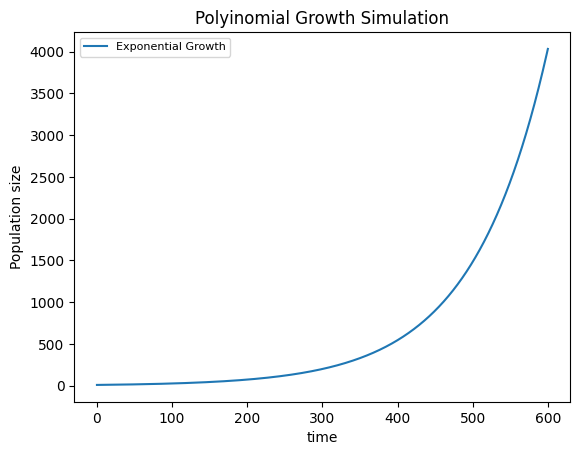
As we can see there is no upper bound of this growth but as we know in the nature there exist various constraints that limits the growth, these constraints are represented as linear approximation in the logistic growth i.e.
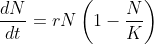
Where,
rN (non-linear growth contributor)
(1-N/K) (Linear density dependent constraint)
r= growing rate
N = initial population size
K = Carrying Capacity
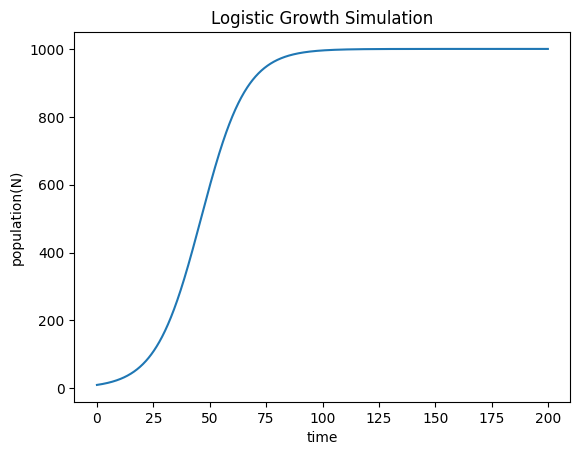
The logistic curve beautifully shows the upper bound the carrying capacity which limits the growth.
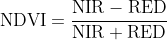
What is NDVI (Normalized Differential Vegetation Index)?
It is the normalized difference of NIR and RED light band, which is used as proxy for vegetation health.
The plant reflect the light of different wavelength differently as in case of red light it is primarily absorbed by photosynthetic pigments while NIR wavelength is scattering dominated and get scattered via cell air interface also via dense canopy.
Now as the amount of the density of plant increase the scattering of the NIR wavelength and the absorption of red wavelength increase but at a very high density the scattering saturates while having a minimal effect on absorption of red light as the light interaction with cell air interface maximize early as compared to photon absorption.
So NDVI saturates at higher density of vegetation thus showing a non-linear relationship with the density of vegetation. But the logistic consider the linear density dependent constraints while NDVI shows non-linear relationship so the linear constraint is not enough to demonstrate the relationship of the growth with NDVI. Let see if our theory also work under real world dynamics.
Testing with real world data:
We used the sentinel data to calculate NDVI of a wheat field in Palampur for 5 years from sowing till harvesting.

Then mean NDVI is calculated form multiyear seasonal growth.

Overlay analysis:
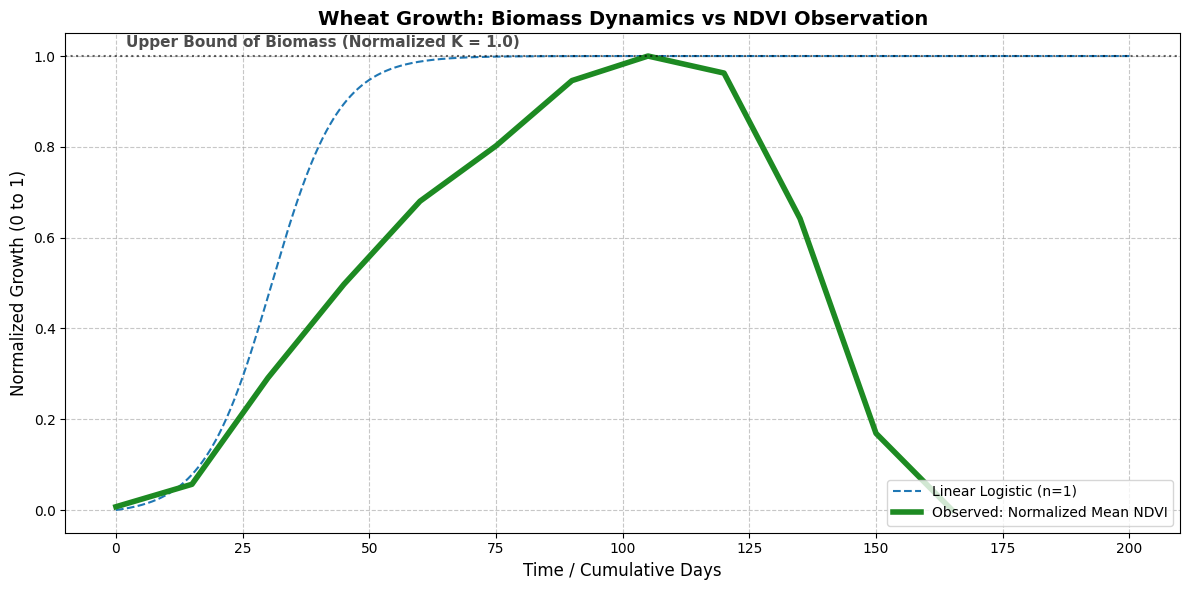
To test logistic growth vs. observed NDVI, we normalized both the theoretical growth curve and the multi-year seasonal NDVI average. Plotting them side-by-side to see the dynamics of NDVI along with theoretical growth curve.
Expected Mismatch:
The NDVI curve doesn’t align with the theoretical logistic curve as expected.
Attempt to fix Non-Linear constraint:
So I thought what if linear constraint is the problem here i.e. it is the Non-Linear constraint that is limiting the ‘NDVI’. So I tried to generalise the non-linear constraint in the logistic model i.e.
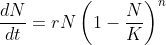
Where ’n’ is the strength of constraint:
For linear relationship n=1 and for non-linear relationship n>1
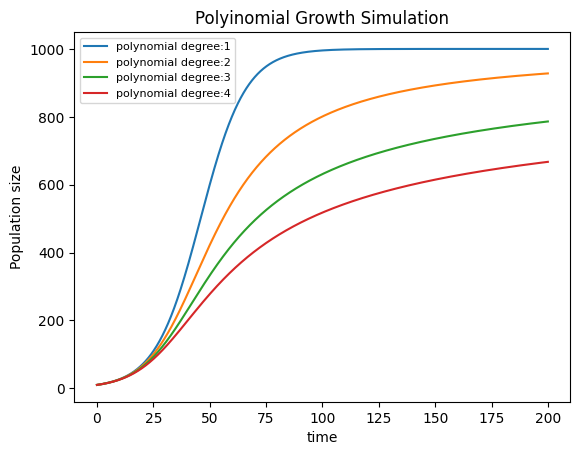
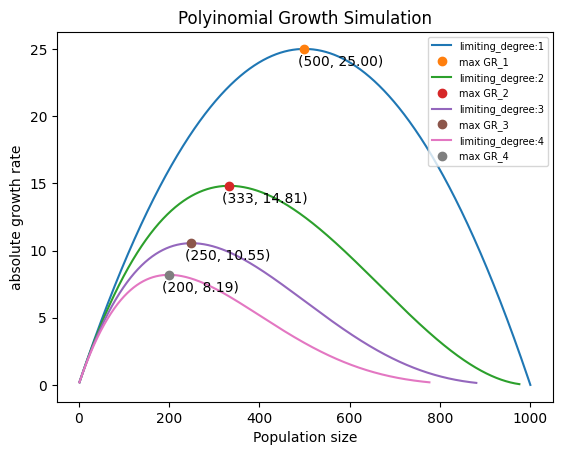
So how the system behaves now the stronger constraint delays the reaching of equilibrium (carrying-capacity) and the maximum growth rate possible in that ecosystem is decreasing while shifting it from K/2 in n=1 to less than K/2 in case of n>1 i.e. shifting the curve to the left.
More appropriately:

Now as we can see that the NDVI isn’t following the typical logistics curve:

Surprisingly it also doesn’t follows any Non-linear generalized constraint curve either. So what are we missing here, the onset of decline can be understood as external shock factor (harvesting, senescence or any other natural shock) which we didn’t include in our model but the ascent still doesn’t behave as our nonlinear growth curve.
THE REAL PROBLEM:
So it came in my mind why we are implying NDVI as Biomass or density of vegetation. Is NDVI even our variable to compare growth with? We are comparing a state variable with its transformed observation without defining the transformation.


As we can see now NDVI is the non-linear observation of state variable not state variable itself so the mismatch is expected.
So correct direction should be to first model NDVI theoretically from the biomass or the biomass from NDVI rather than comparing N directly with the observed NDVI.
The thing we learn here is that the mismatch between logistic growths isn’t the modelling issue but it is an observing issue.
The key insight i get is to keep in mind that the modelling isn’t just about equation. It is also about understanding what we are observing and what the system actually is?
메타데이터
- post_id
- 078ff18ffecf
- slug
- why-ndvi-doesnt-follow-logistic-growth-078ff18ffecf
- url
- https://medium.com/@malikvishant0/why-ndvi-doesnt-follow-logistic-growth-078ff18ffecf
- canonical_url
- https://medium.com/@malikvishant0/why-ndvi-doesnt-follow-logistic-growth-078ff18ffecf
- author_url
- https://medium.com/@malikvishant0
- status
- ok
- fetched_at
- 2026-06-09 15:37:30