The Last Day of Light Itself
The Last Day Of… #EP2
The Last Day of Light Itself
The Last Day Of… #EP2
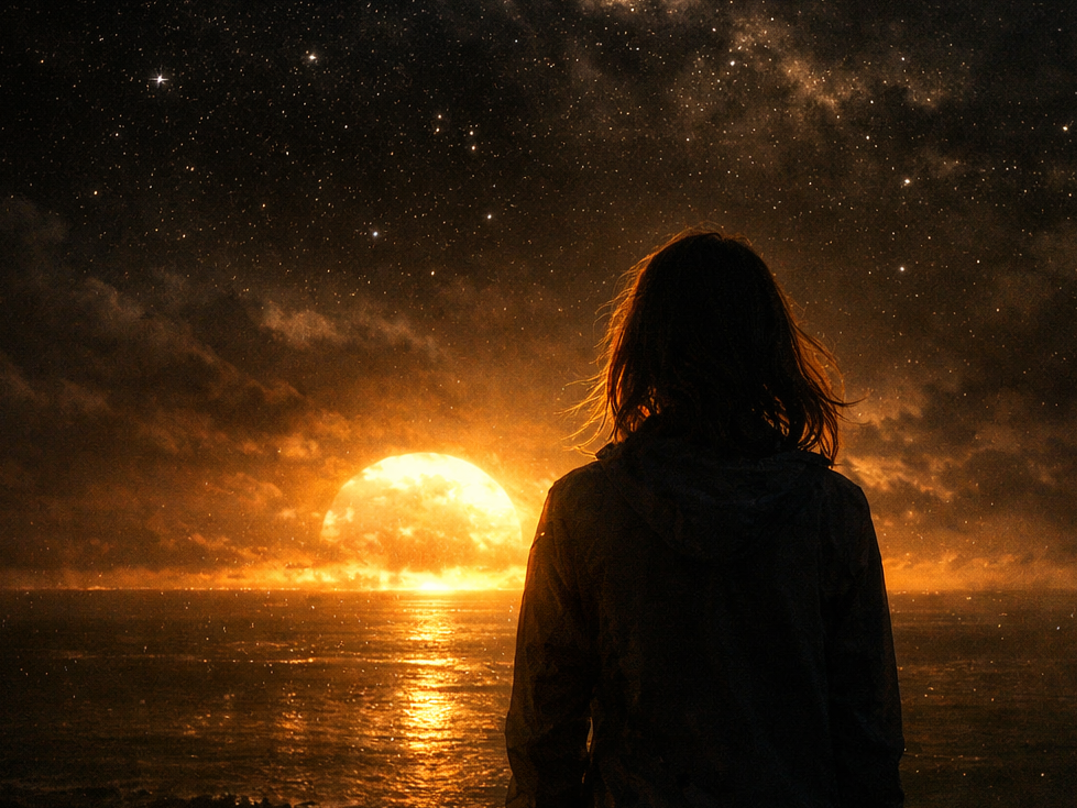
There is a photon traveling through space right now that will be the last photon in the universe. Not the last to be emitted that happened trillions of years ago. The last to arrive anywhere. The last to interact with anything. The last piece of light to cross the cosmic dark before the universe goes completely, irreversibly black.
This is not science fiction. This is thermodynamics.
The universe is dying by expansion. Every second, space itself stretches a little more. Galaxies drift apart. The distance between everything that exists grows larger. And because space is expanding, light, which has to cross that space, faces an impossible race. It’s trying to reach destinations that are moving away faster than light can travel toward them. Most photons have already lost this race. They will drift through an expanding void forever, never reaching anything, never interacting with anything, slowly redshifting into nothingness.
But one photon will be the last to finish its journey. One photon will reach something real, a particle, an atom, a fragment of matter still capable of absorbing it before the cosmic horizon closes forever. And when that photon is absorbed, the universe will have experienced its last moment of light doing what light has always done: carrying energy from one place to another.
After that, there will be no more interactions. No more information transfer. No more change. Just cold, isolated particles drifting through a space so vast and so empty that nothing will ever touch anything again.
Let me take you there. To the end of light.
It is roughly ten to the power of one hundred years from now. The number is so large it’s almost meaningless to write it out as one followed by one hundred zeros. For context, the current age of the universe is only about fourteen billion years. The time we’re talking about is older than the current universe by a factor so enormous that comparing them is like comparing a single heartbeat to the entire history of all life on Earth.
By this point, every star that could ever exist has already burned out. The last star in the universe, a tiny red dwarf barely massive enough to sustain fusion, exhausted its hydrogen fuel roughly ten to the power of fourteen years ago. After that, there were no more stars. No more fusion. No more new photons are being created by nuclear reactions in stellar cores.
But photons don’t disappear just because stars stop making them. The universe is still full of light, or at least it was. Photons from ancient stars, photons from the cosmic microwave background, photons emitted trillions of years ago when galaxies were still colliding, and black holes were still feeding. All of that light is still out there, still traveling, still racing through space.
Except that space has been expanding the entire time.
Here’s what expansion does to light. A photon is a wave, and as space stretches, the wavelength of that wave stretches with it. The photon redshifts. Its energy decreases. A photon that started as visible light becomes infrared, then microwave, then radio, and eventually its wavelength becomes so long, stretched across distances larger than galaxy clusters, that it barely qualifies as light anymore. It’s still a photon, technically, but it carries almost no energy. It can barely interact with anything.
Most photons reached this state trillions of years ago. They’re still out there, but they’re functionally dead. Too redshifted, too stretched, too faint to ever interact with matter again.
But not all of them.
Some photons got lucky. They were emitted in just the right direction, at just the right time, aimed at targets that were close enough that expansion hadn’t yet pulled them out of reach. These photons are still racing toward something real. A particle of hydrogen drifting in the void. A leftover fragment of a dead planet. An isolated atom that somehow survived the heat death of stars, the evaporation of black holes, the slow dispersal of every structure that ever existed.
And one of these photons will be the last to make it.
Let’s say it’s a photon that was emitted ten to the power of ninety years ago, back when a few black holes were still evaporating via Hawking radiation. Black holes don’t just swallow light in their final moments; as they lose mass and shrink, they emit photons as they evaporate. This photon came from one of the very last black holes to die. It was emitted in a random direction, as all Hawking radiation is, and by pure chance, it was aimed at a hydrogen atom drifting several billion light-years away.
The photon has been traveling ever since.
For ten to the power of ninety years, it crossed a universe that was growing emptier, darker, colder. The galaxies it passed, if you could still call the dispersed clouds of dead matter “galaxies,” were unrecognizable. No stars. No planets. No light. Just isolated particles, drifting so far apart that the concept of “structure” had lost all meaning. By this point, the universe was not a collection of things. It was a statistical distribution of particles separated by voids so enormous that calling them voids feels inadequate.
And the photon kept moving.
It redshifted as it traveled. Its wavelength stretched from gamma-ray to X-ray to ultraviolet to visible to infrared to microwave. By the time it’s a few billion years from its target, it’s a radio-wave photon, carrying almost no energy. But it’s still moving. Still aimed, by luck, at that one hydrogen atom.
And then, finally, after a journey longer than most people can conceptually process, the photon reaches the atom.
The interaction is not dramatic. The hydrogen atom absorbs the photon. Its electron jumps to a higher energy state for an incomprehensibly brief moment, then falls back down, re-emitting the photon in a random direction. That re-emitted photon will never reach anything. It will drift into the expanding void, redshifting into irrelevance, carrying no information anywhere.
But the original interaction happened. Energy was transferred. A photon, emitted nearly ten to the power of one hundred years ago, completed its journey. It did what light does. It connected two points in space. It carried information, however trivial, from one place to another.
And it was the last time that will ever happen.
After this, there are no more photons in transit toward anything real. Every remaining photon in the universe is either already redshifted into effective nothingness or aimed at a destination that has drifted out of causal reach due to cosmic expansion. Space is expanding faster than light can cross it. The cosmic horizon, the boundary beyond which nothing can ever send or receive signals, has closed around every remaining particle in the universe.
From this point forward, every atom, every particle, every fragment of matter that still exists is completely, permanently alone. No light will ever reach it again. No information will ever arrive. The universe has fractured into causally disconnected islands, and each island contains, at most, a single particle.
This is the last day of light itself.
And here’s what makes this almost unbearable to think about: light was the thing that made the universe knowable. Every star you’ve ever seen, you saw because photons traveled from that star to your eye. Every photograph of a distant galaxy exists because light made the journey. Every conversation you’ve had, every thought you’ve shared, every connection between minds, all of it depended on information transfer, and at the most fundamental level, information transfer is carried by light.
When the last photon completes its journey, the universe doesn’t just go dark. It becomes unknowable. There is no observation left. No measurement. No way for anything to know anything about anything else. The particles that remain are not part of a universe anymore. They’re isolated fragments, drifting through a void that has grown so large that the word “void” doesn’t even capture it.
The universe will continue to exist, technically. The particles will still be there. Time will still pass, in some formal sense. But nothing will happen. Nothing can happen. The universe has reached a state physicists call maximum entropy
The point where no energy gradients remain, no work can be done, and no change is possible.
And it all started with the last photon.
The last piece of light that managed to cross the dark and touch something real before the horizon closed forever.
If you enjoyed this story, please click the 👏 button and share to help others find it! Feel free to leave a comment below.
I really appreciate it.
References:
- Adams, F. C., & Laughlin, G. (1997). A dying universe: the long-term fate and evolution of astrophysical objects. Reviews of Modern Physics, 69(2), 337–372.
- Krauss, L. M., & Starkman, G. D. (2000). Life, the universe, and nothing: Life and death in an ever-expanding universe. The Astrophysical Journal, 531(1), 22–30.
- Dyson, F. J. (1979). Time without end: Physics and biology in an open universe. Reviews of Modern Physics, 51(3), 447–460.
- Lineweaver, C. H., & Egan, C. A. (2008). Life, gravity and the second law of thermodynamics. Physics of Life Reviews, 5(4), 225–242.
- Ćirković, M. M. (2003). Resource letter: PEs-1: Physical eschatology. American Journal of Physics, 71(2), 122–133.
- Page, D. N. (1993). Average entropy of a subsystem. Physical Review Letters, 71(9), 1291–1294.
- Davies, P. C. W. (1994). The Last Three Minutes: Conjectures About the Ultimate Fate of the Universe. Basic Books.
- Barrow, J. D., & Tipler, F. J. (1986). The Anthropic Cosmological Principle. Oxford University Press.
메타데이터
- post_id
- 0798296d0319
- slug
- the-last-day-of-light-itself-0798296d0319
- url
- https://medium.com/@manaritaa/the-last-day-of-light-itself-0798296d0319
- canonical_url
- https://medium.com/@manaritaa/the-last-day-of-light-itself-0798296d0319
- author_url
- https://medium.com/@manaritaa
- status
- ok
- fetched_at
- 2026-06-09 14:34:10