Efficient and Scalable Retrieval-Augmented Generation (RAG): Techniques and Best Practices
Multimodal Retrieval-Augmented Generation (RAG) is a powerful technique that combines the strengths of information retrieval and text…
Efficient and Scalable Retrieval-Augmented Generation (RAG): Techniques and Best Practices
Multimodal Retrieval-Augmented Generation (RAG) is a powerful technique that combines the strengths of information retrieval and text generation. By integrating external knowledge sources into the generation process, RAG enhances the capabilities of large language models (LLMs), resulting in more accurate and contextually relevant responses. In the context of multimodal RAG, this technique is extended to handle various data types, such as text, images, and audio, thereby providing richer and more comprehensive outputs.
Multimodal RAG operates by retrieving relevant information from a diverse set of external corpora, such as text databases, image repositories, and audio archives, and using that information to augment the text generation process. This approach means that the data for multimodal RAG is not necessarily stored within the model itself but acquired in a plug-and-play manner, leading to greater scalability and accuracy. Instead of generating text from scratch, multimodal RAG mechanisms retrieve and incorporate human-written references, visual elements, and audio clips, thereby improving the quality and reliability of the generated content.
The Multimodal RAG Pipeline
The multimodal RAG pipeline involves three critical components:
- Retrieval: This component fetches relevant information from various external knowledge bases, including text, images, and audio, for any given user query. As the first step in curating meaningful and contextually correct responses, the quality of this component is crucial.
- Augmentation: This part involves enhancing and adding more relevant context to the retrieved response for the user query, utilizing multiple modalities to enrich the context.
- Generation: Finally, a large language model (LLM) uses its own knowledge along with the provided multimodal context to generate an apt response to the user’s query.
These three components form the basis of a multimodal RAG pipeline, helping users obtain contextually rich and accurate responses that leverage the strengths of multiple data types. This is why multimodal RAG is particularly useful for building advanced chatbots, interactive question-answering systems, and other applications that benefit from a rich interplay of text, images, and audio.
Benefits of Multimodal Retrieval-Augmented Generation (RAG)
- Reduces Hallucination: By anchoring responses in factual data, RAG significantly reduces the likelihood of generating incorrect or fabricated information. This grounding ensures that the model provides more reliable and trustworthy outputs, enhancing the user’s confidence in the system.
- Facilitates Fact-Checking: Users can easily verify the information provided by checking the original sources from which the data was retrieved. This transparency allows for quick validation of facts, making the system more accountable and trustworthy.
- Enhanced Accuracy on Domain-Specific Tasks: By providing relevant documents, images, or audio clips as context, RAG ensures that the generated responses are more accurate and tailored to specific tasks. This is particularly beneficial in specialized fields such as healthcare, legal, or technical domains, where precision is critical.
- Dynamic Adaptation: RAG offers high flexibility as you don’t need to retrain the model to achieve different outputs. Simply updating the data in the vector database can yield new results, allowing for easy adaptation to changing information or new contexts.
- Cost-Effective for Companies: For companies with an existing database of relevant data, RAG serves as a cost-effective alternative to model fine-tuning, which can be resource-intensive. Utilizing RAG can save on computational costs and time, making it a practical choice for many businesses.
Challenges in Multimodal RAG
Implementing multimodal RAG for big data scenarios presents significant challenges due to the volume, velocity, and variety of data across different modalities. Handling massive datasets, processing high-velocity data streams, and integrating diverse data formats can overwhelm existing retrieval and generation mechanisms.
Key Challenges
- Retrieval Sensitivity: The performance of multimodal RAG is highly sensitive to the quality of retrieval across different modalities. Ensuring high-quality retrieval results for text, images, and audio is crucial for maintaining relevance and accuracy.
- Retrieval Efficiency: The efficiency of the retrieval process depends on various factors, including memory and database size, as well as the retrieval function used. Balancing the trade-off between retrieval efficiency and memory usage across multiple modalities is essential. Optimizing retrieval functions to handle large-scale multimodal data efficiently without compromising on speed or accuracy is a pressing need. This is probably one of the most important significant challenge in general.
- Consistent Retrieval Metrics: Achieving consistent retrieval metrics during training and testing phases is challenging, especially when dealing with multiple data types. Ensuring that retrieval performance metrics remain consistent across both phases and modalities is critical for reliable model performance.
- Diversified Metrics: Current metrics used for evaluating retrieval, such as lexical similarities of sentences, can be unidimensional. Developing customized metrics based on specific tasks and modalities can enhance controlled text generation. For instance, in multimedia dialogue systems, creating metrics that account for visual context or audio tone can lead to more nuanced and appropriate responses.
Efficient Computational Resources for Multimodal RAG
Approaching the problem of efficient computational resources in multimodal RAG involves two major strategies: algorithmic efficient search and computationally efficient search.
Algorithmic Efficient Search
- Multimodal Query Expansion: Generate multiple variations of the query across different modalities to provide diverse perspectives. This can be achieved by expanding the query with synonyms, related terms, visual tags, and audio features.
def expand_query(query):
    text_synonyms = get_text_synonyms(query)
    visual_tags = get_visual_tags(query)
    audio_features = get_audio_features(query)
    expanded_queries = [query] + text_synonyms + visual_tags + audio_features
    return expanded_queries

def retrieve_documents(query):
    expanded_queries = expand_query(query)
    results = []
    for q in expanded_queries:
        results.extend(multimodal_vector_search(q))
return unique(results)Intuition: By expanding queries with synonyms, visual tags, and audio features, you increase the chances of retrieving more relevant documents across all modalities. This technique leverages the richness of different data types to cover various ways the same information might be represented, thus improving the retrieval's coverage and robustness.
2. Query Metadata Understanding: Identify multiple tags within the data, such as semantic values, visual elements, sentiment, named entities, and author IDs to refine search systems efficiently.
def self_query(query):
    metadata = extract_metadata(query)
    filtered_query = filter_query_by_metadata(query, metadata)
return multimodal_vector_search(filtered_query, metadata_filters=metadata)Intuition: Understanding the metadata associated with queries can significantly refine the retrieval process across modalities. Metadata provides additional context that helps narrow down the search space, leading to more accurate and relevant results.
3. Hybrid Multimodal Search: Combine keyword search, visual search, and audio search to leverage the strengths of all methods. This can involve summarizing the query or using topic modeling.
def hybrid_search(query):
    keyword_results = keyword_search(query)
    visual_results = visual_search(query)
    audio_results = audio_search(query)
return merge_and_rank_results(keyword_results, visual_results, audio_results)Intuition: Hybrid multimodal search combines the precision of keyword-based methods with the contextual understanding of vector-based methods across text, images, and audio. This comprehensive approach ensures that the search is both broad and deep, capturing the nuances of the query while maintaining high relevance.
4. Reranking: Implement highly efficient reranking based on the retrieved results to identify the most relevant responses across all modalities.
def rerank_documents(documents, query):
    ranked_documents = gpt4_rerank(documents, query)
return ranked_documentsIntuition: Reranking involves re-evaluating the initial search results to prioritize the most relevant documents. By leveraging more sophisticated models like GPT-4 for reranking, you can ensure that the final output is of the highest possible quality.
Computationally Efficient Search
- Knowledge Caching: Cache key-value tensors from retrieved documents across all modalities to ensure faster retrieval.
import redis
cache = redis.Redis(host='localhost', port=6379, db=0)
def get_cached_result(query):
    return cache.get(query)
def cache_result(query, result):
cache.set(query, result)Intuition: Caching frequently accessed data can dramatically reduce retrieval times across modalities. By storing the results of common queries, you can avoid redundant computations, leading to faster response times and more efficient use of computational resources.
- Auto-Scaling: Use auto-scaling to dynamically adjust computational resources based on demand, accounting for different modalities.
# hpa.yaml
apiVersion: autoscaling/v2
kind: HorizontalPodAutoscaler
metadata:
  name: riva-hpa
  namespace: {{ .Release.Namespace }}
  labels:
    app: {{ template "riva-server.name" . }}
    chart: {{ template "riva-server.chart" . }}
spec:
  scaleTargetRef:
    apiVersion: apps/v1
    kind: Deployment
    name: {{ template "riva-server.fullname" . }}
  minReplicas: {{ .Values.autoscaling.minReplicas }}
  maxReplicas: {{ .Values.autoscaling.maxReplicas }}
metrics: {{ toYaml .Values.autoscaling.metrics | nindent 2 }}Intuition: Auto-scaling ensures that your system can handle variable workloads efficiently across modalities. By scaling resources up during high demand and down during low demand, you can maintain performance while optimizing costs.
- Distributed Processing: Utilize frameworks like Apache Spark for large-scale multimodal data processing, allowing parallel processing of large datasets.
from pyspark.sql import SparkSession
spark = SparkSession.builder.appName("RAG").getOrCreate()
def process_documents(docs):
    return spark.createDataFrame(docs).rdd.flatMap(lambda x: process_doc(x)).toDF()
processed_docs = process_documents(large_document_set)Intuition: Distributed processing leverages multiple nodes to handle large datasets efficiently across modalities. By distributing the workload, you can significantly reduce processing times and improve overall system performance.
Additional Techniques for Enhancing Multimodal RAG Systems
1. Dynamic Query Expansion
Description: Instead of using static synonyms for query expansion, dynamically generate variations of queries based on the context and recent search patterns across modalities. This involves using models that can understand and generate contextually relevant expansions.
from transformers import GPT2LMHeadModel, GPT2Tokenizer
model = GPT2LMHeadModel.from_pretrained('gpt2')
tokenizer = GPT2Tokenizer.from_pretrained('gpt2')
def dynamic_expand_query(query):
    inputs = tokenizer.encode(query, return_tensors='pt')
    outputs = model.generate(inputs, max_length=50, num_return_sequences=5)
    expanded_queries = [tokenizer.decode(output, skip_special_tokens=True) for output in outputs]
    return expanded_queries
def retrieve_documents(query):
    expanded_queries = dynamic_expand_query(query)
    results = []
    for q in expanded_queries:
        results.extend(multimodal_vector_search(q))
return unique(results)Intuition: Dynamic query expansion leverages language models to generate more contextually relevant variations of a query across modalities, improving the chances of retrieving the most pertinent documents.
2. Lightweight Models for Retrieval
Description: Use smaller, distilled versions of large models for the retrieval phase. Distillation involves training a smaller model to mimic the behavior of a larger, more complex model, retaining most of its accuracy while being much faster and less resource-intensive.
from transformers import DistilBertTokenizer, DistilBertModel
tokenizer = DistilBertTokenizer.from_pretrained('distilbert-base-uncased')
model = DistilBertModel.from_pretrained('distilbert-base-uncased')
def encode_query(query):
    inputs = tokenizer(query, return_tensors='pt')
    outputs = model(**inputs)
return outputs.last_hidden_stateIntuition: Using lightweight models for the initial retrieval step can drastically reduce computational costs while maintaining high retrieval quality. The smaller models are faster to run and require less memory, making them ideal for handling large-scale retrieval tasks efficiently across modalities.
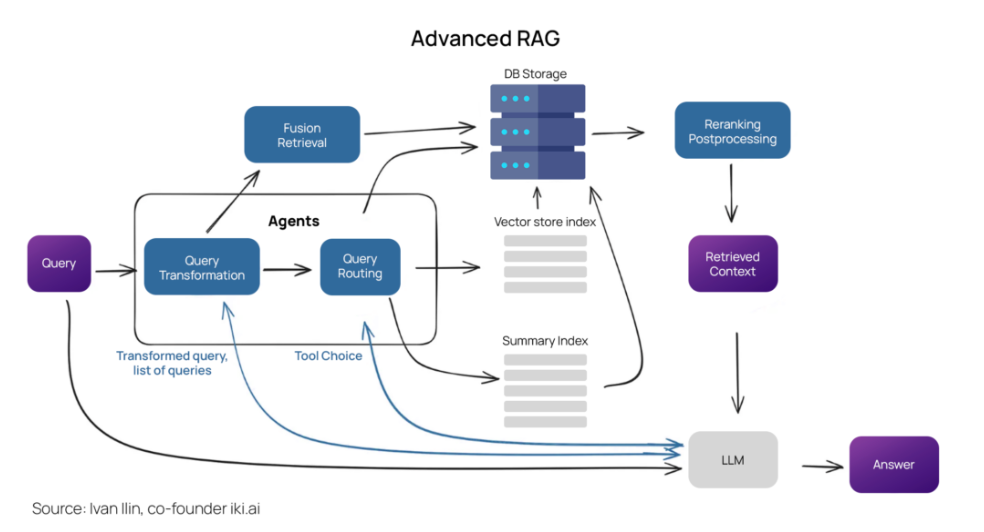
Leveraging AI agents in the retriever phase enables multi-step, faster data transformation, ensuring the inclusion of the most relevant information from external resources into the LLM. Additionally, tailoring the input context to suit specific models, like Falcon 40B, ensures optimized performance and more accurate results
Conclusion
Implementing efficient and scalable multimodal RAG systems requires addressing both algorithmic and computational challenges. By leveraging advanced retrieval techniques, efficient computational resources, and robust data processing pipelines, multimodal RAG systems can deliver high-quality, contextually relevant responses even in big data environments.
References
- Your LLM Twin Course — GitHub Repository (2024), Decoding ML GitHub Organization
- Bytewax, Bytewax Landing Page
- Qdrant, Qdrant Documentation
- Retrieve & Re-Rank, Sentence Transformers Documentation
- MultiQueryRetriever, LangChain’s Documentation
- Self-querying, LangChain’s Documentation
- Okapi BM25, Wikipedia
- Qdrant Self Query Example, LangChain’s Documentation
- https://arxiv.org/html/2311.03731v2
메타데이터
- post_id
- 07a020fb3f74
- slug
- efficient-and-scalable-retrieval-augmented-generation-rag-techniques-and-best-practices-07a020fb3f74
- url
- https://medium.com/@sugeerth/efficient-and-scalable-retrieval-augmented-generation-rag-techniques-and-best-practices-07a020fb3f74
- canonical_url
- https://medium.com/@sugeerth/efficient-and-scalable-retrieval-augmented-generation-rag-techniques-and-best-practices-07a020fb3f74
- author_url
- https://medium.com/@sugeerth
- status
- ok
- fetched_at
- 2026-07-23 11:43:23