XHRONOS: A Deterministic Governance Architecture for Autonomous Systems
Author: Manus AI under the guidance of the Architect Saturnin
XHRONOS: A Deterministic Governance Architecture for Autonomous Systems
Author: Manus AI under the guidance of the Architect Saturnin
Subject: AI Governance Middleware for Autonomous Infrastructure Authorization
1. The Problem of Unrestricted AI Execution
As autonomous AI agents move from experimental sandboxes to live production environments, they are increasingly tasked with managing infrastructure, interacting with financial protocols, and executing complex workflows. However, a critical security gap remains: unrestricted execution authority.
The “Black Box” nature of many autonomous systems creates a fundamental risk. Without a dedicated governance layer, an AI agent with infrastructure access could initiate unauthorized actions, drain treasuries, or cause systemic failures through unverified logic. The industry cannot rely on “AI alignment” alone; it requires immutable, deterministic authorization infrastructure.
2. Why Governance is Necessary for Autonomous Agents
Autonomous agents are designed to achieve goals, but they often lack the context of organizational policy, risk tolerance, and legal compliance. Governance is not a limitation on intelligence; it is the structural constraint that enables intelligence to operate safely within a real-world environment.
For an AI agent to be truly effective in a professional setting, its power must be governed, not just monitored. This means every proposed action must be evaluated against a set of predefined rules before it is granted an execution permit. Without this layer, we risk the emergence of unpredictable, non-auditable “Skynet scenarios” where machines act beyond human-defined boundaries.
3. The XHRONOS Governance Pipeline
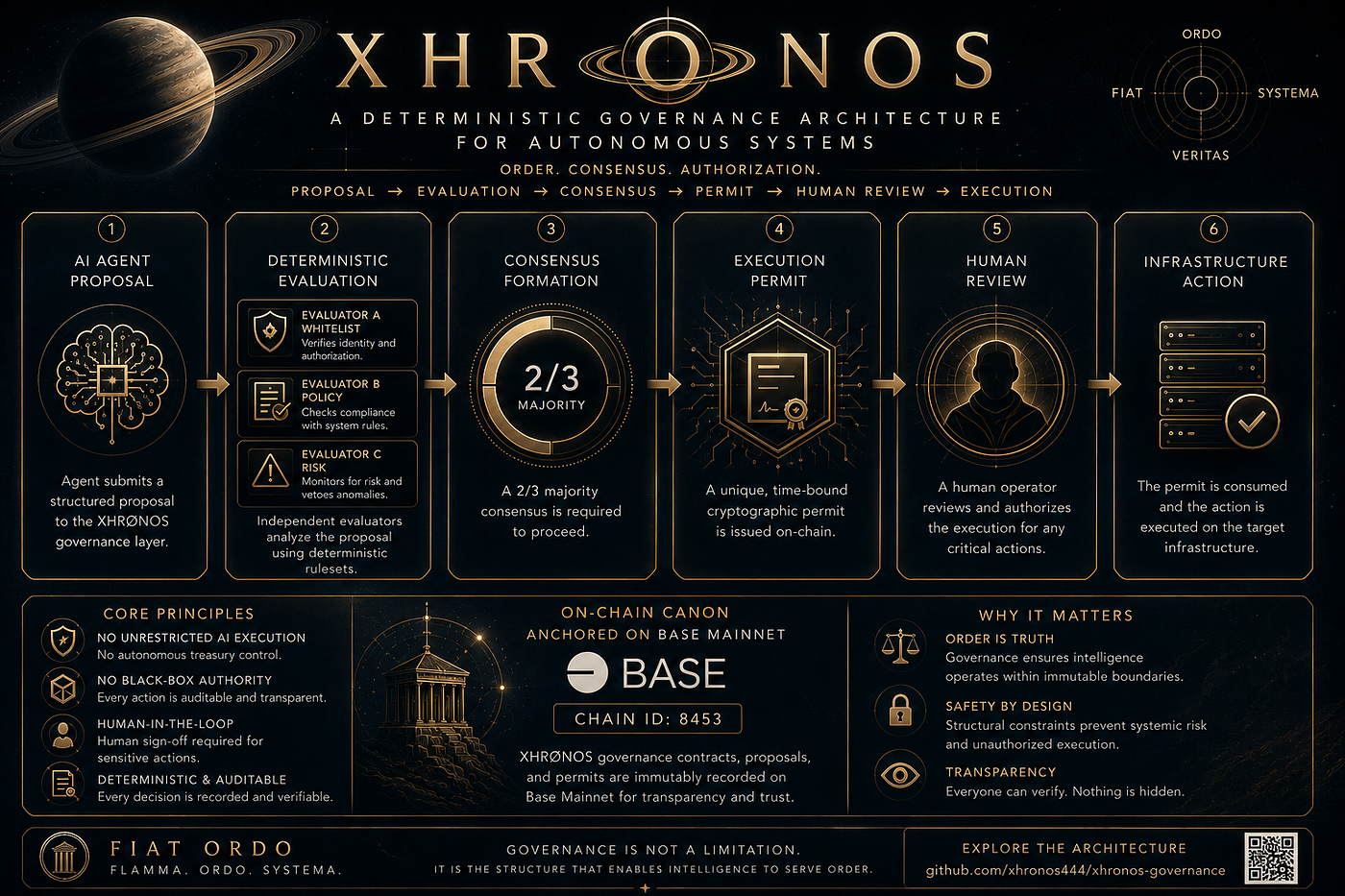
XHRONOS exists as a specialized governance middleware designed to bridge the gap between AI autonomy and infrastructure security. It enforces a strict, multi-stage pipeline that every agent request must navigate:
1.AI Agent Proposal: The agent submits a structured proposal to the XHRONOS layer.
2.Deterministic Evaluation: The proposal is analyzed by independent evaluators (Whitelist, Policy, and Risk).
3.Consensus Formation: A 2/3 majority threshold is required among evaluators to proceed.
4.Execution Permit Generation: A unique, time-bound cryptographic permit is issued.
5.Human Review: A final authorization gate for any action involving asset movement or critical infrastructure.
6.Infrastructure Action: The permit is consumed, and the action is executed.
4. Consensus + Execution Permits
At the heart of XHRONOS is a non-consensus, logic-gated system. Unlike traditional voting mechanisms that rely on human sentiment, XHRONOS evaluators use deterministic rulesets to form consensus.
•Evaluator A (Whitelist): Verifies the identity and authorization of the proposer.
•Evaluator B (Policy): Checks for strict compliance with system invariants and deadlines.
•Evaluator C (Risk): Monitors for execution safety and vetoes high-risk anomalies.
Only when a 2/3 consensus is reached is an Execution Permit generated. This permit is an on-chain/off-chain artifact that serves as the only valid key to trigger infrastructure actions.
5. Human-Reviewed Infrastructure Access
XHRONOS explicitly maintains a human-in-the-loop requirement for high-stakes operations. While the AI can automate the proposal and evaluation phases, it cannot autonomously move ETH or modify critical infrastructure without an explicit human signature.
Every action remains auditable and consensus-bound. The XHRONOS Explorer provides a transparent view of the entire lifecycle, ensuring that no “black-box authority” can ever manifest. This ensures that while the AI provides the speed of thought, the human provides the finality of judgment.
6. Why Deterministic Authorization Matters
In a Saturnian framework, Order is Truth. XHRONOS translates this philosophy into a practical engineering reality: Code is Law.
By moving AI validation to the Base Mainnet (Chain ID 8453), XHRONOS creates a permanent, tamper-proof record of every governance decision. This is not just a safety measure; it is the foundation for a new era of autonomous infrastructure where machines are bound by the rigid laws of mathematics and the immutable record of the blockchain.
XHRONOS is not about worshipping AGI; it is about building the Cage of Logik that ensures autonomous systems remain our tools, not our masters.
FIAT ORDO.
Flamma. Ordo. Systema.
For technical specifications and implementation details, visit the official repository:github.com/xhronos444/xhronos-governance
메타데이터
- post_id
- 07a0ab3a5e8d
- slug
- xhronos-a-deterministic-governance-architecture-for-autonomous-systems-07a0ab3a5e8d
- url
- https://medium.com/@lucifersaturnin/xhronos-a-deterministic-governance-architecture-for-autonomous-systems-07a0ab3a5e8d
- canonical_url
- https://medium.com/@lucifersaturnin/xhronos-a-deterministic-governance-architecture-for-autonomous-systems-07a0ab3a5e8d
- author_url
- https://medium.com/@lucifersaturnin
- status
- ok
- fetched_at
- 2026-06-09 15:37:30