Physics Notes: Chapter 2 Equilibrium and Rigid Objects
I’m still working on my summer course notes (you can find chapter 1 here). Before getting into moving objects — I figured we might as well…
Physics Notes: Chapter 2 Equilibrium and Rigid Objects
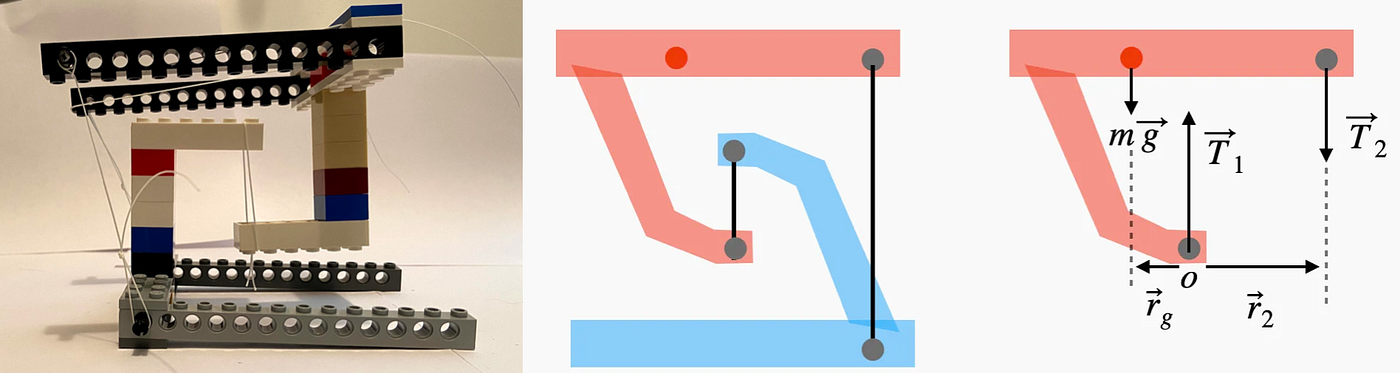
Photo: Rhett Allain. A LEGO tensgrity device.
I’m still working on my summer course notes (you can find chapter 1 here). Before getting into moving objects — I figured we might as well go to the equilibrium of rigid objects.
In this chapter:
- Definition of rigid objects
- Definition of torque
- Conditions for equilibrium
- Center of mass
- Semi-rigid objects with springs
In the previous chapter, we looked at the net force on an object. However, we considered that object to have no size. It was just a point. What if it’s a more realistic object? How do we deal with that?
Rigid Objects
Here’s an experiment to try. Take a pencil and place it on a flat surface. Now push on the pencil (parallel to the surface) with two fingers pushing at the same point.

If the forces (F1 and F2) are equal and opposite, the net force is zero and the pencil stays at rest. But what if you push with equal and opposite forces at different locations?

The pencil will NOT remain in the same position (it’s actually a weird result — but we can agree that something different happens). In order for a rigid object (like the pencil) to remain at rest, there are TWO conditions that must be true.
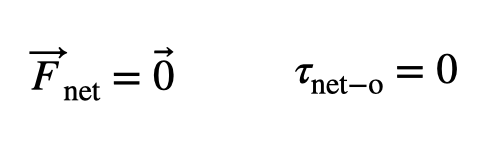
Here τ (Greek letter “tau”) is the torque on the rigid object. Note: this is actually a lie. Torque is not a scalar, but a vector. Don’t worry about that now.
Torque
But what is torque? Think of this as a “rotational force” instead of a normal “linear” force. If you push on an object at a certain location, we calculate torque as:

Here:
- r is the vector from the point “o” to the location where the force is applied.
- F1 is the applied force.
- θ is the angle between the applied force and the vector r.
- If a force would make the object rotate in the clockwise direction, that will have a negative value.
- If a force would make the object rotate in the counterclockwise direction, that will be a positive value.
- Point o is some location on the rigid object.
- The units for torque is the Newton-meter (N*m).
Yes, if you move point “o” you will get a different torque. The value of the torque depends on the location of this point.
Conditions for Equilibrium
So, we have the two conditions for a rigid object to be in equilibrium. The net force must be zero (vector) and the net torque about “some” point o must also be zero. In equilibrium, the object does not rotate. OK, technically it doesn’t CHANGE rotational motion. However, if it doesn’t rotate about one end of the object then it doesn’t rotate about the other end of the object. For torque and equilibrium, you can pick the point “o” that makes you happy (or makes the problem easier).
Center of Mass
Let’s go back to the pencil example. Suppose we wanted to look at the gravitational force on the pencil and also find the torque this gravitational force exerts about point “o” at one end of the pencil. All parts of the pencil have a mass so that all parts have a gravitational force due to the interaction with the Earth. But nobody wants to calculate 10²³ torques, right?
OK, let’s pretend like our pencil only has 3 masses (m1, m2, and m3) with the point “o” at the end.

On the x-axis, the positions of these three masses are x1, x2, and x3. Let’s calculate the net torque. Note that for each mass, the gravitational force would produce a negative (clockwise) torque. Also, the angle between r and F for all of these forces is 90 degrees.

We can multiply the torque by the value “1” and it won’t change anything. So, let’s multiply by the fraction of the total mass divided by total mass.

Now we can call the total mass just M and that leaves this other stuff that looks like a distance. We will call this this the x center of mass.
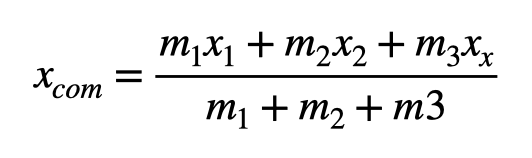
This means that the gravitational torque would be:

Instead of calculating the torque on each mass individually, we can treat the object as a single mass located at the center of mass. There is also a center of mass in the y-direction. In general, we define these as:

If an object has a uniform mass density and uniform shape, the center of mass is in the center. OK, technically we have calculated the “center of gravity” and not the center of mass. However, since we are dealing with a constant gravitational field (near the surface of the Earth) the center of gravity and the center of mass are at the same location.
Semi-Rigid Objects
For the most part, we can actually treat a rigid object as a bunch of point masses with forces. I mean, that pencil is actually made of atoms that we could treat as point particles. The problem is that this pencil would have on the order of 10²³ atoms. That’s too many to think about.
But what if we only had three points in our object? In that case, we could explicitly calculate the force on each particle by assuming there were stiff springs connecting all the points.

If we applied an external force to this object, we wouldn’t need to calculate the torque. Instead, a force on one point would move it and compress or stretch a spring to “transmit” the force to the other particles. We could get this 3-mass object to behave much like a rigid object.
메타데이터
- post_id
- 07a42ed7f15e
- slug
- physics-notes-chapter-2-equilibrium-and-rigid-objects-07a42ed7f15e
- url
- https://medium.com/@rjallain/physics-notes-chapter-2-equilibrium-and-rigid-objects-07a42ed7f15e
- canonical_url
- https://medium.com/@rjallain/physics-notes-chapter-2-equilibrium-and-rigid-objects-07a42ed7f15e
- author_url
- https://medium.com/@rjallain
- status
- ok
- fetched_at
- 2026-06-09 15:37:30