From Water, Every Living Thing: Leighton House’s Arab Hall Comes Alive
Soraya Syed’s mesmerising intervention in Leighton House’s celebrated Arab Hall brings together Arabic calligraphy, water and light in a…
From Water, Every Living Thing: Leighton House’s Arab Hall Comes Alive
Soraya Syed’s mesmerising intervention in Leighton House’s celebrated Arab Hall brings together Arabic calligraphy, water and light in a fitting centrepiece for the museum’s centenary year.
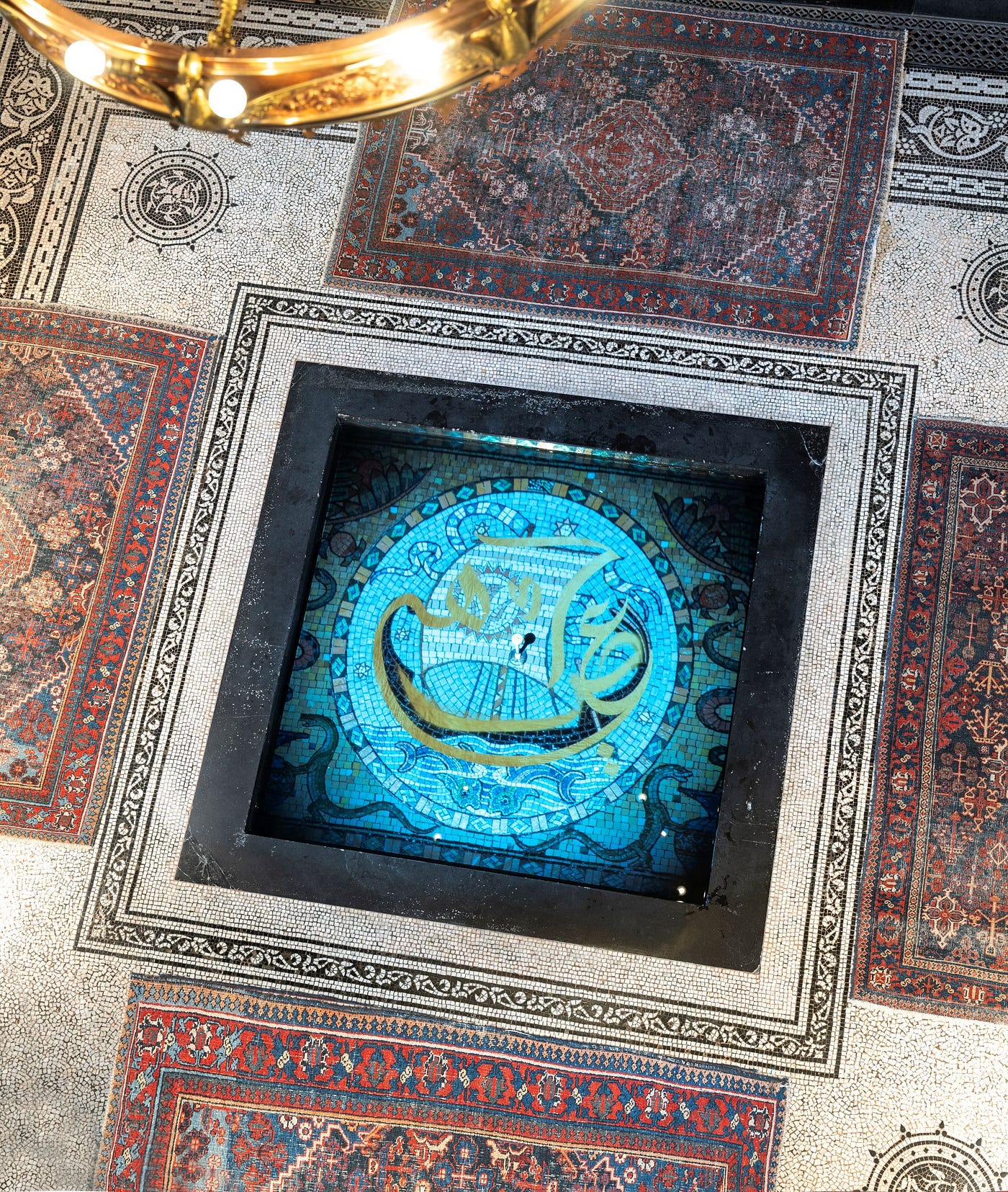
Soraya Syed, From Water, Every Living Thing. The Arab Hall Past and Present © Leighton House, Royal Borough of Kensington and Chelsea. Image courtesy of Jaron James (HR)
There are rooms that contain art, and there are rooms that become works of art themselves. The Arab Hall at Leighton House belongs firmly to the latter category. Stepping into it from the streets of Kensington is an extraordinary shift of atmosphere: turquoise and cobalt tiles climb the walls, marble columns frame the space, gold glimmers overhead and, at its centre, water gently occupies the sunken fountain.
For Leighton House’s centenary as a public museum, this already theatrical interior has been given another layer through Soraya Syed’s From Water, Every Living Thing, a site-specific video installation projected directly onto the fountain. The commission forms the final part of The Arab Hall: Past and Present, a programme reconsidering the room through contemporary art, film and new historical research.
Syed’s intervention is deceptively simple. Rather than inserting another physical object into a room already overflowing with visual detail, she uses what has always been there: the water. Arabic calligraphy appears upon its surface, illuminated letters shifting, dissolving and reforming as the fountain moves beneath them. Light follows the ripples; the words become unstable, briefly legible before being broken apart by another wave.
It is mesmerising precisely because Syed allows the architecture to do so much of the work. The fountain becomes screen, material and collaborator simultaneously. Calligraphy ceases to be something fixed on a page or architectural surface and becomes fluid: stretched and fragmented by water, then momentarily reconstructed. The projection draws attention not only to the beauty of Arabic script but also to the extraordinary visual patterns already created by moving water.
The title comes from the Qur’anic verse, “From water We made every living thing”, while the letters Kāf Hā Yā ʿAyn Ṣād appearing across the fountain are also present in the Arab Hall’s stained glass. Syed additionally draws upon Hizb al-Bahr — The Litany of the Sea — a devotional text traditionally associated with protection, originally composed for travellers undertaking sea journeys. The result connects water with life, movement, vulnerability and renewal without reducing those associations to a single interpretation.
This dialogue feels particularly appropriate for Syed, a London-born artist and calligrapher trained in the Ottoman tradition under Hasan Çelebi and Efdaluddin Kılıç in Istanbul. She became the first Briton to receive an ijazah, the formal authorisation connecting a calligrapher to an established lineage of transmission. Yet her practice extends well beyond traditional calligraphy into film, animation, performance, sculpture and immersive installation.
That combination of tradition and experimentation mirrors the Arab Hall itself.
Completed in 1881, the room grew out of Frederic Leighton’s travels through North Africa and the Middle East. Its architecture combines Islamic, Mediterranean and Victorian traditions, with historic tiles originating in Damascus, Turkey and Iran. New research accompanying the centenary programme reveals the extent of Leighton’s engagement with the region: during his 1873 visit to Damascus, he spent considerable time sourcing tiles, while plans for the Arab Hall appear to have begun years before its construction.
It would be easy today to see such a room simply through the uncomfortable language of Victorian Orientalism and collecting. The centenary programme is more interesting because it does not avoid those questions, but neither does it allow them to close the conversation.
As Mary Beard suggests in the superb introductory documentary shown downstairs before entering the historic house, Leighton House can instead be understood as a place where cultures meet and discussion flourishes. That proposition seems particularly valuable at a moment when public conversation so often encourages cultures to retreat into opposing camps. The Arab Hall, with all its contradictions, becomes a space in which exchange itself can be examined.

The Arab Hall at Leighton House ©RBKC. Image Siobhan Doran
This idea is developed playfully in Soudade Kaadan’s When the Tiles Spoke. Kaadan, a Syrian filmmaker raised in Damascus, uses animation, documentary and magical realism to imagine the Arab Hall’s tiles acquiring voices of their own. They recount their origins, journeys and eventual presence within Leighton House, turning objects normally admired for their decorative beauty into narrators of their own complicated histories. The film manages to be informative without becoming didactic, and humorous without trivialising its subject.
Together, Kaadan and Syed transform the Arab Hall from something merely to be looked at into something that seems capable of answering back.
It is an inspired way to celebrate 100 years of Leighton House as a public museum. The building remains unmistakably what it originally was: an artist’s home, studio and spectacular showroom for Leighton’s aesthetic world. Yet The Arab Hall: Past and Present refuses to preserve it in amber. Instead, contemporary artists are invited inside to question it, respond to it and make it live again.

The Arab Hall at Leighton House ©RBKC. Image Siobhan Doran
And at the centre of it all is water: illuminated, constantly changing and impossible to hold still.
For me, this is one of the cultural events of the year, and highly recommended — deserving a place alongside the forthcoming Bayeux Tapestry exhibition at the British Museum and the Ana Mendieta retrospective at Tate Modern among London’s essential exhibitions of 2026.
From Water, Every Living Thing is at Leighton House, London, until 4 October 2026, as part of The Arab Hall: Past and Present. For more infomation, please visit https://www.rbkc.gov.uk/museums/leighton-house
메타데이터
- post_id
- 07b736360fa7
- slug
- from-water-every-living-thing-leighton-houses-arab-hall-comes-alive-07b736360fa7
- url
- https://medium.com/escapadasuk/from-water-every-living-thing-leighton-houses-arab-hall-comes-alive-07b736360fa7
- canonical_url
- https://medium.com/escapadasuk/from-water-every-living-thing-leighton-houses-arab-hall-comes-alive-07b736360fa7
- author_url
- https://medium.com/@belenguer
- status
- ok
- fetched_at
- 2026-08-21 20:31:35





