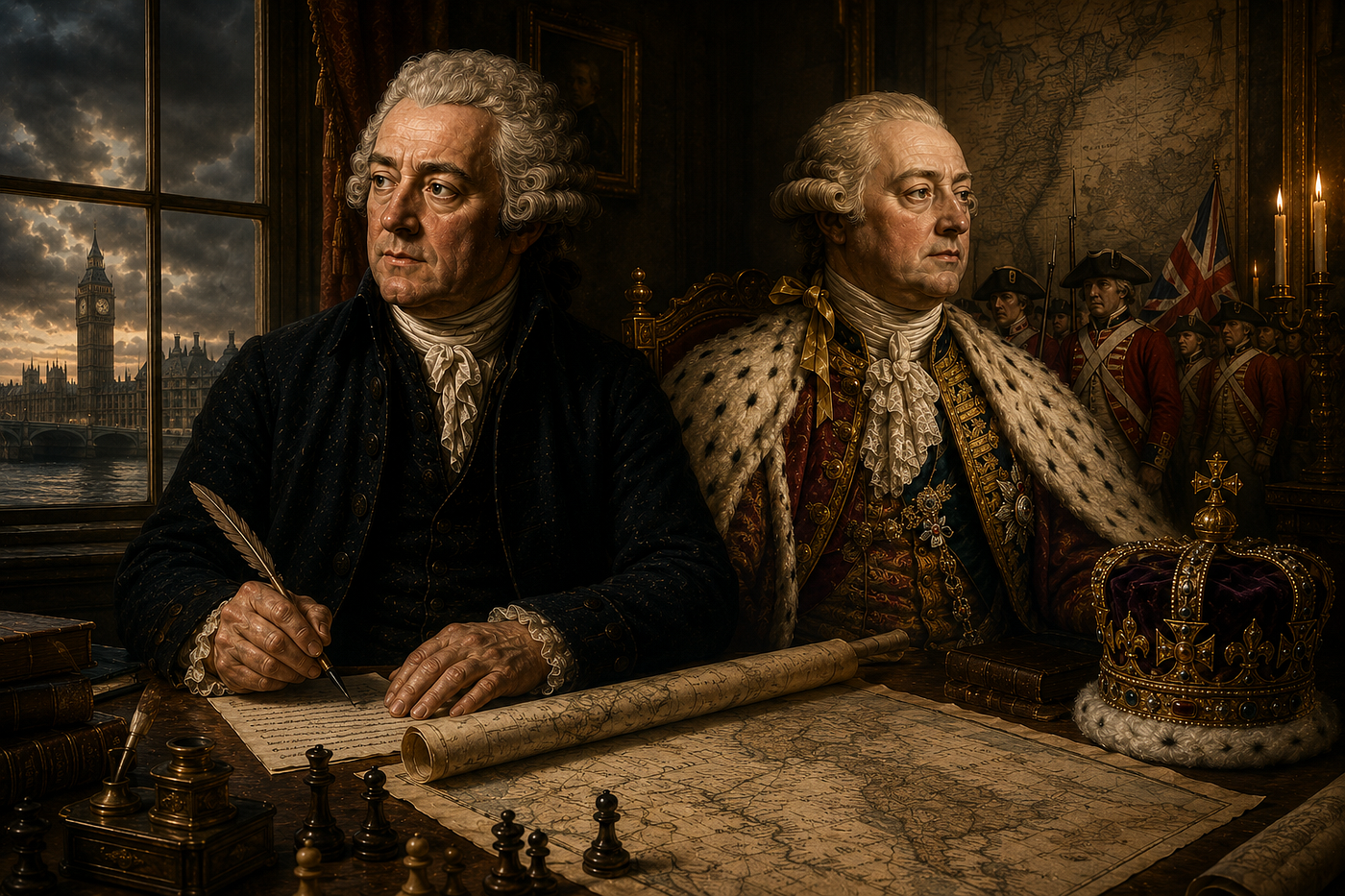
The Committee of Five: The Two Men Who Helped Write the Declaration of Independence and Never…
Jefferson, Adams, and Franklin get the credit. Roger Sherman is the only person in American history to sign all four founding documents —…
The Committee of Five: The Two Men Who Helped Write the Declaration of Independence and Never Signed It
Jefferson, Adams, and Franklin get the credit. Roger Sherman is the only person in American history to sign all four founding documents — and almost nobody knows his name. Robert Livingston helped draft the Declaration, got recalled home before he could sign it, and went on to negotiate the Louisiana Purchase for the same man whose document he never put his name on. Day 16 of The Unfinished Founding.
Quick test: the Committee of Five drafted the Declaration of Independence. Name all five. Most people get three — Jefferson, Franklin, Adams. The other two names tend to come slower, if they come at all. This article is for the other two.
Roger Sherman: No College, Four Signatures
Roger Sherman was born April 19, 1721, in Newton, Massachusetts, the second of seven children of William and Mehetabel Sherman. His father worked as a farmer and shoemaker, and Sherman’s early working life followed a similarly modest, practical path — shoemaking, land surveying, no college education at all, a detail genuinely unusual for a man who would eventually serve on more foundational national committees than almost anyone of his generation.
In 1743, Sherman moved to Connecticut, continuing as a shoemaker, store owner, and surveyor while pursuing an education almost entirely through sustained personal reading. He studied law independently, was admitted to the bar in 1754, and entered Connecticut politics in 1755 as a justice of the peace and General Assembly member, eventually serving as a superior court judge into the 1780s — overlapping national and state service that was, by most accounts, genuinely unusual even for the period.
Sherman’s documented contribution to the founding began before most figures this series has profiled had become politically active at all. In 1774, as a First Continental Congress delegate, he signed the Continental Association — the colonial trade boycott representing one of the first coordinated intercolonial responses to British policy. That was the first of four signatures. Sherman went on to sign the Declaration of Independence in 1776, the Articles of Confederation in 1777, and the Constitution in 1787 — making him, by multiple historical sources’ assessment, the only person in American history whose signature appears on all four of the founding era’s most significant state papers.
Sources vary slightly on the precise framing — some describe him as the only signer of the three most important documents (Declaration, Articles, Constitution); others, counting the earlier Continental Association, describe him as signer of all four. The underlying fact holds either way: nobody else in the documented record put their name on as many of the country’s foundational texts as Roger Sherman.
“A Man Who Never Said a Foolish Thing”
Sherman’s role on the Committee of Five was less about prose and more about judgment. At fifty-five in 1776, he was the second-oldest member of Congress after Franklin, bringing a temperament contemporaries described as careful and notably free of the rhetorical flourish that marked several more famous colleagues. Thomas Jefferson himself reportedly said Sherman was “a man who never said a foolish thing in his life” — a specific assessment from the very man whose draft Sherman was helping revise.
Sherman’s most consequential individual contribution to American government came more than a decade later. At the 1787 Constitutional Convention, where he served as the oldest delegate present, a dispute between larger states wanting population-based representation and smaller states wanting equal representation threatened to derail the entire convention. Sherman, working with fellow Connecticut delegate Oliver Ellsworth, proposed what became the Connecticut Compromise, or Great Compromise: a bicameral legislature with population-based representation in one chamber and equal state representation in the other. That structure — the House and Senate, operating exactly as Sherman proposed — remains the working architecture of Congress today.
Sherman served in the first Federal Congress and was elected to the U.S. Senate in 1791. He contracted typhoid fever in 1793 and died July 23rd, after roughly two months of illness, at seventy-two.
One biographer offered a specific explanation for Sherman’s comparative obscurity: his contemporaries — Franklin, Washington, Adams, Jefferson, Madison — were simply too towering as individual figures, and Sherman’s own genuine personal modesty did nothing to correct the imbalance. He did not promote his own legacy. History largely took him at his own quiet word.
Robert Livingston: The Man Who Missed His Own Signing
Robert R. Livingston’s story runs nearly the opposite direction — born into one of New York’s wealthiest, most politically established families, his connection to the Declaration defined not by what he signed but by what he helped build and never got to sign at all.
Livingston was born November 27, 1746, in New York City. He was educated at King’s College — now Columbia University — studied law under future New York Chief Justice William Smith, and was admitted to the bar in 1773, building an already prominent legal career before his political life began in earnest.
His earliest political involvement traces to the Stamp Act crisis this series examined in its first week — he was likely involved, with his brother William, in New York’s branch of the Sons of Liberty. He was appointed Recorder of New York City in 1773, a position he held only briefly before being effectively forced out for aligning with the Patriot cause. He served in New York’s Provincial Congress and was selected as a Continental Congress delegate in 1775, signing the Olive Branch Petition — the genuine, ultimately rejected peace effort this series examined in detail in Day 3.
The Committee Work, and the Recall
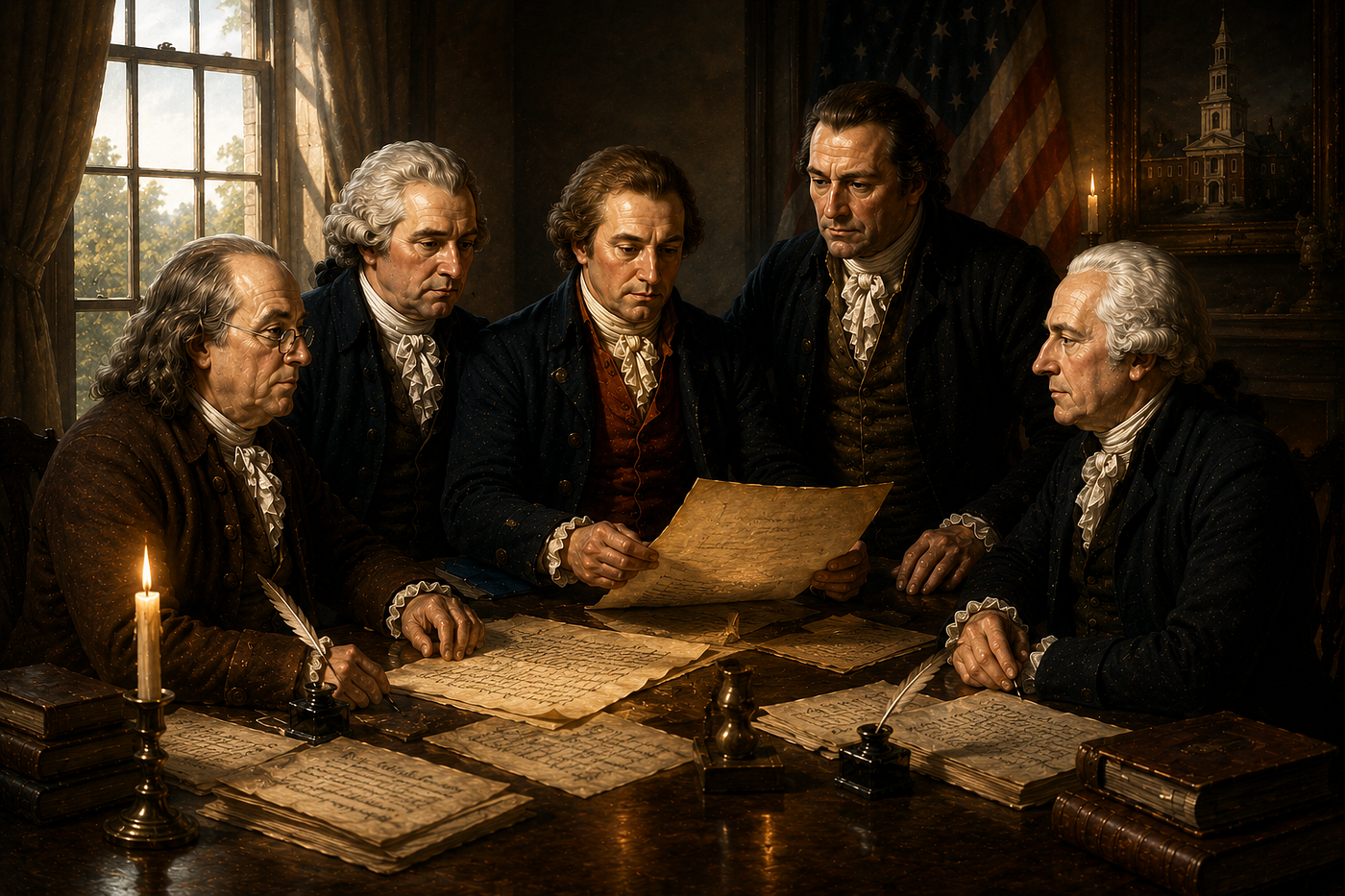
When Congress appointed the Committee of Five on June 11, 1776, Livingston was New York’s representative, joining Jefferson, Adams, Franklin, and Sherman. He participated directly in the committee’s work — reviewing Jefferson’s draft, contributing to what multiple sources describe as extensive editing and revision, sitting through the same weeks of preparation this series has already examined from Jefferson’s and Franklin’s perspectives.
Before the final version was ready for adoption, Livingston was recalled to New York to help his home state form its own new government — work no less consequential, in the immediate moment, than what he was leaving in Philadelphia. He missed the Declaration’s adoption. He missed the signing entirely.
In his place, a relative signed the final document — sources describe the specific connection slightly differently, with some identifying the signer as Livingston’s cousin Philip Livingston, others describing him more generally as a family member sent to represent New York. Whichever the precise relationship, the underlying fact is clear: the man who had actually done the work of revising Jefferson’s draft was not the Livingston whose name ended up on the parchment.
Chancellor, Then Diplomat
Livingston’s subsequent career was genuinely distinguished. In 1777, he became the first Chancellor of New York — the state’s highest judicial office — holding it for twenty-four years, until 1801, becoming known simply as “The Chancellor” for the rest of his life. In that capacity, on April 30, 1789, Livingston personally administered the oath of office to George Washington as the first President — placing him at the literal center of the ceremony inaugurating the government the Declaration had eventually produced.
He also served as Secretary of Foreign Affairs under the Articles of Confederation from 1781 to 1783 and as a Confederation Congress delegate in 1784. Politically, he aligned through the 1790s with the Jeffersonian Republicans, opposing the Federalist vision examined directly in this series’ Hamilton episode — an alignment that produced the almost ironic culmination of his career. In 1801, President Thomas Jefferson appointed Livingston as American minister to France, where he conducted the hands-on negotiations producing the 1803 Louisiana Purchase — the territorial acquisition this series’ Jefferson episode already identified as one of that presidency’s most consequential achievements.
Robert R. Livingston helped revise the Declaration of Independence in June 1776, missed its signing through the ordinary demands of representing his state, and then, nearly thirty years later, personally executed one of Jefferson’s own presidency’s defining diplomatic achievements. He was central to Jefferson’s two most consequential projects, decades apart. His signature appears on neither.
Livingston died February 26, 1813, at Clermont, his family’s Hudson Valley estate, having spent his final years pursuing a serious interest in steamboat development with Robert Fulton — a final chapter extending his documented contributions well beyond law, diplomacy, and politics alone.
Five Men, Three Names
Roger Sherman put his name on more of the documents that actually built this country than anyone else in the historical record, and remains comparatively unknown simply because the men he worked alongside were too famous for his quiet competence to compete with. Robert Livingston did the substantive work of shaping the Declaration’s language, missed its signing through unglamorous necessity, and spent decades in consequential service to the nation it created — including standing at the center of one of the new century’s most significant diplomatic achievements.
Five men sat in a room in June 1776. History remembers three of their names easily. This article was an attempt to make it five.
File 47: Investigative History — opening the cases that the official account left closed. This is Day 16 of The Unfinished Founding, a special daily series running through July for America’s 250th anniversary.
메타데이터
- post_id
- 07d4147e48b1
- slug
- the-committee-of-five-the-two-men-who-helped-write-the-declaration-of-independence-and-never-07d4147e48b1
- url
- https://medium.com/file-47/the-committee-of-five-the-two-men-who-helped-write-the-declaration-of-independence-and-never-07d4147e48b1
- canonical_url
- https://medium.com/file-47/the-committee-of-five-the-two-men-who-helped-write-the-declaration-of-independence-and-never-07d4147e48b1
- author_url
- https://medium.com/@mb661054
- status
- ok
- fetched_at
- 2026-07-17 12:41:56