Family, State, and the Price of Principle: The Collision at the Heart of Antigone
Two men are standing in a city smoking, with a military conflict taking place. One has recently been its king. The other is a young woman…
Family, State, and the Price of Principle: The Collision at the Heart of Antigone
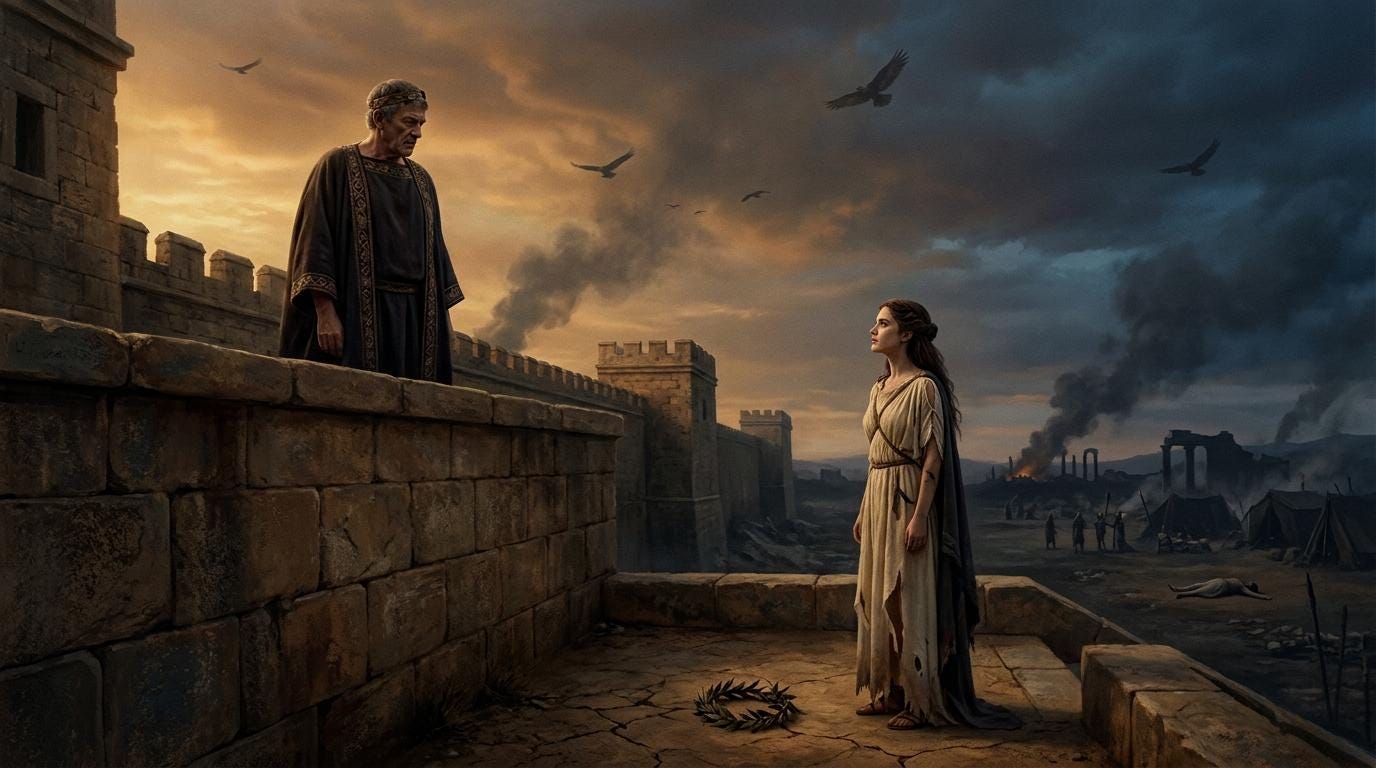
Two men are standing in a city smoking, with a military conflict taking place. One has recently been its king. The other is a young woman, a niece of that ruler, who has just heard her brother’s body has been left to rot outside the walls. At the end of the day, she will defy the king’s edict. At the end of the play, he and she will not be able to get over what happens next. Antigone was written by Sophocles approximately 2500 years ago and the clash between family duty and the duties of the state it portrays is not a new one and has not lost its relevance over the centuries. As it stands today, it’s more of a play written to represent any time private conscience meets public power; what that looks like for the individual, and what it looks like for the society.
The Conflict That Sets Everything in Motion
Antigone’s organization is very efficient. Born of the marriage of Oedipus and Jocasta, two brothers, Eteocles and Polynices, fought each other in a war that just ended, killing one another on opposing sides. The members of the family are their sisters, Antigone and Ismene, Oedipus and Jocasta’s children, and their uncle, Creon, who is now the new king. This is a family where Oedipus is both the father and the former king, and Jocasta is the mother, implying the traditional roles in the family. The tragedy centers on the love-hate relationship among these siblings, sisters, brothers, an uncle, a father, and a mother. This is because the terms used to refer to these relationships, sister, brother, uncle, etc., are essential to comprehend the familial relationships and conflicts.
The new king and uncle of the dead men, Creon, orders that Eteocles will be honored when he is buried, and that Polynices, the “traitor,” will be disinterred. In Greece this was not just a political punishment. Forbidding burial rites meant a soul would wander without finding its way to the underworld. Wisely, as religionists, Creon’s edict was an act of cruelty beyond death.
This is not acceptable to Antigone, the sister of the dead men. She says she’s insisting her brother be buried, even though the law says it’s a crime. Her sister Ismene appeals to her to think realistically, to take into account the expense. Antigone will not. The rest of the tragedy is a result of that one choice.
Two Kinds of Law
What keeps the play alive is that neither of the two characters are clearly “evil. Creon embodies the rule of the state, the need for order and harmony following the chaos, and the fact that a weak ruler begets more violence. Antigone embodies the unwritten laws, the elder laws of family, of the dead, and of the gods. All of them are standing up for a legitimate cause. They are also unaware of the validity of what the other side is defending, which is why it is crucial to have both sides understand each other in the conflict.
This is the backbone of the tragic structure of Sophoclean tragedy. But it is not a battle between good and evil, but a battle between two goods that are incompatible in this context, even though both kinds of law are present in society at the same time. The audience is made aware of the wider consequences of the conflicts between the state and family obligations, as the characters of the state and family are created in part by the interaction of the two. The public is invited not to take sides, but to experience the impossibility to take sides.
Antigone as a Study in Moral Conviction

One of the most unyielding characters in Greek tragedy is Antigone. She is not afraid to take a risk. She won’t bargain. She is caught and is brought in front of Creon and does not deny what she’s done. She tells him straight, almost challenging him to make his own rule.
Antigone has a strong sense of responsibility to her family and the gods, and she would feel deep shame at not honoring her brother. This feeling of guilt and responsibility influences her decisions and emphasizes the emotional consequences. Antigone is a direct cause in the actual tragedy that unfolds, for by not capitulating she is causing a chain of events that’s affecting everyone. Her decisions are key to her character as well as the plot and show how one’s conscience can be a source of honor and destruction to family and society.
Her character is admired and even heroic by some readers. She is seen as stiff by others; maybe even self-destructive. The play can be performed in either reading. Only she knows that she has come to the realization that there are some principles that are more important than her life, and she won’t have any part of anyone, even her own sister, telling her otherwise. This is why she’s a threat to Creon and to herself.
The Cost of Certainty
Her principle’s cost is not only her own death, but a domino effect that ensnares Creon’s family as well. While Oedipus’s daughter Antigone stands steadfast against her doom, her actions bring great tragedy. His son Haemon, who is to be married to Antigone, kills himself in grief. He is followed by his wife Eurydice. At the end of the play, Creon is alive but shattered, as the winner of the argument, he has lost all else, and no peace or quiet for the rest of his family.
The term conviction is not a sinful thing that Sophocles is condemning. He is demonstrating the price of having two convictions that come into conflict with each other, neither of which is willing to give up. It is not a tragedy for one side to be right. The problem is they’re both right, and they’re both wrong.
Creon and the Trap of Power
Creon is sometimes interpreted solely as a tyrant, but the play presents a more nuanced character. He is a moderately sensible man in the beginning, thinking of the law and authority and playing the game of law in a semi-lawyer’s fashion (the belief that every detail of law should be followed strictly, that “rules” are more important than human consideration, that “law” is more important than “civic order”). He is just a man who has inherited a city ravaged by war, and there is reason to suspect that being soft on the warring factions will be interpreted as weakness. It was his error to take care of the state. He has confused the state with himself — that is his error.
Creon’s attitude toward the idea gradually changes, and he begins to protect his own authority instead, just as a lawyer, when he becomes more concerned with winning a case than with the nature of the case. For him, the only thing more embarrassing than being wrong would be to have to admit he was wrong, and if he admits that, then he’s lost power. The trick lies in the trap, and Sophocles paints it in extreme detail. By the time that Tiresias the prophet comes to Creon and foretells his demise, Creon is too far gone to turn around.
Why This Ancient Play Still Speaks
The question that is never answered is why Antigone is still performed, taught, and debated. The play Antigone has been staged and discussed in countries all over the world for decades, with perspectives shaped by diverse cultural contexts and laws. When is it permissible to sacrifice allegiance to family, faith, or conscience for the state? When do we have to obey the law, and when do we have to break the law? This is a conflict that each generation encounters, and the play’s relevance is demonstrated by the number of theaters and educational institutions investing resources and services in performing or teaching it. The importance of location — whether an operable production is set in a historic theater or a modern classroom also shapes the play’s impact. Contemporary productions like the staging of Antigone at Antaeus Theatre Company continue to resonate with modern audiences, who recognize the same collision playing out in their own world and find hope in the play’s meaning or guidance for their lives.
A Mirror for Difficult Moments
In one way or another, whistleblowers, dissidents, COs, and just regular folks who have been inconvenienced by injustice have taken up Antigone’s shoes, exercising their freedom of choice or expression even when it means standing up against family, friends, or society. These conflicts are usually rooted in competing interests, such as individual freedom and public/state interests, and can carry grave physical repercussions for those who speak up for what they believe. So have rulers who, like Creon, believe that anything seen as a concession is a weakness. There is no solution to the play. It provides a reflection, and that reflection is not comfortable for the living memory.
The Lasting Power of an Impossible Choice
Sophocles knew that some collisions can’t be “argued out of the way. When principle meets principle, and one will not bend, the other must bend, and the result is loss, and that is the price we must pay for holding fast to our principle. The play is about two people who prefer to be destroyed rather than concede the legitimacy of the other’s claim, and asks us to contemplate whether it is “bravery gone wrong?” Their reflection on their struggle and what has transpired in the past guides our understanding of conscience and authority in the present. This awareness is very important in developing moral thought because it helps us recognize our place within the wider family of mankind. The question is very old, and is fundamental to all serious discussions of conscience and authority. That’s why Antigone has been read, acted, and debated to this day, and why the cost of principle is one of humanity’s oldest and most needed topics.
메타데이터
- post_id
- 07d44ad6bf85
- slug
- family-state-and-the-price-of-principle-the-collision-at-the-heart-of-antigone-07d44ad6bf85
- url
- https://medium.com/@umairdwg/family-state-and-the-price-of-principle-the-collision-at-the-heart-of-antigone-07d44ad6bf85
- canonical_url
- https://medium.com/@umairdwg/family-state-and-the-price-of-principle-the-collision-at-the-heart-of-antigone-07d44ad6bf85
- author_url
- https://medium.com/@umairdwg
- status
- ok
- fetched_at
- 2026-06-26 21:52:29






