NavBridge: A Deep Dive Into Open-Source NAV Integrity Monitoring for Tokenized Funds
A complete technical walkthrough of the architecture, execution flow, classification engine, policy model, and audit trail in NavBridge and…
NavBridge: A Deep Dive Into Open-Source NAV Integrity Monitoring for Tokenized Funds
A complete technical walkthrough of the architecture, execution flow, classification engine, policy model, and audit trail in NavBridge and why tokenized finance needs a framework like this
Part 1: The Problem This Solves
What Is a Tokenized Fund?
A tokenized fund is a traditional investment vehicle : a money market fund, a treasury fund, an ETF, whose ownership is represented by tokens on a blockchain. BlackRock’s BUIDL, Ondo’s OUSG, Franklin Templeton’s BENJI, and Spiko’s European sovereign instruments are live examples with billions of dollars under management.
The appeal is real: 24/7 transferability, programmable compliance, atomic settlement, and composability with DeFi protocols. A tokenized treasury fund token can be used as collateral in a lending protocol. A tokenized money market fund can settle a DeFi trade. These are not theoretical use cases : they are live.
But tokenization does not eliminate the traditional fund administration machinery. It adds a layer on top of it.
The Two-World Architecture
Every tokenized fund now operates across two parallel data architectures simultaneously.
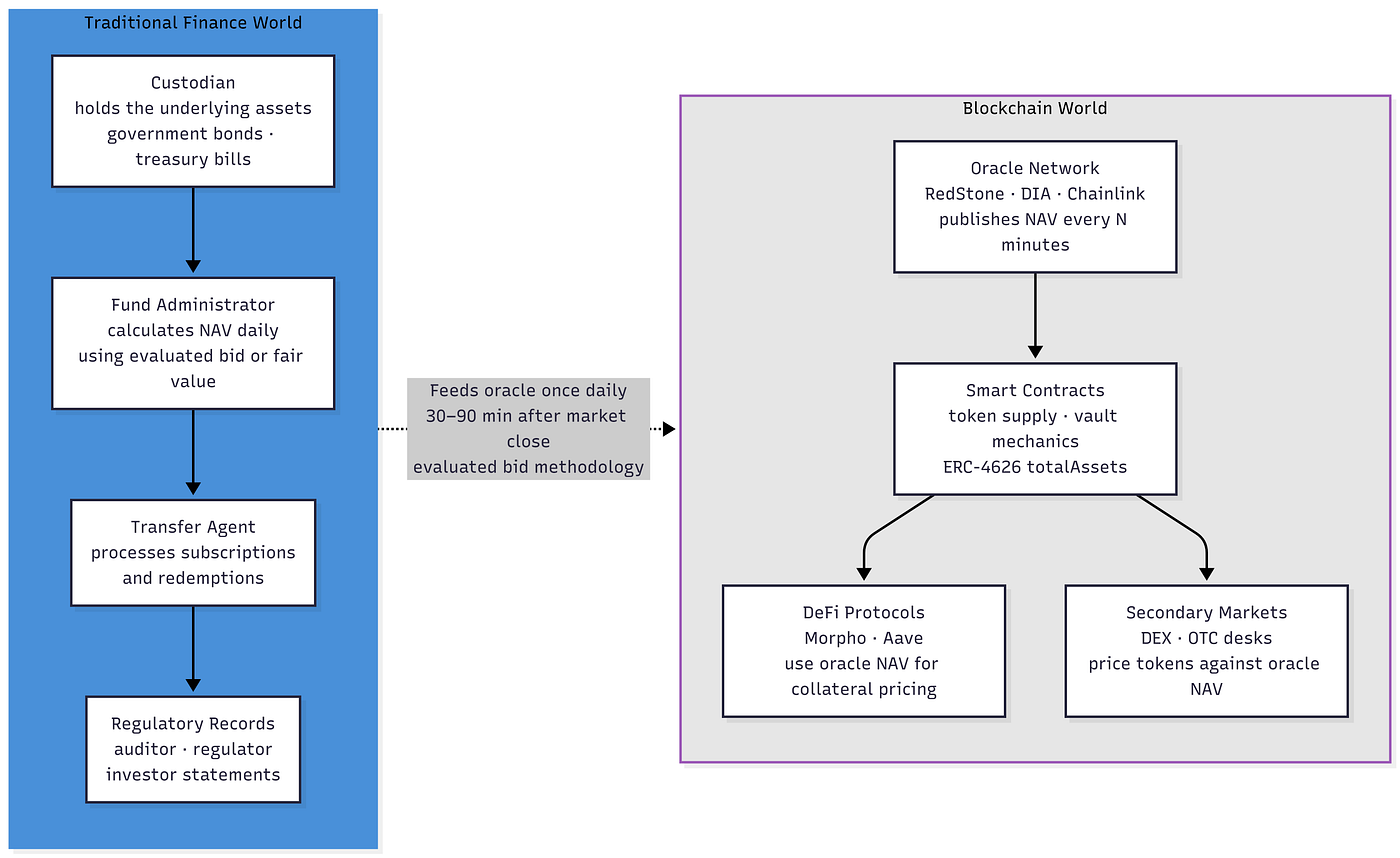
These two worlds run at different speeds, use different pricing methodologies, and have fundamentally different availability characteristics.
The off-chain world operates on a daily rhythm. The fund administrator evaluates prices at market close using the fund’s specific pricing methodology : evaluated bid, mid-market price, or fair value depending on the fund type and jurisdiction. After reconciling against custodian records, the administrator publishes a final, legally binding NAV. This typically happens 30 to 90 minutes after market close. This NAV governs subscriptions, redemptions, regulatory filings, and audit records. It is what the fund is legally worth.
The on-chain world operates continuously. An oracle network aggregates market data from multiple sources, publishes an on-chain NAV every few minutes, and keeps updating 24 hours a day, 7 days a week ; including through nights, weekends, and market holidays when the underlying assets are not trading and the off-chain administrator NAV has frozen at Friday’s close.
The Gap That Emerges
These two systems cannot agree on the same NAV at the same timestamp. They were never designed to.
The result is a persistent divergence between what the oracle says the fund is worth and what the fund administrator has officially calculated. This divergence is not random noise. It has identifiable structure, predictable patterns, and specific causes that repeat across fund types.
Most institutions handle this with proprietary internal reconciliation scripts. Some handle it informally. Almost none handle it with a documented, reproducible classification framework that produces an audit trail.
That is the gap **NavBridge** addresses.
Part 2: Key Concepts Before The Architecture
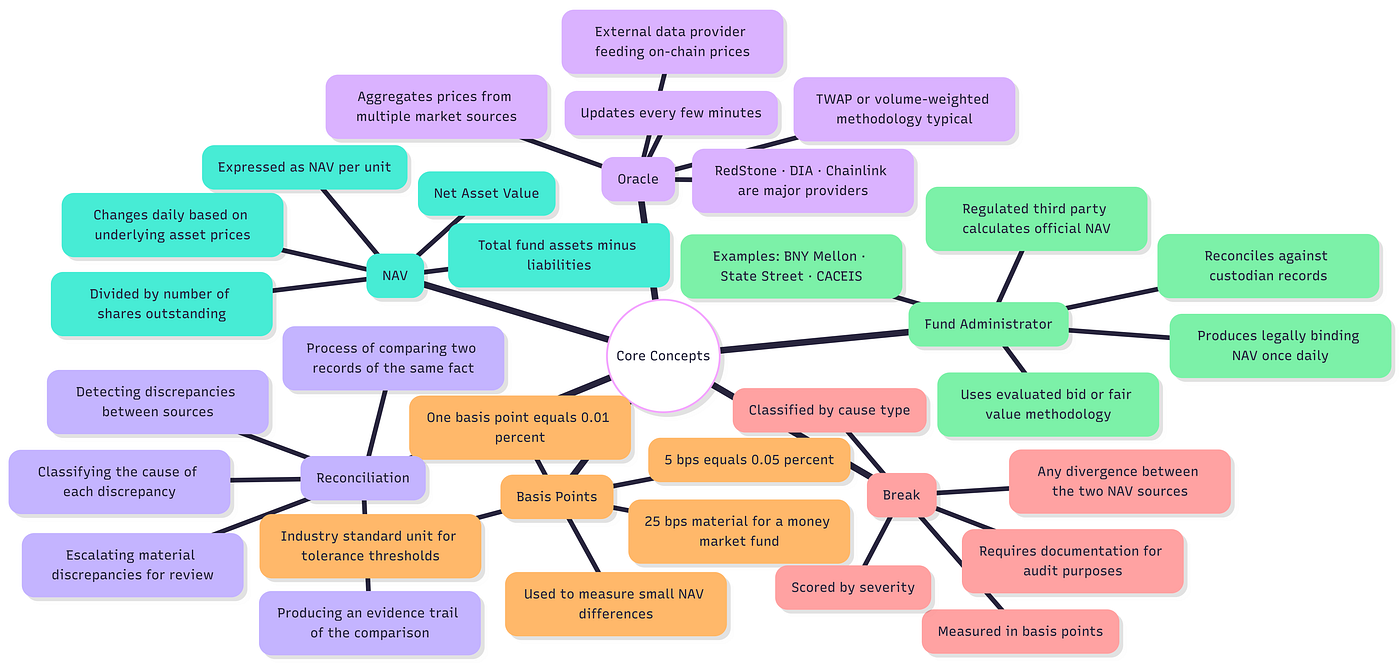
Before diving into how NavBridge works, it helps to have these terms precisely defined. They appear throughout the architecture.
Part 3: Why Existing Infrastructure Doesn’t Solve This
This is a question worth asking directly, because the RWA tooling ecosystem is not empty.
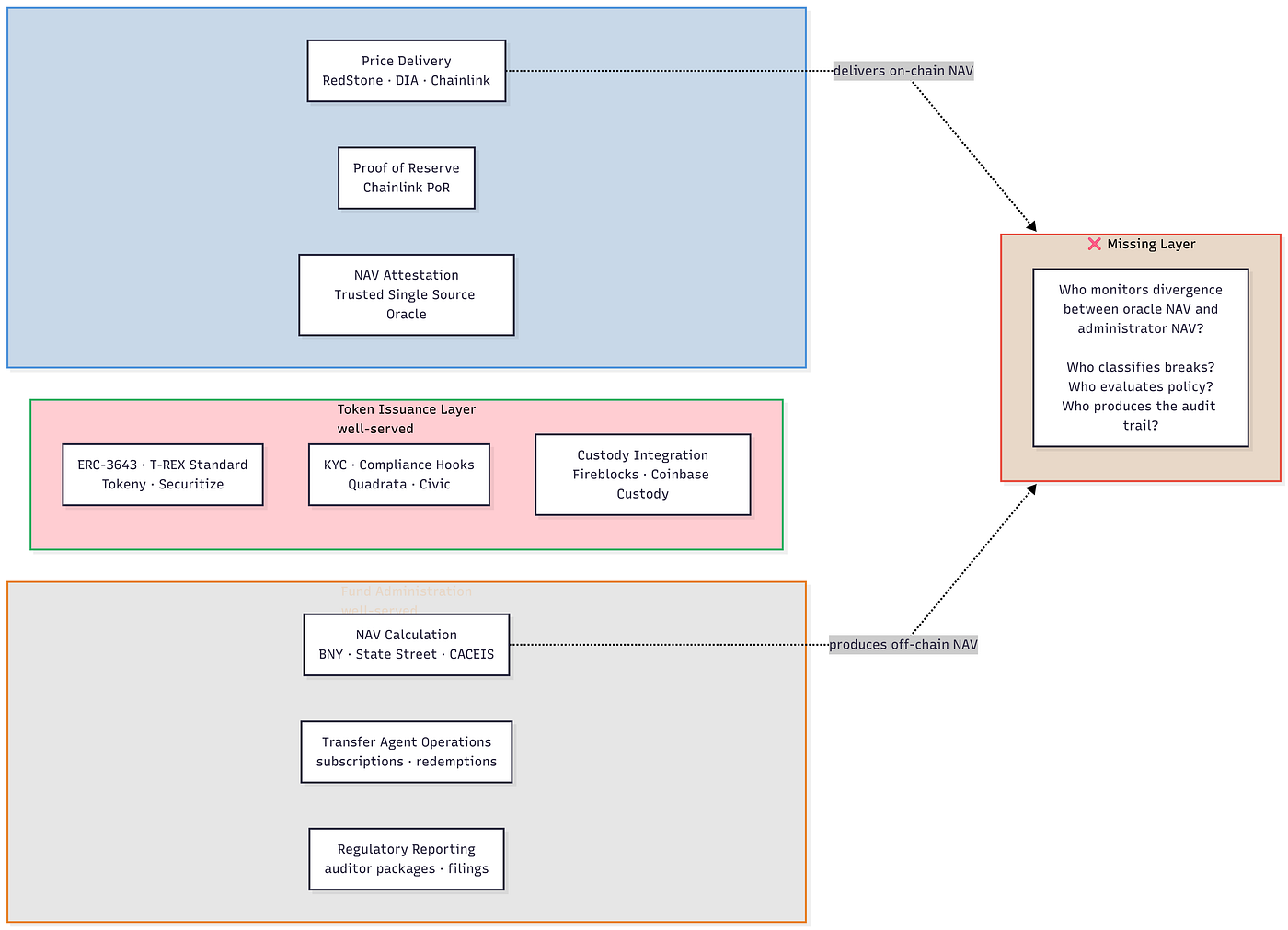
Each layer solves its own problem well. The token issuance layer handles compliance-grade token creation. The oracle layer handles data delivery and proof of reserve. The fund administration layer handles the daily NAV lifecycle and regulatory reporting.
None of them answer the question: Is the number the oracle is publishing sufficiently close to the number the fund administrator calculated and if not, why, with what severity, evaluated against what policy, with what evidence?
That question is a monitoring and control problem, not an issuance problem and not a data delivery problem. It sits between the oracle layer and the fund administration layer. No existing open-source tool addresses it.
Part 4: NavBridge: One-Page Architecture
Before going deep on each component, the complete system in one view.
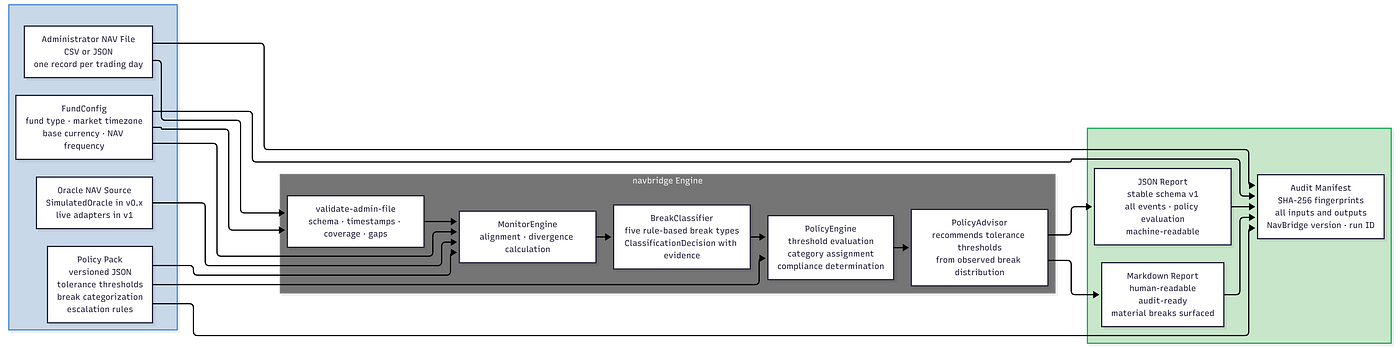
NavBridge is a Python library and CLI. It has no web frontend, no database, no authentication layer. Those are deliberate absences, not gaps. The value is in the monitoring and classification logic, not in a dashboard. The outputs are files : JSON, Markdown, and a manifest which integrate cleanly into any downstream workflow: CI pipelines, audit archives, risk dashboards, alerting systems.
Part 5: The Complete Execution Flow -Step by Step
This is the part most explanations skip. Here is exactly what happens from the moment a navbridge monitor command is invoked to the moment output files are written.
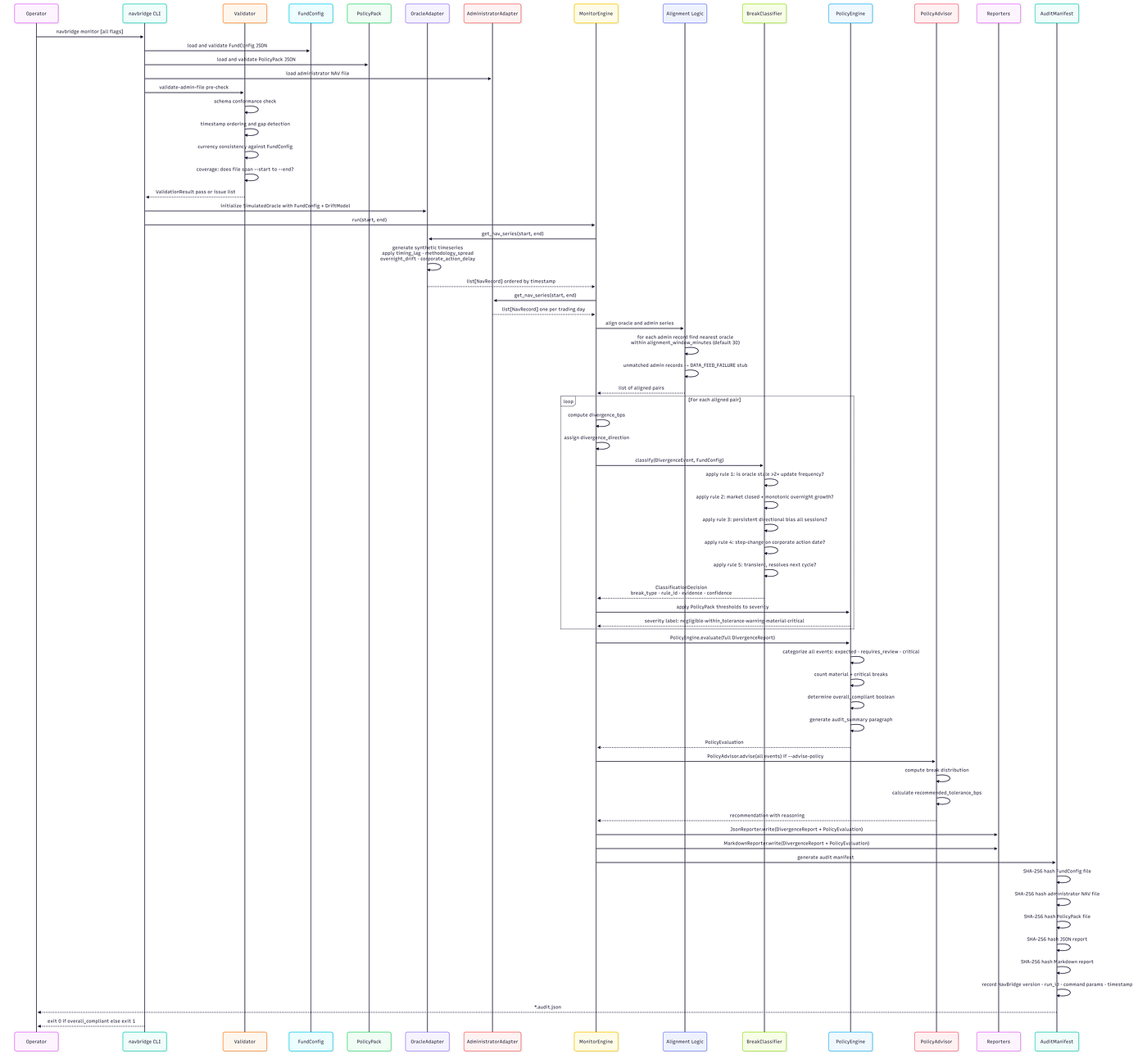
Two steps in this flow deserve special attention because they are where most informal reconciliation approaches fail.
Validation before computation. NavBridge runs a pre-flight check on the administrator NAV file before any divergence calculation begins. A malformed input file : missing timestamps, wrong currency, gap in coverage , that gets silently processed produces results that look authoritative but aren’t. The validation step is explicit, produces a typed result, and can be run independently as navbridge validate-admin-file before any monitoring run. The output includes a JSON list of issues, each with a code, field, message, and severity.
Classification evidence embedded in every event. Each divergence event in the output includes not just a break type label, but the classification_rule_id (which of the five rules fired), and the classification_evidence (the exact observed values and thresholds that triggered the rule). A reviewer, auditor, or engineer can read exactly why the classifier assigned a particular label — not just that it did.
Part 6: The Data Model : From Raw Data to Classified Event
Understanding what data flows through the system makes the architecture concrete.
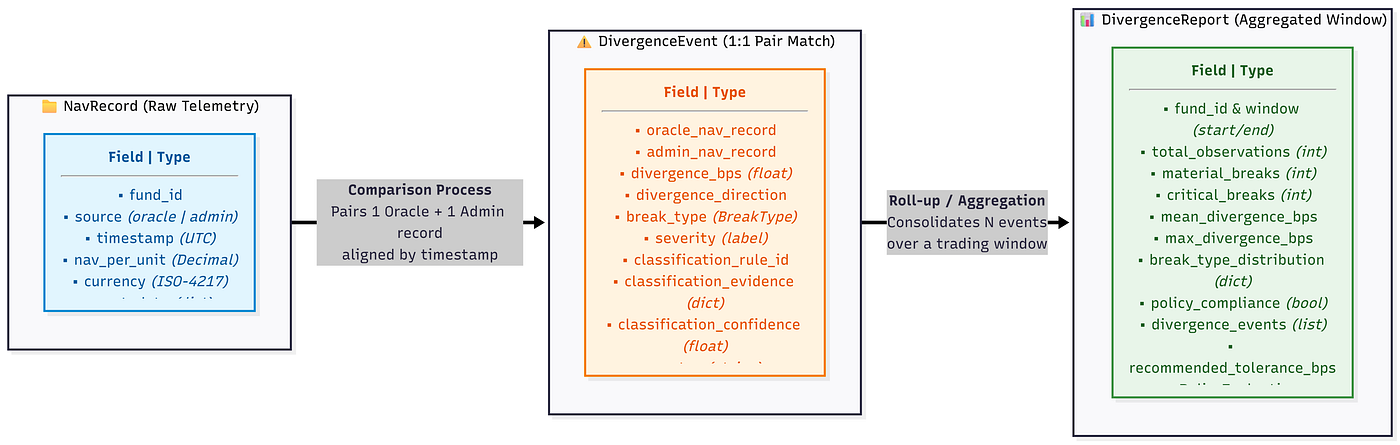
Every NavRecord carries its source label — oracle or administrator — and a metadata dictionary. For oracle records, the metadata contains the oracle feed ID and any relevant update transaction reference. For administrator records, it contains the source file name and the pricing methodology used (evaluated bid, mid, fair value). This matters for classification: a persistent divergence where the oracle uses mid-market and the administrator uses evaluated bid is a METHODOLOGY_DRIFT break, and the metadata provides the evidence.
Part 7: The Classification Engine — Five Rules, All Deterministic
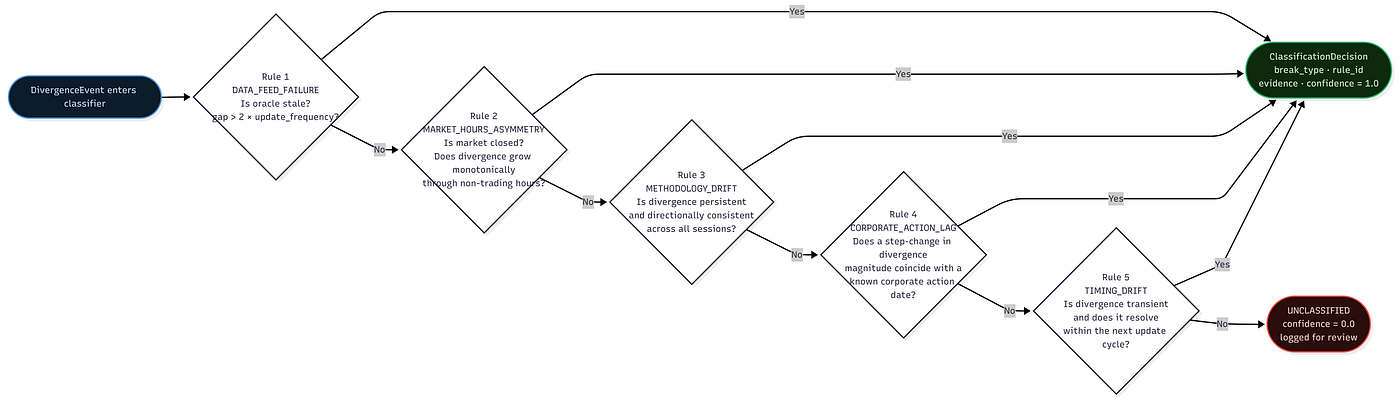
The BreakClassifier is the intellectual core of NavBridge. It assigns a cause type to every divergence event using five rule-based conditions applied in order. No machine learning. No probabilistic scoring. The same input always produces the same output.
This is a design choice, not a limitation. Audit systems require deterministic outputs. A classification that cannot be traced to a specific rule with specific observed values is not a classification — it is a black box, and black boxes do not survive audit examination.
The Five Break Types in Detail
Each break type has a distinct operational signature, a detection condition, and a specific institutional consequence.
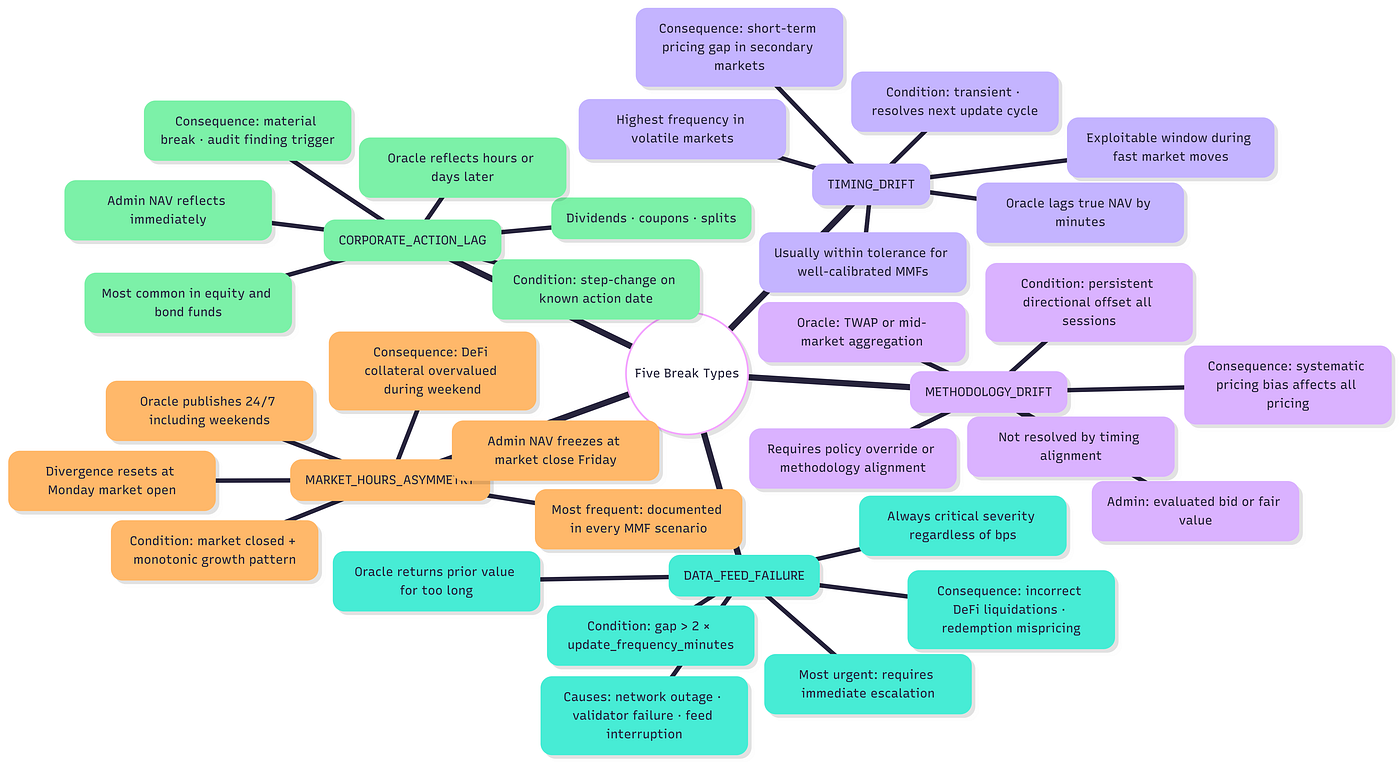
DATA_FEED_FAILURE is the highest-severity break type regardless of its basis-point magnitude. An oracle returning yesterday’s price is not a small divergence ; it is a complete failure of the data layer. The detection condition is simple: if the oracle has not updated for more than twice the expected update frequency, the event is flagged as a feed failure. This is the scenario where DeFi protocols accept stale NAV as collateral valuation, leading to incorrect liquidation thresholds. In the NavBridge market hours scenario, a four-hour outage on Day 8 produces a DATA_FEED_FAILURE at critical severity regardless of how many basis points separate the stale price from the administrator's NAV.
MARKET_HOURS_ASYMMETRY is the most predictable break type and the most common in money market fund monitoring. The oracle publishes continuously including Saturday morning when the administrator’s NAV has been frozen since Friday at 16:30. The detection condition is a market-closed timestamp combined with a monotonically growing divergence pattern through non-trading hours. In the NavBridge MMF scenario, this produces nine classified events across two weekends, all within tolerance, all correctly categorized, with the documented pattern that a DeFi protocol risk team can review and reason about.
METHODOLOGY_DRIFT is the subtlest break type and the one most often ignored in informal reconciliation. When an oracle uses TWAP or volume-weighted mid-market pricing and the fund administrator uses evaluated bid methodology, there is a structural offset between the two NAVs that persists across every session : not just overnight, not just at weekends, but continuously. The detection condition is a persistent, directionally consistent divergence that does not resolve with timing alignment. This type requires either a policy that acknowledges the offset or an alignment of pricing methodology between the oracle and administrator. In the real MMF scenario sample output from the NavBridge README, methodology drift accounts for 22 of 31 events (71%), with a mean divergence of 0.80 bps well within tolerance, but persistent.
CORPORATE_ACTION_LAG produces the most visible breaks in fixed income and equity funds. When a fund pays a coupon or dividend, the fund administrator reflects it immediately in the NAV calculation. The oracle, dependent on market data aggregation, may take hours to reflect the same event. The detection condition is a step-change in divergence magnitude on or around a known corporate action date. In the NavBridge treasury fund scenario, a coupon payment on Day 15 produces a six-hour divergence classified as corporate action lag at material severity : the kind of break that appears in fund launch audit reports.
TIMING_DRIFT is the highest-frequency break type in live fund operations and the least severe. When an oracle update lags the true NAV by 20 minutes during a period of market volatility, there is a temporary divergence that closes at the next update cycle. The detection condition is a transient divergence that resolves without policy intervention. Most well-calibrated funds classify timing drift as within-tolerance and document it as expected.
Part 8: The Policy Engine : Mechanism vs. Policy
This is the architectural decision that distinguishes NavBridge from a monitoring script. The separation of mechanism from policy is what makes the framework institutionally reusable.
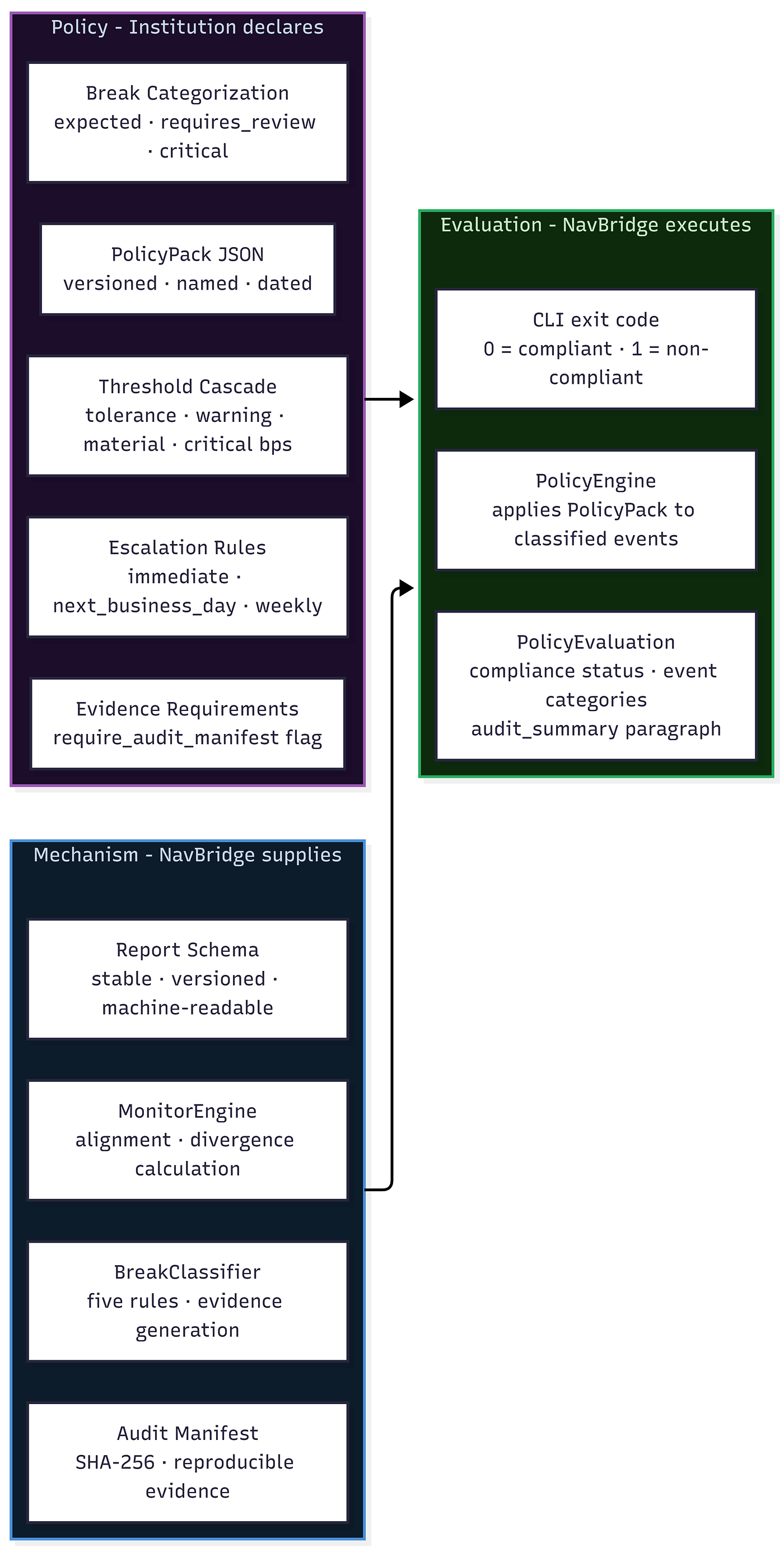
The mechanism is the same for every fund. The five classification rules, the alignment logic, the report schema : these do not change between a tokenized money market fund and a tokenized treasury fund.
The policy is different for every fund, every institution, and every jurisdiction. A money market fund targeting a $1.00 stable NAV has a materially tighter tolerance than a tokenized equity ETF where bid-ask spread methodology differences are an expected and documented source of divergence. A fund subject to MiCA Article 35 has different reconciliation documentation requirements than one subject to GENIUS Act reserve attestation.
NavBridge supplies the mechanism. The institution declares the policy in a versioned Policy Pack JSON file. The engine evaluates observations against the declared policy and produces a compliance determination.
What a Policy Pack Looks Like
{
  "name": "NavBridge Reference Policy — Tokenized MMF v1.0",
  "version": "1.0.0",
  "fund_type": "money_market",
  "effective_date": "2026-01-01",
  "thresholds": {
    "tolerance_bps": 5,
    "warning_bps": 8,
    "materiality_bps": 10,
    "critical_bps": 25
  },
  "break_rules": {
    "expected": ["MARKET_HOURS_ASYMMETRY", "TIMING_DRIFT"],
    "requires_review": ["METHODOLOGY_DRIFT", "CORPORATE_ACTION_LAG"],
    "critical": ["DATA_FEED_FAILURE"]
  },
  "evidence": {
    "require_audit_manifest": true
  },
  "escalation": {
    "critical": "immediate",
    "material": "next_business_day",
    "warning": "weekly_review"
  }
}
Every field is explicit and purposeful:
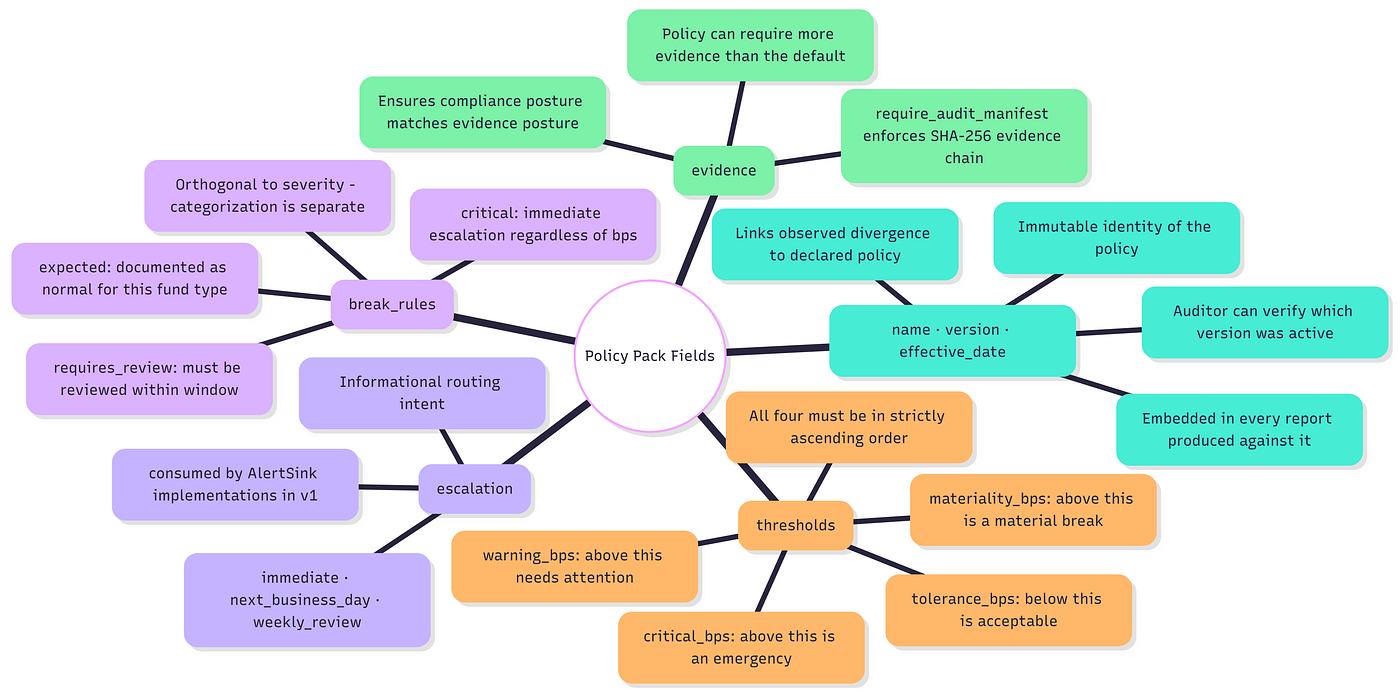
NavBridge ships with two reference policy packs: policies/tokenized_mmf_v1.json for money market funds and policies/tokenized_treasury_v1.json for treasury and bond funds. These are starting points, institutions copy them, adjust thresholds for their specific fund parameters, and version them as their own policy artifact.
Part 9: The Audit Manifest : Evidence That Holds Up
The audit manifest is generated by passing --audit-manifest to navbridge monitor. It is a JSON file that SHA-256 fingerprints every input and output of the monitoring run.
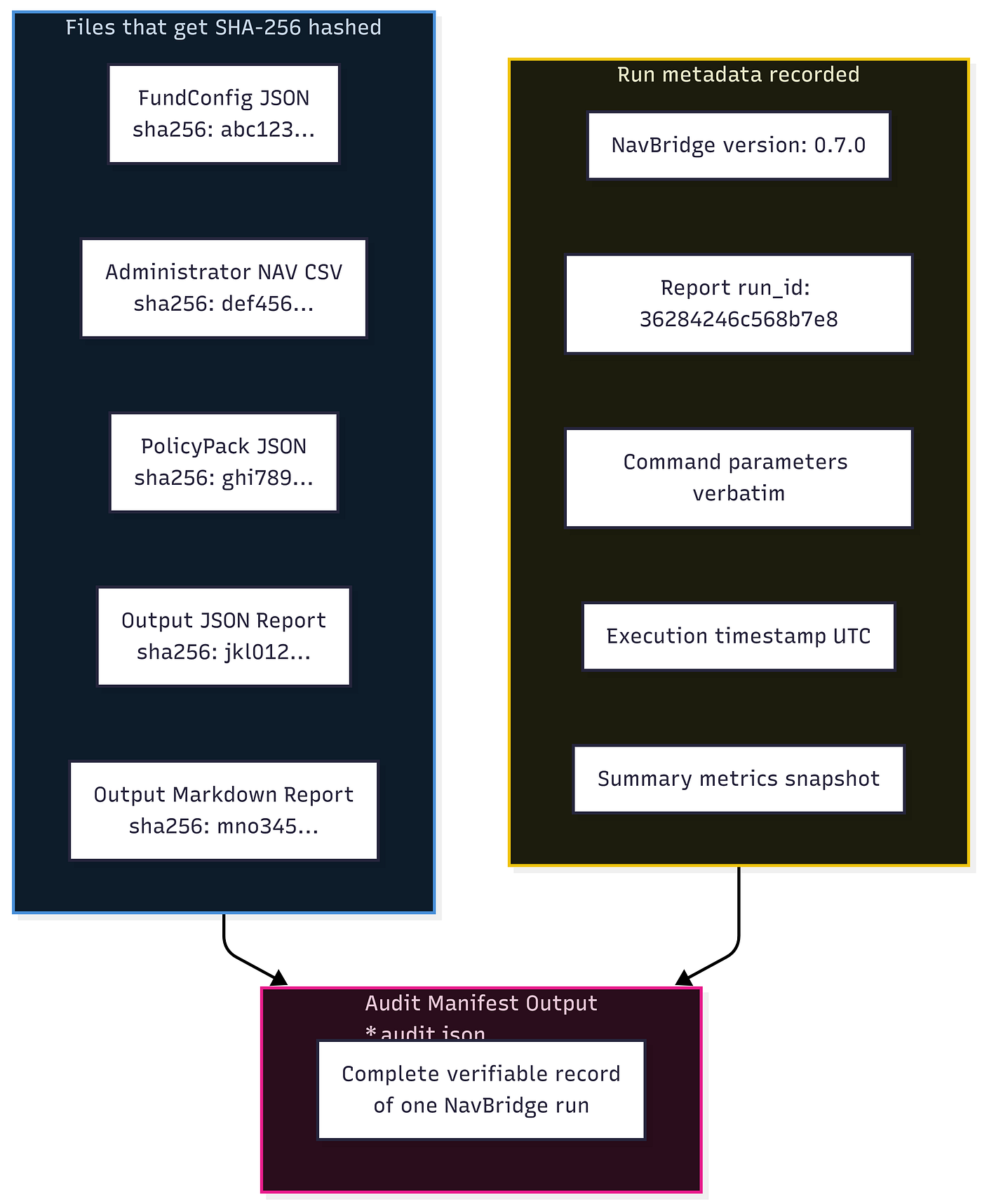
The manifest answers a specific question that arises in audit contexts: “How do I verify that this report was produced from the inputs you claim, and that neither the inputs nor the outputs were modified after the fact?”
An auditor receiving a NavBridge manifest can independently recompute the SHA-256 hash of the administrator NAV file and verify it matches the recorded hash. They can verify the JSON report hash. They can confirm the NavBridge version. The run ID ties all artifacts together. Nothing about the manifest requires trusting the reporting party — it is independently verifiable.
This is two lines of hashlib.sha256 in Python. The implementation is trivial. The institutional value is not: it closes the evidence chain between the monitoring run and the audit record.
When evidence.require_audit_manifest is set to true in the Policy Pack, NavBridge enforces that the manifest is generated before the run is considered complete. The policy itself requires the evidence.
Part 10: Batch Monitoring : Portfolio-Level Operations
For a fund administrator or protocol risk team monitoring multiple funds, individual navbridge monitor runs can be orchestrated through navbridge batch.
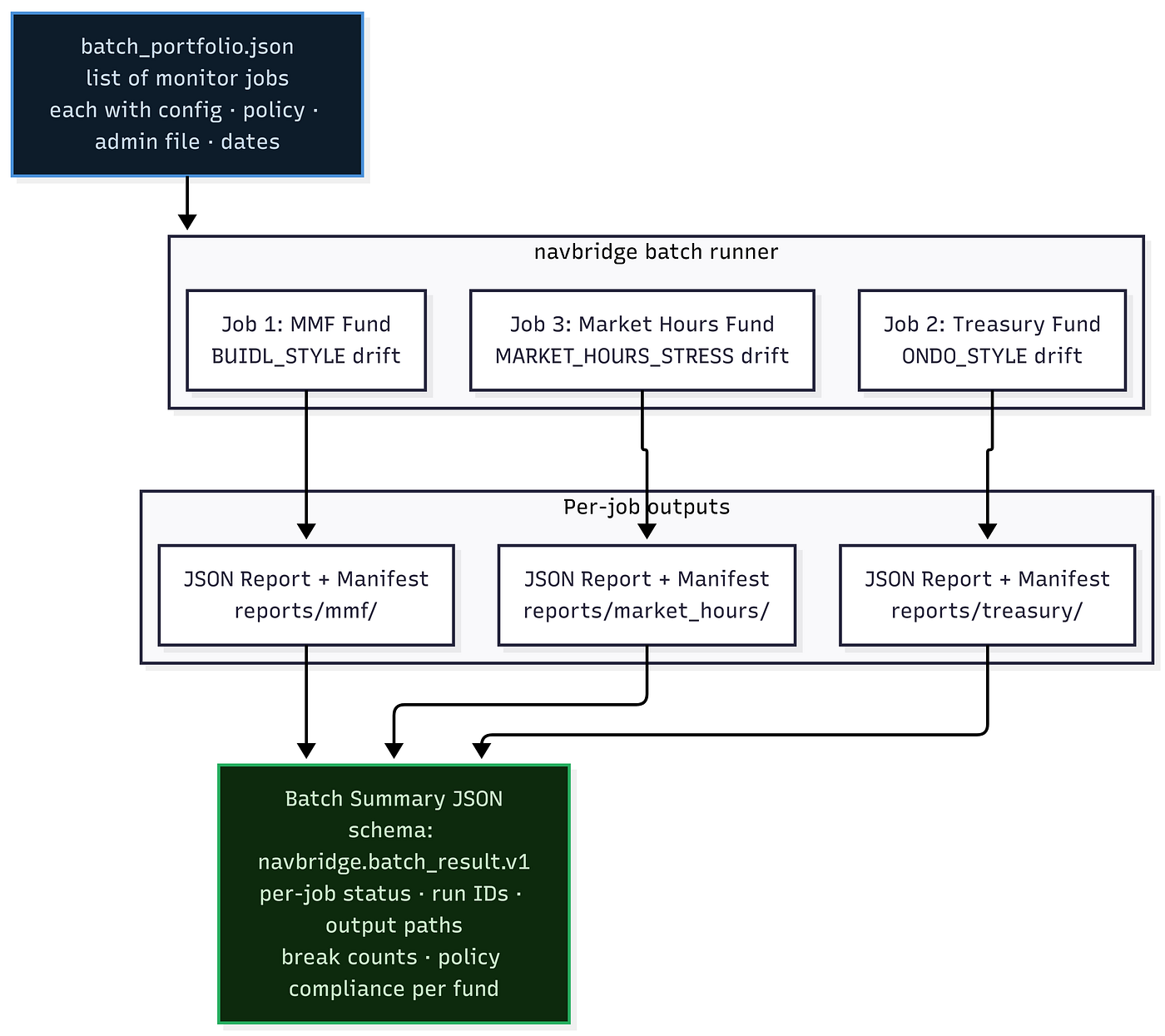
The batch summary JSON uses schema version navbridge.batch_result.v1 and records per-job status (success or failure with error detail), report run IDs, output paths, material break counts, and policy compliance status for each fund. Failed jobs do not halt the batch — they are recorded in the summary with their error and the remaining jobs continue.
This makes NavBridge usable in a daily monitoring workflow: a fund administrator running NavBridge in a CI pipeline can execute the batch against a portfolio of funds, check the summary for any non-compliant evaluation, and route the per-fund manifests to an evidence archive : all from a single command.
Part 11: The Three Reference Scenarios
NavBridge ships with three complete, runnable scenarios. Each one is designed to produce a specific, recognizable pattern of divergence that maps to a real operational situation.
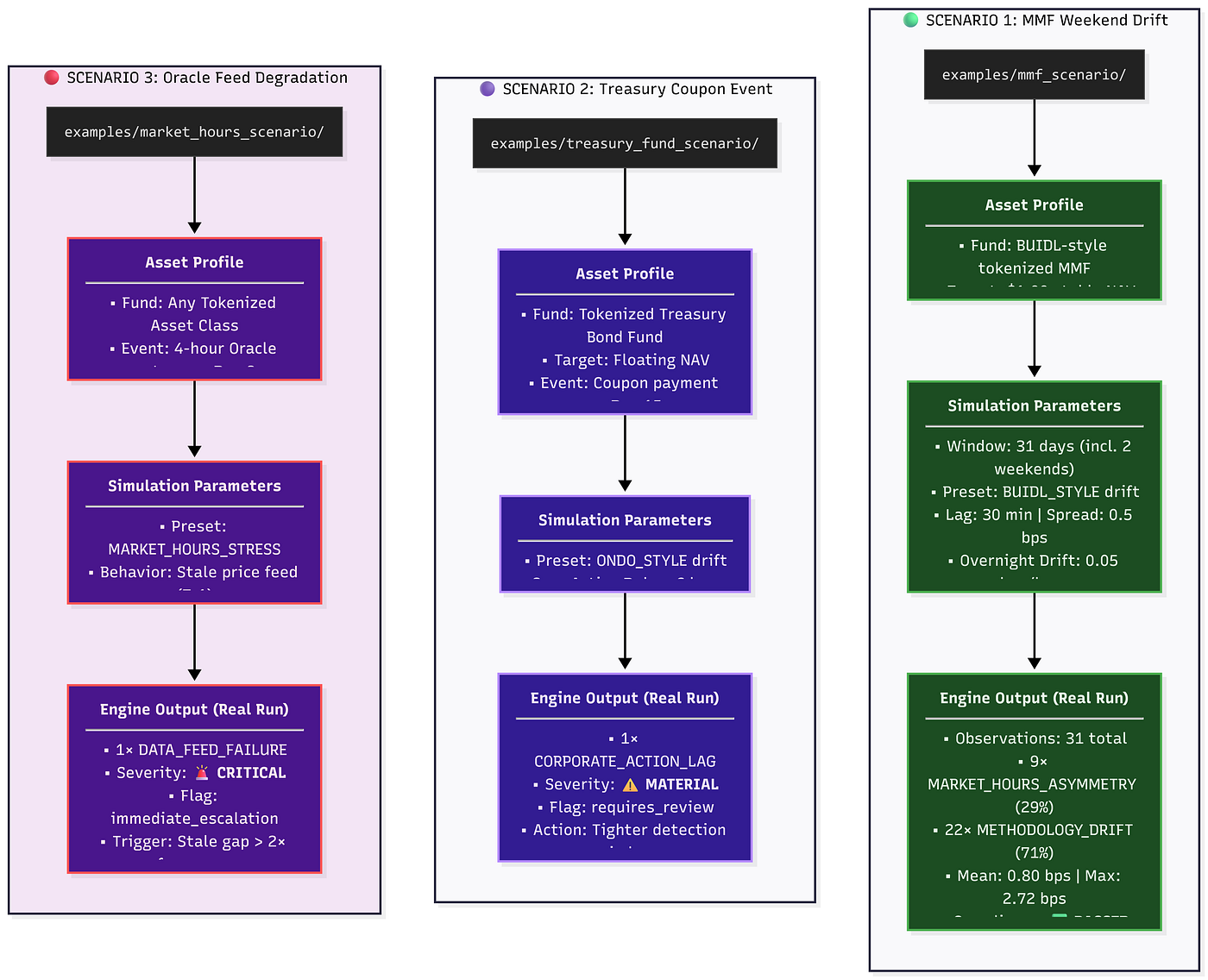
The real report sample in the NavBridge README is the Scenario 1 output. The numbers in that sample are not illustrative — they are produced by running python examples/mmf_scenario/run.py against a 31-day window with the BUIDL_STYLE drift preset. 31 observations. 744 oracle records read. 31 administrator records read. 0.80 bps mean divergence. 2.72 bps maximum. Zero material breaks. Policy compliant.
The value of Scenario 1 is not that it finds a problem. It is that it demonstrates documented compliance. A fund team can run this against their own administrator NAV data, configure the Policy Pack to their tolerance parameters, and produce a monthly report showing that NAV divergence was monitored, classified, and within policy. That document with its audit manifest is what regulators under MiCA and institutional reviewers are beginning to ask for.
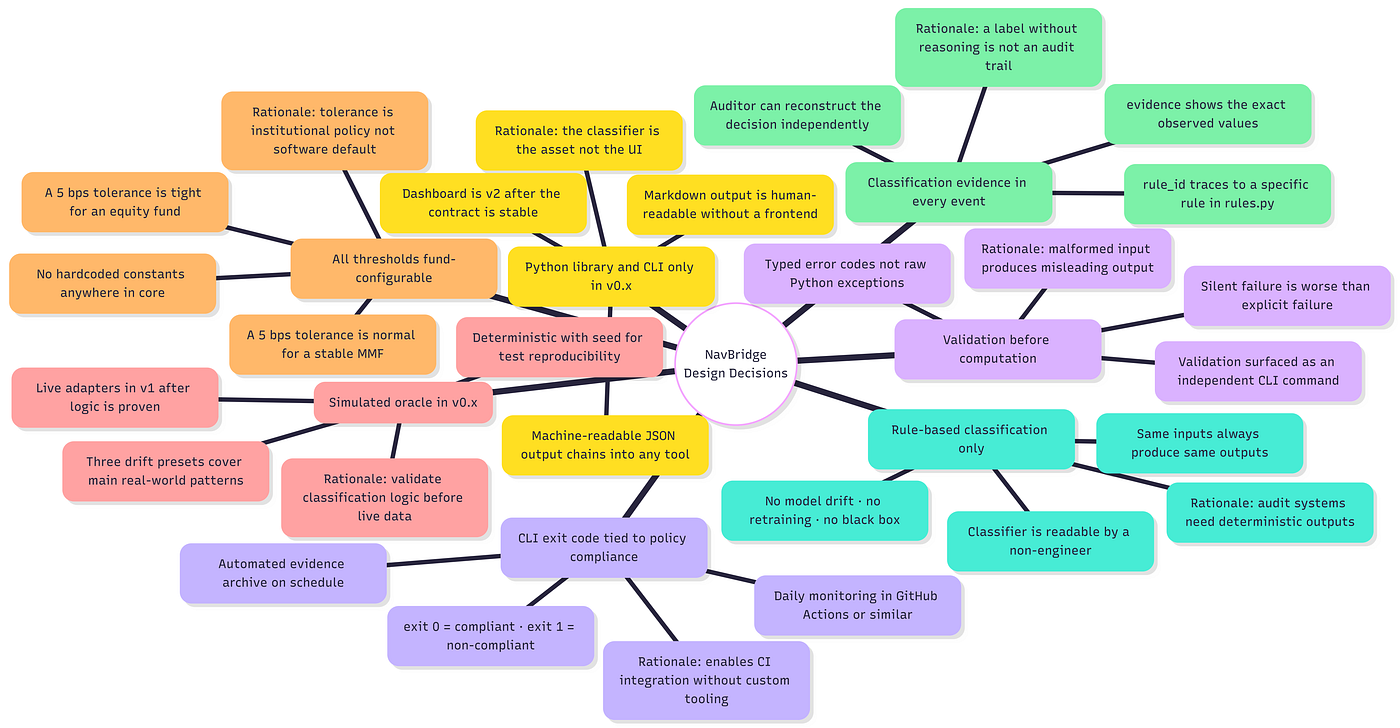
Part 12: The Key Design Decisions
These are not implementation details. They are architectural choices, each with a specific rationale.
Part 13: What NavBridge Is Not
This section belongs in the article because the boundaries are as important as the capabilities.
NavBridge is not a fund accounting system. It does not calculate NAV ; it monitors the divergence between two NAV sources that are calculated by other systems.
NavBridge is not an oracle provider. It does not deliver on-chain prices. RedStone, Chainlink, and DIA do that. NavBridge monitors what those systems produce against the off-chain administrator record.
NavBridge is not a token issuance framework. It has no opinion on ERC-3643, transfer agents, or compliance KYC layers.
NavBridge is not a custody platform. It does not verify custodian records independently.
NavBridge does not certify regulatory compliance. It produces structured evidence that human review processes and qualified legal counsel work with to make compliance determinations.
These are not gaps in the framework. They are scope decisions that keep NavBridge focused on a specific, well-defined problem and that make it possible to evaluate, integrate, and audit as a standalone control layer.
Part 14: The Regulatory Context
The timing of this problem is not accidental.
MiCA Title III Article 35 requires reserve assets for e-money tokens to be reconciled against the issuer’s records on a daily basis, with discrepancies identified and resolved without undue delay. MiCA Title IV Article 45 extends the same obligation to asset-referenced tokens. The GENIUS Act, signed in July 2025, mandates monthly reserve attestation with documented reserve composition for payment stablecoins. IOSCO’s 2024 consultation paper on tokenized securities recommends that market participants demonstrate NAV integrity controls as a condition for institutional participation.
None of these frameworks define what NAV integrity monitoring infrastructure must look like. They define outcomes: daily reconciliation, documented discrepancy resolution, evidence retention. NavBridge produces outputs aligned to those outcomes: classified divergence records, policy compliance evaluations, and SHA-256 audit manifests.
Part 15: The Roadmap
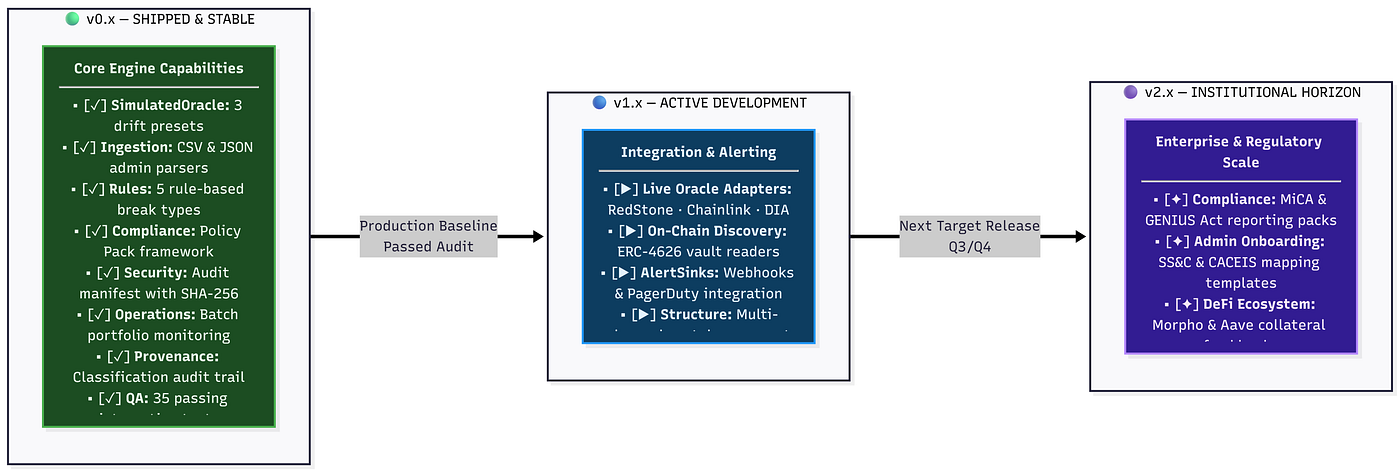
The live oracle adapters in v1 are a two-hour integration once the classification logic is validated. The oracle adapter interface is already defined, any implementation of OracleAdapter.get_nav_series() plugs in without changing the monitor engine or classifier. The ERC-4626 vault reader goes directly on-chain to read totalAssets() and totalSupply() from a tokenized vault contract, computing NAV without an oracle intermediary. The regulatory report packs in v2 format divergence documentation for specific regulatory submission requirements.
What is explicitly not on the roadmap: ML classifiers, web dashboards, trading or portfolio management, token issuance, or cloud deployment tooling. The scope is maintained because the framework’s value is in the monitoring and classification layer. Expanding into adjacent categories would undermine the focused, auditable design that makes institutional evaluation tractable.
Quickstart
git clone https://github.com/vishnugovind10/navbridge
cd navbridge
pip install -e ".[dev]"
# Validate your administrator file first
navbridge validate-admin-file \
--config examples/mmf_scenario/config.json \
--admin-file examples/mmf_scenario/administrator_nav.csv \
--start 2026-01-01 --end 2026-01-31# Run the full monitoring workflow
navbridge monitor \
--config examples/mmf_scenario/config.json \
--policy-pack policies/tokenized_mmf_v1.json \
--oracle simulated \
--drift-model BUIDL_STYLE \
--admin-file examples/mmf_scenario/administrator_nav.csv \
--start 2026-01-01 --end 2026-01-31 \
--output-json reports/mmf_january.json \
--output-md reports/mmf_january.md \
--audit-manifest reports/mmf_january.audit.json \
--advise-policy# Run all three reference scenarios
python examples/mmf_scenario/run.py
python examples/treasury_fund_scenario/run.py
python examples/market_hours_scenario/run.py# Batch: monitor a portfolio
navbridge batch \
--file examples/batch_portfolio.json \
--summary-json reports/batch_summary.jsonAll tests: pytest -q — 35 passing.
The repository is at github.com/vishnugovind10/navbridge. MIT license. Issues, oracle adapter contributions, and scenario additions are welcome; particularly around ERC-4626 vault readers and multi-share-class fund structures, which are v1 priorities.
메타데이터
- post_id
- 07d477cd43e8
- slug
- navbridge-a-deep-dive-into-open-source-nav-integrity-monitoring-for-tokenized-funds-07d477cd43e8
- url
- https://blog.blockmagnates.com/navbridge-a-deep-dive-into-open-source-nav-integrity-monitoring-for-tokenized-funds-07d477cd43e8
- canonical_url
- https://blog.blockmagnates.com/navbridge-a-deep-dive-into-open-source-nav-integrity-monitoring-for-tokenized-funds-07d477cd43e8
- author_url
- https://medium.com/@vishnugovind10
- status
- ok
- fetched_at
- 2026-07-11 10:04:19