Bob Davids
SABR Founder 100 Today
Bob Davids
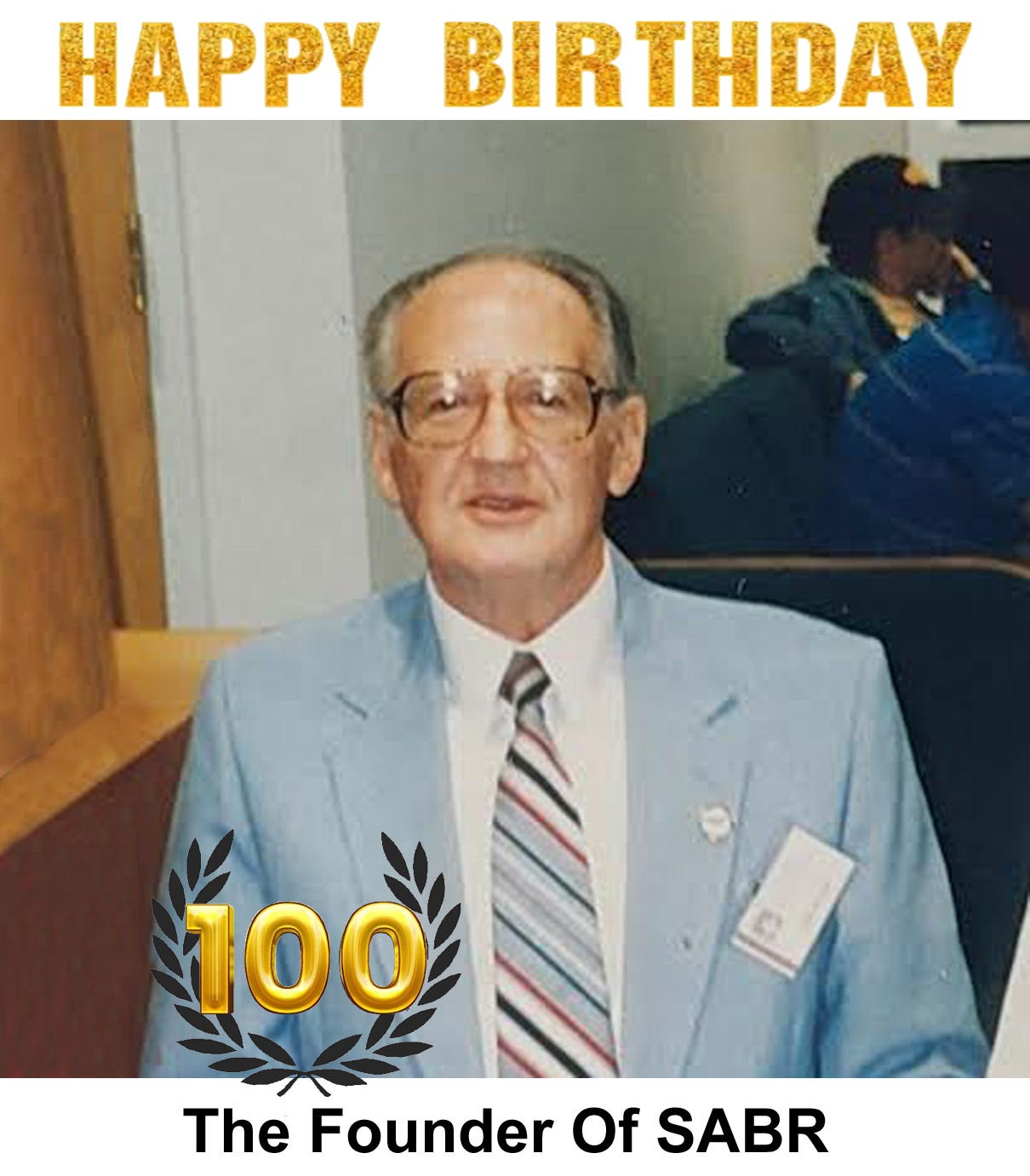
Today is Bob Davids’ 100th birthday, although he passed 24 years ago. SABR is the Society of American Baseball Research. This essay was meant to capture Davids’ energy for the younger members of the organization. This originally appeared as “SABR Sire Called Out, Team’s Tots to Take Torch” for the 2002 SABR National Convention in Boston.
n June of 1930 a 15-year old boy reached across the railings of the press area at Redland Field and handed Cincinnati Enquirer sportswriters Tom Swope and Jack Ryder a note. The boy had counted the pitches of that day’s game and, after a chuckle, the sportswriters made it a regular feature in their columns. That boy’s name was Lee Allen, and what he did over the next forty years did much to give baseball fans what they have today: a baseball encyclopedia and a Hall-of-Fame library.
But in 1969 Allen died. Numbers in the new encyclopedia hung alone when his gregarious storytelling should have filled the air. So too The Sporting News, long the bible of baseball, scaled back it’s baseball coverage that it might devote equal time to other sports. A scattered diaspora of statistically minded baseball writers recoiled to their day jobs; their hometowns; their families.
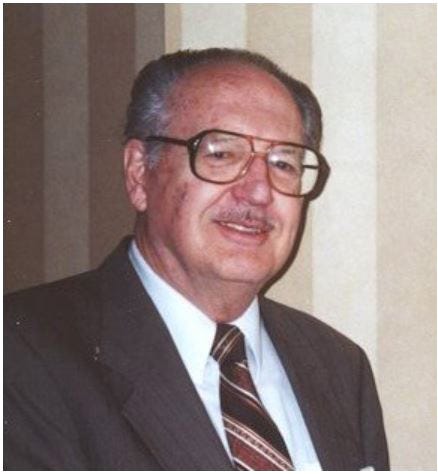
Against this backdrop one man, Leonard “Robert” Davids, a Washington DC area baseball historian recently rejected by publishers and periodicals, seized the moment to create a chartered organization of and for baseball historians. Beginning in 1951 he had submitted short sidebar articles to The Sporting News that by 1965 numbered in the hundreds, most with hokey, double-barreled headlines: “Nellie Mr. Nix in Whiff Parade,” “Roberts in 300 Innings For Fifth Time,” or “Iron Man Yogi Trains Sights on Mitt Full of Mask Marks.” His own correspondence with like minded fans gave him the foundation of a mailing list, and, with the added names from four other prominent baseball historians, he mailed out thirty letters of invite on March 19, 1971, his forty-fifth birthday. He announced a meeting that August at Cooperstown, NY, to create a “formal group,” thus fulfilling a vision he had since the early 1960’s. Hall of Fame librarian Cliff Kachline had previously offered Davids use of the library at the Hall-of-Fame for such an event.
Before most had even responded, Davids pulled out his old Hermes typewriter and banged out twelve sidebar articles on an 11x17 piece of construction paper, Xeroxed it, folded it over and distributed it. Known simply as “Baseball Briefs” it noted among many tid bits that Frank Howard could hit his weight and still have a respectable batting average, and that Jim Bunning had been removed from more games than any other pitcher in history. He continued “Baseball Briefs” monthly until the end of the season.
The August 10th meeting gave birth to the Society of American Baseball Research (SABR), and the sixteen attendees bacme the founding members. “Saber!” Davids used to say, pulling an imaginary sword from a scabbard on his hip. Interest nationwide saw membership grow for seventeen consecutive years with Davids channeling the passions of his members, creating and editing the monthly newsletter, “The SABR Bulletin”, in 1971, the first “Baseball Research Journal” in 1972, “This Day in Baseball” in 1973, “Minor League Stars” in 1978 and 1985, and “The National Pastime” which the current MLB historian, John Thorn, imagined in 1982. These efforts put SABR on the map and led to a spike in membership which endured through the millennium.
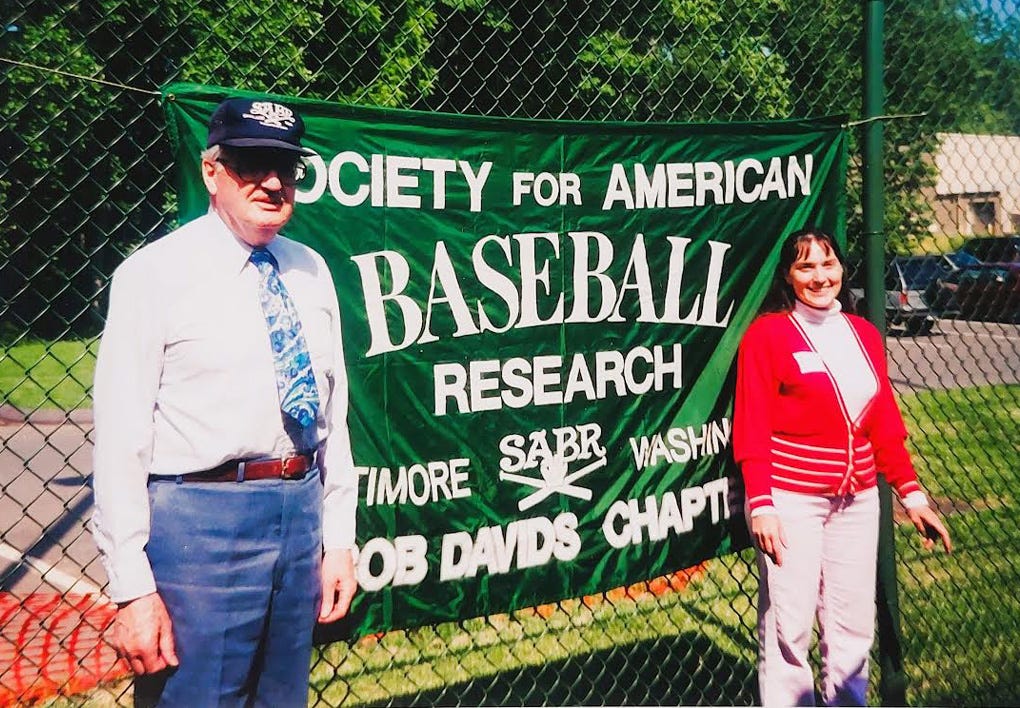
Davids and New York City chapter president Evelyn Begley, shortly after the Washington DC region chapter renamed in his honor. Evelyn, still active, became the first female SABR member in 1974.
Davids’ quaint brick home on 4424 Chesapeake Street NW became SABR’s first national address. With a mellow voice that had a hint of mid-western twang, Davids motivated a motley crew of volunteers in Saturday morning envelope stuffing sessions, his wife Yvonne bringing relief with meals, drinks, and cookies. Many SABR members, it was said, received cookie crumbs along with their bulletins. Always more comfortable out of the spotlight, Davids accepted awards sheepishly, refused an honorary lifetime membership on SABR’s board, and objected when the Baltimore-Washington chapter was renamed the Bob Davids chapter. Yet he had the presence of mind to know when to lead the way and “filled in” as SABR’s President on four occasions, twice after triple bypass surgery in 1982.
Davids was born March 19, 1926, the eighth of nine children on the Iowa farm of James and Katie Bakker Davids. After graduating Kanawha High School in 1943, Davids took work in an aircraft plant in San Diego and joined the Army Air Corps for a two year stint early in 1944. From there he attended the University of Missouri where he earned a journalism degree in 1949 and a masters in history in 1951. He moved to Washington DC, where his inside-the-beltway writing career began for the press office of the Secretary of Defense. He Joined the Bureau of Yards and Docks and edited the Civil Engineer Corps Bulletin, a 32 page monthly magazine. Davids was a rapid typer, a skill he always said he acquired typing transcripts for Corps radio. In 1952 Davids visited the North pole to report on snow packing techniques for arctic air fields. At Thule Air Force Base in Greenland he came up with the idea of honoring the last surviving member of the 1909 expedition that discovered the North Pole under Admiral Robert E. Peary, another member of the Civil Engineer Corps. Soon Davids was leading Air Force representatives and Danish Government officials to a humble nearby Eskimo Camp where Ootah, a native Inuit, was found and honored. Honoring someone else was a theme central to Mr. Davids’ life, although he disdained receiving such attention. The creation of SABR, it is believed, was his way of creating a platform whereby more enthusiasts could be honored.
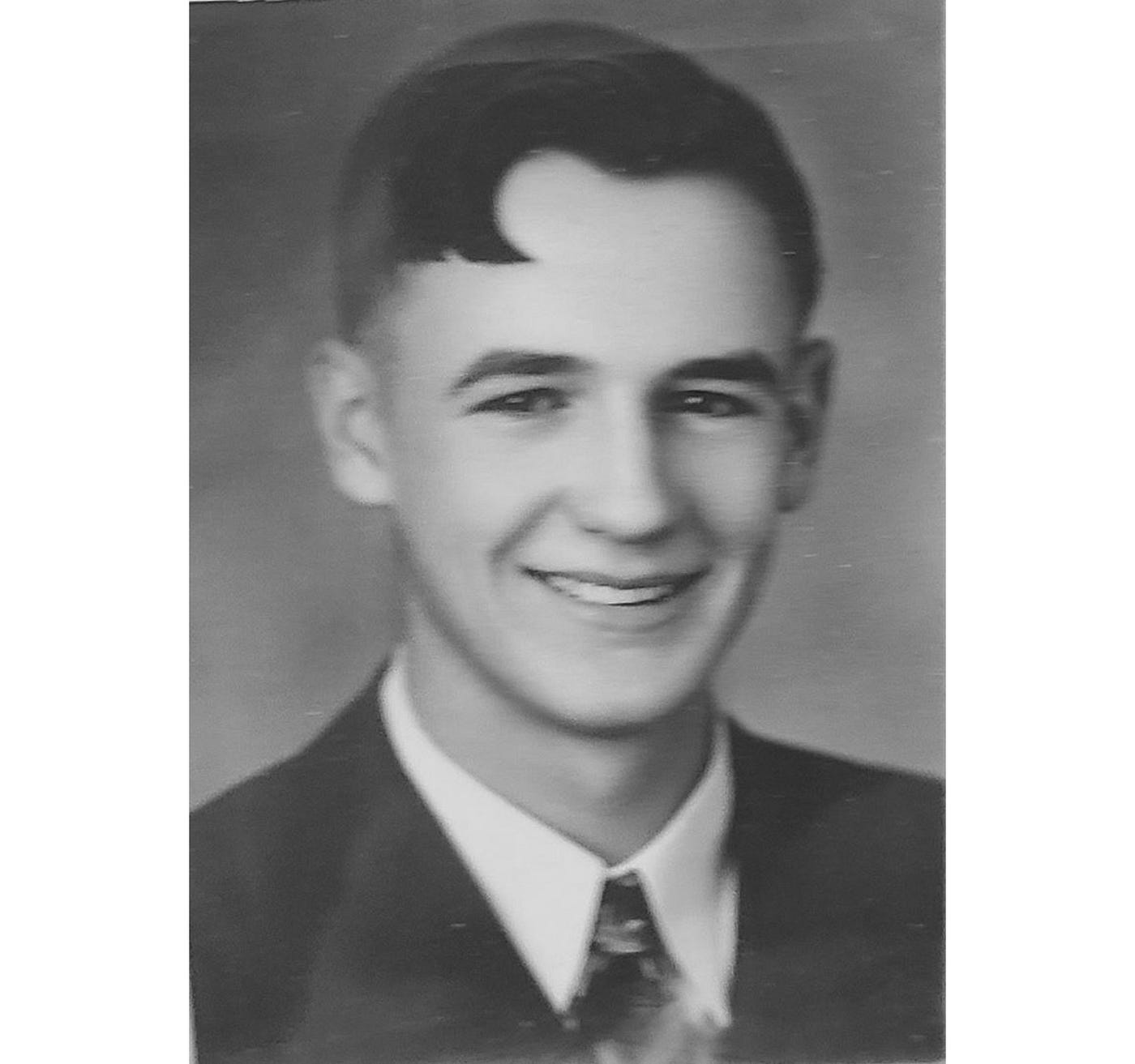
Bob Davids circa 1949.
During his early Washington employment he also studied at the University of Maryland and earned, from Georgetown University, a Doctor of Philosophy in International Relations in 1961. He then worked as a speech writer for the Atomic Energy Commission. In 1968 he served as a Congressional Fellow for the offices of Oregon Senator Mark Hatfield and Ohio Congressman Robert Taft, Jr. When Lee Allen died, Davids was the one who recommended Taft read a memorial in front of the house. Davids wrote the speech. Davids then worked for the Department of Energy where he served as a Speech Writer and Long Range Planning Officer before retiring in 1982.
Besides singing Gene Autry songs while doing kitchen chores, Davids was a man of many interests. He indulged in spinning off long articles for Roll Call, the Capitol Hill newspaper, which sifted the histories of personalities elected to serve in the various seats in Washington. He enjoyed researching boxing history. He maintained a correspondence with former heavyweight champion Max Schmelling and helped found the International Boxing Researcher’s Organization, IBRO, in 1982. On visits to see friends and family in Kanawha, Iowa, he liked stopping in Dyersville, home of the “Field of Dreams” used in the 1989 Kevin Costner movie. Here he brought out bats and gloves and pitched the ball to children of visiting tourists. By the late-1980’s he often threw out the first ball at minor league games and fulfilled an ambition, in 1985, of finding the grave of Bud Fowler, the nineteenth century Negro player. Upon doing so he had a grave marker placed there and organized a ceremony of remembrance for the occasion, beginning a tradition of sleuthing and memorializing so many SABR members have continued. He was a loyal member of the Christian Reform Church. He never drank, smoke, or swore, but did sneak off to the Library of Congress to research baseball history between Saturday services. In 1975 the church held a special service to make him a Deacon with duties ranging from visiting sick church members to helping out with community programs, this included work for the Shepherd’s Table, an organization that feeds the homeless. When he died he left unfinished a book which categorized the achievements of politicians in the fashion of a baseball-styled “record book”. That he was able to fit so much into one lifetime is testament to the resourceful Pentagon secretary in which he fell in love, Yvonne Revier. The two married in 1953 and had daughter Roberta in 1954.
Davids was jolted into fandom when rookie pitcher Bob Feller struck out 15 St. Louis Browns in his first major league start in 1936. Thereafter, he began amassing a collection of clippings that connected the numbers of the sport with names. Doubles and triples, strikeouts and stolen bases — and all stats — were totaled and ranked; classified and categorized. He meticulously glued notes on corresponding themes on large white sheets of construction paper. In his work for the Sporting News no milestone went unobserved and no record breaking performance ignored. Later on in marriage, a small bedroom upstairs was designated “Bob’s little room,” the site for his massive collection of clippings, notes, and baseball reference library. The collections at the Library of Congress were like a second home. His favorite microfilm machine, second row to the left.
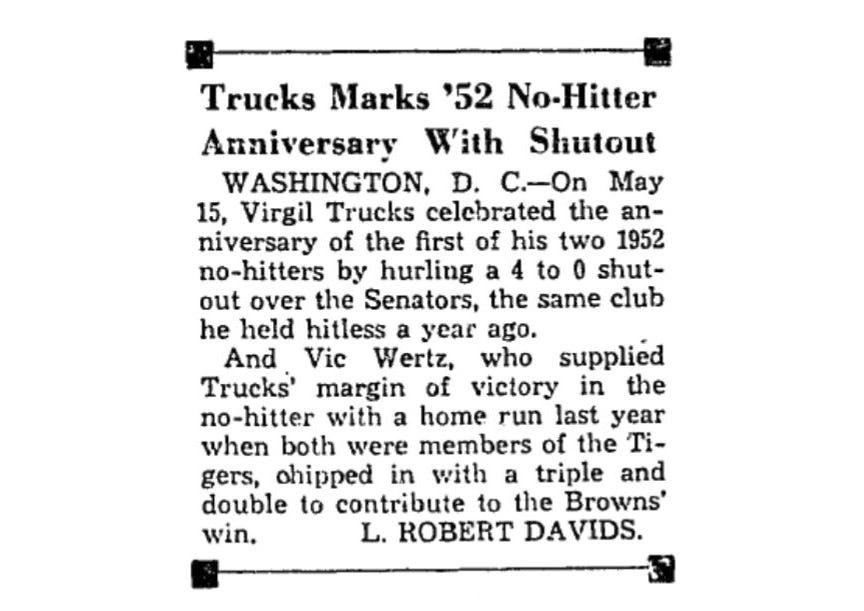
A typical Davids’ blurb, The Sporting News, May 27, 1953, page 19.
“Baseball Briefs” came back to become an annual feature of SABR Bulletins from 1989 to 2000. He never missed a SABR national convention and his magnanimity and sense of humor made him the perfect emcee. To each convention he added his own brand of trivia contests, contests that featured puns and wordplay on players last names. Correct answers ranged from the excruciatingly corn-ball to the profound. For example, the Baltimore Oriole who was “Two-thousand pounds” was Ken Singleton. Ironically in his own name there was a good story. The “L” you often see in front of “Bob” was actually his real first name, the Dutch Lendert. Young Davids so disliked the jibe “Dirty Davids” that he insisted every one call him Bob, even adopting the formal “Robert” in his official capacities. His older brother started the “Bob” nickname in the 1930’s after young Davids marched around the house imitating the sound of the washing machine: “bob, bob, bob…” Arlington National Cemetery, where Davids is buried, used official information from the Veteran’s Association, so Davids’ headstone reads only “Leonard Davids”.
Before bed on February 3, 2002, Davids fell down the back steps of his Washington home while taking out the recyclables. Complications from an advancing cancer were discovered, and he passed away seven days later. He was 75. Those who knew him spoke of his dry humor delivered deadpan while his saucy eyes scanned you for a reaction. They remembered his gentleness; his erect posture that made him seem larger than six feet tall; his encyclopedic knowledge of baseball. He was a people person, organized, modest, liable to produce a week’s worth of baseball research for anyone he’d meet just to help out. The highest award SABR can give to any member is the Bob Davids Award, which SABR instituted in 1985.
His life was the bridge from the hand of a small boy in Cincinnati to all of SABR membership today.
메타데이터
- post_id
- 08321bd2c488
- slug
- sabr-founder-bob-davids-turns-100-08321bd2c488
- url
- https://medium.com/@infofrankvaccaro/sabr-founder-bob-davids-turns-100-08321bd2c488
- canonical_url
- https://medium.com/@infofrankvaccaro/sabr-founder-bob-davids-turns-100-08321bd2c488
- author_url
- https://medium.com/@infofrankvaccaro
- status
- ok
- fetched_at
- 2026-06-21 07:44:09