Nollywood Before 1992: The Forgotten Yoruba VHS Era of the 1980s
The Foundational Home Video Movement Behind Nollywood’s Rise: Often Ignored, Never Absent
Nollywood Before 1992: The Forgotten Yoruba VHS Era of the 1980s
The Foundational Home Video Movement Behind Nollywood’s Rise: Often Ignored, Never Absent
P. Adejare

Alade Aromire, EKUN (1989, VHS)
There is a growing tendency in conversations about Nollywood to compress its origin into a single moment in 1992. It is a neat narrative, easy to repeat, and widely accepted. But it comes at a cost: it erases an entire phase of technological and cultural innovation led primarily by Yoruba filmmakers in the late 1980s, the VHS era that some now pretend never existed.
This erasure is not just inaccurate. It distorts how industries are actually built. Long before 1992, the foundations of Nigeria’s film industry were already shifting beneath the surface. The transition did not begin with a sudden breakthrough; it began with a gradual migration from stage to cinema, and then from cinema to video. At the heart of this transformation was the Ogunde Theatre tradition, pioneered by figures like Hubert Ogunde. This tradition created a fully developed storytelling culture, complete with actors, directors, touring circuits, and audiences, that would later adapt seamlessly to film and video.
By the early 1980s, Yoruba filmmakers had already established themselves in cinema. Films such as Orun Mooru, produced by Moses Olaiya, reflected a mature industry operating within the constraints of celluloid. But celluloid was expensive, distribution was limited, and the model could not easily scale to meet mass demand.
The real revolution came not in 1992, but in the late 1980s, when Yoruba filmmakers began experimenting with VHS. This period is often glossed over, yet it is arguably the most important phase in the birth of modern Nollywood.

Ade Abass, SOSO meji producer in 1988
In 1988, Soso Meji, produced by Ade Ajiboye, marked one of the earliest attempts at direct-to-video filmmaking in Nigeria. It signaled a decisive break from reliance on cinemas and opened the door to a new form of distribution.
Then, in 1989, Ekun, produced by Alade Aromire, demonstrated the commercial viability of VHS distribution at a broader level. This was not merely a technical milestone; it was an industrial one. It proved that Nigerian films could be produced, distributed, and consumed entirely outside the traditional cinema system.
By the time the 1990s began, the essential components of the Nollywood model were already in place:
- Films shot directly for video
- Distribution through VHS tapes
- A ready audience accustomed to home viewing
- A production pipeline rooted in theatre-trained practitioners
In other words, the system existed before it was widely recognized. What makes the current historical narrative troubling is the way this VHS era is often minimized or ignored altogether. The focus on 1992 as a singular starting point creates the impression that nothing of significance existed before it. This is simply not true. The Yoruba video movement of the late 1980s did not just precede Nollywood — it made Nollywood possible.
To be clear, Living in Bondage was a significant film. Its commercial success helped expand the reach of home video across Nigeria, particularly within the Igbo-language market. But it did not invent the model it used. It entered a space that had already been opened.
The problem, therefore, is not that Living in Bondage is recognized. The problem is that recognition has come at the expense of earlier contributions, particularly those of Yoruba filmmakers who pioneered the VHS format.
Industries do not emerge fully formed from a single event. They are built through experimentation, failure, and gradual innovation. The VHS era of the late 1980s represents exactly that kind of foundational work. Ignoring it does not simplify history; it distorts it.
There is also a broader cultural implication. When the contributions of a particular group are consistently minimized in favor of a more convenient narrative, it raises questions about whose history is being told and whose is being sidelined. In the case of Nollywood, the repeated emphasis on 1992 risks obscuring the regional diversity that actually defines the industry.
A more accurate account would acknowledge that Nollywood evolved through multiple phases:
- The theatre era, led by the Ogunde tradition
- The celluloid cinema era of the 1970s and early 1980s
- The VHS transition era of the late 1980s
- The nationwide expansion of the 1990s
No honest account of the Yoruba-led VHS revolution is complete without acknowledging Koto Orun (1989), a defining spiritual epic that captured the imagination of audiences across Nigeria. Produced in the same pre-1992 era that critics conveniently try to erase, Koto Orun was more than just a film — it was a cultural phenomenon rooted deeply in Yoruba cosmology, morality, and metaphysical storytelling. Its exploration of the supernatural, destiny, and the consequences of human actions reflected indigenous narrative traditions long before Nollywood became a buzzword. The film’s widespread circulation on VHS tapes demonstrated the already thriving distribution networks Yoruba filmmakers had built independently. To pretend this era did not exist is to deliberately ignore works like Koto Orun that laid the intellectual, spiritual, and commercial foundation of Nigeria’s home video industry.
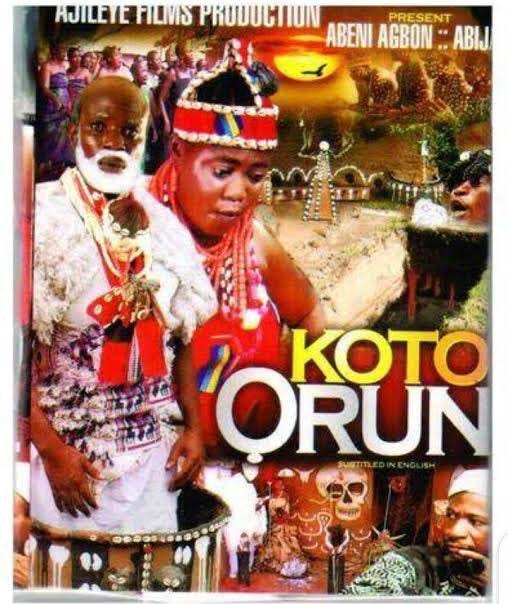
KOTO ORUN, Produced by Ajileye, staring ABIJAWARA (VHS, 1989)
Each phase built on the previous one. None existed in isolation.
The late-1980s VHS movement, driven largely by Yoruba filmmakers, was the bridge between old and new. It transformed film from a limited, cinema-bound medium into a mass-market product that could reach audiences in their homes. That transformation is the essence of Nollywood.
To pretend that this era did not matter or worse, that it did not exist, is to misunderstand the very foundation of the industry. Nollywood did not begin in 1992. It was already in motion. The VHS tapes were already circulating. The system was already being tested. What happened in 1992 was not creation. It was visibility. And history deserves to remember the difference
메타데이터
- post_id
- 0833db07471f
- slug
- before-1992-there-was-yoruba-vhs-the-erased-foundation-of-nollywood-0833db07471f
- url
- https://medium.com/@PAdejare/before-1992-there-was-yoruba-vhs-the-erased-foundation-of-nollywood-0833db07471f
- canonical_url
- https://medium.com/@PAdejare/before-1992-there-was-yoruba-vhs-the-erased-foundation-of-nollywood-0833db07471f
- author_url
- https://medium.com/@PAdejare
- status
- ok
- fetched_at
- 2026-07-13 06:23:13