How the Next Era of Venture-Backed Industry Will Be Built by Founders Who Become the Factory
The Flip
How the Next Era of Venture-Backed Industry Will Be Built by Founders Who Become the Factory
The Flip
For twenty years, venture capital’s relationship with industry has been software looking down at steel, building tools for industrial operators rather than as them. ERP for factories. SaaS for logistics. AI dashboards for manufacturing.
That model is breaking. The next wave isn’t about selling into industry. It’s about founders becoming the industry, launching companies that look operational on the surface, but are, in truth, digitally integrated manufacturing systems disguised as operators.
These are Digital Foundries: industrial firms built from the ground up with proprietary software controlling the economics, the workflow, and eventually, the margin profile. They don’t license SaaS. They are the SaaS.
What a Digital Foundry Is
A Digital Foundry is a vertically integrated industrial company that manufactures products at software velocity by embedding its own digital infrastructure directly into the production loop.
It’s a shift from selling software to the factory → to writing software that runs the factory.
The playbook looks like this:
- Launch with a narrow industrial wedge: metals, composites, or prefabricated materials.
- Write proprietary software to automate quoting, scheduling, and quality control.
- Scale throughput and data feedback loops that continuously compound precision and margin.
- Monetize downstream infrastructure: licensing tooling, APIs, or predictive models.
The software becomes the compounding engine. The factory is just the proof of work.
Why Now
Industrial sovereignty, AI deflation, and the reprogramming of supply chains
The U.S. is rebuilding its industrial base in real time, not through rhetoric, but through capital allocation. Policy, geopolitics, and technology have aligned in a way that makes digital foundries inevitable. Industrial sovereignty is becoming the new frontier of leverage, and software is the invisible layer reprogramming how it works.
1. Industrial Reshoring: Ground Zero Returns to the Heartland
For the first time in 50 years, the American industrial map is being redrawn. Federal stimulus from the CHIPS Act to the Inflation Reduction Act to DoD reindustrialization mandates has kicked off a capital wave flowing into manufacturing corridors across Kentucky, Texas, Ohio, and Tennessee.
This isn’t policy signaling; it’s construction. Billions in federal and state incentives are funding new fabrication, logistics, and energy infrastructure.
“Industrial ground zero” is back in the middle of America, the geography Render already knows best. Founders are returning home from the coasts, bringing technical fluency to legacy industries that have been neglected for decades.
“Industrial America isn’t dying. It’s rebooting and this time, it’s open source.”
2. Resource Realignment: Rare Metals, Foreign Debt, and Materials Sovereignty
Beneath the surface of reshoring is a subtler, structural shift: the U.S. has spent the past decade exporting capital and security guarantees to resource-rich nations holding the critical minerals that power modern industry, nickel, cobalt, lithium, graphite, rare earths, and titanium.
Many of these partner nations, the DRC, Indonesia, Mongolia, Chile, Peru, and Brazil. They can’t repay those commitments in currency, but they can in resource rights.
What’s emerging is a new form of materials-backed diplomacy.
Recent examples:
- The Democratic Republic of the Congo, home to ≈70 % of global cobalt reserves, is finalizing an agreement granting U.S. companies access to its critical-minerals assets in exchange for security and development support (Ecofin, 2025)
- Indonesia, rich in nickel and cobalt, has invited U.S. investment to co-develop its battery-grade mineral ecosystem (Indonesia Business Post, 2025)
- The U.S.–Japan Critical Minerals Supply Chain Agreement now designates cobalt, lithium, manganese, nickel, and graphite as strategic assets, cementing a multi-ally supply web (Congress.gov, 2025)
- The U.S. support of Argentina’s debt and currency stabilization isn’t just a geopolitical or IMF story, it’s an industrial resources play. Argentina sits on one of the world’s largest reserves of lithium, copper, and shale gas, and its economic instability has forced it into a position where repayment often comes not in cash, but in access.
- At the same time, the U.S. is quietly reinforcing strategic partners with the resources that will power the next century.
- Argentina — a country with crippling debt and one of the world’s largest deposits of lithium, copper, and natural gas. Through the IMF (where the U.S. is the largest voting member) and direct financial assistance, Washington effectively bailed out Argentina in 2025, backstopping a $44 billion loan program to prevent default. On the surface, it was a currency rescue.
- Beneath it, it was a resource trade, a stabilization deal that preserved U.S. and allied access to Argentina’s lithium triangle, which holds roughly 19% of global lithium reserves. This move mirrors the same playbook across the Global South: the U.S. extends liquidity and stability, and in return secures preferential access to the inputs of electrification, the rare metals and industrial feedstocks every clean-energy and manufacturing system will depend on.
At home, the DOE announced nearly $1 billion in new funding for critical-minerals processing and battery-materials manufacturing, including a $500 million “Battery Materials Processing & Recycling Grant Program” (Holland & Knight, 2025).
Together, these moves amount to a quiet revolution:
The U.S. is pre-buying the raw input layer of the next industrial cycle and securing it at a global scale.
But government capital can’t operationalize those resources. It can only secure access. The conversion: turning minerals into materials, materials into components, and components into output, will depend on founder-led industrial operators. That’s where digital foundries step in:
They are the translation layer between global resource leverage and local throughput.
They convert policy into product. They are the execution muscle for materials sovereignty.
3. Automation Deflation: The Cost of Precision Has Collapsed
Meanwhile, the tools of production have quietly experienced their own Moore’s Law. Industrial robotics, CNC machining, and additive manufacturing costs have fallen between 30–60% over the past decade. The capex required to stand up a digitally native factory is now less than the average Series A check in 2017. Energy inputs have also normalized. Industrial solar and natural gas costs have flattened, transforming energy from a volatile expense to a controllable variable. Precision manufacturing no longer demands massive balance sheets, just smarter orchestration.
But while hardware costs have deflated, adoption friction remains a real barrier. Legacy manufacturers struggle not because machines are expensive, but because their workflows, labor models, and procurement cultures weren’t designed for automation. Change-management, retraining, and process inertia are their hidden CapEx.
This is where digital foundries gain structural advantage:
They start from zero, designing software and robotics systems together, no legacy ERP, no retrofit inefficiency, no sunk process debt.
For them, automation deflation isn’t a marginal improvement. It’s a founding condition.
From Cost Deflation to TAM Expansion
History shows that when cost deflation pairs with vertical integration, markets expand rather than compress. Consider Costco and Trader Joe’s: both rewired their supply chains. Costco by buying in bulk, Trader Joe’s by vertically owning private-label production; turning cost advantage into margin resilience and customer lock-in. By controlling more of the value chain, they didn’t shrink their market; they rewrote it.
“When costs fall and ownership rises, markets grow.”
Digital foundries are the industrial counterpart to that pattern. They integrate software, hardware, and distribution; producing at lower cost while owning the interface to demand. Their customers don’t just buy parts; they buy certainty.
Automation as Membership: Monetizing Predictability and Resilience
Like Costco and GPOs in healthcare, digital foundries can build a membership layer atop their infrastructure. Instead of consumers paying for store access, industrial customers pay for capacity access; guaranteed throughput, better pricing, or shared data benefits. Membership turns manufacturing capacity into a subscription asset:
Layer Customer Value Foundry Value Access Tier Guaranteed production slots/priority lead times Predictable utilization, recurring cashflow Group Buying Shared raw-materials purchasing leverage Scale discounts & working-capital efficiency Data & Analytics Access to benchmarking and predictive ops dashboards Compounding data moat Trust Layer Embedded warranties and compliance guarantees High-margin recurring revenue Analog Mechanism Quantitative Takeaway Costco (Retail) $60–120 annual membership = 2% of rev, 73% of gross profit; renewal 90%+ Predictable cashflow + thin-margin retail viable GPOs (Healthcare) Group Purchasing Organizations (Premier, Vizient) charge ~1–3% membership or admin fee; avg EBITDA margin 20%+ Aggregated volume → supplier discount → profit spread AWS Reserved Capacity/Azure Savings Plans Users commit to 1–3-yr “capacity memberships” for 40–60% discount Turns infra CapEx into prepaid recurring Opex Industrial Cooperatives (Ag or Energy) Members pay buy-in + annual maintenance fees; access shared equipment Defrays CapEx; creates stable network utilization
When customers band together in these membership groups, they pool exposure to raw-material volatility. Collective purchasing power and shared hedging make them less sensitive to commodity swings and supply-chain shocks. In an era where geopolitical risk, from rare-metal embargoes to tariff cycles can rewrite input costs overnight, membership becomes a resilience mechanism.
“In a fractured world, grouped capacity is a geopolitical hedge.”
A membership layer creates industrial ARR. Stable, high-margin cash flow that compounds beneath cyclical production revenue. It’s the Costco mechanic reinterpreted for industry:
“Costco monetized loyalty. AWS monetized predictability. Digital foundries monetize throughput certainty and supply-chain resilience.”
The New Unit Economics of Automation
A digitally native foundry could run a blended model like this:
- $30M manufacturing revenue at ~25% gross margin
- $10M membership/access revenue at ~50% margin
- Blended margin ≈ 33–35%, a 10-point uplift entirely from software-like economics.
This is how a hardware-heavy company earns venture-level multiples: automation lowers cost, integration expands TAM, and membership monetizes stability.
4. The AI Coordination Layer: From Workflow to Simulation
The final unlock is AI as the industrial control plane. Generative and predictive AI now simulate entire production loops before a single machine starts. Material handling, toolpath optimization, supply-chain balancing, and predictive maintenance can all be modeled in silicon. If AWS abstracted away servers, AI is now abstracting away production planning. A founder can build a factory like deploying a software stack — iterating on models overnight and deploying physical process changes by morning. This is why a new generation of operators can achieve “industrial speed” with software velocity.
They don’t buy ERP systems, they write them.
5. The Venture Reset: Throughput Is the New Growth
Venture capital itself is reverting to discipline. With rates higher and capital scarcer, investors are rewarding cash-efficient builders over valuation narrators. Digital Foundries fit this moment perfectly. They generate revenue from day one selling output, not promises. Their software doesn’t exist to inflate a multiple; it exists to remove waste. They may start with heavy workflows and modest ACVs, but their compounding mechanism, data loops, precision gains, repeat contracts, and create a different kind of venture return curve: slow to start, steep once leverage compounds.
“Achieve more revenue than capital raised.”
Now applies not to SaaS users, but to steel, composites, and energy throughput.
The Synthesis
- Resource-backed globalization is reversing
- Automation is cheap
- AI coordination is here
- And capital has remembered what efficiency feels like
- The U.S. has secured the inputs
- Digital Foundries will secure the execution
That’s why now, not five years ago, not five years from now, is the inflection point for founders who build industrial leverage through software.
Potential Defensibility
Unlike SaaS, where code alone can be cloned, industrial AI systems compound through localized data, supply-chain integration, and geopolitical positioning.The obvious critique: if robots, CAM, and LLMs are broadly available, won’t “digital foundries” converge to commodity margins? Only if moats are defined as tech alone. In this category, moats are situated, they compound from local data, trust, membership economics, and resource position. The code is replicable; the process intelligence is not.
1) Local Process Intelligence (the non-exportable moat)
Every run captures machine drift, alloy variance, supplier reliability, ambient conditions, and operator effects. Over millions of cycles this becomes a context-bound model, optimization tuned to a specific geography, supplier web, and customer mix. That dataset can’t be bought or forked; it must be lived.
Signal to underwrite
- Yield improvement per 10k cycles
- Forecast error delta (quoted vs. actual lead time)
- “Days to learn” for new material/toolpath vs. prior baseline
2) The AI Coordination Layer (orchestration > machinery)
Cheap machinery doesn’t equal coordinated machinery. Advantage accrues to the planner: predictive scheduling, multi-plant load balancing, dynamic toolpathing, anomaly detection, and materials hedging in one loop. Coordination becomes a moat because it compounds across workflows, not SKUs.
Signal to underwrite
- Utilization at steady state vs. peers with similar CapEx
- % of jobs auto-scheduled; “touchless” rate
- Changeover time trend under increased product variety
3) Membership Economics (throughput certainty as a product)
A Costco-style Foundry Access Program turns capacity into subscription: reserved slots, forward-pricing, shared hedging, and data dashboards. Grouped demand pools volatility, customers gain resilience to geopolitical shocks and commodity swings; the foundry locks in high-margin, recurring cash flow.
Signal to underwrite
- Membership renewal/reservation take-up (target 85–90%)
- Share of gross profit from access fees (aim 40–60% at scale)
- Material cost variance vs. spot (basis-point advantage of the group)
4) Resource & Geography Advantage (inputs you can’t fake)
U.S. reshoring incentives + materials diplomacy (critical minerals access, processing grants) create input asymmetry for domestic operators. It doesn’t guarantee victory but it lowers floor risk on cost and availability, especially when tied to long-term offtake or JV supply. (We address this in “Why Now.”)
Signal to underwrite
- Secured supply (% of inputs under contract > 12–24 months)
- Grant/incentive coverage of fixed costs; unit-economics sensitivity
- Region-specific freight/energy advantage vs. imports
5) Trust & Compliance Networks (switching costs hidden in workflows)
Embedded warranties, certifications, QA history, and insured SLAs create trust moats that are hard to unseat. Think Fair Warranty’s trust layer in mobility or Genetica’s first-party data edge, once embedded, counterparties prefer continuity over theoretical savings. Trust becomes the lock-in, not price.
Signal to underwrite
- % revenue under multi-year MSAs
- Audit/recertification time saved vs. industry baseline
- Customer churn after a quality event (downside retention)
Anti-Commoditization Playbook
How a digital foundry avoids the race to the bottom:
- Own the interface to demand (fast quoting, API ordering, simulation-backed DFM).
- Modularize supply (cells you can replicate/route like servers; multi-site orchestration).
- Price the plan, not the part (access tiers, lead-time SLAs, availability insurance).
- Exploit variety (more SKUs → better models → higher switching cost).
- Monetize the brain (dashboards, predictive benchmarks, and eventually a licensed control layer).
Red-Team Risks & Mitigations
- Global parity on hardware → Counter: win on coordination/data; publish on-time %, changeover, yield; keep CapEx modular to out-iterate.
- Policy/election reversals → Counter: diversify incentives by state; secure multi-year offtakes; use membership groups to hedge inputs.
- China/Vietnam price pressure → Counter: compete on lead-time, QA, IP handling, and total landed risk; sell certainty, not just cost.
- Customer concentration → Counter: membership cohorts; cap any single-buyer exposure; design cells for demand rebalancing.
- Model leakage → Counter: on-prem/air-gapped control where needed; restrict telemetry that can recreate process intelligence.
Potential pillars on Moat Formation Path and Risk & Resilience:
Dimension Metric (12–18 mo) Venture Bar Process Intelligence Yield ↑ >300 bps; forecast error ↓ 40% Clear local data moat Coordination Auto-scheduled jobs >70%; utilization >80% Orchestration advantage Membership Access ARR >15% of rev; renewal >85% High-margin base, sticky Resource Position >50% inputs on term; energy/freight edge Input asymmetry Trust/Compliance Multi-year MSAs >50% rev; audit time ↓ 50% Embedded switching costs
Why It’s Venture
At first glance, Digital Foundries look uncomfortably like capital-intensive businesses, gross margins in the 30s, asset-heavy operations, lots of equipment. That’s what keeps most venture capital out. But is this a pattern recognition bug instead of a business flaw? Because the leverage doesn’t appear in the first twelve months, it compounds invisibly in the software layer.
The result:
- Software-driven utilization gains
- Near-zero marginal cost scheduling and quoting
- Predictive demand forecasting from internal data loops
- Network effects once tooling or data models become shared infrastructure
The “factory” becomes a byproduct of a software monopoly running underneath it. This is the Tesla lesson reinterpreted: the product is industrial, the moat is digital, and the margins bend toward software as scale compounds.
The Precedent: Venture-Scale Industrials Already Exist
If we look at the scoreboard, it’s clear: the idea that full-stack industrials can’t achieve venture-scale outcomes has already been disproven. Tesla, SpaceX, ICON, Firefly Aerospace, and Anduril are each case studies in full-stack, hardware-rooted companies compounding software leverage into venture-level multiples. They demonstrate that when the underlying technology compresses cost curves; automation, robotics, AI simulation, and integrates vertically, the TAM doesn’t shrink, it explodes.
Each of those companies started where traditional investors saw “manufacturing risk,” and ended where the smartest capital now sees data compounding and margin acceleration.
Timeline Reality: Venture Velocity, Not Venture Speed
Yes.. Digital Foundries will take longer to mature. But that’s not disqualifying; it’s becoming the new norm. Software exits now take 10–12 years. Life sciences and deep tech have always played on 12–15 year horizons. The meaningful variable is not time-to-exit, it’s VC velocity: the speed at which a company compounds leverage and optionality inside that timeline.
“VC velocity is not about how fast you exit, but how fast your leverage compounds.”
Digital Foundries accrue leverage through:
- Margin expansion with every production run
- Compounding process intelligence (data as a byproduct of throughput)
- Software-like predictability via membership economics and network utilization
Their timelines may look slower, but their velocity of leverage is faster than most late-stage SaaS, and far more durable.
The Macro: Venture Markets Are the Buyers
Digital Foundries don’t exist in isolation; they are the industrial substrate of every major venture trend:
- Data center buildout
- Defense autonomy
- Energy and grid modernization
- Advanced materials for AI hardware
If the end markets are venture-scale, then the suppliers that make them possible can be too. In that sense, Digital Foundries are the meta-bet behind American Dynamism; they’re not just feeding the industrial boom; they’re monetizing its infrastructure.
“If your customers are venture-scale, your suppliers can be too. End of the day, you either have the risk tolerance and patience for it or you don’t.”
The Founder Archetype: Industrial Hackers
Ultimately, this category’s performance won’t hinge on the model but on the founder. The ones who break through will resemble industrial hackers more than SaaS operators, obsessive, grounded, fluent in both code and constraint. Complexity isn’t outsourced but metabolized. The world is seen not as markets to sell into but as systems to reprogram. These founders often come from factories, warehouses, and construction sites, places where things fail and must be rebuilt. Coding started as a form of problem-solving, not self-expression. The first hires are machinists, robotics techs, and materials scientists; not engineers. The first product is a production line, not an app. Each venture begins with a single cell of execution, a lone production line, but the architecture anticipates hundreds. These are high-agency, systems-first builders who convert operational intimacy into leverage. This isn’t app-building; it’s infrastructure-building. And the infrastructure compounds.
The Venture Equation
- Inputs: automation deflation, AI coordination, supply-chain reshoring.
- Flywheel: each run improves precision, throughput, and data.
- Output: expanding TAM, resilient margins, and software-like multiples.
Digital Foundries are venture-scale not because they sell software but because they compound software leverage through physical throughput.
The Flywheel
A Digital Foundry comprises four stages:
Software Leverage → Cost Advantage: Proprietary automation layers optimize scheduling, materials, and maintenance. Margins quietly expand.
Data Capture → Predictive Precision: Every production run trains the system, reducing waste and increasing quoting accuracy.
Vertical Control → Iteration Velocity: Owning the factory eliminates integration bottlenecks. Decisions happen in minutes, not quarters.
Platform Optionality → Margin Expansion: Once software and data reach scale, the company can license its control layer or open APIs — turning its internal OS into a new business line.
Each turn of this loop widens the moat.
My Lens
This category fits perfectly inside my obsession with the “weird archaic legacy infrastructure” frame.
These companies look boring, industrial manufacturing, logistics, materials, but they carry inevitable momentum because their flywheels are embedded in workflows too sticky to rip out.
They are the industrial equivalent of the invisible pipes that I already love:
- Fair Warranty: trust infrastructure for auto.
- Genetica: data infrastructure for retail genomics.
- Dappier: API infrastructure for publisher data.
Digital Foundries extend that thesis into industrial infrastructure for production itself. Except now, that revenue might come from cutting metal or fabricating carbon, and the alpha is baked into how the software directs the machines.
Where the Opportunities Live
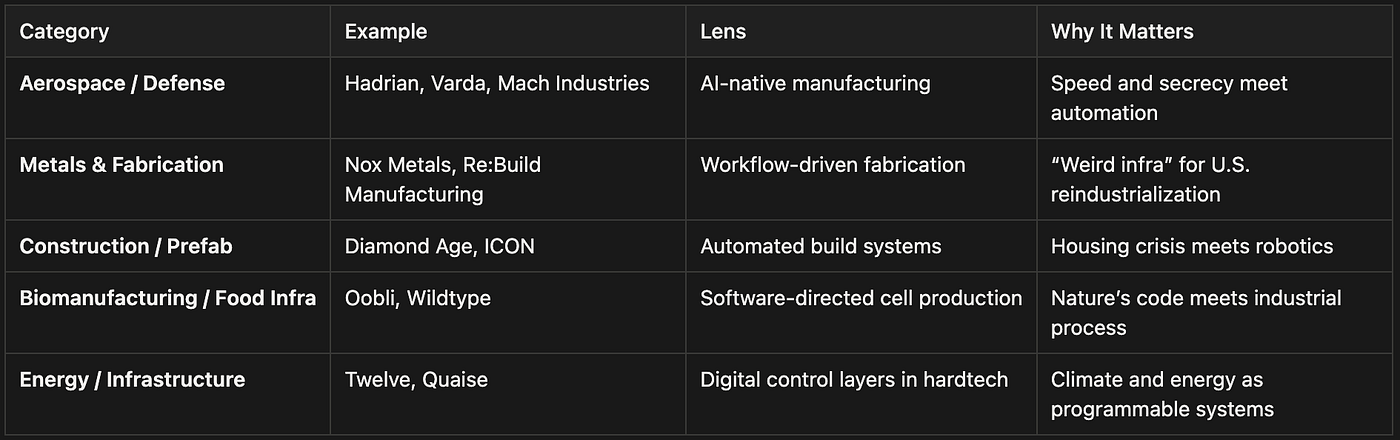
Investment Framework
When underwriting Digital Foundries, the classic SaaS metrics fail. Render’s framework evolves accordingly:

The Open Secret
If you walk through one of these factories, it doesn’t feel like a startup. It feels like an organism, code, machines, and people moving in an orchestrated rhythm.
But underneath is a simple truth:
- They’re not competing on labor or capacity; they’re competing on code leverage.
- The world doesn’t yet have a language for these businesses.
- They sit between “industrial operator” and “software company.”
But venture has always made its best returns in the gaps, when the form factor of innovation looks misaligned with its substance.
Digital Foundries are that gap.
The Closing
“The next Tesla won’t build cars. It will build everything else — faster, cheaper, and smarter — by rewriting how industry coordinates itself.”
The industrial base is being reprogrammed. Not by the incumbents, but by the high-agency founders who realize that the fastest way to change an industry is to become it.
Digital Foundries might just be the way.
메타데이터
- post_id
- 0845e01f2a5d
- slug
- how-the-next-era-of-venture-backed-industry-will-be-built-by-founders-who-become-the-factory-0845e01f2a5d
- url
- https://medium.com/@ventreet/how-the-next-era-of-venture-backed-industry-will-be-built-by-founders-who-become-the-factory-0845e01f2a5d
- canonical_url
- https://medium.com/@ventreet/how-the-next-era-of-venture-backed-industry-will-be-built-by-founders-who-become-the-factory-0845e01f2a5d
- author_url
- https://medium.com/@ventreet
- status
- ok
- fetched_at
- 2026-06-09 15:37:30