From Telegraph Wires to Internet NTP: How the World Learned to Stay in Sync
AI-assisted: written through iterative author questioning, fact requesting, and critique using ChatGPT (GPT-5).
From Telegraph Wires to Internet NTP: How the World Learned to Stay in Sync
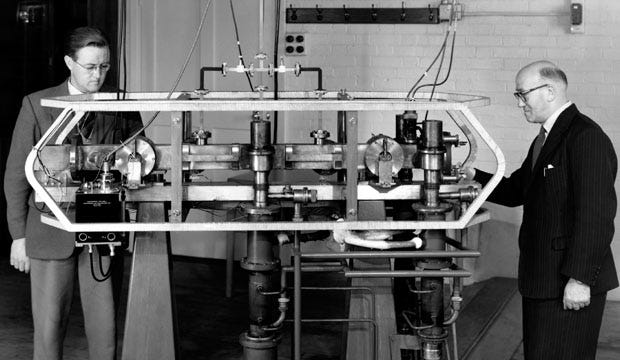
Louis Essen and J. V. L. Parry standing next to the world’s first caesium atomic clock, developed at the UK National Physical Laboratory in 1955.
AI-assisted: written through iterative author questioning, fact requesting, and critique using ChatGPT (GPT-5).
Every device you own silently agrees on the same second.
Your phone, laptop, bank server, and GPS satellites tick in unison — a global heartbeat known as UTC.
But this harmony didn’t appear overnight.
It’s the result of two centuries of innovation — first learning how to share time, then how to define it.
From the spark of telegraph wires to the invisible pulses of Internet NTP, this is how the world learned to stay in sync.
The Telegraph: Britain’s First Network of Time
When telegraph lines spread across Britain in the mid-1800s, they didn’t just carry messages — they carried time.
Every day at precisely noon, the Royal Observatory, Greenwich sent an electric signal through the telegraph network.
Railway stations and post offices adjusted their clocks accordingly.
For the first time, clocks from London to Glasgow struck the same hour.
This was Greenwich Mean Time (GMT) — mean solar time measured at the Greenwich meridian.
Railway companies adopted it to eliminate the chaos of local solar times.
Passengers could finally read one national timetable and know it applied everywhere.
Railway time became national time — and that national time was GMT.
The Age of Punctuality
Before the telegraph, every town lived by local noon — the moment the Sun stood highest over that town.
But trains exposed how incompatible that was: noon in Bristol came about ten minutes after noon in London.
By the 1850s, railway clocks across Britain were set by telegraph signal to Greenwich Mean Time, ending centuries of fragmented hours.
This synchronization wasn’t just technical; it reshaped daily life.
Church bells, factory shifts, and shop openings aligned to a common rhythm.
Britain became the first society truly living by a single clock.
Radio: When Time Escaped the Wire
The telegraph unified Britain; radio unified the world.
Starting in the early 20th century, national observatories began broadcasting time signals over the air.
Mariners at sea — beyond any telegraph line — could tune their receivers to correct their chronometers.
The signal from Greenwich could now reach ships halfway across the Atlantic.
That’s why radio became the first global clock:
its electromagnetic waves ignored borders and oceans.
For the first time in history, a merchant vessel, a scientist in Africa, and a listener in Canada could all synchronize to the same second — Greenwich Mean Time — by listening to the same broadcast.
In 1924, the BBC introduced the famous “six pips”, a short sequence of tones marking the precise start of each hour.
It was the sound of national — and increasingly global — coordination.
Television and the Ritual of Synchronization
By the 1950s, television inherited that authority.
Every evening news bulletin began with a broadcast clock face, often captioned “Greenwich Mean Time.”
Millions of viewers compared their wristwatches to the glowing dial before the headlines began.
The shared moment of synchronization had become cultural as well as technical — a nationwide ritual of trust.
The Internet and NTP: Time Without Thinking
By the 1980s, synchronization disappeared from sight.
NTP — the Network Time Protocol — allowed computers to query remote servers automatically and correct their clocks down to milliseconds.
NTP doesn’t distribute GMT or UT1; it distributes UTC — Coordinated Universal Time, the modern atomic successor of GMT, kept in alignment with Earth’s rotation to within a second.
Today, every computer, smartphone, payment terminal, and GPS receiver continually adjusts itself to UTC without human attention.
Time has become invisible infrastructure.
When Computers Drift Alone
Without synchronization, a computer’s internal clock slowly loses accuracy.
Most modern systems keep time using a quartz crystal oscillator, similar to what drives a wristwatch.
The nominal frequency might be 32,768 Hz, but small variations in temperature, voltage, and manufacturing tolerances make it imperfect.
A typical desktop or server clock drifts about 0.5 seconds per day, sometimes more.
After a week, it can be several seconds off; after a month, it’s clearly wrong.
That’s why operating systems poll NTP servers regularly — often every few minutes — to discipline their local oscillator and stay aligned with UTC.
Without NTP, the digital world would quickly desynchronize.
Behind It All: When the Earth Drifted Off Beat
While technology perfected synchronization, the Earth itself proved unreliable.
Its rotation slows and wobbles, so the Sun drifts relative to atomic time.
Since 1972, leap seconds have been added to UTC to keep it within one second of the planet’s rotation.
But in 2022, the international community decided to stop inserting leap seconds after 2035.
That means atomic time will steadily drift from solar time — by a minute in about a century.
Noon UTC will slowly stop matching the Sun over Greenwich.
For the first time in human history, we’ve chosen precision over sunlight.
From Telegraph to NTP: Each Network, Tighter Sync
If you trace the story, every new medium tightened our global agreement:
• Telegraph (1850s): Unified Britain through wires.
• Radio (1910s): Made time wireless and worldwide.
• Television (1950s): Turned synchronization into a shared national ritual.
• Internet & NTP (1980s+): Achieved millisecond precision across the planet.
Each generation of communication reduced the uncertainty window — from minutes, to seconds, to milliseconds — until synchronization itself became background noise.
The End of Chasing the Sun
For millennia, people looked up to the sky to know the hour.
Now, the sky is irrelevant.
The rhythm of the modern world flows not from the Sun but from atoms vibrating 9,192,631,770 times per second inside a cesium clock.
From telegraph wires to Internet NTP, we didn’t just learn to tell time — we learned to agree on it, everywhere, all at once.
That agreement is the invisible foundation of the digital age.
Further Reading
• Royal Observatory Greenwich — Bref History
• Greenwich Time Signal (the pips)
• National Physical Laboratory (NPL, UK) — Time scales
• NTP
메타데이터
- post_id
- 084cbf877f58
- slug
- from-telegraph-wires-to-internet-ntp-how-the-world-learned-to-stay-in-sync-084cbf877f58
- url
- https://medium.com/@blazejsleboda/from-telegraph-wires-to-internet-ntp-how-the-world-learned-to-stay-in-sync-084cbf877f58
- canonical_url
- https://medium.com/@blazejsleboda/from-telegraph-wires-to-internet-ntp-how-the-world-learned-to-stay-in-sync-084cbf877f58
- author_url
- https://medium.com/@blazejsleboda
- status
- ok
- fetched_at
- 2026-06-24 11:06:28




