7 Steps to Highly Successful Interview Protocols: Scripting the Interview
“A well-designed interview protocol serves as both a roadmap and a standardization tool. It guarantees that every participant experiences…
7 Steps to Highly Successful Interview Protocols: Scripting the Interview
“A well-designed interview protocol serves as both a roadmap and a standardization tool. It guarantees that every participant experiences the same fundamental process while providing the interviewer enough flexibility to dive deeper into specific, relevant responses.” Articles such as *Writing Interview Protocols and Conducting Interviews: Tips for Students New to the Field of Qualitative Research* are interesting, but they focus on questions, not the protocol part.
Interview protocols, for semi-structured, structutred, and free flowing interviews, are a requirement for most qualitative research studies, yet most researchers get hung up on the idea of “protocol.” Many websites, like the Stanford Interview Protocol Form and Imperial College London, claim to describe protocols but fall far short.
Recently, someone emailed me with a list of questions to ask me what I thought of her “interview protocol,” stating her uncle and father, both professors, had reviewed and approved the questions. While the questions were terrible — a reason interview protocols and questions are technical and require piloting — the person totally missed the word and idea “protocol.” Many websites, like Sage Research Methods or Gugiu & Rodriguez-Campos, offer generalities that are difficult to implement. Semi-structured interview protocols can be difficult to understand, with so many different iterations.
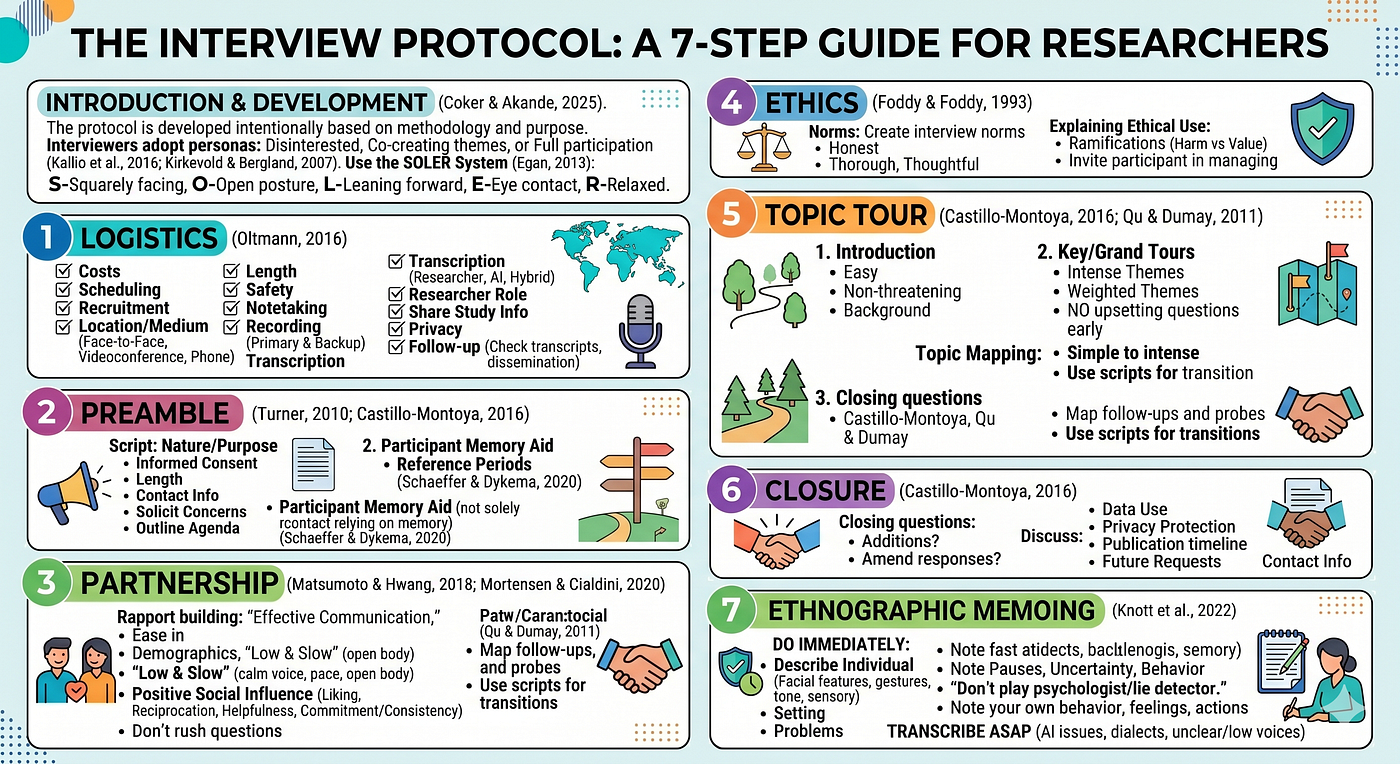
“The process for conducting in-depth interviews follows the same general process as is followed for other research: plan, develop instruments, collect data, analyze data, and disseminate findings.” See Coker & Akande (2025) for the seven steps to a true protocol:
- Logistics. Interviews happen over time and space, so researchers should clearly develop a plan of action for the development and delivery of the interview protocol that could serve as a checklist: costs, scheduling, recruitment, location/medium (face-to-face, videoconferencing, phone, etc.), site selection/permission, length of interview, researcher/participant safety and sensitivity, notetaking, recording (if applicable, including primary and backup), transcription (if applicable, researcher, computer generated, researcher-computer collaboration), role of researcher (attempts at neutrality/nonparticipation, cocreator, participant, etc.), what to share about the study beforehand, privacy, and follow-up (checking transcripts, checking results, dissemination final product, etc.)
- Preamble. Develop a script or preamble to outline the nature/purpose of the study, discuss informed consent, length, contact information, solicit concerns before starting, outline the interview agenda, and participants need to not solely count on memory. A script and preamble might also be needed at multiple points to assist with transitions from one topic or from one part of the interview to another. The following points be defined and explained: the context, if any, to which the interview questions relate; definitions of any terms or phrases that might not be commonly or universally understood; and reference periods of the timeframe of interest for the study.
- Partnership. Rapport building is to ease into the interview. Relevant demographic questions can be collected at this time, unless done during screening. Techniques that can build relationships and put participants at ease include “low and slow,” which means speaking in a calm voice, at an appropriate pace, and with body language to display openness and warmth. Developing positive social influence through liking and complimenting, reciprocation in sharing, seeing the interviewer as helpful and an authority, and commitment/consistency can put people at ease. Unfortunately, many researchers are so rushed that they dive right into complex, value-laden questions without establishing a positive, careful rapport.
- Ethics. Creating and discussing norms for the interview can improve communication, keep people on track, and invite participants to assist in managing the interview. Instruct participants to be honest, thorough, and thoughtful. An explicit explanation of the ethical use and ramifications could be useful as well, such as the possibility of harm and the value of participating.
- Topic Tour. Questions or prompts proceed in three stages: introduction or mini tours, key or grand tours, and closing. Typically, introduction questions are easy and nonthreatening, and they establish the background. Key questions become more intense and include the weighted themes; questions that might be upsetting or invoke an emotional response should not be in the introduction. Spontaneous utterances of paraphrasings, follow-ups, and probes can be mapped as well. Directions and scripts might be necessary at different points.
- Closure. Closing questions include asking participants if they have questions, want to add anything, or if any response needs to be amended. Providing information on how the data will be used, the protection of privacy, when the study will be published, future requests, and contact information (if appropriate) should be discussed.
- Ethnographic Memoing. Describing the individual (facial features, gestures, tone of voice, and sensory details), the setting, and any problems can add to the interview. Pauses, uncertainty, or behavior outside the baseline might be important, but interviewers should not play psychologist or act like lie detectors. As much as attending to the participant, the interviewer should note one’s own behavior, feelings, talk, and actions. Researchers should transcribe the interview as soon as possible (even if using AI, problems with dialects, abbreviations, and unclear/low voices can render transcriptions ambiguous and with a loss of information).
Coker, D. C., & Akande, A. (2025). Preparation, development, and refinement of the interview protocol in qualitative research. The Qualitative Report, 30(8), 4205–4235. https://doi.org/10.46743/2160-3715/2025.7964
David C. Coker, Ed.D., is an education and research expert who consults nationally and internationally. On the faculty of West Liberty University, Dr. Coker teaches students research methods. He can be found on LinkedIn, Google Scholar, and ResearchGate. He teaches qualitative, quantitative, and mixed methods research skills. He is a graduate of the University of Illinois, Eastern Illinois University, Fort Hays State University, Indiana University, and ACE.
메타데이터
- post_id
- 084cf02b5c52
- slug
- 7-steps-to-highly-successful-interview-protocols-scripting-the-interview-084cf02b5c52
- url
- https://medium.com/@dcokeman23/7-steps-to-highly-successful-interview-protocols-scripting-the-interview-084cf02b5c52
- canonical_url
- https://medium.com/@dcokeman23/7-steps-to-highly-successful-interview-protocols-scripting-the-interview-084cf02b5c52
- author_url
- https://medium.com/@dcokeman23
- status
- ok
- fetched_at
- 2026-06-09 15:37:30