Playtime
Playtime, one quickly discovers, is not the sort of film that ambles along in the usual narrative fashion, doffing its cap politely to plot…
Playtime
Playtime, one quickly discovers, is not the sort of film that ambles along in the usual narrative fashion, doffing its cap politely to plot and dialogue as it passes. No, it is more of a grand cinematic contraption — part symphony, part clockwork marvel — devised by the inimitable Jacques Tati, who appears to have approached filmmaking with the air of a man determined to rearrange reality itself, just to see if it might look better from a slightly more mischievous angle.
Released in 1967, the film has since acquired the reputation of a masterpiece, though one suspects that at the time of its arrival it must have struck audiences rather like an eccentric uncle at a formal dinner — fascinating, faintly bewildering, and quite impossible to ignore. It is, in every sense, an ambitious affair, eschewing the conventional reliance on plot and chatter in favour of something far more visual and, dare one say, architectural. Dialogue is reduced to a sort of genteel murmur, as though it had been instructed not to make a scene, while the real business of the film unfolds through movement, reflections, and the curious geometry of modern life.
Into this gleaming, glassy world wanders Monsieur Hulot — Tati’s well-known creation — though here he is less the centrepiece and more a genial, slightly baffled participant in a much larger pageant. Paris, as he encounters it, is no longer the charming, idiosyncratic creature of postcards and poetry, but a brisk, impersonal expanse of steel and glass, where individuality has been quietly shown the door and uniformity reigns with the quiet confidence of a well-run bureaucracy.
The narrative, such as it is, proceeds along two gently intertwining paths. Hulot arrives for an appointment, only to find himself adrift in a bewildering maze of identical offices, transparent walls, and people who seem to exist primarily to look busy. His attempts to locate the appropriate individual become a sort of comic pilgrimage through corridors of sameness, where reflections conspire against him and doors masquerade as walls with a straight face that would do credit to the most seasoned impostor.
Meanwhile, a group of American tourists — led with admirable cheerfulness — drift through this modern Paris in search of its legendary charm. Among them is Barbara, a figure of quiet perceptiveness, who longs for the Paris of romance and history, only to find it peeking out shyly from reflections and glimpses — an Eiffel Tower here, an Arc de Triomphe there — like old friends reduced to waving from behind glass.
The trade exhibition sequence is a particular triumph of satirical invention. Here, modernity struts about displaying its latest marvels: doors that close in “golden silence,” brooms equipped with headlights (for the nocturnal enthusiast, one presumes), and a parade of gadgets whose chief accomplishment appears to be their own existence. Salesmen present these items with a solemnity usually reserved for matters of state, while Hulot drifts among them with the mild curiosity of a man who suspects the joke may be on everyone involved.
If this portion concerns itself with public life, the apartment sequence turns its gaze toward the private sphere — or what passes for it. Observed entirely from the street, through large, unblinking windows, the residents appear as though arranged in display cases, living out their lives with a curious awareness of being seen. Conversations unfold silently, movements echo across identical interiors, and one cannot help but feel that privacy has slipped out for a moment and neglected to return.
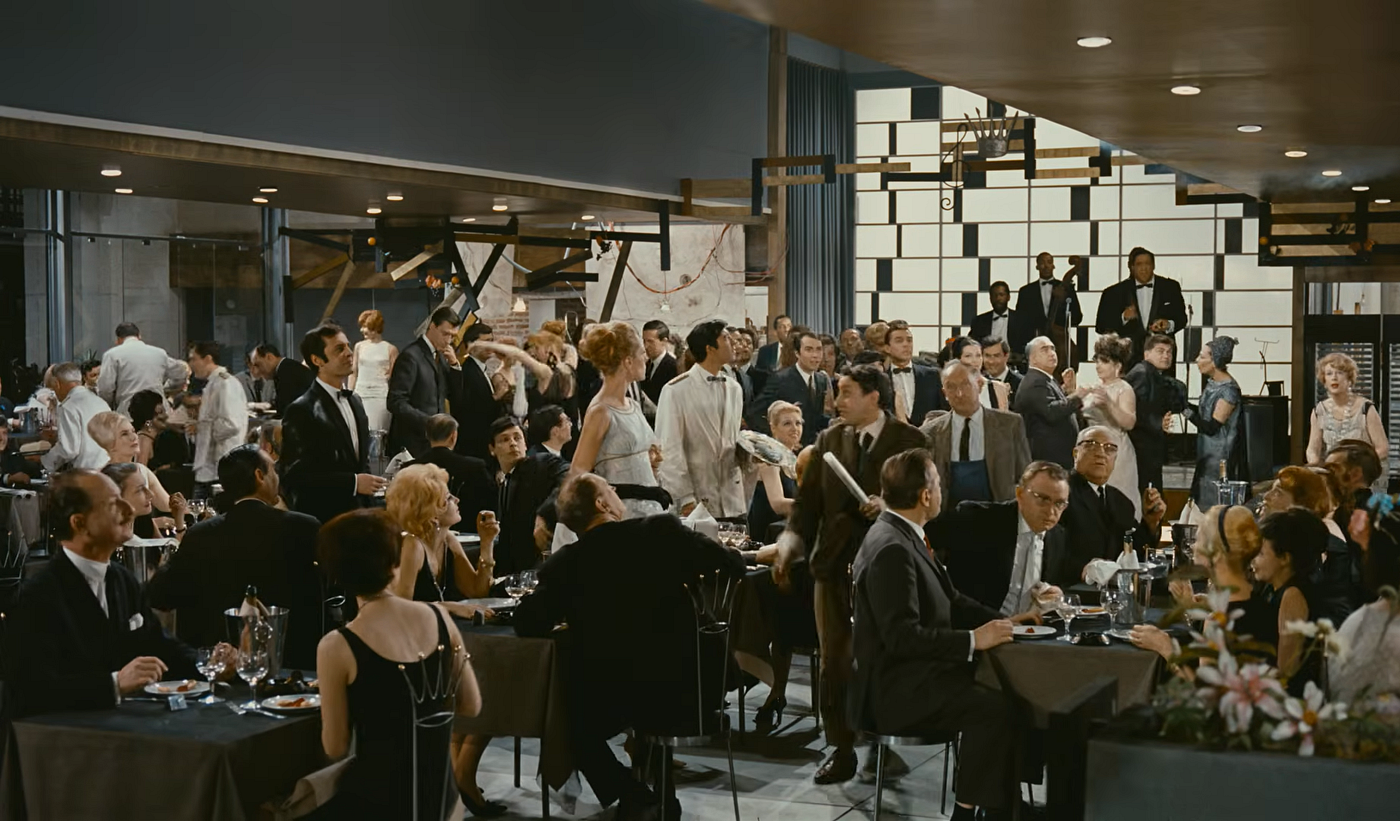
Then comes the Royal Garden restaurant — an establishment whose opening night might best be described as a spirited experiment in how many things can go wrong without anyone quite losing their composure. Fixtures collapse, doors shatter and are subsequently “maintained” by an imaginative doorman, garments suffer indignities, and the entire enterprise gradually unravels with the elegance of a badly tied cravat. Yet, in this unraveling, something remarkable occurs: the rigid formality dissolves, and a kind of joyous, improvised camaraderie takes its place. Guests and staff alike abandon their prescribed roles, discovering — rather to their surprise — that chaos can be exceedingly good fun.
By morning, the city resumes its orderly rhythm. Barbara prepares to depart, and Hulot presents her with a small gift — a scarf, modest yet sincere — suggesting that even in a world of glass and impersonality, genuine human connection has not been entirely mislaid. The final image, of traffic circling like a carousel, lends the proceedings a note of gentle whimsy, as though the machinery of modern life had briefly remembered how to play.
Tati’s critique of modernity is as precise as it is playful. The glass-and-steel environment, for all its efficiency, creates a curious distance between people, rendering them faintly anonymous. Paris, once a city of character, threatens to become interchangeable with any other metropolis, its history visible only in fleeting reflections.
And yet, the film never descends into dour sermonizing. Its humour is light, observational, and quietly devastating in its accuracy. One is reminded, at moments, of the mechanical absurdities in Modern Times, where progress marches on with admirable determination, regardless of whether anyone is quite keeping up.
Playtime is not a film to be consumed in the idle manner of a casual diversion. It requires attention, patience, and a willingness to meet it on its own peculiar terms. Those who do may find themselves rewarded with a work of extraordinary richness — a film that, in stripping away the usual trappings of storytelling, invites us to look again at the world around us and, perhaps, to notice the quiet poetry lurking in its most unassuming corners.
메타데이터
- post_id
- 084fa126e67e
- slug
- playtime-084fa126e67e
- url
- https://medium.com/@vram45/playtime-084fa126e67e
- canonical_url
- https://medium.com/@vram45/playtime-084fa126e67e
- author_url
- https://medium.com/@vram45
- status
- ok
- fetched_at
- 2026-06-09 15:37:30