🧭 Part 11 — Orchestrate Like a Pro: Airflow Patterns, Retries, and Quarantine
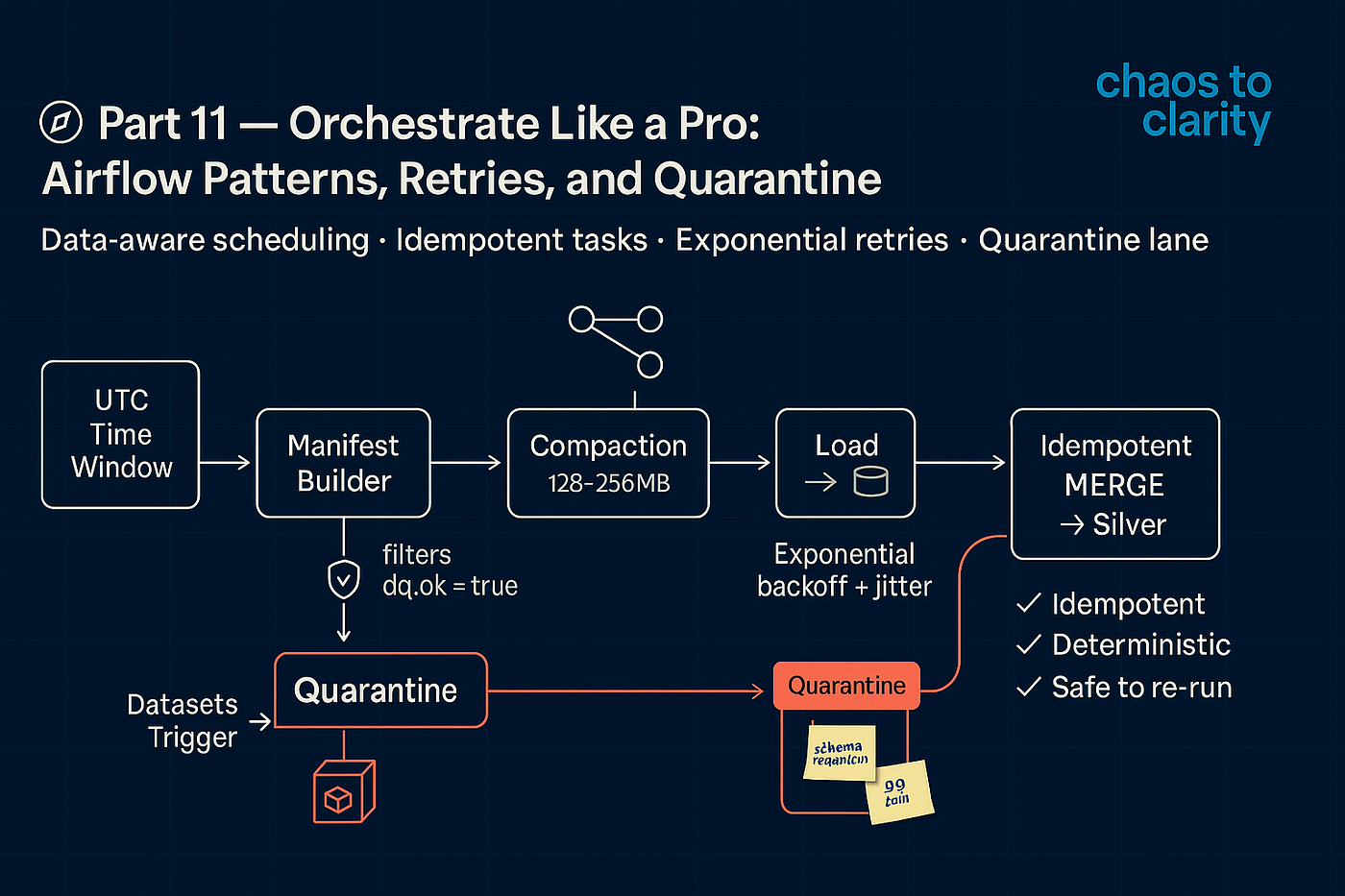
Turn your pipeline into a calm, clockwork system with data-aware scheduling, idempotent tasks, exponential retries, and a quarantine lane…
🧭 Part 11 — Orchestrate Like a Pro: Airflow Patterns, Retries, and Quarantine
Turn your pipeline into a calm, clockwork system with data-aware scheduling, idempotent tasks, exponential retries, and a quarantine lane that keeps prod clean.
⬅️ Previous: 👀 Part 10 — See It Before It Breaks: Observability for Data Pipelines* | 🔗 All Parts (Series Hub) | ➡️ Next: *🧯 Part 12 — Cost & Reliability Guardrails: Budgets, Quotas, Auto-Tuning
🏷️ Topics: Airflow · Orchestration · Retries & Backoff · Quarantine · Google Cloud (GCP)
Why this part matters
Airflow is your control plane, not your data engine. It decides when to run micro-batches, what windows to stitch into manifests, and which steps to skip or quarantine when quality gates fail. Get orchestration right and your system feels predictable and safe — even when producers misbehave or traffic spikes.
This guide gives you the patterns that make the rest of our series hum:
- Data-aware scheduling (by time windows or upstream datasets)
- Retries that don’t thrash (exponential + jitter, with idempotent tasks)
- Quarantine lane (bad partitions get isolated, not blocked)
- Backfill harness (replay any window without surprises)
- Separation of concerns (Airflow orchestrates; Cloud Run/Dataflow does the work)
1) Principles (to keep Airflow boring — in the best way)
- UTC everywhere for scheduling and windows (Part 3).
- Airflow controls, services compute: call out to Cloud Run/Dataflow/Spark for heavy work.
- Idempotent operators: every task can be retried safely (Part 7–8).
- Data-aware dependencies: trigger on manifests, sidecars, or dataset readiness, not just time.
- Circuit breakers: quality gates send work to quarantine, never block the world (Part 6).
- Declarative inputs: manifests list exactly which files to load (Part 7).
2) A reference DAG (hourly window, data-aware)
We’ll orchestrate the core path: Kafka → Cloud Run Writer → GCS (Parquet + dq.json) → Manifest → Load → MERGE.
# Airflow 2.x TaskFlow API (Python)
from airflow import DAG
from airflow.decorators import dag, task
from airflow.models.param import Param
from airflow.utils.trigger_rule import TriggerRule
from datetime import datetime, timedelta, timezone
import json, os, random, time

DEFAULTS = dict(
    catchup=True,
    start_date=datetime(2025, 1, 1, tzinfo=timezone.utc),
    schedule="@hourly",  # data_interval_start/data_interval_end define the window
    max_active_runs=4,
    dagrun_timeout=timedelta(hours=2),
    default_args=dict(
        retries=4,
        retry_delay=timedelta(minutes=3),
        retry_exponential_backoff=True,   # Airflow feature
        max_retry_delay=timedelta(minutes=30)
    ),
    params={
        "topic": Param("orders", type="string"),
        "project": Param("proj", type="string"),
        "quarantine_enabled": Param(True, type="boolean"),
    }
)

def jitter(sec):  # tiny random delay to avoid thundering herds
    time.sleep(sec * (0.6 + 0.8 * random.random()))

@dag(**DEFAULTS, tags=["orchestration","gcp","manifests"])
def hourly_orders_pipeline():

    @task
    def compute_window(**ctx):
        """Derive the exact UTC window from the DAG run (no local TZ!)."""
        ds = ctx["data_interval_start"]
        de = ctx["data_interval_end"]
        return dict(
            start=ds.isoformat(),
            end=de.isoformat(),
            date=ds.strftime("%Y-%m-%d"),
            hour=ds.strftime("%H")
        )

    @task
    def check_quarantine(window, **ctx):
        """Ask ops.quarantine if this topic/hour is blocked; return True/False."""
        topic = ctx["params"]["topic"]
        # Pseudo: query BigQuery or read a tiny JSON in GCS
        # SELECT reason FROM ops.quarantine WHERE topic=... AND date=... AND hour=... AND active=true
        return False  # assume not quarantined

    @task(trigger_rule=TriggerRule.ALL_SUCCESS)
    def build_manifest(window, **ctx):
        """
        List Parquet parts under raw/topic=.../event_date=YYYY-MM-DD/hour=HH,
        include only those with dq.json ok=true, prefer compacted/.
        Write manifest to gs://manifests/...
        """
        # This is a small control task; the heavy listing/filtering can run in Cloud Run if needed
        topic = ctx["params"]["topic"]
        # ... call Cloud Run job via REST/GCP hook (omitted), which returns the manifest URI
        manifest_uri = f"gs://manifests/{topic}/date={window['date']}/hour={window['hour']}/manifest-{window['end'].replace(':','')}.json"
        return manifest_uri

    @task
    def load_to_staging(manifest_uri: str, **ctx):
        """Kick a load job (Cloud Run or BQ API) reading the manifest URIs into stage table."""
        jitter(1.0)
        return dict(ok=True, loaded_files=128)

    @task
    def merge_to_silver(**ctx):
        """Run idempotent MERGE (Part 8): latest-wins on event_time, then ingest_time, then run_id."""
        jitter(0.5)
        return dict(updates=1500, inserts=22000)

    @task(trigger_rule=TriggerRule.ALL_FAILED)
    def quarantine(window, **ctx):
        """If upstream tasks fail, mark the window quarantined so the next runs skip it safely."""
        if ctx["params"]["quarantine_enabled"]:
            # INSERT INTO ops.quarantine(topic, date, hour, reason, created_at) ...
            pass
        return "quarantined"

    window = compute_window()
    is_quarantined = check_quarantine(window)

    # Simple branch: if quarantined, short-circuit the hour (keep prod clean)
    # In TaskFlow, return value can be used inside tasks to early-return.

    manifest = build_manifest(window)
    staging = load_to_staging(manifest)
    merged = merge_to_silver()

    # Failsafe: if anything above fails hard, mark quarantine
    _q = quarantine(window)

hourly_orders_pipeline()
Notes
- Use
**data_interval_start/end** for precise UTC windows. - Retries are safe because every downstream step is idempotent (manifests, load, MERGE, processed_parts ledger).
- A quarantine task runs on failure to mark the window blocked; later jobs will skip it until you unquarantine (after a fix/backfill).
3) Data-aware scheduling (time + datasets)
Two powerful levers:
- Cron-ish time windows (
@hourly,@daily) → deterministic ranges aligned to UTC partitions. - Dataset-based triggers (Airflow Datasets) → downstream loads only kick when manifests or success markers land.
- Emit a dataset update when the Manifest Builder writes
manifest-…json(or__SUCCESSfile) to GCS. - The Loader DAG declares a dependency on that dataset; no “sleep sensors” needed.
Tip: Prefer deferrable sensors/operators for anything that waits (GCS object sensor, external job polling) so workers aren’t blocked.
4) Retries that don’t thrash
- Exponential backoff + jitter to avoid synchronized storms.
- Cap retries by failure type (transient vs permanent):
- Transient (429, 5xx, network): up to 5–7 retries, backoff 2–30 min.
- Permanent (schema mismatch, DQ failed): 0–1 retry → quarantine immediately.
- Idempotency check at the top of each task (e.g., “does
processed_partsalready contain this URI?”). If yes → short-circuit success.
5) The quarantine lane (containment, not chaos)
Quarantine isolates bad windows or bad keys without blocking the pipeline.
- Where to store it: a tiny
**ops.quarantine** table or a JSON in GCS keyed bytopic/date/hour(and optional key list). - When to apply:
- DQ gate failed for the hour (Part 6).
- Schema bump detected (incompatible) → hold until both producer & warehouse agree.
- Incident declared (producer bug) → pause hours while hotfix ships.
What happens:
- The Manifest task writes an empty/annotated manifest or the DAG skips downstream tasks for the window.
- Alerts notify owners (from Part 10).
- On unquarantine, you run a backfill (Part 9) to rebuild the quarantined windows.
Pattern: Fail fast → Quarantine → Fix → Backfill → Unquarantine. No long-running red DAGs, no guessing.
6) Backfills & replays (first-class citizens)
Don’t craft one-off DAGs; make backfill a parametrized run of the same DAG:
- Params:
start,end, optionalkeys(IDs to include),backfill_tag. - Generate manifests per hour/day in that window (Part 9).
- Run the same Load → MERGE code paths and same ordering (latest-wins).
- Use pools & concurrency limits to keep costs predictable.
Airflow features to lean on
**airflow dags backfillor manual DagRun** withconfJSON.- Dynamic task mapping to fan out hours (be mindful of task explosion; group by day if needed).
- Pools & priorities so backfills don’t starve the hot path.
7) Concurrency, queuing, and pools
- Limit parallel hours with
max_active_runson the DAG. - Use Pools: e.g.,
gcs_ops=20,bq_loads=5,cloud_run=10. - Priority weights: put the current hour above backfills.
- Executor: Celery/Kubernetes/Local — match your scale; for cloud-native, K8s Executor with autoscaling works well.
8) Cross-DAG dependencies (without spaghetti)
- Use Datasets (recommended) or ExternalTaskSensor sparingly.
- Keep DAGs small and purpose-built:
- Writer DAG (optional if event-driven by Kafka)
- Manifest DAG (per topic)
- Loader DAG (consumes manifest datasets)
- Backfill DAG (same tasks but parameterized window)
- Never hide compute inside DAG Python loops — call Cloud Run/Dataflow with clear inputs/outputs, then observe success markers.
9) Idempotent operator patterns (copy-paste)
Before doing anything destructive:
- Check ledger tables (
ops.processed_parts) or success markers. - If work already completed → log and return
Skipped/success.
Example: idempotent load operator (sketch)
@task
def load_from_manifest(manifest_uri: str, table: str):
    """
    - Read manifest (URIs).
    - Filter URIs already in ops.processed_parts.
    - Load remaining URIs to staging.
    - MERGE to silver.
    - Insert newly processed URIs into the ledger.
    """
    # Pseudocode: the real work happens in a Cloud Run service; this is orchestration glue.
    return {"loaded_files": 84, "skipped_files": 176}
10) SLAs & alerts (wired to Part 10)
- SLA on DAG: hour should finish < N minutes after window end; Airflow can flag SLA misses.
Burn-rate alerts on:
- Manifest lag (Part 7 metric)
- Load completion lag
- Freshness SLI
- Distinct key inequality (dup risk)
- DLQ surge (specific error codes)
Attach runbooks right in the alert message (copy from Part 10).
11) Secure & compliant orchestration
- Service Accounts per task type (writer, manifest, loader) scoped to least privilege.
- No PII in logs; scrub variables; mask connections.
- Retries must not re-emit PII to logs; keep summaries only.
- Approvals: optional manual gate for schema-breaking changes (simple
ShortCircuitOperatorreading a “change approved” flag).
12) Testing & CI for DAGs
- Unit test DAG structure (task graph, params, default_args).
- Mock provider hooks (GCS/BQ) and validate idempotency branches.
- DagBag import tests to fail fast on syntax errors.
- Pre-prod smoke runs with tiny windows (e.g., one hour on a dev bucket/table).
13) Common failure modes (and cures)
- Zombie sensors consuming workers → switch to deferrable operators.
- Time zone leaks → ensure all macros use UTC window params.
- Task explosion from dynamic mapping → group by day; cap parallelism.
- Hot partitions (millions of small files) → compaction before load (Part 7).
- Non-idempotent Python tasks → move state to manifests & ledgers; make tasks check-before-do.
14) Production checklist
- DAGs use data_interval_start/end (UTC) and/or Datasets
- Retries: exponential + jitter; transient vs permanent failure policy
- Quarantine lane with
ops.quarantinetable and skip logic - Idempotency: manifests, processed_parts ledger, success markers
- Pools & priority weights configured (hot path > backfill)
- Deferrable sensors/operators where waiting is needed
- Backfill harness (params, dynamic mapping, pools)
- SLAs & Alerts tied to freshness, manifest lag, load lag, DQ surge
- Least-privilege service accounts; secrets masked
- Tests for DAG load, structure, and idempotent branches
Closing
Great orchestration is invisible: hours close on time, backfills glide through, and bad windows step into a quarantine lane instead of detonating your pipeline. With Airflow as the calm control plane — and Cloud Run/Dataflow doing the heavy lifting — you get repeatable runs, safe retries, and stress-free backfills.
⬅️ Previous: 👀 Part 10 — See It Before It Breaks: Observability for Data Pipelines | 🔗 All Parts (Series Hub) | ➡️ Next: 🧯 Part 12 — Cost & Reliability Guardrails: Budgets, Quotas, Auto-Tuning
Found value here?
Give it a few 👏, **follow for more, and explore my other articles on AWS, Azure, and GCP** architecture.
- 🧹 Git Cleanup Made Simple: How to Delete a Local Branch Without Committing Changes
- 🧭 Cloud-Agnostic by Design: Hexagonal Architecture That Outlives Your Stack
- 💤 Lazy Loading Secrets in Cloud-Native Apps: Why It Matters More Than Ever
- 🔑 GitLab and GitHub on One Machine: The Ultimate Guide to Handling Two Repos Seamlessly
- 🤖 Robot Framework, Unboxed: A Practitioner’s Deep Dive
- 🚀 Run Jupyter Notebooks in VS Code — No Browser Required
- 🧵Kinesis Partial Batch Failure, Done Right (Deep-Dive)
- ⚡DynamoDB Lambda Done Right: NAT-Free, Idempotent, Scalable
- 🛡️ Injecting Chaos into AWS Architectures with Diagram-as-Code
- 🔐 Least-Privilege by Construction: Policy-as-Code for OpenSearch
- 🔵🟢 Blue/Green OpenSearch Ingestion — Snapshots as Your Safety Net
- 🔎 Forensic Snapshots Opensearch: Root-Cause in Minutes
- 🚀 Snapshot-Driven Staging Environments for Every Pull Request
- 🌐High Availability in AWS: Designing for Resilience and Uptime
🧭 More deep-dive content is on the way!
☁️I’ve just started a new technical series on Cloud Architecture. Stay tuned
메타데이터
- post_id
- 085a1d5712f2
- slug
- part-11-orchestrate-like-a-pro-airflow-patterns-retries-and-quarantine-085a1d5712f2
- url
- https://medium.com/@sonal.sadafal/part-11-orchestrate-like-a-pro-airflow-patterns-retries-and-quarantine-085a1d5712f2
- canonical_url
- https://medium.com/@sonal.sadafal/part-11-orchestrate-like-a-pro-airflow-patterns-retries-and-quarantine-085a1d5712f2
- author_url
- https://medium.com/@sonal.sadafal
- status
- ok
- fetched_at
- 2026-06-09 15:37:30