Top 08 No-Code Automation Testing Tools for 2026
What is no-code test automation?
Top 08 No-Code Automation Testing Tools for 2026
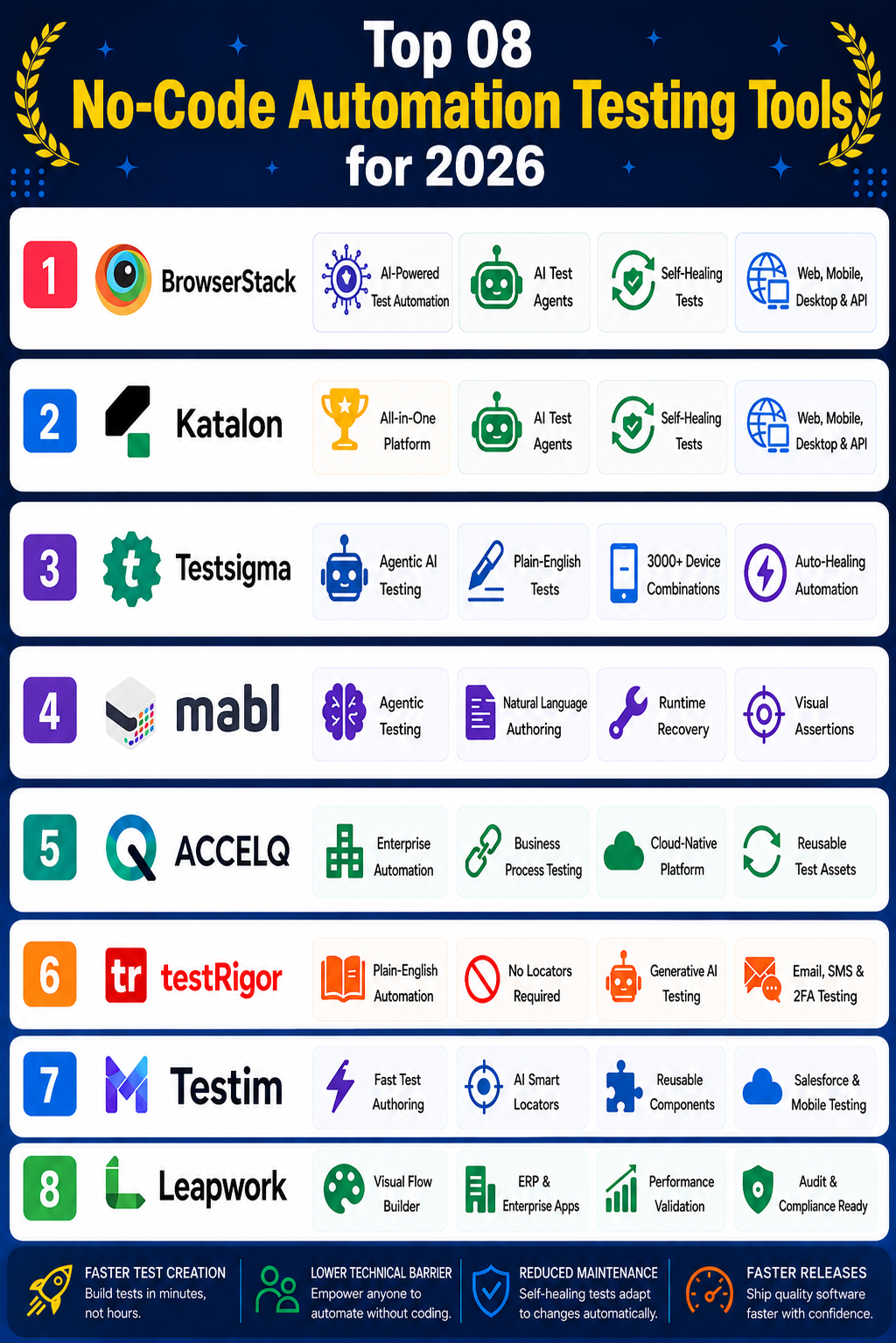
Top 08 No-Code Automation Testing Tools for 2026
What is no-code test automation?
No-code test automation (also called codeless test automation) is a software testing approach that allows users to create, execute, and maintain automated tests without writing programming code. Instead of building test scripts in languages such as Java, JavaScript, Python, or C#, users create tests through visual workflows, drag-and-drop builders, record-and-playback tools, natural language instructions, or AI-powered test generation.
The goal is simple: make test automation accessible to more people. Manual testers, QA analysts, product managers, business users, and subject matter experts can contribute to automation efforts without learning complex frameworks or programming languages.
Modern no-code testing platforms go beyond simple record-and-playback functionality. Many now use artificial intelligence to generate test cases, identify application elements automatically, create assertions from plain English instructions, and self-heal tests when user interfaces change. As a result, organizations can build automation faster while reducing the maintenance burden commonly associated with traditional scripted automation.
How does no-code testing work?
Most no-code automation platforms simplify test creation through one or more of the following approaches:
- Visual test builders that let users create workflows through drag-and-drop actions.
- Record-and-playback tools that capture user interactions and convert them into automated tests.
- Natural language testing where users describe actions in plain English.
- AI-generated tests are created from prompts, requirements, user stories, or existing workflows.
- Self-healing automation that automatically adapts when application elements change.
- Reusable test components that reduce duplication and simplify maintenance.
Benefits of no-code test automation
Faster automation development
Teams can create automated tests significantly faster because there is no need to build frameworks, write scripts, or maintain large codebases.
Lower technical barrier
Business analysts, manual testers, product owners, and QA professionals can contribute directly to automation initiatives without programming experience.
Reduced maintenance effort
Many modern platforms include AI-powered self-healing capabilities that automatically adjust tests when application interfaces change, reducing broken test cases and maintenance work.
Broader test coverage
Organizations are no longer limited by the availability of automation engineers. More stakeholders can participate in testing, resulting in wider coverage across business processes and user journeys.
Faster release cycles
Automation can be created, updated, and executed quickly, helping organizations support Agile, DevOps, and continuous delivery workflows.
Codeless vs low-code vs no-code test automation
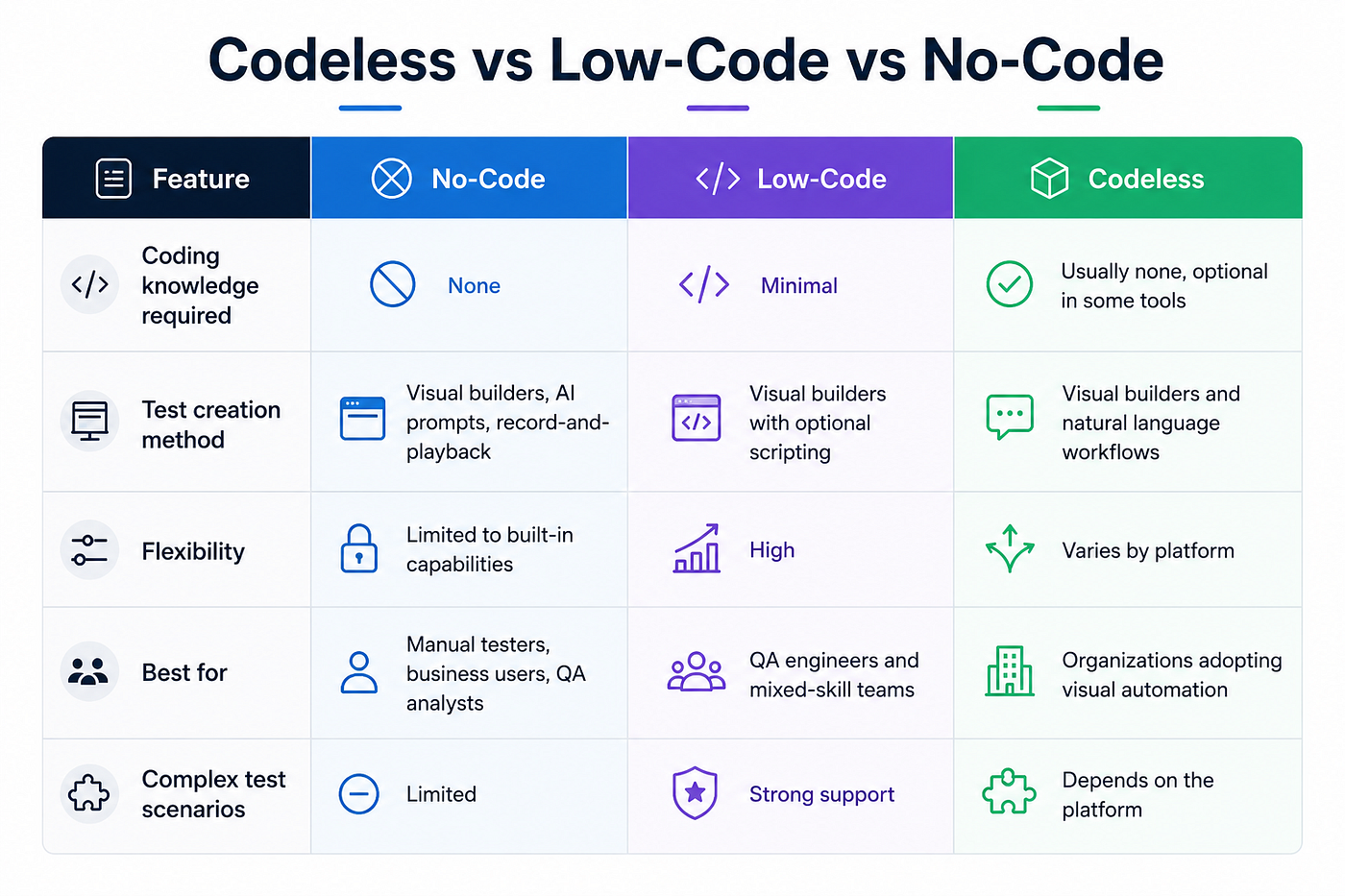
Codeless vs low-code vs no-code test automation
No-code testing is designed for users with no programming experience. Tests are created through visual builders, record-and-playback tools, natural language prompts, or AI-generated workflows. The goal is to make automation accessible to manual testers, business users, and QA professionals.
Low-code testing still relies primarily on visual test creation but provides options to add custom scripts, JavaScript snippets, API calls, or advanced logic when needed. This approach offers greater flexibility for complex testing scenarios.
Codeless testing is often used as a broad industry term that covers both no-code and low-code automation platforms. In practice, many vendors marketed as “codeless” actually fall into the low-code category because they support optional coding for advanced use cases.
Top 08 No-Code Automation Testing Tools for 2026
To help you choose the right platform, let’s explore the best no-code test automation tools for 2026 and see how they compare in terms of features, ease of use, pricing, supported testing types, and real-world adoption.
1. BrowserStack
BrowserStack is an AI-powered low-code test automation platform that helps teams create, execute, and maintain automated tests across web and mobile applications with minimal coding.
BrowserStack stands out for its AI-powered automation agents, broad device coverage, strong CI/CD integrations, and a generous free plan that helps you evaluate automation capabilities before committing to a paid subscription. Trusted by more than 50,000 customers across 135+ countries, the platform serves over 6 million registered users, provides access to 3,000+ real browsers and devices, and executes more than 60 million tests every month.
No-code products and capabilities include:
- AI Automated Tests
- AI-Powered Validations
- AI Agents
- AI Steps (Natural Language Automation)
- Self-Healing Agent
- API Steps
- Real Device Cloud Testing
Developed By
BrowserStack was founded in 2011 by Ritesh Arora and Nakul Aggarwal and is headquartered in Mumbai, India. The company also operates offices in San Francisco, New York, and Dublin.
Key No-code Features
Create automated tests using AI agents
BrowserStack’s AI agents help accelerate test creation by generating automation from natural language instructions and existing test cases. According to BrowserStack, these agents can help teams create tests faster while increasing automation coverage across applications.
Generate automation tests from plain English prompts
With AI Steps, users can describe a workflow in natural language and let the platform generate the required automation steps automatically. This makes it possible to automate complex user journeys without manually configuring every interaction.
Convert manual test cases into automated tests
BrowserStack can transform existing manual test cases into executable low-code automated tests using AI. This reduces the effort required to migrate from manual testing to automation while preserving existing testing assets.
Validate applications with AI-powered checks
AI-powered validations can automatically verify visual appearance, text content, UI elements, and downloaded files. Instead of creating custom validation logic, testers can use AI to confirm that applications behave and render as expected.
Reduce maintenance with self-healing automation
BrowserStack’s Self-Healing Agent automatically adapts tests when application interfaces change. This helps reduce broken tests caused by UI updates and lowers the ongoing maintenance effort required to keep automation reliable.
Update tests without re-recording
Tests can be edited directly without recording an entire flow again. This helps you to make targeted changes quickly whenever application functionality changes.
Improve test reliability with intelligent waits
The Intelligent Wait Time-out feature automatically waits for elements to become available before performing actions. This helps reduce flaky tests caused by loading delays and synchronization issues.
Combine UI and API testing in a single workflow
BrowserStack supports API steps within low-code tests, allowing you to perform setup, teardown, test data generation, and backend validations as part of the same automated workflow. This reduces the need for separate API automation tools in many scenarios.
Scale automation through reusable components
BrowserStack includes data-driven testing, reusable modules, variables, secrets management, dynamic test data, and version history to help you build maintainable automation suites. These capabilities help a single test to cover multiple scenarios, reuse common workflows across projects, securely manage credentials, and track changes over time without creating duplicate tests.
Analyze failures with AI-powered insights
BrowserStack provides AI-driven failure analysis, dashboard analytics, debugging insights, and automation coverage metrics. Test runs include screenshots, videos, logs, and historical trends to help you identify and resolve failures faster.
Execute tests across real browsers and devices
One of BrowserStack’s strongest advantages is its extensive real-device cloud. You can run automated tests across a wide range of browsers, operating systems, and mobile devices without maintaining your own testing infrastructure.
Integrate automation into CI/CD pipelines
BrowserStack integrates with Jira, GitHub, Jenkins, GitLab CI/CD, Azure DevOps, Slack, TestRail, and other testing tools. This helps automated tests run as part of the existing development and release cycle.
Why BrowserStack stands out for no-code testing?
Many no-code testing platforms help users create automated tests, but organizations often need more than test creation as their automation programs grow. BrowserStack combines test authoring, execution, reporting, device access, test management, and debugging capabilities within a single ecosystem by reducing the need to adopt and maintain multiple testing tools.
Another advantage is the platform’s maturity and scale. With millions of users, over 60 million tests executed every month, and adoption across thousands of organizations worldwide, BrowserStack has built one of the largest software testing ecosystems in the industry.
BrowserStack is also well-suited for organizations transitioning from manual testing to automation. Your organization can start with recorder-based automation and AI-assisted features, then gradually adopt more advanced capabilities.
Awards
- 2026 — Received the TrustRadius Buyer’s Choice Award, based entirely on verified customer reviews, highlighting BrowserStack’s value, product capabilities, and overall user experience.
- 2021 — Achieved unicorn status with a valuation of $4 billion, becoming one of India’s fastest-growing technology companies.
- Forbes Cloud 100 — Featured on the Forbes Cloud 100 list for four consecutive years, recognizing BrowserStack among the world’s leading private cloud companies.
Ratings
- G2: 4.5 / 5 (5,000+ reviews across the broader platform)
- Capterra: 4.5 / 5
- Gartner Peer Insights: 4.5 / 5
Customers
Trusted by more than 50,000 customers across 135+ countries, including Google, Amazon, Microsoft, X (Twitter), Tesla, Coca-Cola, Nike, Booking.com, Warner Bros. Discovery, United Nations, HSBC, and Spotify.
Pricing
BrowserStack Low-Code Automation uses a custom pricing model and does not publicly list subscription costs. Pricing depends on whether you are purchasing the Web or Mobile Low-Code Automation product, as well as your team size and feature requirements. Organizations need to contact BrowserStack sales for a custom quote.
Web-Based Low-Code Automation
- Essentials: Entry-level plan for teams starting their low-code automation journey. Includes data-driven testing, cross-browser testing for Chrome, Edge, and Firefox, quick debugging tools, user-state simulation, global variables, test scheduling, and CI/CD integrations.
- Pro: Adds mobile browser testing, database interactions, parallel test execution, synchronization with test management tools, email workflow testing, and advanced reporting and analytics. Also includes AI-powered capabilities such as the Low-Code Authoring Agent and Self-Healing Agent.
- Ultimate: Adds accessibility testing and Percy-powered visual testing capabilities. Includes AI agents for visual review and visual test integration to help expand test coverage across multiple testing types.
- Enterprise Add-on: Available for organizations requiring additional governance and support capabilities. Includes Single Sign-On (SSO), IP whitelisting, IP geolocation, priority support, dedicated solutions engineers, and dedicated customer success management.
- Reporting for External Tests Add-on: Enables reporting and analytics for unit, API, and UI tests executed outside the BrowserStack platform.
Mobile-Based Low-Code Automation
- Essentials: Designed for teams getting started with mobile app automation. Includes AI-first test authoring, zero-setup authoring on real cloud devices, natural mobile gestures such as tap, scroll, and type, text and element validation, intelligent wait management, automated test scheduling, and debugging through videos and logs.
- Enterprise Add-on: Available for larger organizations that require additional security, governance, and support capabilities. Includes Single Sign-On (SSO), IP whitelisting, priority support, and access to dedicated solutions engineers.
Free Trial
BrowserStack offers a free account that allows teams to evaluate its automation platform before purchasing a subscription. Unlike many enterprise testing platforms that only provide a limited trial, BrowserStack gives users access to real devices and automation features that can be used to explore the platform.
The free plan includes:
- Instant access to real browsers and mobile devices
- 30 minutes of interactive browser testing
- 30 minutes of interactive mobile app testing
- 100 minutes of automated browser testing
- 100 minutes of automated mobile app testing
- 5000 screenshots/month for visual testing with Percy
- Testing against internal development and staging environments
2. Katalon
Katalon is an end-to-end test automation platform that supports web, mobile, desktop, and API testing through no-code, low-code, and full-code approaches. For users focused on no-code automation, Katalon provides visual test creation, record-and-playback automation, AI-assisted test generation, self-healing maintenance, automated execution, and AI-powered test agents that can run tests from plain English instructions.
No-code products and capabilities include:
- Record & Playback test creation
- Visual Testing
- Katalon True Platform
- Autonomous Test Runner
- Katalon TrueTest Platform
- Katalon StudioAssist
- TestOps reporting and analytics
- Built-in test scheduling and execution management
Developed By
Katalon, Inc. (Katalon LLC) was founded in 2016 and is headquartered in Atlanta, Georgia, with offices in Ho Chi Minh City, Vietnam, and Singapore. Founded by Vu Lam.
Key No-code Features
Create automated tests through record-and-playback
Katalon can capture user interactions on an application and convert them into executable automated tests. Instead of writing scripts, testers perform actions inside the application while Katalon records each step automatically. This makes it possible to build UI test cases without programming knowledge.
Run automated tests from plain English instructions
Katalon’s Autonomous Test Runner removes the need for scripting entirely. Testers can describe a workflow in natural language, such as searching for a product, adding it to a cart, completing checkout, and verifying an order confirmation page. The AI agent interprets the instructions, executes the test, captures screenshots, records evidence, and generates pass/fail results automatically.
Automatically generate tests from real user behavior
TrueTest analyzes real application usage and automatically discovers, models, generates, and maintains user journey test cases. Instead of manually building every test scenario, organizations can create coverage based on how users actually interact with the application.
Reduce maintenance through self-healing tests
UI changes are one of the biggest challenges in no-code automation. Katalon’s self-healing capability automatically detects broken object locators and attempts to identify alternative elements when applications change. This reduces the amount of manual test maintenance required after UI updates.
Handle page loading issues automatically
The Smart Wait feature automatically waits for front-end processes to finish before executing the next test action. This helps prevent failures caused by timing issues without requiring testers to manually configure waits or synchronization rules.
Perform visual testing without coding
Katalon includes visual testing capabilities that compare images and identify visual differences that may be difficult to detect manually. This provides an additional validation layer for UI testing without requiring image comparison scripts.
Generate test cases directly from Jira requirements
For Jira users, Katalon can automatically generate manual test cases from requirement descriptions. A tester can create comprehensive test scenarios from a Jira issue with a single action instead of writing every test case manually.
Execute tests across multiple environments
Tests can run on local machines, cloud environments, remote devices, and CI/CD pipelines. Katalon also supports parallel execution across multiple browsers, operating systems, and mobile device combinations to increase test coverage and shorten execution times.
Generate defect reports automatically
When a test fails, Katalon’s AI-powered Bug Reporter can create a structured defect report containing failure details, screenshots, and reproduction information. Reports can be submitted directly to Jira or Azure DevOps without manually documenting issues.
Centralize reporting and test analytics
Katalon provides built-in reporting, failure analysis, alerts, and test analytics through a centralized dashboard. Test results can be exported in HTML, CSV, and JUnit formats while stakeholders receive automated notifications based on predefined conditions.
Why Katalon stands out for no-code testing
Many no-code testing tools rely primarily on record-and-playback automation. Katalon combines traditional no-code capabilities with AI-driven test generation, autonomous execution, self-healing maintenance, visual testing, and automated defect reporting. This enables non-technical users to create, execute, maintain, and analyze automated tests with minimal reliance on scripting.
This structure works much better for SEO, AEO, and GEO because each subsection directly answers a specific user question, such as:
- Can Katalon create tests without coding?
- Does Katalon support AI-generated tests?
- How does Katalon reduce test maintenance?
- Can Katalon run tests from natural language?
- Does Katalon support visual testing?
- How does Katalon handle bug reporting?
Awards
- 2026 — G2 Winter Enterprise badges: Regional Leader (India), Leader, and High Performer (Asia)
- 2026 — G2 Spring badges: Leader, Momentum Leader, and High Performer Enterprise
- 2025 — Visionary in the Gartner Magic Quadrant for AI-Augmented Software Testing Tools KARK
- 2025 — Inc. 5000, ranked №149 in software with 329% revenue growth
- 2025 — G2 Leader in software testing for 14 consecutive quarters
Ratings
- G2: 4.4 out of 5 across 222 reviews, holding Leader status (vendor pages show 4.5; cite 4.4 from the live product page to stay accurate).
- Gartner Peer Insights: 4.5 out of 5 from 866 verified reviews in the AI-Augmented Software Testing Tools market.
- Trustpilot: not a meaningful signal for this category. The profile shows 3.2 from one review; QA tool sentiment lives on G2 and Gartner, so I’d drop Trustpilot rather than cite a sample size of one.
- Capterra: 4.4 out of 5(706 reviews)
Customers
ING, GE Digital, Rakuten, Cardinal Health, Vodafone, Standard Chartered, PwC, Santander, Nasdaq, Samsung, Oracle, Tokio Marine, and Fifth Third. Verifiable scale: trusted by more than 30,000 QA and DevOps teams across 80+ countries.
Pricing
- Team Edition (small to mid-size organizations): $167/seat/month billed annually, or $185/seat/month billed monthly. A package offer drops it to $67/seat/month billed annually (60% off at 5 seats). Covers the AI agents (creation, execution, bug reporting, analytics), Katalon Studio, manual and automated testing in one workspace, cloud and self-hosted execution, unified test management, reports and analytics, web/mobile/desktop/API testing, Jira/GitHub/ADO/Slack/CI-CD integrations, and digital support.
- Enterprise Edition (large-scale organizations): custom pricing via Talk to Sales. Everything in Team, plus cross-project reports, role-based access and permissions, SSO, SCIM user provisioning, IP allowlisting, audit logs, compliance controls, and live support.
Free Trial
30-day free trial on the True Platform, no credit card required; after 30 days, you upgrade to keep your projects and data. Includes unlimited agentic AI, no-code-to-full-code manual and automation testing, cloud and self-hosted execution with parallel runs, and Jira/GitHub/Slack/CI-CD integrations.
3. Testsigma
Testsigma is an agentic test automation platform that enables testers, business users, and QA professionals to create, execute, and maintain automated tests without writing code. The platform combines natural language test creation, AI-powered test generation, self-healing automation, and cross-platform execution for web, mobile, desktop, Salesforce testing, and API testing.
No-code products and capabilities include:
- Atto AI Testing Agent
- Plain English Test Authoring
- AI Test Generation
- Test Recorder
- Self-Healing Automation
- Cloud Device Farm
- Parallel Test Execution
- Test Management
- Visual Testing
- API Testing
- Accessibility Testing
- CI/CD Integrations
Key No-code features
Create automated tests without coding
Testsigma enables users to build automated tests using plain English statements instead of programming languages. Tests can also be generated automatically from Jira stories, PRDs, Figma designs, images, videos, release notes, and existing test suites. This significantly reduces the time required to create automation coverage.
Generate tests with AI
Atto, Testsigma’s AI testing agent, can create executable test cases from requirements, prompts, user stories, and product documentation. Rather than manually defining every test step, users can describe a scenario and generate automated tests within seconds.
Handle complex testing scenarios without code
Testsigma supports advanced testing workflows such as conditional logic, loops, assertions, dynamic user interface flows, geo-location testing, mailbox validation, API validations, visual checks, and accessibility testing through structured low-code controls rather than traditional scripting.
Reduce maintenance through self-healing automation
Testsigma’s AI agents continuously monitor changes in application interfaces and APIs. When locators or elements change, the platform automatically updates test logic to keep automated tests running without manual intervention. The vendor claims this can reduce maintenance effort by up to 90%.
Execute tests across browsers, devices, and platforms
Users can run tests across web, mobile, desktop, and API environments from a single platform. Testsigma supports execution across more than 3,000 browsers, operating systems, and device combinations, including over 2,000 real mobile devices. Parallel execution further shortens feedback cycles.
Perform end-to-end testing in a single workflow
Testsigma combines functional testing, API testing, visual validation, and accessibility checks within the same automated test flow. This enables broader test coverage without switching between multiple tools.
Debug failures with AI assistance
When tests fail, Testsigma’s AI agents analyze failures, identify potential root causes, and provide screenshots, logs, videos, and diagnostic details. Failure information can be sent directly to tools such as Jira and GitHub to speed up issue resolution.
Integrate with CI/CD and development workflows
Testsigma integrates with Jira, Jenkins, Azure DevOps, GitHub, Bamboo, and other DevOps platforms. Automated tests can be scheduled or triggered within CI/CD pipelines to support continuous testing and faster release validation.
Centralize reporting and test management
The platform includes requirements management, version control, review workflows, role management, execution dashboards, screenshots, logs, videos, and test analytics in a centralized cloud environment. This provides visibility across the entire testing lifecycle.
Why does Testsigma stand out for no-code testing?
Many no-code testing platforms still rely heavily on record-and-playback automation. Testsigma places AI at the center of the workflow through Atto, its testing agent that can generate tests from requirements, maintain tests automatically, identify failures, and recommend additional coverage. Instead of focusing only on test execution, the platform addresses test creation, maintenance, debugging, and execution within a single environment.
Testsigma is particularly strong for organizations looking to scale automation beyond QA specialists. Business analysts, manual testers, product owners, and quality engineers can all contribute to automation efforts through natural language workflows and AI-assisted test generation.
Awards
- G2 Fall 2025 Leader
- G2 Fall 2025 Momentum Leader
- Enterprise-grade security and compliance recognition highlighted by the vendor
Ratings
- G2: 4.4/5 (109 reviews)
- Capterra: 4.4/5
- GetApp: 4.3/5 (19 reviews)
- Gartner: 4.7/5 (54 reviews)
- Glassdoor: 3.4/5 (95 reviews)
Customers
Samsung, Cisco, Carrier, KFC, Nestlé, Sanofi, DHL, Alten, Epsilon, Hansard Global, Nagra, FairPrice. Trusted by more than 10,000 QA teams and over 25 million test executions.
Pricing
Testsigma uses custom pricing for both Pro and Enterprise plans. Pricing varies based on the testing product selected, including web, mobile, desktop, Salesforce, and test management. Organizations must contact sales for a quote.
Pro
- Available for Web Testing, Mobile App Testing, and Test Management
- Includes Atto AI companion, unlimited projects, parallel execution, cloud testing, auto-healing scripts, and access to 800+ browser/OS combinations plus 2,000+ real mobile devices
Enterprise
- Available for Web, Mobile, Desktop, Salesforce Testing, and Test Management
- Adds accessibility testing, SSO, private cloud deployment, geo-location testing, 40+ integrations, AI-powered test case generation, and upcoming autonomous testing capabilities
Free Trial
- Yes, free trial available
- No credit card required
4. Mabl
Mabl is an AI-native, agentic low-code testing platform designed for web and mobile application testing. It combines natural language test creation, point-and-click automation, self-healing execution, and AI-powered test maintenance in a single platform. Unlike traditional no-code tools that focus primarily on recording user actions, Mabl emphasizes agentic testing where AI helps generate, maintain, recover, and optimize test coverage throughout the testing lifecycle.
No-code products and capabilities include:
- Natural Language Test Writing
- Point-and-Click Test Builder
- Agentic Test Generation
- Self-Healing Tests
- Runtime Recovery
- Visual Assertions
- Mobile App Testing
- API Testing
- Accessibility Testing
- Performance Testing
- Playwright Integration
- CI/CD Integrations
Key no-code features
Create automated tests using natural language
Mabl allows users to create tests from plain English descriptions, user stories, and Jira tickets. Test authors focus on the intended user behavior rather than selectors, locators, or scripting logic. This approach enables QA professionals and business users to contribute to automation without programming experience.
Build tests through a visual interface
Users can create end-to-end tests through Mabl’s point-and-click interface while retaining the flexibility to extend workflows with JavaScript, Appium, or Playwright when needed. This supports collaboration between non-technical testers and developers within the same testing framework.
Reduce maintenance through self-healing automation
When applications change, Mabl automatically detects affected tests and applies routine fixes through adaptive auto-healing. For larger changes, the platform recommends updates and requests user approval before modifying test logic. This reduces maintenance effort while preserving control over test coverage.
Generate assertions without coding
Mabl can generate assertions from plain language descriptions. Users can validate visual elements, business workflows, AI chatbot responses, and other complex behaviors without manually creating verification logic.
Execute and recover tests automatically
The platform includes agentic runtime recovery capabilities that help tests continue executing when expected application changes occur. Combined with advanced auto-healing, this helps reduce false failures and improve test reliability.
Support web, mobile, API, accessibility, and performance testing
Mabl provides a unified testing environment covering web applications, mobile applications, APIs, accessibility testing, and performance validation. Organizations can manage multiple testing disciplines through a single platform rather than maintaining separate tools.
Scale testing across teams and applications
The platform includes unlimited applications, environments, workspaces, participant licenses, local test runs, and cloud concurrency. This makes it suitable for organizations that want to expand automation across multiple products without managing infrastructure limits.
Integrate with existing development workflows
Mabl integrates with Jira, Slack, Microsoft Teams, CI/CD pipelines, Playwright, and other developer tools. Automated tests can be incorporated directly into release workflows for continuous quality validation.
Centralize reporting and diagnostics
The platform provides test failure summaries, root cause insights, visual assertions, diagnostic data, accessibility results, performance metrics, and execution analytics through a centralized interface.
Why Mabl stands out for low-code testing
Many no-code testing platforms focus on helping users create tests faster. Mabl extends beyond test creation by applying agentic AI throughout the testing lifecycle. Tests can be generated from natural language, recover from application changes, suggest fixes, provide root-cause analysis, and maintain coverage with less manual effort.
Mabl is particularly well-suited for organizations that want QA professionals, business stakeholders, and developers working within the same testing environment. Its combination of visual test creation, natural language workflows, AI-powered recovery, and developer extensibility makes it one of the strongest low-code options for enterprise-scale testing.
Awards
- 2025 — Won its 5th consecutive AI Breakthrough Award for AI-powered testing innovation.
- 2025 — Won its 5th Built In Boston’s Best Places to Work award and was recognized among the Best Startups to Work For.
- 2024 — Winner of the Business Intelligence Excellence in Customer Service Awards.
- 2022 — Recognized as a Leader in Test Automation by G2.
- 2022 — Named one of the SD Times Companies to Watch.
- 2021 — Named Best in Show — Software Development Testing in the SD Times 100 Awards.
- 2021 — Finalist in the North American Software Testing Awards (Leading Vendor category).
- 2021 — Finalist in the DevOps Dozen Awards for Best Testing Service/Tool.
- 2020 — Recognized as a Strong Performer in the Forrester Wave™: Continuous Functional Test Automation Suites.
- 2020 — Winner of the AI Breakthrough Award for Best AI-Based Solution.
- 2020 — Featured among the Best Codeless Testing Tools by Software Testing Material.
- 2019 — Winner of the AI Breakthrough Award for Best AI Tool for Developers.
- 2019 — Winner of a Bronze Stevie Award for Tech Startup of the Year (Software).
- 2019 — Winner of a Devies Award for Best Innovation in Artificial Intelligence & Machine Learning.
- 2019 — Named to the CB Insights AI 100, recognizing leading AI startups.
- 2019 — Finalist in the Software Testing & QE Awards for Best Test Automation Project (Functional).
- 2019 — Finalist in the DevOps Industry Awards for Most Innovative Project.
- 2018 — Winner of a Gold Stevie Award for Best New Product or Service of the Year in Software Development Solutions.
- 2018 — Finalist in the European Software Testing Awards for Most Innovative Project
Ratings
- G2: 4.4/5 (40 reviews)
- Gartner: 4.7/5 (7 reviews)
- Capterra: 4.0/5 (67 reviews)
Customers
JetBlue, NCR, Dollar Shave Club, Project Management Institute (PMI), FIGS, Komatsu, New York Life, Unifiedpost Group, NEC, Aptean, Barracuda, Stack Overflow, ADP, Priceline, SmugMug, Tokio Marine, DataRobot, Turo.
Pricing
Mabl uses custom enterprise pricing based on testing requirements rather than fixed public plans. Pricing covers web, mobile, API, accessibility, and performance testing through a shared platform model designed for organization-wide adoption.
Core Platform
- Web application testing, API testing, accessibility testing, performance testing, advanced auto-healing, agentic runtime recovery, visual assertions, unlimited local test runs, and unlimited cloud concurrency.
- Includes unlimited applications, environments, workspaces, participant licenses, CI/CD integrations, and Customer Success Manager support.
Add-ons
- Mobile App Testing with unlimited parallel cloud testing across iOS and Android devices.
- Technical Account Manager (TAM) for strategic guidance, implementation support, training, and adoption assistance.
Free Trial
Yes, a 14-day free trial is available
5. ACCELQ
ACCELQ is a cloud-based codeless test automation platform designed for enterprises that need automation across web, mobile, API, desktop, backend systems, packaged applications, and business processes. Unlike many no-code tools that focus primarily on simple UI testing, ACCELQ emphasizes business-process-driven automation, reusable design assets, AI-assisted maintenance, and end-to-end quality lifecycle management.
No-code products and capabilities include:
- Web Automation
- Mobile Automation
- API Automation
- Desktop Automation
- Backend & Database Testing
- ACCELQ LIVE
- Manual Test Management
- Change Bot
- Continuous Action Dashboard
- Integrated Data Designer
- Business Process Automation
- AI-Powered Autopilot
- Cloud Device Farm
Key no-code features
Create automated tests without coding
ACCELQ enables users to build automation using natural language and visual modeling rather than scripts. Testers can create complex workflows without worrying about programming syntax while maintaining the flexibility required for real-world enterprise applications.
Automate complex business processes
Unlike many codeless tools that focus on simple test cases, ACCELQ is built around business-process-driven automation. Users can automate dynamic workflows, multi-step transactions, backend validations, API interactions, and cross-application processes through a visual interface.
Reduce maintenance through AI-powered self-healing
ACCELQ uses AI-powered self-healing, intelligent element recognition, and visual change detection to keep tests stable when applications change. This reduces flakiness and minimizes manual maintenance efforts.
Scale automation with reusable design assets
ACCELQ follows a design-first approach that encourages reusable automation assets instead of isolated test cases. This improves maintainability and helps organizations scale automation across large application portfolios.
Support web, mobile, API, desktop, and backend testing
The platform provides automation coverage across web applications, mobile apps, APIs, desktop software, databases, backend systems, microservices, middleware, SSH environments, message queues, and packaged enterprise applications from a single platform.
Simplify test data management
ACCELQ includes an Integrated Data Designer that enables users to create, organize, and manage test data through a visual interface. Test case generation can be automated based on business-oriented data structures.
Manage application changes automatically
The platform’s Change Bot and Smart View Analyzer help teams manage test assets across multiple application revisions. This helps automation stay aligned with changing business processes and application updates.
Integrate with CI/CD and DevOps workflows
ACCELQ integrates with CI/CD pipelines, test management platforms, Agile workflows, and enterprise DevOps ecosystems, helping organizations incorporate automation into continuous delivery processes.
Centralize quality lifecycle management
Beyond automation, ACCELQ provides unified quality lifecycle management through dashboards, reporting, traceability, change management, collaboration features, and business-oriented visibility across testing activities.
Why ACCELQ stands out for codeless testing
Many no-code platforms simplify automation by limiting what users can build. ACCELQ takes a different approach by combining the simplicity of codeless automation with capabilities traditionally associated with code-based frameworks. This makes it particularly attractive for large enterprises managing complex business workflows, packaged applications, and cross-platform automation initiatives.
Its design-first architecture, AI-powered maintenance capabilities, and broad technology coverage help organizations scale automation without sacrificing flexibility or maintainability.
Awards
- 2025 — Named a Forrester Wave Leader in Autonomous Testing Platforms. (shown on vendor website)
- 2025 — Recognized as a G2 Leader in test automation.
- 2024 — Received a SoftwareSuggest Award for test automation excellence.
- 2023 — Named to the Deloitte Technology Fast 500.
- 2023 — Recognized by the testing community for leadership in codeless test automation.
Ratings
- G2: 4.8/5 (106 reviews)
- Gartner Peer Insights: 4.5/5 (34 reviews)
- Capterra: 4.9/5 (135 reviews)
Customers
Pfizer, Anthem, Intel, Atlassian, Frontier Airlines, UnitedHealthcare, GE, Popeyes, Comcast, M&T Bank, eBay, Carnival, Macy’s, United Airlines, Ericsson, Mastercard.
Pricing
ACCELQ offers custom enterprise pricing based on automation scope, users, applications, and execution requirements. Pricing is available through a sales consultation rather than fixed public plans.
Platform
- Web, mobile, API, desktop, backend, packaged application, and business-process automation in a unified cloud platform.
- Includes AI-powered self-healing, reusable automation assets, change management, test management, reporting, and collaboration features.
Enterprise Capabilities
- ACCELQ LIVE for packaged applications and cloud platforms.
- Cloud device farm access, advanced lifecycle management, CI/CD integrations, enterprise support, and AI-powered automation capabilities.
Free Trial
- Yes
- Free 14-day trial available
- No credit card required
- Includes ACCELQ Academy training access
- Includes cloud device farm access
- Includes 24/7 technical support
- Includes personalized product onboarding and sample projects
6. TestRigor
TestRigor is a generative AI-powered test automation platform that enables users to create, execute, and maintain automated tests using plain English. Unlike traditional record-and-playback tools or low-code frameworks, testRigor focuses on true codeless automation where manual testers, business analysts, and QA professionals can build end-to-end tests without programming knowledge, XPath locators, CSS selectors, or complex automation frameworks.
No-code products and capabilities include:
- Plain English Test Automation
- AI Test Generation
- Autonomous Test Creation
- Self-Healing Tests
- Visual Testing
- Web Testing
- Mobile Testing
- Desktop Testing
- API Testing
- Email Testing
- SMS & Phone Testing
- 2FA Testing
- Mainframe Testing
Key no-code features
Create automated tests using plain English
testRigor allows users to create tests using natural language commands rather than code. Users can describe actions the same way they would write a manual test case, making automation accessible to non-technical users.
Generate tests from existing manual test cases
Organizations can copy and import existing manual test cases directly into testRigor. The platform converts those test cases into executable automated tests using its AI-powered engine, reducing the effort required to start automation initiatives.
Eliminate dependency on locators and selectors
Unlike Selenium-based frameworks, testRigor identifies elements the way users see them on screen instead of relying on XPath, CSS selectors, or IDs. This reduces automation fragility and simplifies test creation.
Reduce maintenance through AI-powered self-healing
The platform uses machine learning, Vision AI, and contextual analysis to adapt tests when applications change. According to customer feedback shared by the vendor, maintenance effort can be reduced dramatically compared to traditional automation frameworks.
Support web, mobile, desktop, API, and communication testing
testRigor supports testing across web applications, mobile apps, desktop software, APIs, email workflows, SMS verification, phone calls, two-factor authentication, and even mainframe applications through a unified no-code platform.
Improve test coverage with autonomous test creation
The platform can automatically analyze user behavior and application workflows to generate tests for commonly used business processes. This helps organizations increase automation coverage without manually creating every test case.
Scale automation beyond QA engineers
Because tests are written in plain English, manual testers, business users, product teams, and QA professionals can contribute to automation efforts without learning programming languages or automation frameworks.
Integrate with CI/CD and testing ecosystems
testRigor integrates with GitHub Actions, GitLab, Jenkins, Jira, Azure DevOps, TestRail, Zephyr, CircleCI, Spinnaker, and other DevOps platforms to support continuous testing workflows.
Built-in security and compliance
The platform supports enterprise security requirements through SOC 2, ISO/IEC 27001:2022, HIPAA, GDPR, and other compliance standards.
Why testRigor stands out for no-code testing?
Most no-code testing tools still depend on underlying technical concepts such as locators, object repositories, or automation frameworks. testRigor takes a different approach by focusing on human-readable automation written entirely in plain English. Tests are created from the user’s perspective rather than application implementation details, making them easier to create, understand, and maintain.
The platform is particularly well-suited for organizations looking to expand automation coverage without increasing reliance on automation engineers. Its AI-powered maintenance capabilities, autonomous test creation, and support for multiple testing channels make it one of the strongest true codeless testing platforms available today.
Awards
- 2025 — Ranked among the Inc. 5000 Fastest-Growing Private Companies in America, achieving an overall rank of 807 and a software industry rank of 80.
- 2025 — Recognized as the #1 GenAI Testing Tool by multiple testing and technology publications.
- 2023 — Named a Gartner Cool Vendor™ in Software Engineering: Improving Digital Resilience.
- 2025 — Received recognition as the #1 AI-Powered Testing Tool, #1 Best Automation Testing Tool, and #1 Mobile Automation Testing Tool by industry review platforms. (vendor-recognized awards shown on website)
Ratings
- G2: 4.7/5 (20 reviews)
- Gartner: 4.6/5 (10 reviews)
Customers
United States Department of Agriculture (USDA), Cisco, Esri, Perficient, Business Wire, Infor, IDT, Medrio, Cornerstone.
Pricing
testRigor offers three pricing tiers ranging from a free public plan to private and enterprise deployments. Pricing scales based on execution environments, privacy requirements, and enterprise support needs.
Public & Private Plans
- Public Open Source plan is free forever, with tests and results publicly accessible through shareable URLs.
- Private Complete includes a 14-day trial, support for Windows, Mac, Ubuntu, Android, iOS, Windows Native testing, and access to all AI capabilities. (Most Popular)
Enterprise
- Custom pricing for organizations requiring private deployments, enterprise support, security controls, and large-scale automation programs.
- Designed for enterprise QA environments with advanced governance and compliance requirements.
Free Trial
- Yes
- 14-day free trial available
- No credit card required
- Includes access to AI-powered testing capabilities
- Supports web, mobile, desktop, and API testing during the trial period
7. Testim
Testim is a low-code test automation platform that combines visual test authoring with code-level flexibility. The platform enables QA teams, developers, and business users to create automated tests through recording, visual editors, reusable components, and AI-powered self-healing capabilities while still allowing custom JavaScript when advanced scenarios require it.
Key low-code features
Record and create tests quickly
Users can record application workflows and convert them into automated tests within minutes. Testim automatically recognizes repeated sequences and suggests reusable elements, helping teams build scalable test architectures from the beginning.
Visual editor for no-code customization
Tests can be configured through a visual editor without writing code. Teams can add validations, loops, conditions, parameterization, reusable groups, and API steps directly from the UI.
AI-powered Smart Locators
Testim’s Smart Locator technology evaluates hundreds of attributes to identify elements and adapt when applications change. This AI-powered self-healing reduces test failures caused by UI updates and lowers maintenance effort.
Low-code flexibility when needed
Unlike purely codeless platforms, Testim allows users to insert custom JavaScript inside or outside the browser. This provides flexibility for advanced testing scenarios while preserving fast visual test creation.
Built-in reusable components
Teams can create reusable groups, shared steps, loops, conditions, and test modules to improve maintainability and reduce duplication across test suites.
Root cause analysis and debugging
Testim automatically captures screenshots, console logs, network logs, and execution details for every test step. Recurring failures are grouped together to simplify troubleshooting.
TestOps for scaling QA programs
The platform includes TestOps capabilities such as dashboards, branching, pull-request workflows, ownership tracking, audit logs, analytics, and quality reporting to support larger teams.
Specialized Salesforce testing
Testim offers a dedicated Salesforce testing solution with metadata-aware locators, Salesforce Flow testing, permissions validation, Lightning support, and pre-built Salesforce testing steps.
Supported platforms
- Web applications
- Mobile applications (iOS & Android)
- Salesforce applications
- Cross-browser testing
- API testing
- Accessibility testing
- CI/CD workflows
Why Testim stands out for low-code testing?
Many codeless tools focus entirely on no-code test creation but struggle with complex use cases. Testim positions itself as a low-code platform that combines fast visual authoring with the flexibility of code when needed. This makes it particularly attractive for teams that want broader participation in test automation without sacrificing advanced capabilities.
Awards & Recognition
- 2021 Digital Innovator Award (Intellyx)
- 2020 DevOps Dozen Finalist
- 2020 North American DevOps Awards Finalist
- 2019 SD Times 100
- 2020 QA Lead Best Automation Tool Award
- SOC 2 Type II Certified
Ratings
- G2: 4.5/5 (4 reviews)
- Gartner: 4.5/5 (28 reviews)
- Trustpilot: 3.2/5 (1 review)
- Capterra: 4.6/5 (50 reviews)
- Popular among Agile and DevOps teams looking for low-code automation
Customers
Microsoft, Salesforce, USA Today, JFrog, Sprinklr, NetApp.
Pricing
Testim offers separate plans tailored for Web, Mobile, and Salesforce testing. Pricing is provided through custom quotes based on testing requirements and team size.
Testim Salesforce
- Agentic Test Automation with natural language test generation
- Pre-built Salesforce testing steps
- Salesforce metadata-powered locators
- Salesforce Flows and permissions testing
- Optimized for Salesforce Lightning
Testim Web
- AI-powered Smart Locators
- Low-code recorder-based authoring
- Cross-browser testing
- Turbo execution mode
- Accessibility testing
- Activity audit logs
- Free Community plan available after trial
Testim Mobile
- Cloud-based mobile testing
- Real and virtual device support
- iOS and Android testing
- AI-powered Smart Locators
- Root-cause analysis visualization
- Test and application management
Free Trial
- Yes
- Free trial available for all products
- Automatically converts to the Community Free Plan after the trial period
- One Community plan allowed per organization
8. Leapwork
Leapwork is a no-code automation platform that combines functional testing, API validation, performance testing, and agentic orchestration within a single visual platform. Built for enterprise environments, Leapwork enables teams to automate testing through visual workflows instead of code while supporting web, desktop, ERP, SaaS, and AI-native applications.
ROI figures reported by Leapwork
- 3× faster releases
- 70% productivity increase
- 90% fewer defects
- 75% faster time to value
No-code products and capabilities include:
- Visual Test Automation
- API Testing
- Performance & Load Testing
- Agentic Orchestration
- AI Studio
- Web Testing
- Desktop Testing
- ERP Testing
- SaaS Application Testing
- Continuous Validation Platform
- End-to-End Business Process Validation
- Enterprise Governance & Audit Trails
Key no-code features
Build automation through visual flows
Leapwork replaces scripting with a visual flow-based designer where users create automation by connecting reusable building blocks. This approach makes test creation accessible to both technical and non-technical users while reducing automation complexity.
Validate web, desktop, ERP, and SaaS applications
The platform follows an application-agnostic approach that supports modern web applications alongside desktop software, packaged applications, ERP systems, and SaaS platforms from a single automation environment.
Automate end-to-end business processes
Users can automate complete business workflows that span multiple systems, applications, and technologies rather than limiting automation to individual application tests.
Integrate performance, API, and functional validation
Leapwork combines functional automation, API validation, and performance testing capabilities within one platform, reducing the need to manage multiple testing tools.
Agentic orchestration across the SDLC
The platform includes agentic orchestration capabilities designed to coordinate validation activities across development, testing, and release processes.
AI flexibility with enterprise controls
Leapwork’s AI Your Way™ approach allows organizations to adopt AI capabilities while maintaining governance, explainability, auditability, and enterprise controls.
Built for regulated industries
The platform emphasizes deterministic execution, audit trails, traceability, and governed results, making it suitable for organizations operating in highly regulated environments.
Scale automation without coding expertise
Visual automation enables business users, QA professionals, and subject matter experts to contribute to automation initiatives without requiring programming skills.
Why Leapwork stands out for no-code testing?
Many no-code testing tools primarily focus on web automation. Leapwork differentiates itself through broad enterprise coverage, supporting web, desktop, ERP, SaaS, and business-process automation from a single platform. Its visual-first approach, combined with governance controls and agentic orchestration capabilities, makes it particularly attractive for large organizations managing complex application portfolios.
Awards
- 2022 — Ranked #58 in the Sifted B2B SaaS Rising 100.
- 2022 — Recognized among Europe’s fastest-growing B2B software companies.
- Featured in multiple enterprise automation and digital transformation rankings.
- Recognized for innovation in visual no-code test automation and enterprise validation platforms.
Ratings
- G2: 4.5/5 (107 reviews)
- Capterra: 4.3/5 (50 reviews)
- Glassdoor: 3.3/5 (263 reviews)
- Gartner: 3.7/5 (9 reviews)
- Frequently recognized in enterprise automation and software testing categories.
Customers
Amazon, Google, Porsche, PayPal, AstraZeneca, Novo Nordisk, Blackstone, BMW, BNP Paribas, BT, Canada Goose, Credit Suisse, Investec, TotalEnergies, Vanguard, Patagonia.
Pricing
Leapwork uses custom enterprise pricing designed to scale with automation adoption, testing volume, and organizational requirements. Pricing is available through direct consultation rather than fixed public plans.
Platform
- Visual test automation for web, desktop, ERP, SaaS, and enterprise applications.
- Functional testing, API validation, performance testing, and end-to-end business process automation.
Enterprise Capabilities
- Agentic orchestration and validation across the SDLC.
- AI Studio capabilities.
- Enterprise governance, audit trails, and compliance controls.
- Enterprise support and implementation services.
Free Trial
- No publicly available free trial is advertised
- Personalized demo available
- Custom proof-of-concept and evaluation programs may be available through sales
- Organizations can request a custom quote and product demonstration
Frequently Asked Questions (FAQs)
What is the best no-code test automation tool in 2026?
The best no-code test automation tool depends on your requirements. Katalon is a strong choice for organizations looking for web, mobile, desktop, and API testing in a single platform. Testsigma and Mabl focus heavily on AI-powered and agentic testing capabilities. ACCELQ is often preferred by enterprises that need business-process-driven automation, while testRigor stands out for plain-English test creation.
Can no-code testing replace Selenium?
For many organizations, yes. Modern no-code testing platforms can automate web, mobile, API, and end-to-end testing without requiring Selenium expertise. However, highly customized automation frameworks and unique testing scenarios may still benefit from Selenium or other code-based approaches.
Are no-code testing tools suitable for enterprise applications?
Yes. Many enterprise-grade no-code testing platforms support Salesforce, SAP, Oracle, Microsoft Dynamics, ServiceNow, desktop applications, packaged applications, APIs, and complex business workflows. Tools such as ACCELQ, Leapwork, and Tricentis Tosca are widely used in enterprise environments.
Can AI generate automated test cases automatically?
Many modern testing platforms now use generative AI to create test cases from requirements, user stories, Jira tickets, screenshots, recordings, and natural language prompts. AI can also suggest missing test coverage, generate assertions, and identify potential edge cases.
How do self-healing tests work?
Self-healing automation uses AI and machine learning to identify application elements when attributes change. Instead of failing when a button ID or locator changes, the platform analyzes multiple characteristics and automatically updates the test to maintain stability.
Can non-technical users create automated tests?
Yes. Most no-code testing tools are specifically designed for manual testers, QA analysts, product managers, business analysts, and subject matter experts. Users can create tests through visual workflows, natural language instructions, drag-and-drop builders, or record-and-playback features.
Which testing types can be automated using no-code tools?
Modern no-code automation platforms commonly support:
- Functional testing
- Regression testing
- End-to-end testing
- API testing
- Mobile app testing
- Cross-browser testing
- Visual testing
- Accessibility testing
- Salesforce testing
- Performance testing
The supported testing types vary by platform.
Are no-code testing tools suitable for CI/CD pipelines?
Yes. Most enterprise no-code platforms integrate with Jenkins, GitHub Actions, GitLab CI/CD, Azure DevOps, CircleCI, Bamboo, Jira, and other DevOps tools. Automated tests can run after commits, pull requests, deployments, or scheduled release validations.
What are the limitations of no-code test automation?
No-code testing platforms can be less flexible than custom automation frameworks for highly specialized testing requirements. Some tools may also introduce platform dependencies or require upgrades to access advanced AI capabilities. Organizations with unique testing needs should evaluate customization options before selecting a platform.
How much do no-code testing tools cost?
Pricing varies significantly. Some platforms offer free community editions or free trials, while enterprise-focused solutions typically provide custom pricing based on users, execution volume, supported applications, and testing requirements. Costs generally range from free plans for small teams to enterprise agreements for large-scale automation programs.
Is no-code testing good for Agile and DevOps teams?
Yes. Faster test creation, reduced maintenance effort, AI-powered automation, and CI/CD integrations make no-code testing particularly attractive for Agile and DevOps environments where rapid release cycles require continuous validation.
What should I look for when choosing a no-code testing tool?
Key evaluation criteria include:
- AI-powered test creation
- Self-healing capabilities
- Supported testing types
- Web and mobile coverage
- API testing support
- Salesforce or ERP testing support
- CI/CD integrations
- Reporting and analytics
- Enterprise security certifications
- Ease of maintenance
- Pricing and scalability
메타데이터
- post_id
- 08641ad408ac
- slug
- top-07-no-code-automation-testing-tools-for-2026-08641ad408ac
- url
- https://medium.com/@shanikaw/top-07-no-code-automation-testing-tools-for-2026-08641ad408ac
- canonical_url
- https://medium.com/@shanikaw/top-07-no-code-automation-testing-tools-for-2026-08641ad408ac
- author_url
- https://medium.com/@shanikaw
- status
- ok
- fetched_at
- 2026-06-29 01:02:39