Inflation, Consumer RWAs, and the Future of Tokenized Commerce
An analysis of imported inflation, stablecoins, and the growing role of Consumer RWAs in the next phase of asset tokenization.
Inflation, Consumer RWAs, and the Future of Tokenized Commerce
Author: Xinyue, Fu Rao Tony Edited by Avrum
(Introduction)
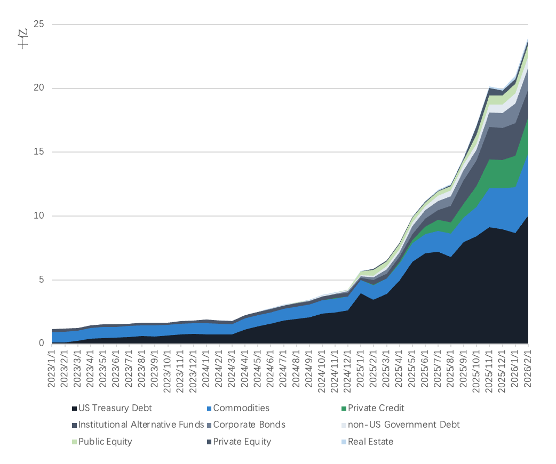
Since 2024, the global RWA (Real World Assets) market has expanded rapidly, but the market’s current understanding of RWA remains largely at the “asset on-chain” level, overlooking its deeper macroeconomic attributes. RWA is essentially a mapping of the value and risks of real-world assets. Therefore, the impact of macroeconomic cycles on the underlying assets of different RWAs is far more important than tokenization itself.
Amid rising geopolitical tensions and supply-chain disruptions, imported inflation is once again becoming a core variable in global capital market pricing. Unlike the monetary inflation driven by liquidity expansion in the past, imported inflation will lead to a distinct divergence in different types of RWAs: some assets will benefit from rising commodity prices, while others will be suppressed by the dual pressures of interest rates and economic strain. From this perspective, RWA is not a single asset class but rather a collection of assets with distinct sensitivities to the macroeconomic environment.
I. Classification of Underlying RWA Assets
Currently, mainstream underlying RWA assets can be roughly divided into four categories. The first category is Treasury bond assets, which is the largest RWA category today; its core value comes from stable yields and US dollar interest rate dividends. The second category is gold assets, including physical gold-backed tokens and precious metal reserve assets; the core logic of gold RWAs lies in safe-haven and long-term credit hedging. The third category is high-dividend equity assets, such as equity yield mappings in energy, utilities, and resources; these assets are essentially cash-flow-type RWAs. The fourth category is consumer RWAs, including various consumer goods, services, and collectibles; compared with financial assets, consumer RWAs are closer to the real economy and to the transmission of physical inflation. Different assets perform markedly differently during imported inflation cycles, and these differences determine RWAs’ pricing and capital flows in the next stage.

Source: RWA.xyz, RWA.LTD Research Department
II. The Impact of Imported Inflation on Various RWA Underlying Assets
1. Classification and Judgment of Inflation
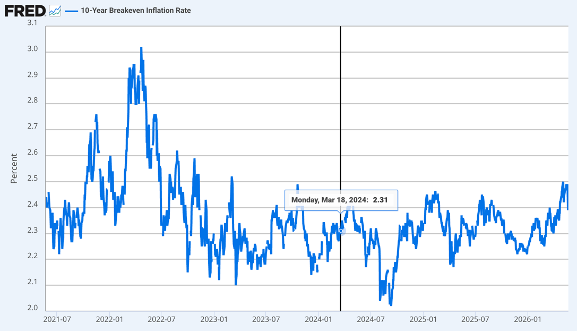
In the past, the market was more familiar with liquidity inflation. After 2008, major global economies maintained low interest rates and engaged in quantitative easing for an extended period, driving up asset prices. This type of inflation essentially originated on both the demand and liquidity sides. However, imported inflation is completely different. Imported inflation is often triggered by shocks in oil, natural gas, commodities, or supply chains, and its core is cost-push inflation. For example, when crude oil prices rise, the impact will gradually ripple through society along the path: energy → transportation → manufacturing → consumer goods → service industry. This type of inflation often suppresses economic growth due to rising costs and product prices, forming an environment closer to stagflation. A key indicator for judging whether imported inflation is a short-term shock or a long-term trend is the 10Y Breakeven Inflation. If the 10Y Breakeven continues to rise, it indicates that the market is beginning to re-price the long-term inflation structure. This change will directly affect all RWA underlying assets.
Source: FRED, RWA.LTD Research Department
2. The Impact of Inflation on Treasury Bond RWAs
The impact of imported inflation on Treasury bond RWAs is relatively complex. Short-term Treasuries are highly sensitive to Fed interest rates. In the early stages of imported inflation, the Federal Reserve often observes rather than immediately raises interest rates, so short-term interest rates are relatively insensitive. However, as inflation further feeds through to the consumer end and the Fed enters an interest-rate-hike cycle, short-term rates like the 2Y will rise rapidly. And in the later stages of the cycle, when high interest rates begin to suppress the economy and the market starts trading on rate-cut expectations, short-term rates will fall quickly again. Therefore, in the context of imported inflation, short-term bond RWAs are essentially trading the monetary policy path. For geopolitically driven imported inflation, this volatility will be even more pronounced. Because the market can neither judge how long elevated oil prices will persist nor the risk of conflict escalation, the volatility of short-term interest rates and short-term bonds usually increases significantly.
In contrast, the logic of long-term interest rates is more complex. Long-term interest rates are essentially determined by expected real growth, expected inflation, and the term premium. On the one hand, imported inflation will raise inflation expectations, thereby driving up long-term interest rates; on the other hand, rising energy prices will suppress consumption and economic growth, thereby lowering long-term growth expectations. Therefore, the 10Y Treasury often experiences a “rise first, then fall” pattern during imported inflation cycles: trading inflation and rate hikes in the early stage, and trading recession and future rate cuts in the later stage. This is also why, during the imported inflation phase, the trend of long-term Treasury bonds is often more complex than the market imagines.
3. The Impact of Inflation on Gold RWAs
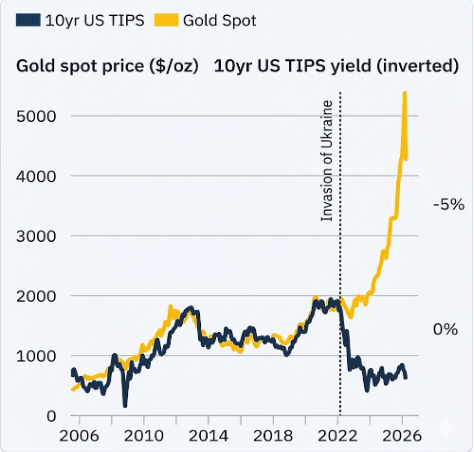
Gold is usually viewed as an inflation hedge, but its true underlying logic is not CPI itself, but real interest rates. When inflation rises rapidly and exceeds nominal interest rates (actual interest rates fall below zero), the opportunity cost of holding non-yielding gold decreases, and gold prices often rise. Therefore, historically, gold is more of a “negative real interest rate asset” rather than a simple inflation asset. However, after 2022, the logic for gold began to change. The Russia-Ukraine conflict, the weaponization of the US dollar, and global geopolitical fragmentation have led global central banks to de-dollarize and increase their gold reserves again. Central banks’ gold purchases have begun to partially deviate from the traditional real interest rate framework. Gold is shifting from a pure anti-inflation asset to a hedging asset against long-term systemic credit risks. In other words, the market buys gold not only because of concerns about rising prices but also because of concerns about changes in the global monetary system and sovereign credit structure. This change also significantly enhances the strategic value of gold RWAs.
In contrast, although BTC also possesses an anti-inflation narrative, it is simultaneously a high-volatility risk asset. Imported inflation will bolster BTC’s “digital gold” narrative, but interest rate hikes and liquidity contraction will suppress valuations of high-risk assets. Based on historical data, during the Russia-Ukraine conflict, BTC’s risk-asset attributes clearly dominated, with its price pulling back significantly while gold continued to rise. This also means that the behavioral patterns of BTC and gold in the macroeconomic cycle are not the same.
Source: Financial Times, Bloomberg, RWA.LTD Research Department
4. The Impact of Inflation on High-Dividend RWAs
High-dividend RWAs exhibit some of the most significant divergences during imported inflation cycles. Upstream resource industries are usually the biggest beneficiaries. For enterprises in oil, natural gas, coal, and non-ferrous metals, revenue benefits directly from rising commodity prices, while their capital expenditure cycles are often longer, making their short-term profit elasticity extremely strong. This is why energy-based, high-dividend assets usually perform well during periods of imported inflation. In contrast, midstream and downstream enterprises face pressure on profit margins. Rising raw material, transportation, and energy costs will erode profit margins, and only enterprises with strong pricing power can pass these costs on to consumers. Therefore, even among high-dividend assets, industries perform very differently during imported inflation, and bank stocks are in an even more distinctive position. In the early stage of a rate hike cycle, the repricing speed of bank assets is faster than that of liabilities, Net Interest Margin (NIM) expands significantly, and profits surge quickly; however, entering the mid-to-late stages of the rate hike, high interest rates cause macroeconomic strain, corporate bad debts surge, and provisioning significantly erodes profits. By contrast, when bank profits hit rock bottom due to bad-debt expectations, this often coincides with the lowest valuation point for bank stocks in the entire macroeconomic cycle.
III. The Important Role of Consumer RWAs in the Era of Inflation
1. Distribution and Use of Stablecoins
Compared to financial assets, the importance of consumer RWAs in the era of imported inflation may be underestimated by the market. Currently, the main usage areas of stablecoins are concentrated in APAC (Asia-Pacific), MENA (Middle East and North Africa), and the Americas, and use cases increasingly extend beyond crypto trading to supplier payments, commercial collections, liquidity management, product payments, and distributor settlements. This means that stablecoins are gradually becoming the infrastructure for cross-border trade and product trading.
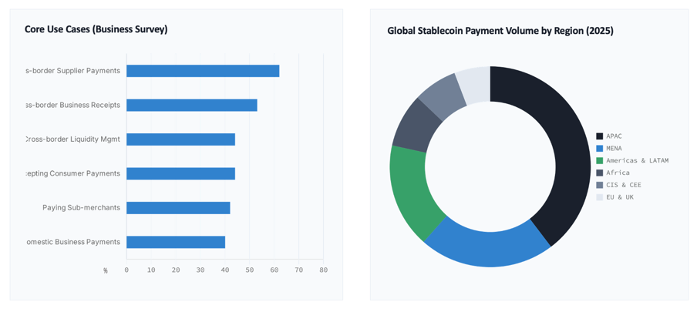
Source: EY, RWA.LTD Research Department
2. The Important Role of Consumer RWAs in Anti-Inflation
By combining the high-frequency commercial use cases of stablecoins mentioned above, the strategic value of consumer RWAs can be better understood, and, against the backdrop of imported inflation, their importance will further increase. Product prices will continue to rise as inflation is transmitted; therefore, the value of consumer RWAs lies not only in trading efficiency but, more importantly, in locking in future purchasing power. For example, purchasing rights to consumer goods in advance, locking in service prices in advance, or obtaining supply chain quotas in advance are essentially hedges against future inflation risks. For the aforementioned enterprises in APAC and MENA that rely heavily on cross-border supply chains, purchasing and holding consumer RWAs in advance via stablecoin channels during the early stages of inflation is essentially a forward cost-locking mechanism. In many industries, forwards and futures play similar roles; in those lacking them, long-term agreements serve a similar function. Compared with long-term agreements, RWAs enable real-time market quotes and post-purchase trading, adding flexibility to supply chain management. From this perspective, consumer RWAs are not merely asset tokenization but the mapping of real-world inventory and supply chains on-chain, serving as an inflation-management tool for ordinary consumption and corporate supply chain management. This may help mitigate the risk of future price increases in certain categories of physical goods due to subsequent imported inflation, thereby transforming Consumer RWA infrastructure into a solid anti-inflation moat for the traditional commercial system.
Conclusion: The Macro Logic of RWA’s Next Stage
In the past, the market focused more on technical paths when discussing RWAs, but as the world re-enters the inflation and geopolitical cycle, the core issue of RWA is shifting from “how to get on-chain” to “what is the underlying asset”. Different underlying assets behave very differently in periods of imported inflation: Treasury bonds trade on interest-rate paths, gold trades on systemic credit risk, high-dividend assets trade on commodity cycles, and consumer RWAs trade directly on real inflation. Therefore, the next stage of RWA is no longer just tokenization itself but asset selection within the macroeconomic environment.
About RWA.LTD
RWA.LTD explores consumer RWAs, tokenized commerce infrastructure, and the integration of real-world products and services with blockchain technology.
Website: rwa.ltd LinkedIn: https://linkedin.com/company/rwaltd X: https://x.com/RWA_LTD Instagram: https://instagram.com/rwa.ltd_
메타데이터
- post_id
- 0878aca5bca0
- slug
- inflation-consumer-rwas-and-the-future-of-tokenized-commerce-0878aca5bca0
- url
- https://medium.com/@rwa-ltd/inflation-consumer-rwas-and-the-future-of-tokenized-commerce-0878aca5bca0
- canonical_url
- https://medium.com/@rwa-ltd/inflation-consumer-rwas-and-the-future-of-tokenized-commerce-0878aca5bca0
- author_url
- https://medium.com/@rwa-ltd
- status
- ok
- fetched_at
- 2026-06-15 20:49:13




