Portraits from Hobohemia
Faces of Men Bound by Hunger and Hope
Portraits from Hobohemia
Faces of Men Bound by Hunger and Hope
It was early October of 1927, when the first hard breath of cold swept in off Lake Michigan and sent the leaves skittering in color down Madison Street. I had been dispatched from my desk at the Chicago Tribune — part reporter, part photographer — to capture a portrait of the restless tide of men in Hobohemia — part neighborhood, part social underworld — that held the largest concentration of homeless men in America. The Speed Graphic camera hung heavy at my side, its stiff bellows and wooden tripod as much a burden as a witness. Jim Langley, my editor, had demanded pictures, not just prose. He wanted “grit,” the city’s underbelly in black and white. But what I uncovered was quieter — less sensational, more enduring: a sadness and a stubbornness, a grief and a strength that no words or images could quite hold.
Jefferson Park — west of Throop, between Adams and Monroe — served as their parlor. The men called it “Bum Park,” and they named its knoll “Crumb Hill.” Here the grass gave way under the constant pressure of bodies; here the shade was contested as keenly as a labor contract. I saw drunks dozing, yes, but also men who were simply tired — tired in a way that had nothing to do with liquor. Their shoes spoke of miles walked. Their faces carried the stamp of weather and want.
My lens aimed at honesty. But honesty in such a place was never only rags and ruin. It meant catching the guarded dignity that still flickered in their eyes, the wry grin exchanged by men who had survived another night on the hard boards of a lodging house or on the splintered floor of a freight car. Around me, Jefferson Park moved to its own rhythm — the shuffle of worn shoes, the murmur of voices rising and falling like the tide, the coughs and long silences of men who had run out of stories to tell. I had come as a chronicler, dispatched to take notes and frame images for a feature story back at the Tribune. But as I stood on Crumb Hill that autumn afternoon, watching the men, I felt something shift. These were not merely subjects for a lens; they were lives pressed thin by circumstance, and in coming here to record them I had crossed a line. I would no longer be just a collector of grit for my editor’s desk. I would become, instead, a custodian of their quiet truth — a keeper of fragments the world was all too willing to forget.
At first I was a stranger with a notebook and a heavy camera, a man from the Tribune sent to take stock of them. But in time, and with patience, the men let me in. They saw I wasn’t there to mock them or move them along. A place was made for me on the bench, a share of their mulligan stew or a smoke pressed into my hand. In their eyes, that was acceptance enough, and it gave me leave to learn their names, to hear their stories, and to try — as best I could — to hold them faithfully in my frame.
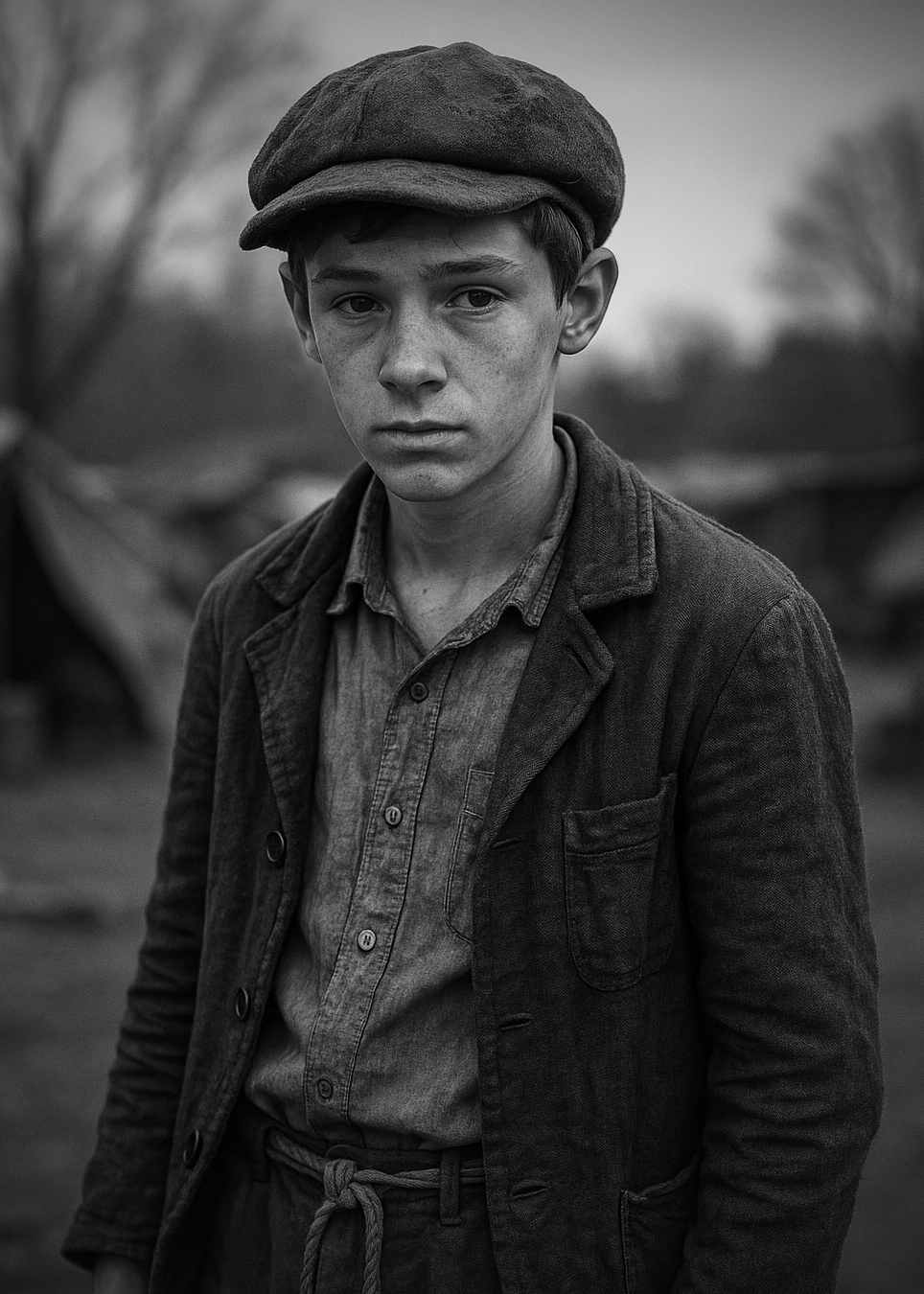
Varney, age 15 — portrait by author and AI
The youngest I met was Varney, just fifteen. His father, a blacksmith, had died of consumption at age thirty-four. His mother had run off with another man and left the boy homeless. He had only a third-grade education, a season in the cotton fields, and no other work to be found in Alabama. So he rode the rails north. Chicago meant meatpacking jobs — or so he’d heard. What I saw was a shy boy, bright beyond his years, yet marooned among men far older than he, learning too soon the rough lessons of the road.

Hank, portrait by author using AI
Hank was a quiet man, generic at first glance, yet ruggedly handsome in his way, with a wiry resilience. When I leveled my Speed Graphic at him, what held me wasn’t only Hank’s look of resolve but the unlikely presence at his side: a Chihuahua. The little dog shadowed him closely, weaving between his legs, a companion in exile. Hank would not smile for the shutter. His eyes fixed on mine, steady and unblinking, as though to warn that whatever story I told must hold the truth of them both.
When asked about his past, he said little — only that he was from a farm in Nebraska. A place of wide skies and stubborn soil, where winters cut deep and summers baked the ground until it cracked. He had known corn rows and cattle chores, the creak of windmills drawing water up from far below. Whatever drove him from that life he left unspoken, but in his silence it seemed the land still clung to him.

Abe, portrait by author using AI
Abe came up out of the hollers of West Virginia, a coal miner in his youth until a broken body forced him from the shafts. The years since had been lean, yet he found his voice in the blues, singing and playing with a raw skill that carried through the night camps. Folks gathered close when he picked a tune, his gravelly voice telling stories of hardship and grace. He said he was content now, grateful for each day, simply waiting for the Lord to call him home.

Leonard, portrait by author using AI
Leonard is a mellow fellow by nature, a man with a gentle way of speaking that puts others at ease. For a time, he taught high school in Joliet, some fifty miles from Chicago, where his steady patience suited him to the classroom. But the epileptic fits ended that life — his attacks struck so often that the school board quietly let him go.
Now he drifts, finding a home of sorts in the hobo camp, where men know what it is to be discarded. He is beloved here not for strength of arm or quick wit, but for the calm he carries, a kindness that endures despite his condition. His fits still come — heavy, shaking storms that seize his body about once a week — reminders of why no foreman will hire him and no steady job will last. When the fits pass, he wakes hollow-eyed but smiling, as though nothing has been lost.
Leonard is rarely alone. His dog — ever loyal and alert — shadows him always, the two moving together as if bound by one spirit. Around the campfire, the animal rests at Leonard’s side, head on his master’s knee, eyes lifted at every sound. The men respect that bond, knowing it is the dog who keeps watch when Leonard cannot, and perhaps even loves him all the more for his weakness. In this rough brotherhood, where most attachments are fleeting, Leonard and his dog stand as a quiet emblem of devotion, their bond unshaken by hardship or want.

Sully, portrait by author using AI
Sully was one of the cooks, by choice as much as by habit. An Irishman who had come to New York City as a boy, he now stirred the mulligan stew with the ease of long practice, coaxing flavor from onions, potatoes, and whatever scraps the others could scrounge. He pressed a dented tin bowl into my hands before I could even set up the camera, his rough voice saying only, “Eat while it’s hot.”
Once, he said, he had a wife and two daughters. He admitted it like a man giving testimony, unsure if the words still belonged to him. The years had carried them off somewhere beyond his reach, swallowed in a haze of bad choices and worse drink. “Took the memory clean out of me,” he muttered, tapping the side of his temple. Yet when the stew bubbled and the firelight struck his face, you could glimpse the echo of the father he had once been.
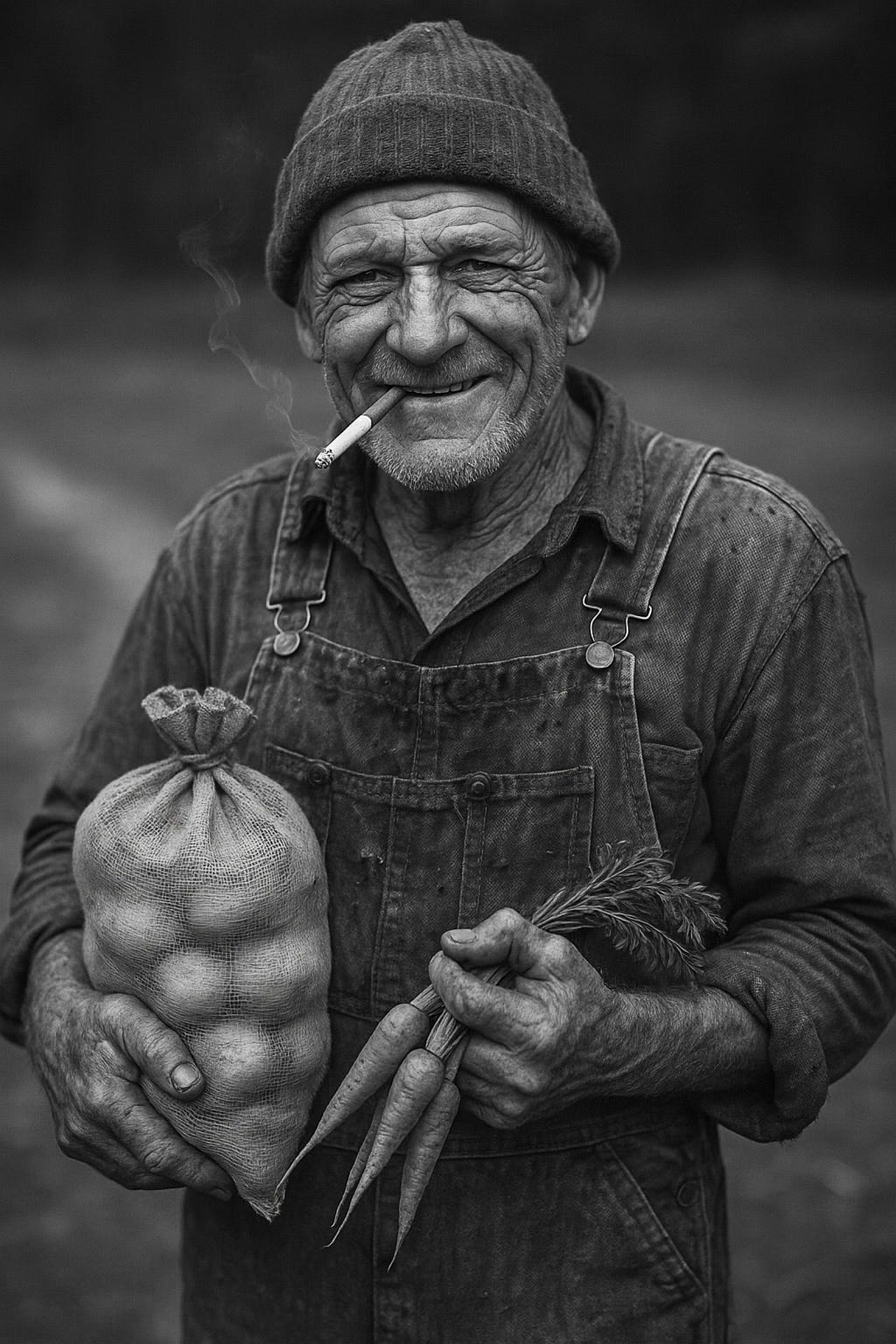
Ed Jim, portrait by author using AI
Ed Jim was a happy man past his prime, his hair gone thin and his face marked with the long lines of rugged years. He was not the sort to talk much, but he carried with him a quiet usefulness. Wherever the rail or the road took him, he had a knack for finding work — odd jobs on farms or a day at a loading dock. And when he was paid, he rarely thought only of himself. Ed Jim would come back to Crumb Hill loaded with whatever provisions he could manage: apples, potatoes, green beans, sometimes cobs of corn or fresh carrots. He shared them without ceremony, setting the food in the stew pot as though it were the most natural thing in the world.
Yet even generosity cannot keep a man warm through winter. As the cold began to creep in, Ed Jim talked more often of California — the far-off land of orange groves and work that never froze up. He hoped to catch the right line west before the weather turned harsh, to stake a place for himself in the sun, and perhaps at last to rest his weary bones where every morning carried more promise than worry.

Leopoldo, portrait by author using AI
Leopoldo had come over from Italy some ten years back, though he never said just what had sent him away. He had once hoped for college, to make something of himself, but work and study both proved scarce, and so, like many, he took to the rails. His sights were set westward — San Francisco, where he believed fortune might yet be found. In the meantime, he made himself useful. Leopoldo was a skilled trapper, often bringing in rabbits or other small game to fill the stew pot, and it was on just such a return that I was lucky enough to capture him on film, his catch dangling at his sides as he came back into camp.
Seven portraits seemed enough, a fair and honest showing of the men who called Hobohemia home. Three days among them left me less a visitor than a friend, and the parting was not easy. Perhaps, on some future payday, with a sack of potatoes or a hunk of roast to drop into the pot, I’ll find myself at their fire once again.
메타데이터
- post_id
- 08862ade1305
- slug
- portraits-from-hobohemia-08862ade1305
- url
- https://medium.com/@jchjcck/portraits-from-hobohemia-08862ade1305
- canonical_url
- https://medium.com/@jchjcck/portraits-from-hobohemia-08862ade1305
- author_url
- https://medium.com/@jchjcck
- status
- ok
- fetched_at
- 2026-07-17 22:26:45