BTL1 vs BTL2 vs CCDL2: Which Blue Team Certification Is Right for You?
A first-hand comparison by someone who’s done all three.
BTL1 vs BTL2 vs CCDL2: Which Blue Team Certification Is Right for You?
A first-hand comparison by someone who’s done all three.
If you’ve been lurking in blue team communities wondering which certification to pursue (BTL1, BTL2, or the newly rebranded CCDL2, formerly Certified CyberDefender / CCD), you’re not alone. These three certifications are often mentioned in the same breath, yet they serve different purposes, target different experience levels, and test you in meaningfully different ways. Having earned all three, here’s my honest take.
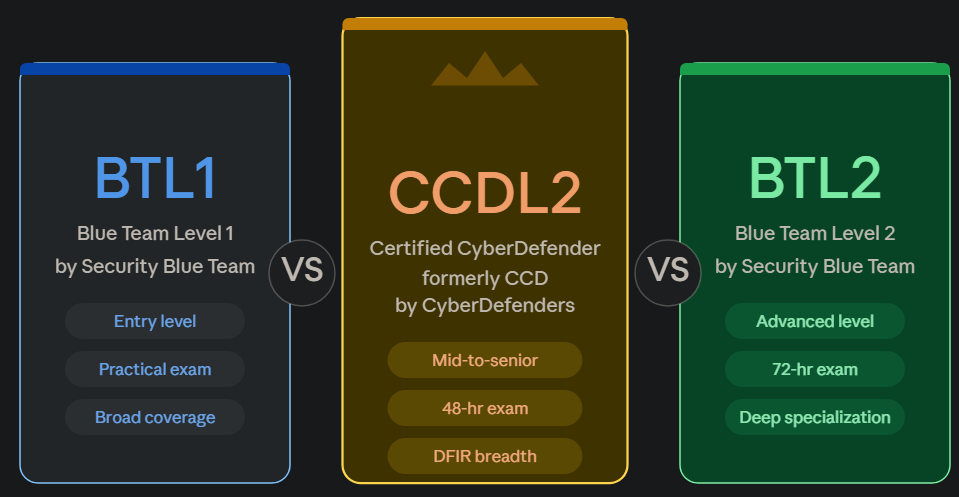
A Quick Overview
BTL1 (Blue Team Level 1) by Security Blue Team is the entry point into the series. It covers a broad range of foundational blue team topics including network security, incident response, threat hunting, and log analysis, with a strong emphasis on hands-on labs and CTF-style challenges. It’s designed to give you a solid, well-rounded foundation and build genuine confidence as a defender.
BTL2 (Blue Team Level 2), also by Security Blue Team, is the advanced follow-up. It goes much deeper into four specialized domains: Malware Analysis, Threat Hunting, Advanced SIEM, and Vulnerability Management. With 28 labs totaling 120 hours of lab time and a 72-hour practical exam, this is a serious undertaking.
CCDL2 (formerly known as CCD, Certified CyberDefender) is offered by CyberDefenders. It’s a vendor-neutral, fully practical certification aimed squarely at SOC analysts and DFIR practitioners. The course spans an impressive range of tools from AnyRun and Zeek to Elastic SIEM, Microsoft Sentinel, Volatility, and Suricata, and tests you across threat hunting, network forensics, disk forensics, memory forensics, and perimeter defense in a single brutal 48-hour exam.
Course Content & Depth
BTL1 is broad by design. It’s the kind of course that introduces you to the entire blue team landscape without overwhelming you. The curriculum flows naturally and gives you enough exposure to each topic to feel capable, not just informed.
BTL2 dials in on depth. Each of the four domains could arguably be its own certification. The Malware Analysis section alone covers static and dynamic analysis, YARA rules, PE file analysis, PDF and Office document triage, and Sysinternals, all with dedicated labs. The Threat Hunting domain extends to hunting at scale with tools like Velociraptor, and the Advanced SIEM section brings in adversary emulation with CALDERA. If BTL1 gives you breadth, BTL2 gives you serious depth.
CCDL2 (CCD) takes a slightly different angle. Rather than organizing content by technical discipline, it builds your profile as a complete SOC/DFIR analyst. You’ll work with a rich toolkit including Cuckoo Sandbox, CyLR, CyberChef, Elastic SIEM, Sentinel, pfSense, Suricata, Nessus, WireShark, Sysmon, and Volatility, and the scenarios mirror what you’d actually encounter in a SOC: phishing investigations, intrusion timelines, memory and disk forensics, and network analysis all rolled together.
The Exam Format: Where They Really Differ
This is where the three certifications diverge most sharply, and it’s worth paying close attention.
BTL1 features a practical exam that tests you on the skills from the course in a structured, manageable way. It’s challenging for beginners but fair.
BTL2 gives you a 72-hour window for a scenario-based exam where you’re playing the role of an incident responder investigating a complex network intrusion. You’ll use Linux CLI tools, Splunk, OpenVAS, Nikto, and a full suite of malware analysis utilities. Crucially, reports are manually graded and you receive detailed, personalized feedback, which is a rare and valuable feature. You also get a physical coin upon passing: gold for at least 90% on the first attempt, silver otherwise. That’s a nice touch that makes the achievement feel tangible.
CCDL2 (CCD) throws you into a 48-hour exam across multiple domains simultaneously with no report required, just a structured set of questions across threat hunting, perimeter defense, disk forensics, network forensics, and more. The format rewards time management: don’t get stuck in one domain. Move around, accumulate points, and come back. Some experienced professionals I know consider this harder than BTL2. Having done both, I understand why. It’s not that the individual tasks are harder, but the breadth of what’s being tested simultaneously is genuinely demanding.
Difficulty & Where They Sit in Your Learning Journey
Here’s how I’d map these onto a career path:
BTL1 is suited for intermediate beginners to junior analysts. It’s a great first cert if you’re transitioning into blue team or just getting started in cybersecurity defense.
BTL2 is aimed at mid-level analysts looking to specialize. It’s ideal after a year or two working in a SOC or IR role, or after completing BTL1. The malware analysis and threat hunting depth alone make it worthwhile.
CCDL2 (CCD) targets mid-to-senior analysts. The breadth of simultaneous domains and the 48-hour exam format make it a real test of whether you can operate independently under pressure.
As for the debate about which is harder, I’d say they’re hard in different ways. BTL2 is harder to prepare for due to the volume of material. CCDL2 is harder to execute in the moment due to breadth and time pressure.
Cost & Value
BTL1 is priced accessibly and represents excellent value for what it covers, especially given the quality of the hands-on labs and the community access.
BTL2 comes in at £1,999, which is squarely aimed at corporate training budgets. For individual learners, the cost is steep, but catching a Black Friday deal can make it much more achievable. The ROI is strong: the depth of content, the quality of labs, and the detailed exam feedback are hard to find anywhere else at this level.
CCDL2 (CCD) from CyberDefenders is typically more accessible price-wise than BTL2 and offers tremendous value given the toolset coverage and the practical depth of the certification.
Community & Support
All three have decent communities, but BTL2’s Discord stood out to me as particularly active and helpful. Security Blue Team has clearly invested in making the learning experience social, not just solo. CyberDefenders also has a solid community, especially around their labs platform, which is worth exploring beyond the certification itself.
My Recommendation
Start with BTL1 if you’re new to blue team work or want a comprehensive foundation. It will build your confidence, your vocabulary, and your practical toolkit without overwhelming you.
Add BTL2 when you’re ready to specialize and go deep. It’s the most professionally polished of the three, with excellent course structure, lab quality, and exam feedback.
Pursue CCDL2 (CCD) when you want to stress-test your abilities across a wide range of DFIR domains simultaneously. The 48-hour exam format is genuinely different from anything else in this space and will tell you a lot about yourself as a practitioner.
If you can only do one, pick based on where you are in your journey. If you can do all three, I’d do them in that order. Together, they cover the full spectrum of what a capable blue team professional needs to know.
My badges for all three of them:
CCDL2
BTL2
BTL1
메타데이터
- post_id
- 08862f85b320
- slug
- btl1-vs-btl2-vs-ccdl2-which-blue-team-certification-is-right-for-you-08862f85b320
- url
- https://medium.com/@Cstm/btl1-vs-btl2-vs-ccdl2-which-blue-team-certification-is-right-for-you-08862f85b320
- canonical_url
- https://medium.com/@Cstm/btl1-vs-btl2-vs-ccdl2-which-blue-team-certification-is-right-for-you-08862f85b320
- author_url
- https://medium.com/@Cstm
- status
- ok
- fetched_at
- 2026-06-23 03:48:11