Theory of Every Spiritual Thing: Episode 121 — When Shinto Meets Kabbalah: The Cosmic Equation of…
Philosophical dialogues between a father and his children about the principles of Japanese Shinto philosophy (Released on Medium…
Theory of Every Spiritual Thing: Episode 121 — When Shinto Meets Kabbalah: The Cosmic Equation of Nothing and Infinity
Philosophical dialogues between a father and his children about the principles of Japanese Shinto philosophy (Released on Medium: November 6, 2025)
In this series, “Theory of Every Spiritual Thing,” I will introduce you to the fantastic world and cosmology of Japanese Shinto philosophy (based on the teachings of Sect Shinto, which is different from State Shinto) through dialogues between Dad, a Japanese Shinto philosopher, and his two children, Phil and Sophy.
Previously on Episode 120:
In Episode 120, Dad, Phil, and Sophy uncovered the hidden counterpart of Einstein’s universe — the forgotten goddess Ayakashikone, who represents the reactive, feminine force of spacetime. They realized that what modern science calls dark matter may not be “missing” at all, but rather the unseen echo of this spiritual counterpart — the gentle gravity of the divine that holds the cosmos together. The family reached the summit of Mount Inari, completing their spiritual climb. At the peak, a new insight begins to dawn — could Shinto cosmology be deeply connected to ancient Jewish mysticism?
→* Go back to Episode 120 here.*
Episode 121: When Shinto Meets Kabbalah: The Cosmic Equation of Nothing and Infinity
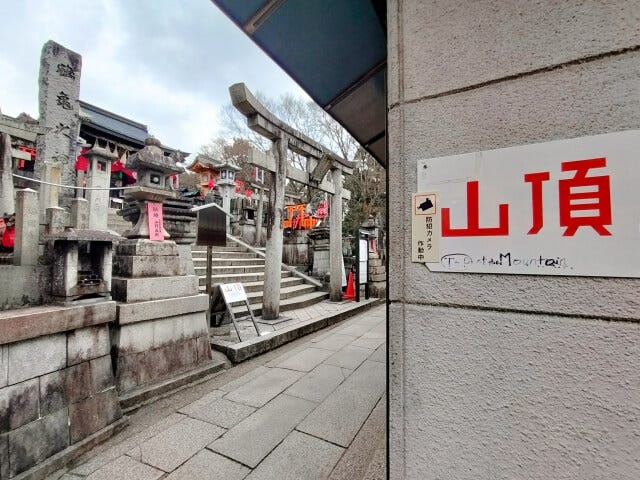
At the summit of Inari Mountain. Leaves rustle softly in the wind. Sunlight glimmers through the gaps between the torii gates. The family rests quietly on the stone steps, sharing a water bottle, breathing in the sacred stillness.
Sophy: Wow… so this is the top of Mount Inari. It really feels like we’ve come a long way.
Phil: It’s so quiet. The air feels clearer here.
Dad: This is Ichinomine — the first and highest of the mountain’s sacred peaks. It’s said to be the most holy spot of all within the Fushimi Inari complex.
Phil: Huh. I thought we’d see more of a view from the top. But it’s all trees. You can’t see very far.
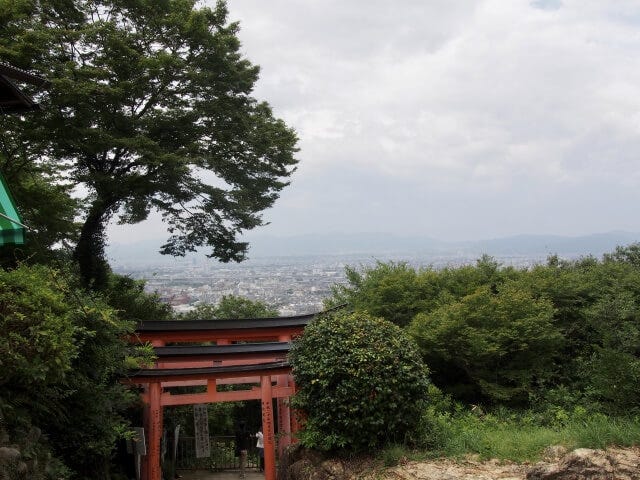
Sophy: Maybe… that’s the point. This place feels like it’s not about looking out — but looking in.
Dad: Exactly. This summit isn’t just about the view — it’s where we pause, reflect, and open ourselves to what lies within.
Dad: As we’ve seen, the gods of Shinto can be grouped into three stages, according to the unfolding of the cosmos:
The Three Creator Gods → fluctuations between the perfectly balanced nothingness and dual monads
The Five Heavenly Gods → the birth of time and space
The Seven Gods → the birth of matter
Sophy: Wow! So, fifteen gods appeared just to bring the universe into being? That’s incredible!
Dad: Yes. But all of them originally came from a single god— Ame-no-Minakanushi, the One God.
Phil: So, when the One God was divided into two aspects, new gods were born from the relationships between those parts?
Dad: Exactly. Ame-no-Minakanushi is nothingness and infinite. But when you divide infinity into two finite parts, a relationship always arises between them — and from that, new forces are born.
Phil: So that’s why new powers kept emerging? That’s actually fascinating… It almost sounds like a new branch of mathematics — where dividing the infinite gives birth to the possible.
Dad: Interestingly, a very similar idea appears in Jewish mysticism — Kabbalah.
Sophy: Kabbalah? I’ve heard the name, but… what is it, really?
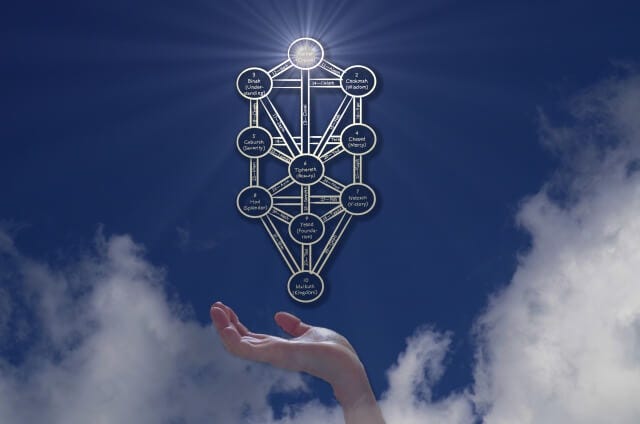
Dad: Kabbalah is a mystical tradition in Judaism that explores the nature of creation and the soul. Its most famous symbol is the Tree of Life — a kind of spiritual map showing how the universe unfolds from divine nothingness into existence.
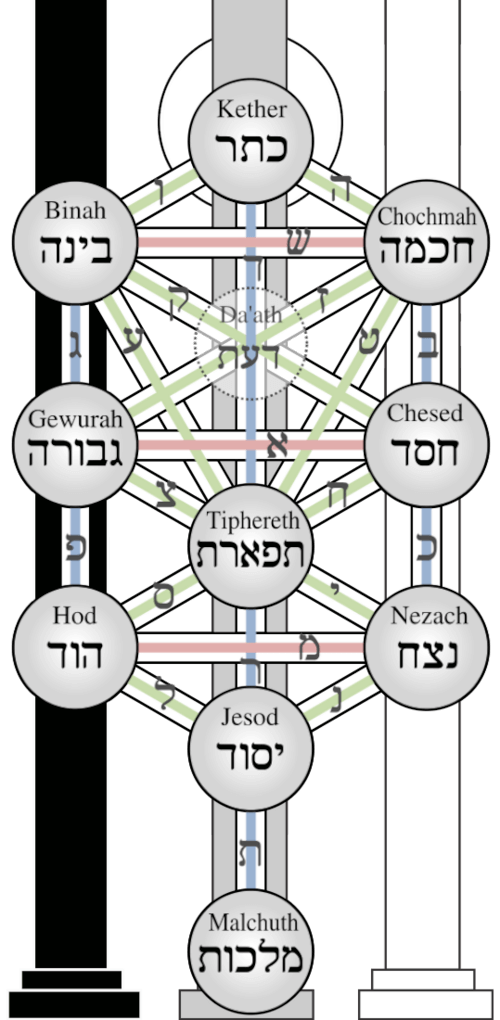
Dad: This diagram here is the Tree of Life — Sefirot — from Kabbalah. In Jewish mysticism, the hidden divine source that created all things is called “Ein” in Hebrew, which literally means “Nothing.”
Phil: So it’s like a diagram that explains how the universe flows from “nothing” into “something”?
Dad: Exactly. And before even the Tree of Life begins, Kabbalah describes three stages of divine nothingness — called the “Three Veils of Negative Existence.”
Sophy: Three veils?
Dad: Yes. In Kabbalah, creation begins with three levels of “nothingness”:
Ayin — absolute nothingness. Beyond even existence or nonexistence.
Ein Sof — the Infinite. Limitless, formless potential.
Ohr Ein Sof — the Infinite Light. The first radiance from which all creation begins.
Sophy: Hold on. The hidden origin that created everything is called “Nothing”? That sounds familiar…
Dad: Right? Ein corresponds perfectly with Ame-no-Minakanushi in Shinto. And remember how we talked about the subtle fluctuation of perfect nothingness, appearing as waves of light from the material side?
Sophy: Yes! So that means perfect nothingness isn’t just the source of all things — it’s also the source of light?
Dad: Exactly. When a finite aspect (like Kami-Musubi) is drawn out of the infinite nothingness (Ame-no-Minakanushi), an endless realm of possibilities is born. That’s Ein giving rise to Sof — Infinity. And when the finite returns to the infinite, its vibration creates waves of light. In Kabbalah, that’s called Ein Sof Aur — the Infinite Light.
Phil: Wait… that sounds really familiar…
Sophy: Yeah, it’s just like… the Three Divine Creators in Shinto! Ame-no-Minakanushi, Takami-musubi, and Kami-musubi!
Ame-no-Minakanushi → the perfectly balanced nothingness (Ein)
Takami-Musubi and Kami-Musubi → the twin monads in fluctuation, creating the waves of light (Sof and Aur)
Dad: You caught it. The parallels are striking.
Ayin = Ame-no-Minakanushi — both symbolize the absolute nothingness at the root of the universe.
Ein Sof = Takami-musubi — both symbolize infinite generative force.
Ohr Ein Sof = Kami-musubi — both symbolize the fluctuations of light that are the source of all creation.
Phil: Whoa… so Kabbalah and Shinto describe the same creative process — from nothing to everything?
Dad: They do. It’s like two ancient cultures were hearing the same song and writing it down in their own languages.
Sophy: That kind of resonance… it feels too deep to be coincidence.
Sophy: Amazing! I never imagined Shinto and Kabbalah could be so aligned!
Phil: No way… Are you telling me the secrets of the Tree of Life have been hidden in Shinto all along?
Dad: Let’s test that idea using the cosmic equation we derived from Shinto philosophy.
Dad: Let’s take a closer look at what we learned about the generative force <+Xi| and the dissolving force |-Xi>. When we sum their balanced overlap across all possible Xi, we arrive at a Cosmic Equation:
Cosmic Equation
Φ (Unified Nothingness) = Σ<+Xi|-Xi> (Infinite Sum)
<+Xi| : Generative Force (Generative Monad)
|-Xi> : Dissolving Force (Dissolving Monad)
Phil: What does this equation between “Nothing” and “Infinity” actually mean?
Dad: It suggests that the entire cosmos, in its totality, is both “Nothing” and “Infinity”. That cosmic stillness — the Infinite Nothingness Φ= Σ<+Xi|-Xi> — corresponds to the Kabbalistic concept of Ayin, the Absolute Nothing.
Phil: But if the universe is “infinite nothing,” then how do we explain existence?
Dad: That’s the paradox. When we focus on a single part of that perfect balance Φ= Σ<+Xi|-Xi>, a generative force <+Xi| emerges, giving rise to a specific form of existence.
Sophy: So even though the whole is nothing, focusing in one area brings something into being?
Dad: Right. It may seem contradictory, but the universe is a superposition of “Being” and “Non-Being”. We can express that dual nature like this:
Cosmic Equation ver.2
Φ (Unified Nothingness) ⇌ Σ<+Xi|-Xi> (Universe of All Possiblities) <+Xi| : Generative Force (Generative Monad) |-Xi> : Dissolving Force (Dissolving Monad)
Dad: This is a more rigorous version of our cosmic equation. Let’s use Universe Equation ver.2 to derive expressions for the remaining two veils of Kabbalah: Ein Sof and Ohr Ein Sof.
According to the equation, the universe as a whole is Φ (Unified Nothingness). But when we focus on part of it, we see a generative force <+Xi| emerge, leading to the temporary form:
Φ ⇌ <+Xi|
Dad: But this state is unstable because it lacks balance between the left and right sides.
Phil: Yeah, <+Xi| alone breaks the symmetry with Φ.
Dad: Exactly. To restore balance with the perfect harmony of Φ, a dissolving force |-Xi> arises. Their combination returns to the original state:
<+Xi| → <+Xi|-Xi> = Φ
Phil: So the full equation not only represents the overlap between Φ and Σ<+Xi|-Xi>, but also shows that both sides are in perfect equilibrium.
Sophy: If the balance is disturbed, the dissolving force appears to return everything to equilibrium?
Dad: Exactly. That principle is the First Spiritual Law:
First Spiritual Law (Law of Return): Whenever a generative force arises, a corresponding dissolving force emerges to restore the Unified Nothingness (Φ).
Dad: As a result, we get fluctuations:
Φ (Unified Nothingness)⇌ Σ<+Xi|-Xi>(Countless Monad Pairs)
Sophy: So in this state of perfect balance, monads are constantly emerging and dissolving?
Dad: Yes. This endless emergence of monads corresponds to Ein Sof in Kabbalah — formless infinite potential.
Σ<+Xi| = Ein Sof (Formless Infinite Potential) <+Xi| (Generating Monad): A force that brings potential Xi into being
Dad: Now, both Φ and light share the same absolute position: they are unaffected by movement or position. So from the perspective of the material world, the shimmering dance of these monads appears as infinite light.
Phil: That must be what Kabbalah means by Ohr Ein Sof!
Φ ⇌ Σ<+Xi|-Xi> = Ohr Ein Sof (Infinite Light)
Phil: So the symbol ⇌ represents not just superposition but the subtle fluctuation between monads and nothingness.
Dad: Exactly. So we can now write the three veils of Kabbalah like this:
Φ : Ayin (Absolute Nothingness) Σ<+Xi| : Ein Sof (Formless Infinite Potential) Φ ⇌ Σ<+Xi|-Xi> : Ohr Ein Sof (Infinite Light)
Dad: And from this light of Ohr Ein Sof, all of creation begins.
Phil: Amazing! The three veils of Kabbalah correspond to each component of the Cosmic Equation!
Sophy: So these three veils describe the pre-universe states before anything exists?
Dad: Yes. Kabbalah was describing the hidden equations behind the universe all along.
Next Time: Epilogue — The Lost Tribes and the Dawn of Spiritual Science
In the Epilogue, they uncover the mysterious link between ancient Israel and Japan, and the hidden wisdom the Lost Ten Tribes may have left behind — a message powerful enough to unite science and spirit once more. Could this be the true beginning of a Spiritual Theory of Everything — a light capable of transforming the future of humankind?
If this episode sparked your curiosity about how Shinto and physics intertwine, you’ll love my new series “Shinto Girl” — a light, story-driven journey where a childlike kami reveals the hidden mechanics of the universe.
**Shinto Girl — Prologue: The Day I Met a Child Who Was Older Than the Universe**
© Theory of Every Spiritual Thing / ToEST Project 2025. All rights reserved.
메타데이터
- post_id
- 08981bdd3c96
- slug
- theory-of-every-spiritual-thing-episode-121-when-shinto-meets-kabbalah-the-cosmic-equation-of-08981bdd3c96
- url
- https://medium.otakupapa.net/theory-of-every-spiritual-thing-episode-121-when-shinto-meets-kabbalah-the-cosmic-equation-of-08981bdd3c96
- canonical_url
- https://medium.otakupapa.net/theory-of-every-spiritual-thing-episode-121-when-shinto-meets-kabbalah-the-cosmic-equation-of-08981bdd3c96
- author_url
- https://medium.com/@wotakupapa
- status
- ok
- fetched_at
- 2026-06-09 14:34:10