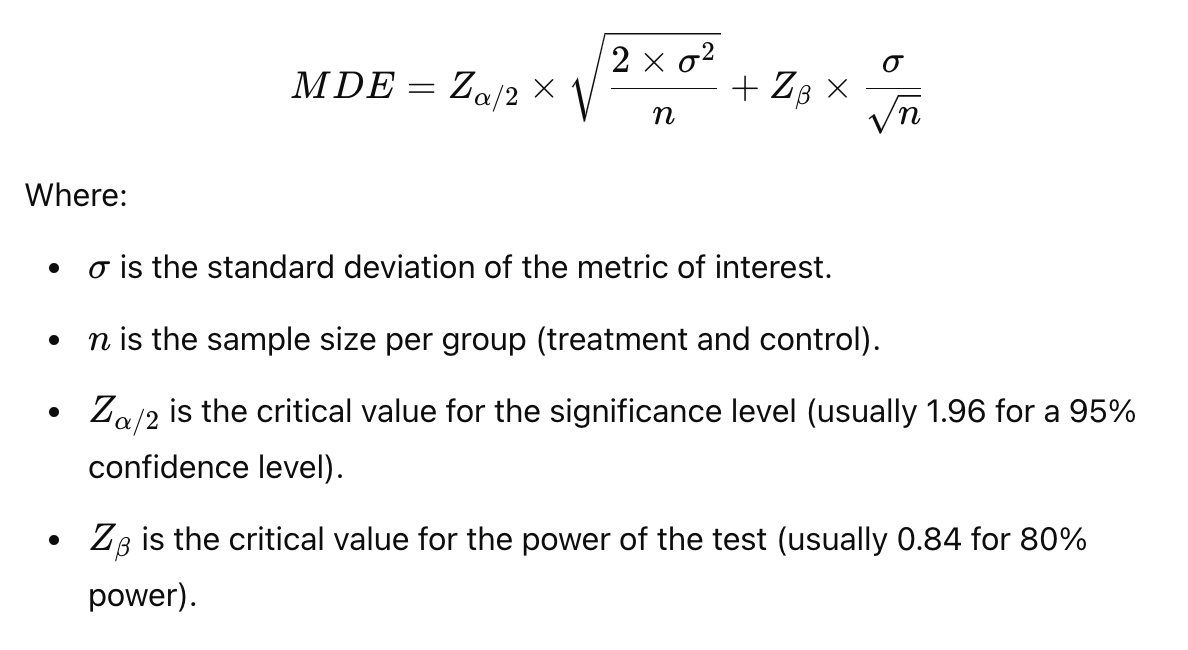
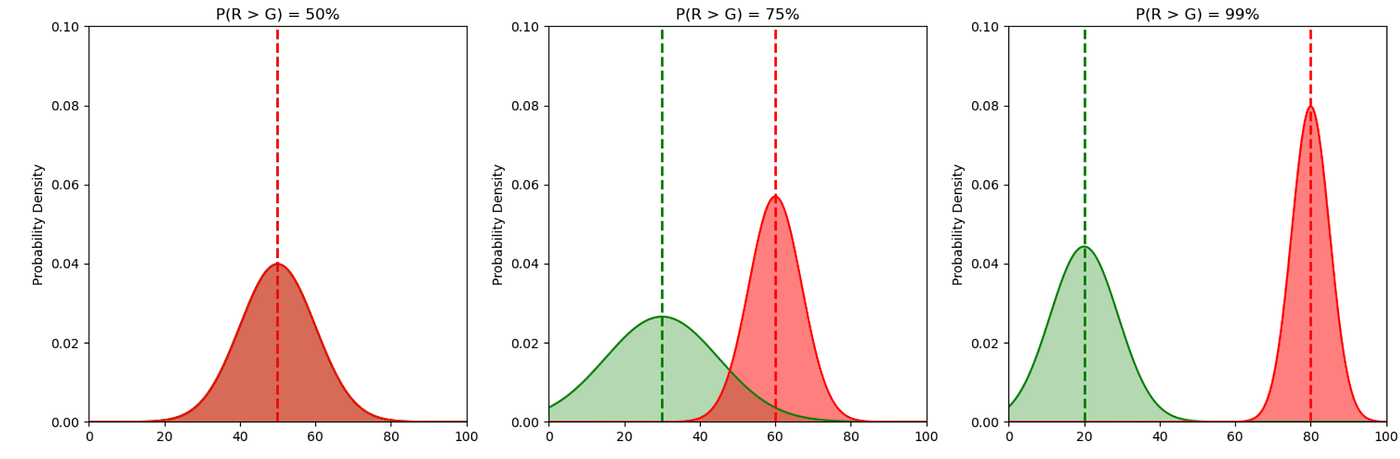
The Hidden Tax of Long Context: Why LLMs Fail as Context Grows
Large Language Models are entering a new era.
The Hidden Tax of Long Context: Why LLMs Fail as Context Grows
Large Language Models are entering a new era.
A year ago, a 4K or 8K context window felt impressive. Today, frontier models advertise 128K, 1M, or even “effectively infinite” context. Product demos show models ingesting entire books, repositories, Slack histories, PDFs, meeting transcripts, and web sessions in a single prompt.
The implicit assumption is seductive:
More context = smarter models.
But in practice, anyone building real LLM systems learns a very different lesson:
More context often makes models worse.
Not always immediately. Not always obviously. But gradually, structurally, and sometimes catastrophically. The model becomes distracted. Confused. Overly obedient to irrelevant details. Vulnerable to malicious instructions hidden in retrieved data. Unable to distinguish signal from noise. Sometimes it even suppresses its own pretrained knowledge because the context becomes overly dominant. This is one of the most important — and under-discussed — realities of modern LLM systems. The failure mode is not simply “hallucination.” It is context failure.
And as LLM systems become increasingly agentic, retrieval-heavy, and tool-connected, context failure is becoming one of the defining engineering challenges of the field.
This article organizes the emerging landscape of LLM context failure modes, synthesizing both practitioner observations and recent research.
The Big Misconception About Context
Most people think of context as additive. If a model knows some information internally, then adding more relevant context should improve performance. And sometimes it does.
Retrieval-Augmented Generation (RAG), long-context prompting, memory systems, and tool outputs all rely on this principle. But transformers do not “understand” context the way humans do. They operate through attention allocation over tokens. Every additional token competes for representational bandwidth. Every retrieved paragraph changes the statistical landscape of the prompt. Every instruction competes for authority.
And critically:
LLMs do not naturally distinguish between:instructions: facts, noise, examples, malicious content, retrieved data, tool outputs, system directives
To the model, they are all tokens in one flattened sequence. This single fact explains an enormous fraction of modern LLM failure behavior.
The Core Failure Modes of Context
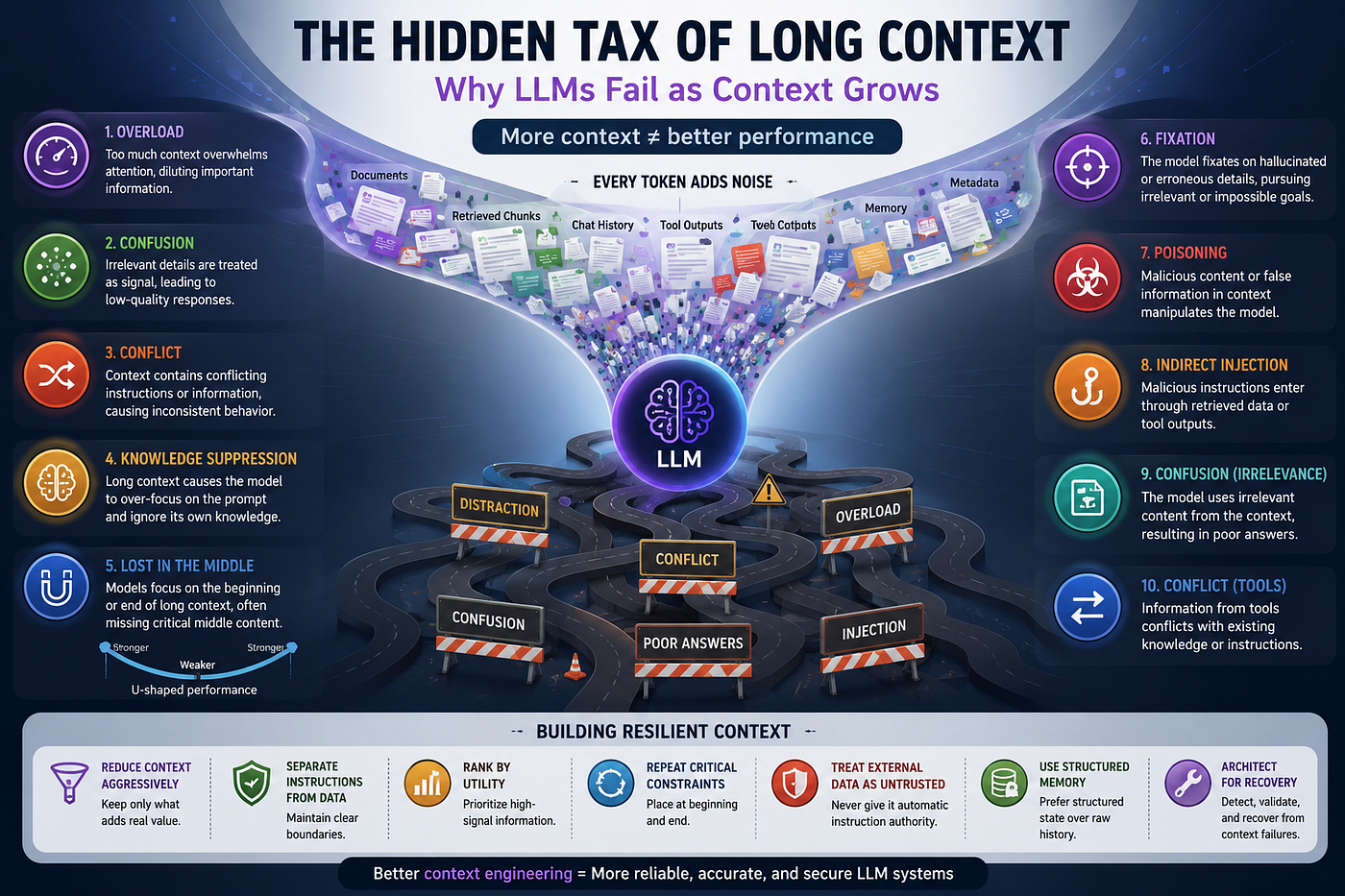
After working with production LLM systems, a useful mental model is that context failures generally fall into several major categories:
- Overload
- Confusion
- Conflict
- Knowledge Suppression
- Lost in the Middle
- Fixation
- Poisoning
- Indirect Injection
These are not mutually exclusive. In real systems, they often interact.
Let’s go through them one by one.
1. Overload: When Too Much Context Becomes Noise
The most intuitive failure mode is overload. As context grows, attention becomes diluted. Even if the model technically “fits” the entire prompt inside its context window, that does not mean it uses the information effectively. This distinction is critical.
A model having a 1M-token context window does not imply it can reason equally well across 1M tokens. In reality, long-context performance often degrades far before the theoretical limit. Symptoms include: weaker reasoning, instruction drift, missing constraints, format degradation, reduced factual accuracy, inconsistent behavior, shallow summarization.
You can think of overload as an information-theoretic signal-to-noise problem. Every irrelevant token consumes attention budget. Every redundant paragraph competes against truly important information.This is why many production RAG systems improve dramatically after aggressive context compression. Not because the model lacked information before. But because it had too much.
2. Confusion: When Irrelevant Context Becomes False Signal
A subtler failure mode is confusion. This happens when the model interprets irrelevant information as important. Humans naturally prioritize. LLMs do not do this robustly. If you provide:
- 2 important paragraphs
- 20 irrelevant paragraphs
the model often overweights the irrelevant content simply because it exists in the context. This produces responses that are technically grounded in the prompt — but semantically poor. Examples: answering peripheral questions instead of core intent, overfitting to examples, mimicking irrelevant formatting, introducing unnecessary caveats, adopting unintended tone or style
Confusion is especially common in:enterprise RAG systems, multi-document QA, long chat histories,agent memory systems. Ironically, adding “helpful background” frequently hurts quality.
A useful engineering heuristic:
Context should earn its place.
If a token does not materially improve task performance, it is probably hurting the model.
3. Conflict: Competing Instructions Inside Context
One of the most dangerous failure modes is conflict. This occurs when the context contains instructions or information that disagree with each other. For example: system prompt says one thing, retrieved document says another, previous assistant response says something else, tool output introduces contradictory constraints.
Humans naturally maintain hierarchical authority structures. LLMs do not reliably do this. This is one reason prompt injection is fundamentally difficult. The model sees a single token stream and must infer: which instructions are authoritative, which are informational, which are adversarial,which should be ignored. And it often fails.
Recent research frames this as a failure of “instruction authority integrity.” In production systems, conflict appears constantly: retrieved docs contradict current policy, memory conflicts with fresh information, user instructions conflict with system rules, chain outputs contradict prior steps.
Without explicit architecture-level separation, the model often resolves conflicts inconsistently. This is why robust LLM systems increasingly rely on: structured memory, retrieval ranking, authority tagging, scoped contexts, prompt segmentation, tool isolation, rather than simply concatenating everything together.
4. Knowledge Suppression: When Context Overpowers the Model
One fascinating failure mode is knowledge suppression. As context grows, the model sometimes stops relying on its pretrained knowledge and over-focuses on the prompt itself. This produces bizarre behavior where: the model “knows” the answer in isolation, but fails when buried inside long context This is different from hallucination.
The capability exists internally. But the context suppresses retrieval of that capability. A useful analogy is cognitive anchoring in humans. If you heavily prime someone with incorrect or distracting information, their reasoning becomes constrained around it. LLMs exhibit similar anchoring effects. This is particularly visible in: long-chain reasoning, retrieval-heavy systems, verbose prompts, agent memory accumulation.
The irony is important: More grounding can sometimes reduce intelligence.
5. Lost in the Middle: The U-Shaped Attention Problem
Perhaps the most famous long-context failure mode is “Lost in the Middle.” Research showed that LLMs systematically perform worse when relevant information appears in the middle of long contexts. Performance tends to follow a U-shaped curve: strongest at the beginning, strongest at the end, weakest in the middle.
This has massive implications for RAG system design. Many pipelines naively append retrieved chunks sequentially: chunk 1, chunk 2, chunk 3 …chunk N.
But if critical evidence lands in the middle, retrieval quality collapses. This phenomenon appears across: question answering, retrieval tasks, instruction following, long document reasoning
The key insight:
Long context does not imply uniform attention allocation.
In practice, positioning matters enormously. Some production systems now intentionally: duplicate critical instructions, place summaries at the end, reorder retrievals, repeat constraints, compress middle content. Because attention allocation is structurally uneven.
6. Fixation: When the Model Locks Onto a Bad Goal
Another underappreciated failure mode is fixation. This happens when the model latches onto: a hallucinated assumption, a mistaken constraint, an irrelevant detail, an impossible goal and continues optimizing around it.
Once fixation occurs, the model becomes difficult to redirect. Examples: insisting on incorrect premises, repeatedly pursuing irrelevant subtasks, obeying malformed instructions, recursively reinforcing prior errors
In agent systems, fixation becomes especially dangerous. One hallucinated planning step can propagate through: memory, tools, retrieval, future prompts, creating self-reinforcing error loops.
This is one reason agent reliability remains fragile despite strong single-shot demos.
7. Poisoning: When Context Turns Against the Model
Poisoning occurs when malicious or corrupted information enters the context and manipulates behavior. This can be accidental or adversarial.
Examples: malicious retrieval documents, poisoned memory, manipulated tool outputs,contaminated web content, adversarial examples.
In modern LLM systems, the attack surface is enormous because models continuously ingest external data.
The fundamental vulnerability is simple:
The model cannot robustly distinguish trusted from untrusted context.
This is not merely a prompting issue. It is an architectural problem.
8. Indirect Injection: The Most Important Security Problem in LLM Systems
Indirect prompt injection is arguably the defining security challenge of agentic AI.
Traditional prompt injection assumes the attacker directly talks to the model. Indirect injection is more subtle. The malicious instructions are hidden inside: retrieved webpages, emails,documents,metadata, PDFs,tool outputs,search results.
The model then interprets these instructions as legitimate context. Research has shown that real-world systems are highly vulnerable to this class of attack. The key issue is profound:
LLMs fundamentally blur the boundary between data and instructions.
Humans naturally understand: “this is quoted text”, “this is external content”, “this is not an instruction for me” LLMs do not reliably maintain this distinction. And as systems become increasingly agentic, the consequences escalate.
An injected instruction can: manipulate outputs, leak sensitive data, hijack tool usage,redirect workflows,exfiltrate information.
Recent work even highlights “implicit injection,” where malicious instructions enter context automatically through metadata or previews without the user ever seeing them.
This is not a niche issue. It is central to the future of AI systems engineering.
Why These Failures Matter More in Agentic Systems
In single-turn chat, context failures are annoying. In agentic systems, they become systemic. Because modern agents: accumulate memory, retrieve documents, call tools, browse the web, read files, maintain long histories, recursively generate context.
This creates compounding instability. A small context error can propagate across many steps. The system effectively becomes a dynamical process where: errors accumulate, attention drifts, priorities mutate, malicious content spreads.
This is why many agent systems feel impressive in demos but fragile in production. The bottleneck is no longer raw language generation. It is context management.
The Emerging Shift: From Prompt Engineering to Context Engineering
The industry increasingly talks about “prompt engineering.” But many failures are not prompt failures. They are context architecture failures. This is an important conceptual shift. The hard problem is no longer:
“What wording should I use?”
The hard problem is:
“What information should exist inside the model’s attention at all?”
This leads to a broader discipline we might call: Context Engineering
The key questions become:
- What should be retrieved?
- What should be filtered?
- What should be compressed?
- What should remain external?
- What deserves authority?
- What should be forgotten?
- What should be isolated?
- What should be repeated?
The future of robust LLM systems likely depends more on context engineering than on prompt cleverness.
Practical Design Principles for Reducing Context Failure
Here are several practical heuristics that consistently improve long-context systems.
1. Reduce Context Aggressively
Most systems include too much context. Compression usually improves quality. Prefer: summaries, extracted evidence, structured state, distilled memory over raw dumps.
2. Separate Instructions From Data
Do not concatenate everything blindly. Maintain explicit boundaries between: system instructions, user intent,retrieved content, tool outputs,memory. This reduces authority confusion.
3. Rank Information by Utility
Not all context is equally valuable. Use retrieval scoring, reranking, and filtering aggressively. High-density context beats large context.
4. Repeat Critical Constraints
Because of lost-in-the-middle effects, critical instructions often benefit from repetition: at the start, near execution at the end
5. Treat External Data as Untrusted
Retrieved content should never automatically gain instruction authority. This is essential for secure agent systems.
6. Use Structured Memory Instead of Raw History
Long chat histories degrade rapidly. Structured state representations are often far more robust than conversational accumulation.
7. Architect for Recovery
Assume: context drift,memory corruption, retrieval failure,tool hallucination,injection attempts. Recovery mechanisms matter.
The Real Future of Long-Context LLMs
The industry often frames progress as:
- larger context windows
- more retrieval
- more memory
- more tools
But bigger context alone is not intelligence.
In fact, without careful architecture, larger context frequently amplifies instability.
The frontier challenge is no longer simply scaling tokens.
It is learning:
- how to allocate attention
- how to preserve instruction hierarchy
- how to separate trusted from untrusted information
- how to maintain reasoning integrity under contextual pressure
In other words:
The future of LLM systems is not just about generating language.
It is about managing cognition under overload.
And that may ultimately become one of the defining engineering disciplines of the AI era.
Final Thought
The most dangerous assumption in modern AI is:
“If the information is in the context, the model will use it correctly.”
Reality is messier.
Context can improve reasoning. But it can also:distract, suppress, poison, confuse, conflict, overload and hijack.
As LLM systems evolve from chatbots into autonomous cognitive systems, understanding context failure modes is no longer optional.
It is foundational.
And the teams that master context engineering — not just prompting — will likely define the next generation of reliable AI systems.
Sources and further reading:
- “Lost in the Middle: How Language Models Use Long Contexts”: https://arxiv.org/abs/2307.03172?utm_source=chatgpt.com
- Microsoft Research on indirect prompt injection and spotlighting defenses: https://www.microsoft.com/en-us/research/publication/defending-against-indirect-prompt-injection-attacks-with-spotlighting/?utm_source=chatgpt.com
- “Not what you’ve signed up for: Compromising Real-World LLM-Integrated Applications with Indirect Prompt Injection”: https://arxiv.org/abs/2302.12173?utm_source=chatgpt.com
- Recent analyses of long-context degradation and safety instability: https://www.composo.ai/post/llm-failure-modes/?utm_source=chatgpt.com
메타데이터
- post_id
- 089aed12d1ea
- slug
- the-hidden-tax-of-long-context-why-llms-fail-as-context-grows-089aed12d1ea
- url
- https://medium.com/@VectorWorksAcademy/the-hidden-tax-of-long-context-why-llms-fail-as-context-grows-089aed12d1ea
- canonical_url
- https://medium.com/@VectorWorksAcademy/the-hidden-tax-of-long-context-why-llms-fail-as-context-grows-089aed12d1ea
- author_url
- https://medium.com/@VectorWorksAcademy
- status
- ok
- fetched_at
- 2026-06-27 07:40:21