Foundations of Knowledge: Understanding the ‘Missing Layer’ in AI
1. The Shift: Why Data Engineering is No Longer Enough
Foundations of Knowledge: Understanding the ‘Missing Layer’ in AI
1. The Shift: Why Data Engineering is No Longer Enough
The landscape of enterprise technology is undergoing a fundamental paradigm shift. For the past decade, the primary engineering challenge was one of logistics: moving fragmented data into centralized repositories for human analysis. However, as we transition from building passive chatbots to designing autonomous systems capable of performing complex work, a new bottleneck has emerged. The failure of modern AI projects rarely stems from a lack of raw processing power or missing data points; it stems from a profound absence of structural understanding.
“Almost every time the system failed, it wasn’t because the model was weak. And it wasn’t because the data was missing. It was because the system didn’t understand the knowledge behind the data.”
To navigate this new era, we must distinguish between the legacy of data movement and the future of knowledge representation.
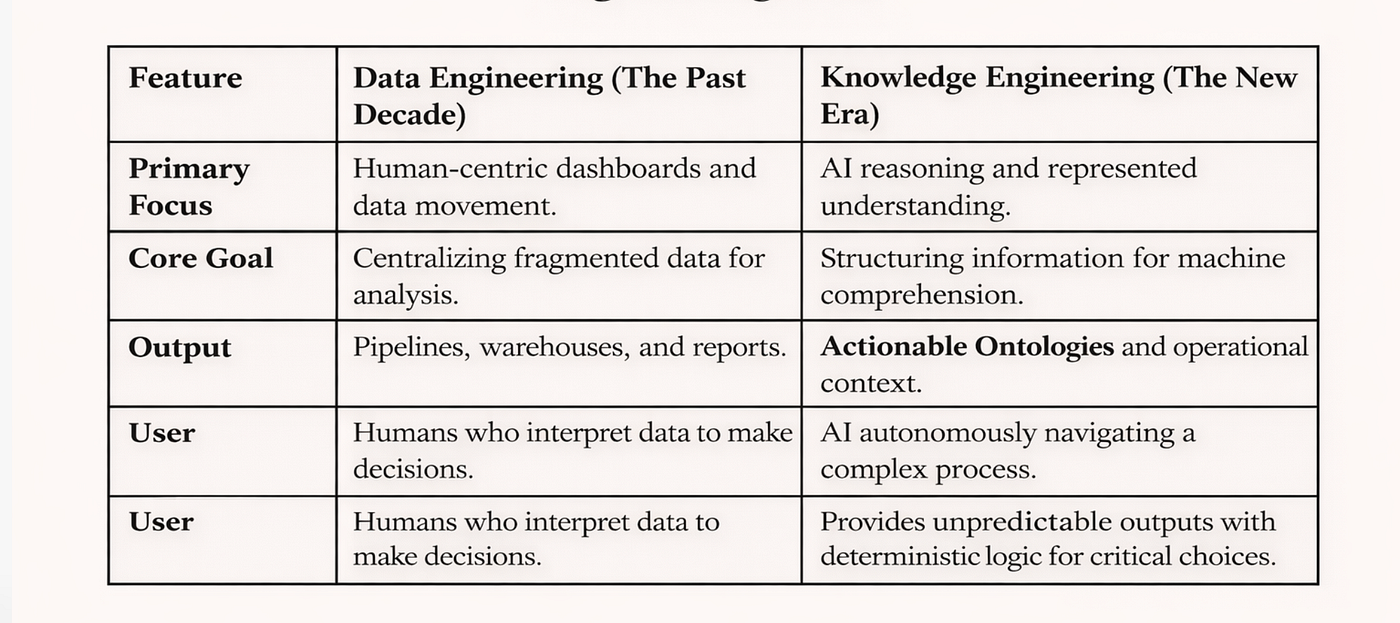
While traditional data methods successfully organized information for human consumption, they fail to provide the functional context required for AI to act. This gap is the “Missing Layer” — the barrier between a system that can talk and a system that can work.
2. Defining the ‘Missing Layer’
Most contemporary AI projects rely on a standard architecture: connecting a data source to a Vector Database and using Retrieval-Augmented Generation (RAG) to provide answers. While this provides semantic similarity — the ability to find text related to a query — it fails to provide functional logic. RAG is sufficient for Q&A, but Knowledge Engineering is required for task performance.
When an AI system only has access to indexed documents without a knowledge layer, it lacks:
- System Relationships: A map of how disparate internal systems connect and influence one another.
- Internal Processes: A granular understanding of the specific workflows that drive the organization.
- Tool Permissions: Clear boundaries on which interfaces it is authorized to trigger and under what conditions.
- Decision Logic: The deterministic and heuristic frameworks used to move from “information” to “action.”
Structured Knowledge is the architectural practice of encoding how an organization functions, rather than merely documenting what information it possesses. It is the transition from a latent list of facts to a functional, machine-readable environment.
To witness this missing layer in a practical setting, we must look at where standard data retrieval falls short of operational reality.
3. Case Study: The CRM Blind Spot
Consider a common directive given to an AI agent: “Analyze the sales pipeline and identify which deals are likely to slip this quarter.” From a traditional data perspective, the system has the raw ingredients: CRM fields, opportunity stages, and meeting notes. Yet, without the knowledge layer, the AI cannot provide a reliable answer.
Data vs. Knowledge: The Sales Perspective
- The Data Perspective:
- Raw CRM fields (close dates, deal sizes).
- Unstructured meeting transcripts and contracts.
- Standard stage names (e.g., “Discovery,” “Negotiation”).
- The Knowledge Perspective:
- Organizational Definitions: What specific criteria qualify a lead as “pipeline” versus “forecast”?
- Risk Patterns: Which historical stage transitions — or lack thereof — statistically indicate failure?
- Temporal Context: Should the system compare current state to historical data patterns to identify anomalies?
- Operational Protocol: Who is the stakeholder for this specific territory, and what is the escalation path?
The “So What?” The system’s failure here isn’t a “hallucination” or a “weak model.” It is a lack of operational context. The logic required to evaluate a deal isn’t found in the raw CRM data; it is buried in internal playbooks and unwritten tribal knowledge. Without engineering this context into the system, the AI remains an observer rather than a participant.
4. The Anatomy of Structured Knowledge
Bridging the gap requires a formal breakdown of “understanding” into concrete, machine-usable components.
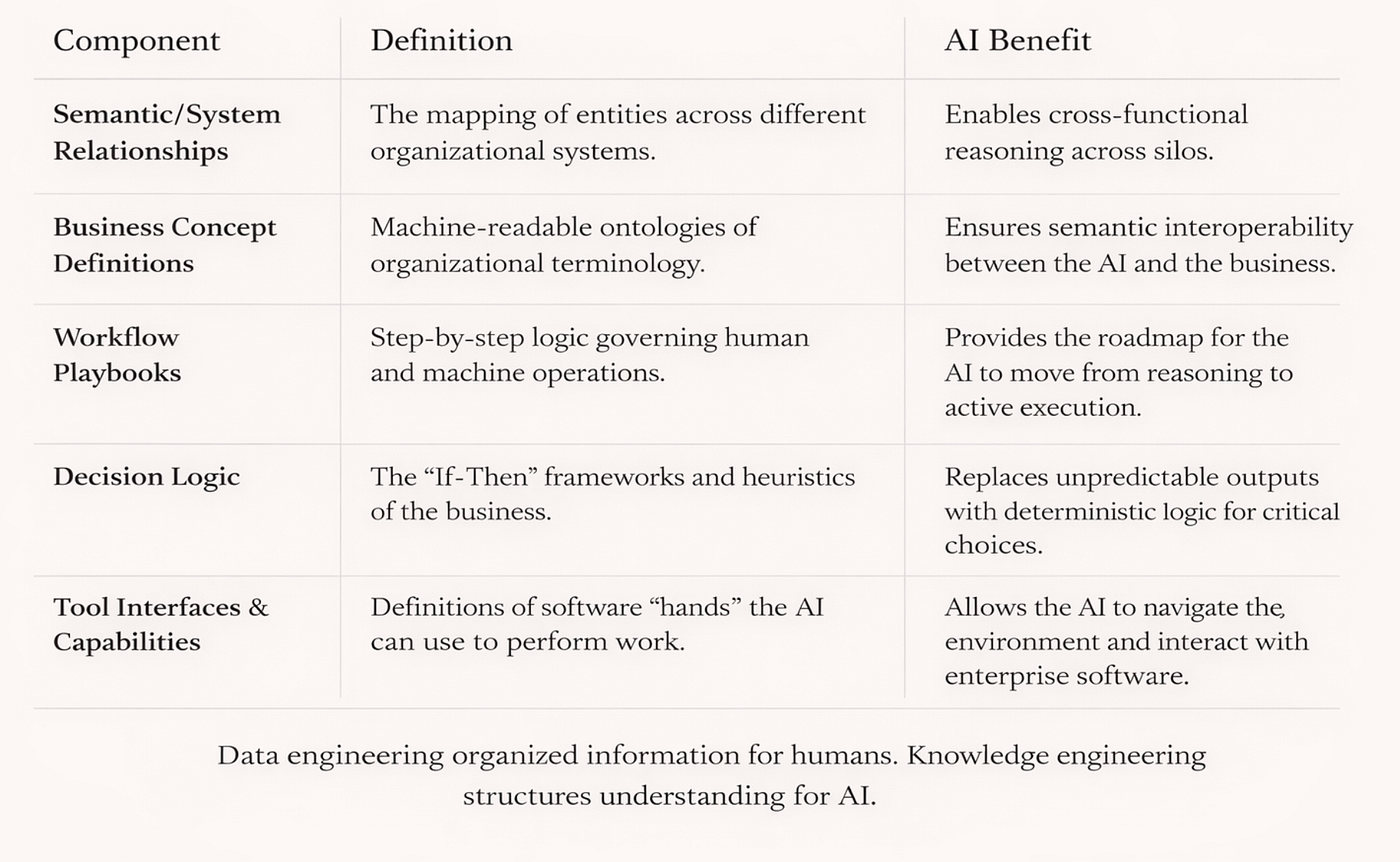
- Relationships: Focus on mapping cross-functional dependencies; this allows the AI to perform complex reasoning where one department’s data impacts another’s workflow.
- Definitions: Create a single source of truth for terms like “churn” or “margin” to ensure the AI’s reasoning aligns with executive KPIs rather than general internet definitions.
- Workflows: Encoding playbooks transforms the AI from a passive observer into an agent that knows the “next logical action” in a multi-step sequence.
- Logic: By formalizing decision logic, you shift the AI from probabilistic guessing to high-fidelity alignment with company policy.
- Interfaces: Treat tool definitions as the AI’s “sensory-motor” system; clear interface mapping is the bridge between latent thought and real-world impact.
This structural shift necessitates a fundamental change in the person responsible for building these systems.
5. The Rise of the Knowledge Engineer
The transition from data-centric to knowledge-centric systems is creating a new professional archetype. While a traditional data engineer focuses on the question, “How do I move and store data reliably?”, the Knowledge Engineer asks:
“How do I structure the knowledge of this organization so machines can use it?”
Future-Proof Skills for the Knowledge Engineer
To lead in this new landscape, engineers must move beyond the ETL pipeline and master the following:
- Designing Actionable Knowledge Graphs: Building relational maps that connect entities and logic.
- Semantic Relationship Mapping: Defining the nuanced ways in which disparate data points relate to organizational goals.
- Agentic Tool-Use Architecture: Designing the protocols that allow AI to safely and effectively trigger software actions.
- Memory and Context Engineering: Building persistence layers that allow AI to retain and apply context across long-running tasks.
- Operational Workflow Design: Formalizing human processes into machine-executable logic.
The Decisive Challenge
Building the “knowledge infrastructure” of an organization is the most significant engineering challenge of the next decade. As AI evolves from simple chat interfaces into operational systems that analyze, coordinate, and execute, the competitive advantage will shift from those who have the most data to those who have the most structured understanding.
The future of AI is not a race for larger models; it is a race to build the knowledge architecture that allows those models to truly see, understand, and operate within our world. The era of the Data Engineer was about storage; the era of the Knowledge Engineer is about meaning.
This article reflects my personal views and perspectives and should not be interpreted as representing the views of my employer
메타데이터
- post_id
- 089ceed4fd39
- slug
- foundations-of-knowledge-understanding-the-missing-layer-in-ai-089ceed4fd39
- url
- https://medium.com/@anwinphilips/foundations-of-knowledge-understanding-the-missing-layer-in-ai-089ceed4fd39
- canonical_url
- https://medium.com/@anwinphilips/foundations-of-knowledge-understanding-the-missing-layer-in-ai-089ceed4fd39
- author_url
- https://medium.com/@anwinphilips
- status
- ok
- fetched_at
- 2026-06-09 14:34:10



