IntelliJ’s Biggest Change in 16 Years Just Dropped!
Community Edition is gone. Ultimate as a separate download is gone. And honestly, this is not just a packaging change.
IntelliJ’s Biggest Change in 16 Years Just Dropped!
Community Edition is gone. Ultimate as a separate download is gone. And honestly, this is not just a packaging change.
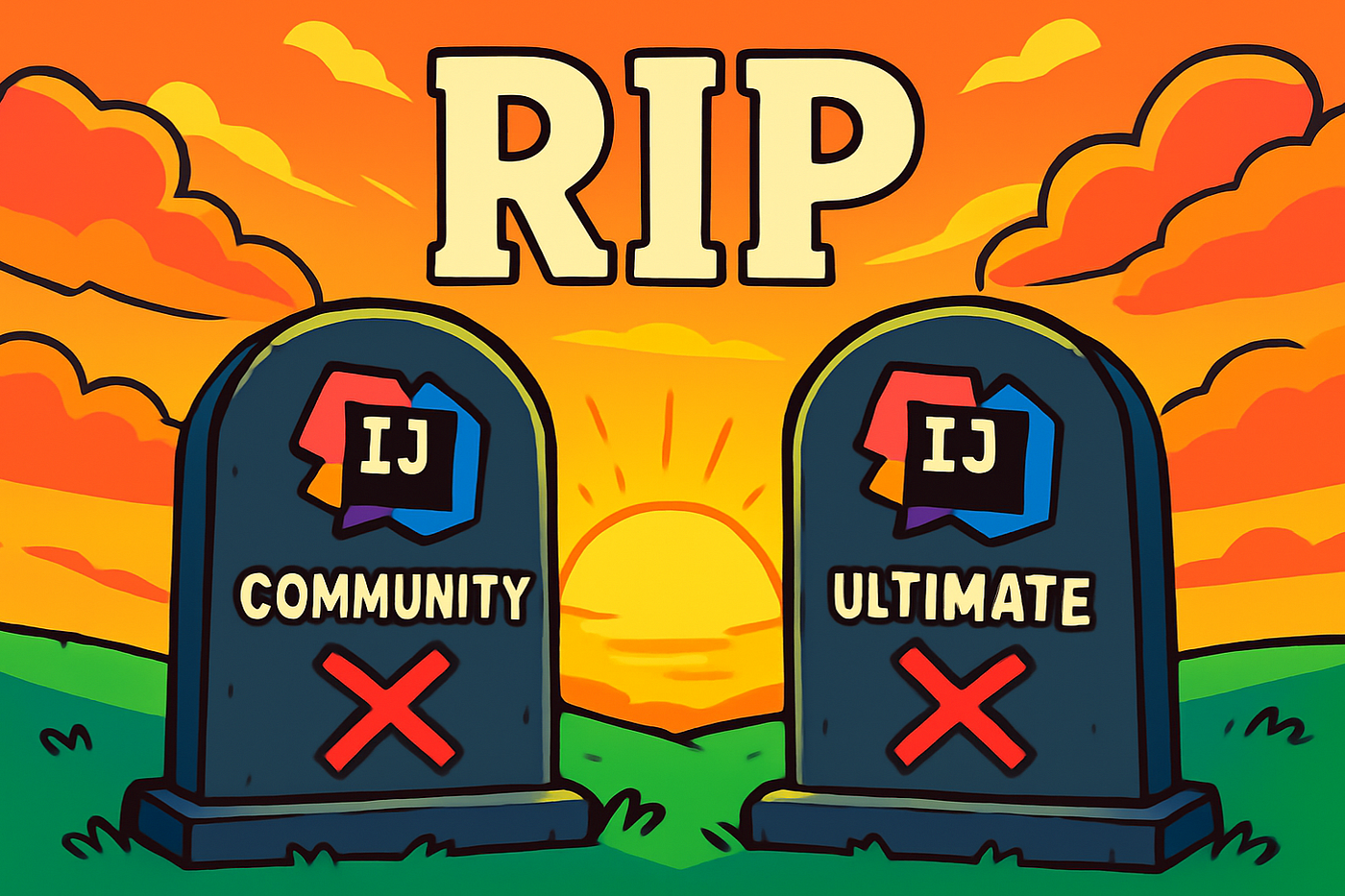
IntelliJ IDEA Community Edition is gone.
IntelliJ IDEA Ultimate Edition, as a separate product download, is also gone.
Not gone as in “JetBrains deleted IntelliJ and everyone panic.” No. The IDE is still there. Java developers can breathe. But the old choice that existed for years, Community or Ultimate, is being removed.
Starting with IntelliJ IDEA 2025.3, JetBrains is moving to one unified IntelliJ IDEA distribution.
One installer. One IDE. One update stream.
And then, depending on whether you have a subscription or not, some features are unlocked and some are not.
So technically, this is simpler.
But also, let’s not pretend this is just about making download pages cleaner.
There is something bigger happening here.
[Non members can read full article by clicking here!](https://medium.com/@harrymarkjava/intellijs-biggest-change-in-16-years-just-dropped-08a41ecc3fda?sk=af5f5da1ad9bd01bfb9d1d0dbd5e2511)**
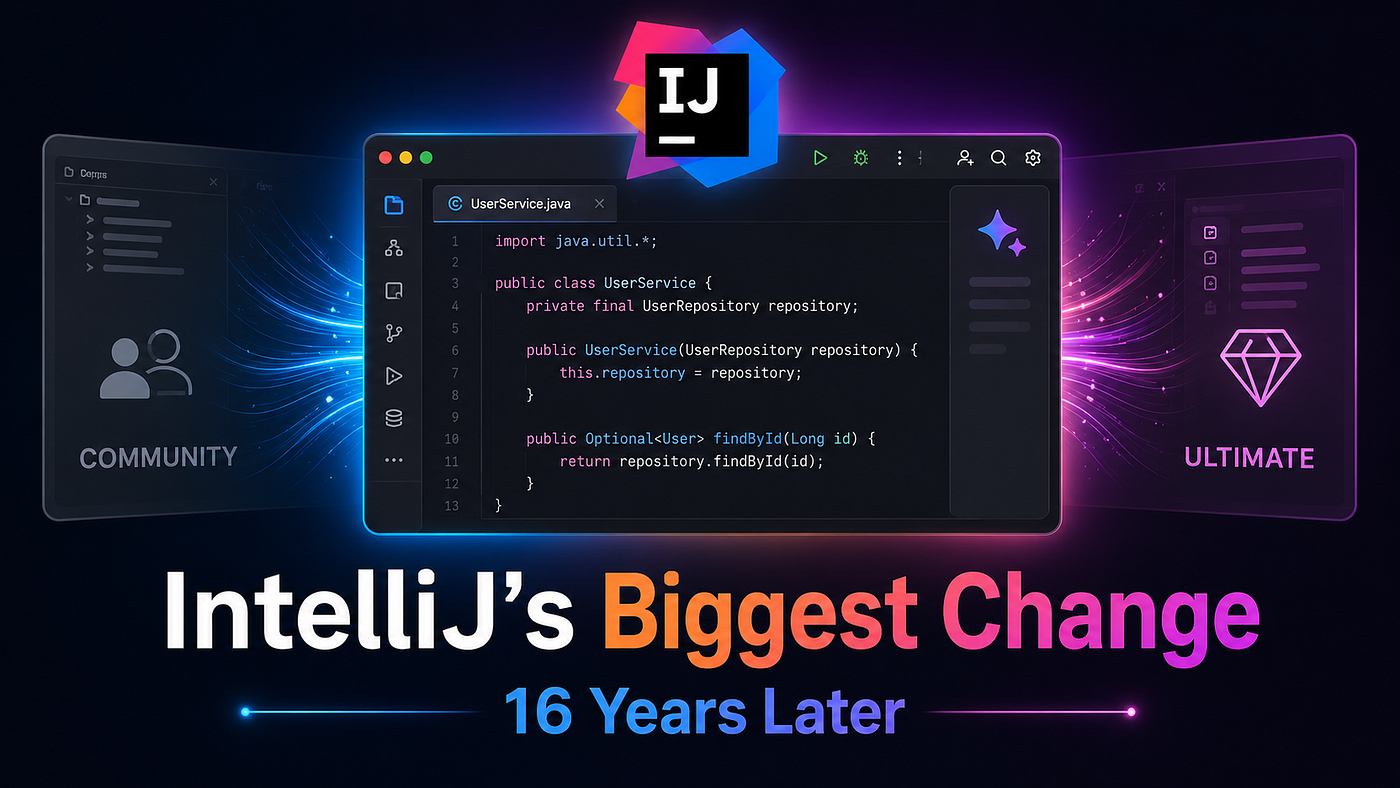
Image Edited on Canva
The old choice was always slightly fake
For years, IntelliJ users had this very clear decision.
Do you download Community Edition?
Or do you download Ultimate?
Community was free, open-source based, and good enough for learning Java, Kotlin, small projects, and many basic workflows.
Ultimate was the “real professional one” for many developers. Spring support, advanced framework tooling, database features, web development stuff, enterprise conveniences, all of that lived there.
That separation made sense from a business perspective.
But from a user perspective, it always felt a bit artificial.
Because it was not like Community and Ultimate were two completely different IDEs built from scratch. It always felt more like the same house, but some rooms were locked unless you paid.
Now JetBrains is basically admitting that.
You download IntelliJ IDEA. That’s it.
If you are using it for free, you get the free tier. If you pay, the advanced features unlock inside the same IDE.
No uninstalling Ultimate because your license expired. No downloading Community separately. No weird “wrong edition” moment.
That part is good. Sensible, even.
But it also changes the psychology of the product.
Before, free users chose the free product.
Now, everyone downloads the full product, and the paid features are just sitting there.
That is a very different feeling.
The good news is actually good
Let’s be fair. Some of this is genuinely good for developers.
JetBrains says the free version is not losing what Community Edition already had. The core Java and Kotlin development features remain free.
Even better, some features that were previously more associated with Ultimate are becoming free or more accessible in the unified version.
That matters. Spring support is a big one.
A lot of Java developers do not use IntelliJ just to write plain Java classes and feel productive in a vacuum. They use it because their real work is Spring Boot, databases, configuration files, project generators, REST endpoints, dependency injection, and all the boring enterprise glue that pays the bills.
And yes, boring enterprise glue is where IDE quality actually matters.
If some Spring-related support, database viewing, framework project wizards, and other useful features become available without paying, that is good news.
Not “developer productivity revolution” good.
Just normal good.
The kind of good where someone learning Spring Boot does not immediately hit a paywall and wonder if they should just use VS Code because at least it does not make them think so much.
That matters for students, hobby developers, people building side projects, and developers in countries where an IDE subscription is not a small expense.
Not everyone has a company card.
The license expiry thing is nice, but come on
JetBrains also talks about a smoother license expiration experience.
Basically, if your Ultimate subscription expires, you do not get kicked out into some awkward migration. The same IDE keeps working, but it falls back to the free feature set.
Fine. That is better.
But I am not going to clap like this is some heroic act of software kindness.
This is how it should have worked anyway.
If the product is already built on the same platform and the difference is feature access, then downgrading gracefully is obvious. It is good that it exists, but it is not exactly the invention of electricity.
Also, for professional developers, this is mostly a personal-license problem.
At work, your company usually pays. If they stop paying, you probably have bigger workplace problems than IntelliJ’s installer model.
But for personal laptops, side projects, and independent developers, yes, this makes life less annoying.
Less annoying is underrated.
The open source part is where people will start asking questions
Whenever a company merges a free open-source-ish edition with a paid proprietary edition, people immediately get nervous.
And honestly, they should.
Not because JetBrains is secretly evil or something dramatic like that. But because developers have seen this movie before.
A company says, “Nothing changes.”
Then later, “Small changes.” Then later, “Actually, this is better for sustainability.” Then suddenly the thing you depended on is not really the thing anymore.
In this case, JetBrains says the open-source commitment continues. The open-source code remains available on GitHub. They are also supporting builds of the open-source version.
So if you want the pure open-source build, you can still go that route.
But here is the practical reality.
Most people will not do that.
Most people will go to the IntelliJ website and download the main version.
That means the unified IntelliJ IDEA becomes the default reality for most users. The GitHub build becomes the thing for people who care enough to look for it.
And that is not a small difference.
Defaults matter.
Developers like to pretend they are rational creatures who carefully inspect licensing models before downloading tools.
No.
Most developers click the big download button and move on because they have a bug to fix and a meeting in 17 minutes.
So yes, the open source version still existing matters.
But the main user path is now the unified product.
That gives JetBrains more room to put proprietary features, AI features, trial prompts, and paid upgrade paths directly into the default experience.
Maybe they handle that carefully. Maybe they do not. We will find out.
This is not really about Community vs Ultimate
The obvious story is
“JetBrains merged Community and Ultimate.”
That is true.
But I do not think that is the whole story.
The bigger story is that traditional IDEs are under pressure.
And yes, unfortunately, we have to talk about AI.
I know. Everyone is tired.
Every tool now has AI. Every release note sounds like someone fed “developer productivity” into a blender. Every company is pretending they invented autocomplete with a personality disorder.
But in this case, AI actually matters.
Because IntelliJ’s biggest strength has always been its deep understanding of your project.
It indexes everything. It understands your classes. It knows your imports. It can refactor across files with scary accuracy.
It can navigate your codebase better than you can navigate your own downloads folder.
That is why people paid for it.
But that value assumes one thing:
You, the developer, are still directly writing and navigating most of the code.
You type. The IDE completes.
You jump to definitions. The IDE guides you.
You refactor. The IDE protects you from doing something stupid.
That is the traditional IDE contract.
AI first coding tools change that contract.
With tools like Cursor, GitHub Copilot, Claude Code-style workflows, and similar AI coding environments, developers increasingly ask for changes instead of manually performing every step.
“Refactor this service.” “Add tests for this class.” “Explain where this bug is coming from.” “Convert this logic to use a repository pattern.”
Now, does AI get it right all the time?
Absolutely not.
Sometimes it writes confident nonsense and then looks at you like you are the problem.
But the workflow is changing.
And that is the part JetBrains cannot ignore.
IntelliJ is still better for serious Java
Let’s not become ridiculous.
For serious Java development, IntelliJ IDEA is still excellent.
VS Code with Java extensions is fine for some things. Small projects, quick edits, lightweight work, sure.
But enterprise Java? Spring Boot? Large Maven or Gradle projects? Framework navigation? Refactoring? Debugging weird dependency issues?
IntelliJ is still the king there.
Eclipse and NetBeans are still around too. They work. They are like old cars that refuse to die. Not exciting, but they can get you somewhere.
But IntelliJ has been the premium Java experience for a long time.
The problem is that the new competition is not trying to beat IntelliJ by becoming a better Java IDE.
That is the important part.
Cursor does not need to have better Java inspections than IntelliJ if its pitch is: “Just describe the change and I will generate the diff.”
That is a different fight.
JetBrains built a beautiful machine for developers who directly manipulate code.
AI first tools are trying to make direct code manipulation feel less central.
Whether that is good or bad is another argument.
But it is happening.
JetBrains probably wants every user inside the same funnel
Here is my blunt reading of this move.
By removing the Community vs Ultimate download choice, JetBrains gets everyone into the same product experience.
Free users. Paid users. Students.
Enterprise developers.
People trying IntelliJ for the first time.
People whose licenses expired.
Everyone.
That makes it easier to expose users to more features.
Including AI features. Including paid features. Including trials. Including whatever JetBrains wants to push next.
Again, that does not automatically make it bad.
But it does make the business logic obvious.
If you are competing with AI-first editors, you do not want half your users sitting in a separate Community Edition product with fewer integrations and a different upgrade path.
You want one main product surface.
One place to improve. One place to promote. One place to defend your territory.
That is probably smart.
Maybe even necessary.
But let’s not dress it up as purely “simplifying the user experience.”
It is that.
And also a product strategy move.
Both can be true.
The weird part: JetBrains still has too many IDEs
This is where things get funny.
JetBrains is simplifying IntelliJ IDEA.
Good.
But JetBrains still has this huge lineup of language-specific IDEs.
PyCharm for Python. WebStorm for JavaScript. PhpStorm for PHP. GoLand for Go. RubyMine for Ruby. CLion for C and C++. Rider for .NET.
And so on.
I understand the argument.
Each IDE is optimized for its language ecosystem. PyCharm feels like a Python tool. WebStorm feels like a JavaScript tool. IntelliJ Ultimate is more polyglot but still Java-first in many ways.
Fine.
There is truth there.
But developers have complained for years that JetBrains’ product fragmentation is annoying.
Full stack developers do not always live inside one language.
A modern project might have Java backend, TypeScript frontend, Python scripts, SQL migrations, Docker files, YAML files, Terraform, and some random shell scripts nobody wants to admit exist.
The real world is messy.
So the idea that each language needs a separate paid IDE starts to feel strange.
And AI makes that argument even weaker.
An LLM does not care that JavaScript and Python are different JetBrains products.
It does not need WebStorm brain on Monday and PyCharm brain on Tuesday.
It just works across languages.
Sometimes badly, yes.
But conceptually, it is polyglot by default.
That makes the old “separate IDE for each language” model look less natural.
Maybe JetBrains keeps it forever. Maybe they slowly move toward some universal IDE strategy. Maybe they keep the names but blur the boundaries.
I do not know.
But IntelliJ unification feels like the first crack in an older product model.
Free features are nice. Upgrade pressure is the real test.
The success of this change depends on how JetBrains handles the unified IDE experience.
If free users get a clean, respectful IDE with more useful features than before, this is a win.
If every other menu item becomes a greyed-out reminder that you are poor, then no thanks.
Developers hate being nagged inside tools they use for deep work.
Nobody wants to be debugging a Spring configuration issue and also mentally swatting away upgrade prompts like mosquitoes.
The best version of this unified IntelliJ is simple:
Use the free stuff.
See the paid stuff only when it is relevant.
Upgrade when you actually need it.
The worst version is
Everything is technically there, but the product constantly reminds you that you are not using the “real” version.
That would be annoying.
And developers are very good at leaving tools that annoy them.
Even tools they like.
Image Edited on Canva
This move is good, but not innocent
Overall, I think this change is probably good for most IntelliJ users.
The Community Edition name going away is emotional for some people, but practically, the free tier may become more useful.
One installer is simpler.
License expiry becomes less stupid.
Some previously paid features becoming free is genuinely useful.
The open source build still exists. So no, this is not some disaster.
But it is also not just a nice little cleanup.
It is JetBrains repositioning IntelliJ for a world where IDEs are no longer just competing on autocomplete, refactoring, and framework support.
They are competing against AI-first workflows. They are competing against developer habits changing.
They are competing against the possibility that the IDE itself becomes less important than the agent sitting inside it.
That is uncomfortable for a company whose whole reputation is built on making the best IDEs.
But it is also exactly why this move makes sense.
Bring everyone into one IntelliJ.
Make the free tier better. Reduce friction. Keep users close. Prepare the ground for whatever comes next.
That sounds like the real story to me.
Maybe I am wrong.
Maybe this is just JetBrains cleaning up a product split that had outlived its usefulness.
But the timing is hard to ignore.
The old IDE world was about choosing the best tool to write code.
The new one might be about choosing the best place to argue with an AI until it writes the code you meant.
And in that world, IntelliJ still has a lot of strength.
But it cannot just be “the best Java IDE” forever and assume that is enough.
메타데이터
- post_id
- 08a41ecc3fda
- slug
- intellijs-biggest-change-in-16-years-just-dropped-08a41ecc3fda
- url
- https://medium.com/javarevisited/intellijs-biggest-change-in-16-years-just-dropped-08a41ecc3fda
- canonical_url
- https://medium.com/javarevisited/intellijs-biggest-change-in-16-years-just-dropped-08a41ecc3fda
- author_url
- https://medium.com/@harrymarkjava
- status
- ok
- fetched_at
- 2026-06-11 15:16:29