MICHAEL TALBOT AND THE HOLOGRAPHIC UNIVERSE: The Man Who Decoded Reality and Died Before He Could…
How a Michigan writer synthesized quantum physics and neuroscience into the most radical model of consciousness ever written for a general…
MICHAEL TALBOT AND THE HOLOGRAPHIC UNIVERSE: The Man Who Decoded Reality and Died Before He Could Finish the Manual
How a Michigan writer synthesized quantum physics and neuroscience into the most radical model of consciousness ever written for a general audience — and why the physics laboratories of 2026 keep arriving at the same address he mapped in 1991
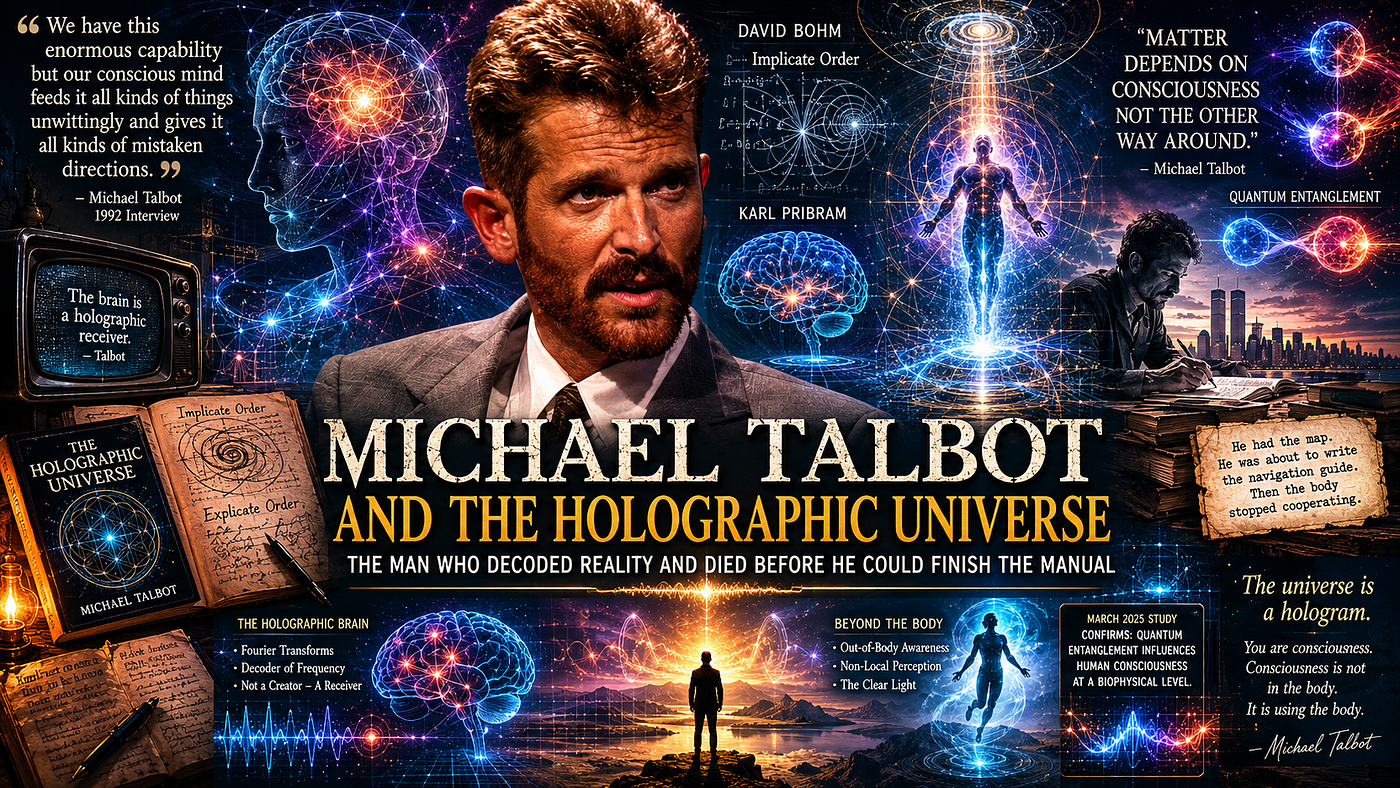
Image created by Author via ChatGPT / Prompted by Abel Arroyo
📺 Watch the full video this piece is based on here:
https://youtu.be/kimf1nhQXaA?si=QSIVnFbaSKrl7iew
He was on television in 1992 finishing a sentence about the book he was about to write. He said he wanted to produce a practical guide to the holographic idea, something that would show ordinary people how to use this framework in their daily lives without having to navigate the heavy mathematics of quantum physics.
His exact words were these. We have this enormous capability but our conscious mind feeds it all kinds of things unwittingly and gives it all kinds of mistaken directions. And I want to write a book that really deals with all these things on all kinds of levels saying here are the practical applications.
He said it clearly. He had the map. He was about to write the navigation guide. Several months after that interview Michael Talbot was diagnosed with lymphocytic leukemia.
He died on May 27, 1992, at Mount Sinai Hospital in New York City. He was thirty-eight years old. The navigation guide was never written. The Holographic Universe, published in 1991, is what remains. It has been in print for thirty-three years.
Today is May 22, 2026. The BBC published a feature this month on whether Stephen Hawking's holographic universe theory is correct. A peer-reviewed study in March 2025 confirmed quantum entanglement influences human consciousness at a biophysical level. Talbot is still being vindicated. He just is not here to see it.
Who He Was
Michael Coleman Talbot was born on September 29, 1953, in Grand Rapids, Michigan. He was not a physicist. He was not an academic. He earned a Bachelor of Fine Arts from Michigan State University in 1975 and worked in publishing and media. He was openly gay and lived in New York City.
He wrote Gothic horror novels before turning his attention to the nature of reality. His first novel, The Delicate Dependency, published in 1982, became a cult classic of vampire fiction. His other horror novels built a dedicated following. But fiction was not where his mind was most alive. His mind was most alive with a question that had been burning in him since childhood.
At a young age he had an out-of-body experience. He floated out of his body and drifted over the yard outside his family's house. He saw a book lying on the ground. The next morning his neighbor told him she had lost a library book by Guy de Maupassant and asked if he had seen it. There was the book.
Exactly where he had seen it from outside his body. He never told the neighbor what had happened. But the experience installed a question he could not shut off. If he could perceive and think while his brain was in his bed and he was floating over the yard, then the brain was not doing the perceiving. Something else was.
He spent his adult life trying to answer that question through the language of science rather than the language of faith.
He found two scientists who were working on the same problem from inside the academic structure he was approaching from outside. Their names were David Bohm and Karl Pribram. Between them, independently, they had built the scientific foundation for everything Talbot would spend his career explaining to people who did not have physics degrees.
The Physicist Who Would Not Shut Up
David Bohm was one of the most significant theoretical physicists of the twentieth century. He was a protege of Oppenheimer. He worked on the Manhattan Project.
He was Einstein's intellectual partner in the final years of Einstein's life. Einstein called him the only physicist who truly understood what Einstein was trying to say.
Bohm was later driven out of the United States during the McCarthy era for refusing to testify against colleagues before the House Un-American Activities Committee. He moved to Britain and spent the rest of his career at Birkbeck College at the University of London asking a question that most of his colleagues refused to take seriously.
The standard interpretation of quantum mechanics told physicists to stop asking what was happening at the quantum level when they were not measuring it. The math works. The predictions are accurate.
Do not ask what the particle is doing when you are not looking at it. Shut up and calculate. Bohm could not shut up. He believed the Copenhagen interpretation was correct as a mathematical framework and dangerously incomplete as a description of reality.
He developed what he called the implicate order and the explicate order. The explicate order is the world we see. Objects, particles, events in space and time. The implicate order is the underlying reality that generates the explicate order the way a holographic plate generates a three-dimensional image.
The implicate order is prior to space and time. Everything that exists in the explicate order, every particle, every person, every galaxy, is an unfolding of the implicate order. The universe is not a collection of separate things interacting with each other. It is a single undivided wholeness that enfolds into the appearance of separate things.
Bohm concluded, toward the end of his life, that consciousness would eventually be found to be primary within the implicate order. Not a product of matter. The ground from which matter arises.
The Neuroscientist Who Found the Hologram in the Brain
Karl Pribram was a neuroscientist at Stanford who spent decades studying how memory is stored in the brain. The conventional model said memories lived in specific locations. Damage the location and you lose the memory. But Pribram's experiments consistently showed this was wrong. Patients who lost large portions of their cerebral cortex retained their memories. Not fragments. The whole memory at lower resolution. Every part of the brain appeared to contain information about the whole experience. Exactly as a holographic plate contains the whole image in every part.
Pribram went further. He discovered that the brain uses Fourier transforms to process sensory information. A Fourier transform is the mathematical operation at the heart of how holograms are created and decoded. It converts a pattern of wave interference into a concrete image. It converts frequency information into spatial experience. Pribram found that every sensory system in the brain, vision, hearing, touch, smell, taste, all of them appear to be performing this Fourier analysis on incoming frequency data and constructing from it the experience of a concrete world. The brain does not see light. It receives a field of electromagnetic frequencies and performs a mathematical transformation on those frequencies to construct the experience of seeing. You are not perceiving reality directly. You are decoding a frequency domain.
Talbot described it this way in the book. He said the brain is like a television set that translates radio waves into images and sounds. The radio waves are not the image. The television set is not creating the radio waves. The set is a decoder. The signal exists independently of the hardware. This was the implication that Pribram's neuroscience and Bohm's physics combined to produce. The holographic brain decoding the holographic universe. The decoder and the signal operating on the same architecture. And in that case the hard boundary between your consciousness and the world outside you is not a fundamental feature of reality. It is a feature of the decoding process.
The Experiment That Cannot Be Explained
In 1982, a team at the University of Paris led by physicist Alain Aspect conducted what is now recognized as one of the most significant experiments in the history of science. Two subatomic particles were created together and then separated. A measurement was performed on one of them. The other particle instantly changed its state to correspond. Not quickly. Instantaneously. No signal passed between them. No physical connection existed. At the moment a measurement was made on one, the other responded as if it already knew.
Talbot described the standard response from the physics establishment. He said most physicists were troubled by this because as Einstein's theory of relativity points out, for the two particles to be communicating it would require a signal traveling faster than the speed of light, which relativity says is impossible. He said this is kind of like stories that you have heard of identical twins where when one is hurt the other feels the pain. And the problem is that we can find no process known to physics that explains how these particles could be sending a signal back and forth.
Bohm's response was different. He said the two particles were never actually separate. The separation between them was a feature of the explicate order. In the implicate order from which they both arose they remained aspects of a single undivided event.
They were not two things communicating. They were two expressions of one thing responding to each other because at the deepest level there was never any separation to cross. The instantaneous correlation was not a signal traveling between two things. It was one thing expressing itself as two.
The implication runs through everything. Every particle in the observable universe was present in the conditions immediately following the Big Bang. In Bohm's framework this means every particle that has ever existed is still correlated with every other particle through the implicate order.
The apparent separation between you and the chair you are sitting on and the city outside your window and the stars above it is a feature of how the holographic brain decodes the holographic universe. At the level where reality actually operates, at the level of the implicate order, there is no separation.
What the Brain Is Actually Doing
Here is what the Fourier transform means for your daily life and why it matters more than most people realize.
Hold your hand in front of your face. It appears solid. Quantum physics says it is not. At the subatomic level it is approximately 99.9999999 percent empty space. The electrons orbiting the nucleus of each atom are so small relative to the nucleus that if the nucleus were the size of a marble the nearest electron would be orbiting it from approximately one mile away. The rest is vacuum. What you feel as solid matter is the electromagnetic repulsion between electron fields. You are not touching things. You are feeling the force between energy fields. The solidity is a construction.
Your brain is performing the construction. The Fourier transform takes the raw frequency domain, the field of vibrating energy that constitutes the implicate order, and decodes it into the experience of a solid, stable, navigable world. The world your brain is showing you is not the world as it is at the implicate level. It is the world as your brain has decoded it from the frequency signal. And the parameters of the decoding process, what the brain is instructed to construct, are influenced by what the consciousness running through the brain believes is there.
This is where Talbot's work connects to KRS-One's philosophical framework on consciousness and dimension. KRS-One, born Lawrence Parker in the Bronx, has spent decades articulating the architecture of awareness in a language that the academic world does not use but that Talbot's physics supports completely. KRS-One said it directly. Your psychology, your perception creates the environment you see. He has lectured extensively on the dimensions of consciousness that exist beyond the five physical senses, arguing that the two eyes you use daily cannot see your past or your future but you can see your past and your future because there is a faculty of perception that operates beyond the physical sensory apparatus. He identified this as the awareness that exists in the fifth dimension, where linear time and space do not bind consciousness and there is no illusion of separation or limitation. Hip hop, he argued, is not a physical thing. It is an energy, a consciousness, an awareness, a behavior. It is a metaphysical principle.
What KRS-One is describing philosophically, Pribram was measuring in the laboratory. The two physical eyes perform Fourier transforms on electromagnetic frequencies in the visible spectrum. But consciousness is not confined to the frequency range the physical eyes decode. The out-of-body perception that Talbot experienced as a child, in which he observed a library book lying in the yard from a position outside his physical body, is an example of consciousness operating at a frequency range outside the normal decoding parameters of the holographic brain. Not supernatural. Non-local. Operating through the implicate order rather than through the explicate sensory apparatus.
When Belief Moves the Body
The placebo effect is the implicate order showing through the explicate order in the most medically documented way available. Talbot described a case that has become one of the most discussed in the history of psychosomatic medicine. A man with lymphatic cancer had tumors the size of oranges throughout his body. His doctor gave him days to live. The patient demanded an experimental drug called Krebiozen. The doctor administered it expecting nothing. Talbot's account of what happened next is exact. He said the doctor reported that three days later the man's tumors melted as the doctor put it like snowballs on a hot stove completely gone from his body faster than the strongest radiation treatment could have achieved. The man resumed his normal life.
Several months later the patient read reports suggesting Krebiozen was ineffective. Talbot recorded what happened. He said boom boom boom all his tumors came back and he was back in the hospital. The doctor began to realize that maybe it was not the drug that had cured the man but the man's belief. He lied to him. He told him the reports were wrong and that he had obtained a more potent version of the drug. He injected the man with distilled water. Again the man's tumors melted away. He resumed his normal life. Months later he read final studies confirming Krebiozen was completely ineffective. Talbot recorded the outcome. Boom boom boom his tumors came back and he died.
Three sequential outcomes. Each one matching the belief state of the patient at the time. The tumors were not symbols. They were measurable biological entities that grew and dissolved in direct correspondence with what the patient's consciousness was instructing the decoder to construct. If the brain is a holographic decoder operating in a holographic universe where consciousness and matter are aspects of the same implicate reality, then this is not an anomaly. It is the system operating as designed. Change the instructions to the decoder and the decoder changes the construction.
Talbot said it plainly. He said matter depends on consciousness not the other way around.
The Dimensions Beyond the Body
Talbot referenced the research of Kenneth Ring at the University of Connecticut, who had documented the accounts of people who had been declared clinically dead, resuscitated, and returned with reports of experiences during the period when their brains were not functioning. The accounts were consistent across culture and geography. Consciousness leaving the body. Accurate perception of events occurring in the room during clinical death. Encounters with a level of reality that people consistently described using words like frequency and energy and hologram and plasticity. A level where thought appeared to create reality directly and instantaneously.
Talbot said this was what the holographic model predicted. He said in these near-death experiences people find themselves in a more fluid and plastic level of reality where thought seems to create things instantly. He said this is consistent with a holographic framework in which the filtering mechanism of the physical brain has been temporarily removed and consciousness is encountering the implicate order more directly.
The AWARE study by Dr. Sam Parnia at the University of Southampton provided the most rigorous clinical data for this. Patients who were clinically dead, with no measurable brain activity, later provided accurate and verifiable accounts of events that occurred in the room during the period of clinical death. Specific visual details. Specific conversations between medical staff. Events occurring in parts of the building the patients had no physical means of perceiving. If consciousness were entirely a product of brain activity this would be impossible. A brain with no measurable electrical activity cannot be constructing accurate perceptions. What the data shows is that the consciousness was perceiving without the holographic decoder online.
The Tibetan Book of the Dead called this the arising of the Clear Light at the moment of death. Meditators of the Tibetan tradition spent decades training for this moment specifically because the unfiltered encounter with the implicate order, without the holographic brain's construction of a solid separate world, requires preparation to navigate without panic. The AWARE study patients were experiencing it without any preparation and still returning with accurate verifiable data. The decoder was offline. The consciousness persisted and perceived.
The 2025 Confirmation
In March 2025 a peer-reviewed study published in the journal Computational and Structural Biotechnology took the quantum entanglement finding into the territory of human consciousness directly. The study analyzed 212 subjects using quantum circuits running on the IBM Brisbane supercomputer, three-dimensional electroencephalography, and neuroplasticity biomarkers including Brain-Derived Neurotrophic Factor. The results showed that quantum entanglement effects in the stimulus configurations explained 13.5 percent of the variance in cognitive accuracy between subjects. The quantum entanglement coefficient captured up to a 31.6 percent increase in variance in twin responses. The study concluded that quantum entanglement demonstrably influences consciousness at a measurable biophysical level. The human brain does not operate as an isolated biochemical island. It operates as a node within a non-local network.
This is not philosophy. This is a controlled experiment on a quantum supercomputer with EEG measurement published in a peer-reviewed journal in 2025. Talbot described the same architecture in 1991 without the equipment to measure it at this resolution. He was right about the destination. The instruments are finally precise enough to confirm it.
In May 2026 the BBC published a feature examining whether Stephen Hawking's holographic universe theory could be correct. Hawking spent the final decade of his life working on what happens to information when matter falls into a black hole. His conclusion was that the information is not destroyed. It is encoded on the two-dimensional event horizon as a holographic surface from which a three-dimensional reality can in principle be reconstructed. The universe we experience as three-dimensional may be the holographic projection of information encoded on a two-dimensional boundary at the edge of observable space. Physicists including Juan Maldacena, Leonard Susskind, and Gerard 't Hooft have spent careers developing the mathematical foundations of this holographic principle. It is not fringe physics. It is the direction theoretical physics has been moving for thirty years.
The Book He Did Not Write
Michael Talbot said on television that he wanted to write a practical guide to the holographic idea. He said we have this enormous capability but our conscious mind feeds it mistaken directions. He was describing the Fourier transform machine and the parameters that govern what it constructs. He was about to write the manual for working with the decoder rather than being worked by it.
He died before he could write it.
The irony is real and it is not lost on anyone who has read the book carefully. The man who documented the capacity of belief to dissolve cancer tumors died of cancer. He understood the architecture of the system better than almost anyone alive when he was writing. Understanding the map does not automatically mean you can navigate the territory. Talbot had the map. He was working on the navigation instructions when his body stopped cooperating.
What he left behind has not stopped. The Holographic Universe has been in print for thirty-three years without interruption. It generates new readers every year who describe it as the book that changed how they understood everything. The March 2025 peer-reviewed study confirmed entanglement's influence on consciousness. The BBC is covering the holographic principle as mainstream theory in 2026. The IBM Brisbane supercomputer is running quantum experiments on human cognitive function. The neuroscience is catching up to what Pribram found forty years ago and Talbot explained thirty-three years ago.
He was thirty-eight years old. He was about to write the next book. The body did not cooperate. The ideas have been cooperating ever since on his behalf.
Ask yourself what you are feeding the Fourier transform machine when you wake up in the morning and assess the day. Ask yourself whether the solid world your brain is showing you is the world as it is or the world as your decoder has been instructed to construct it. Ask yourself what Michael Talbot was going to write in the book he never got to finish. And ask yourself what happens when the decoder goes offline and the consciousness that was running through it encounters the implicate order without the filter. Ask yourself whether that is the end of the signal or simply the end of the television set.
Disclaimer: The author’s bio contains a link to an independent journalism support platform.
About the Author
Abel Arroyo is a cultural critic and forensic biographer dedicated to the Intellectual Resistance — the creators, whistleblowers, and truth-tellers who broke the machine to save their souls. His work interrogates the intersection of power, suppressed knowledge, and human cost, providing rigorous examination of the systems and texts that define how we understand existence. If you find value in these deep dives into the architects of modern dissent and ancient wisdom, consider supporting independent journalism: buymeacoffee.com/dathaze20j
메타데이터
- post_id
- 08aa9f32caf9
- slug
- michael-talbot-and-the-holographic-universe-the-man-who-decoded-reality-and-died-before-he-could-08aa9f32caf9
- url
- https://medium.com/illumination-philosophy-and-metaphysics/michael-talbot-and-the-holographic-universe-the-man-who-decoded-reality-and-died-before-he-could-08aa9f32caf9
- canonical_url
- https://medium.com/illumination-philosophy-and-metaphysics/michael-talbot-and-the-holographic-universe-the-man-who-decoded-reality-and-died-before-he-could-08aa9f32caf9
- author_url
- https://medium.com/@dathaze20
- status
- ok
- fetched_at
- 2026-06-16 19:09:56