I Beat 98% of Wall Street Funds Last Year. Here’s the Real Strategy I Follow.
A 4-step framework I’ve used for 15 years, with real examples from Meta, Palantir & the one mistake that cost me an Apple fortune.
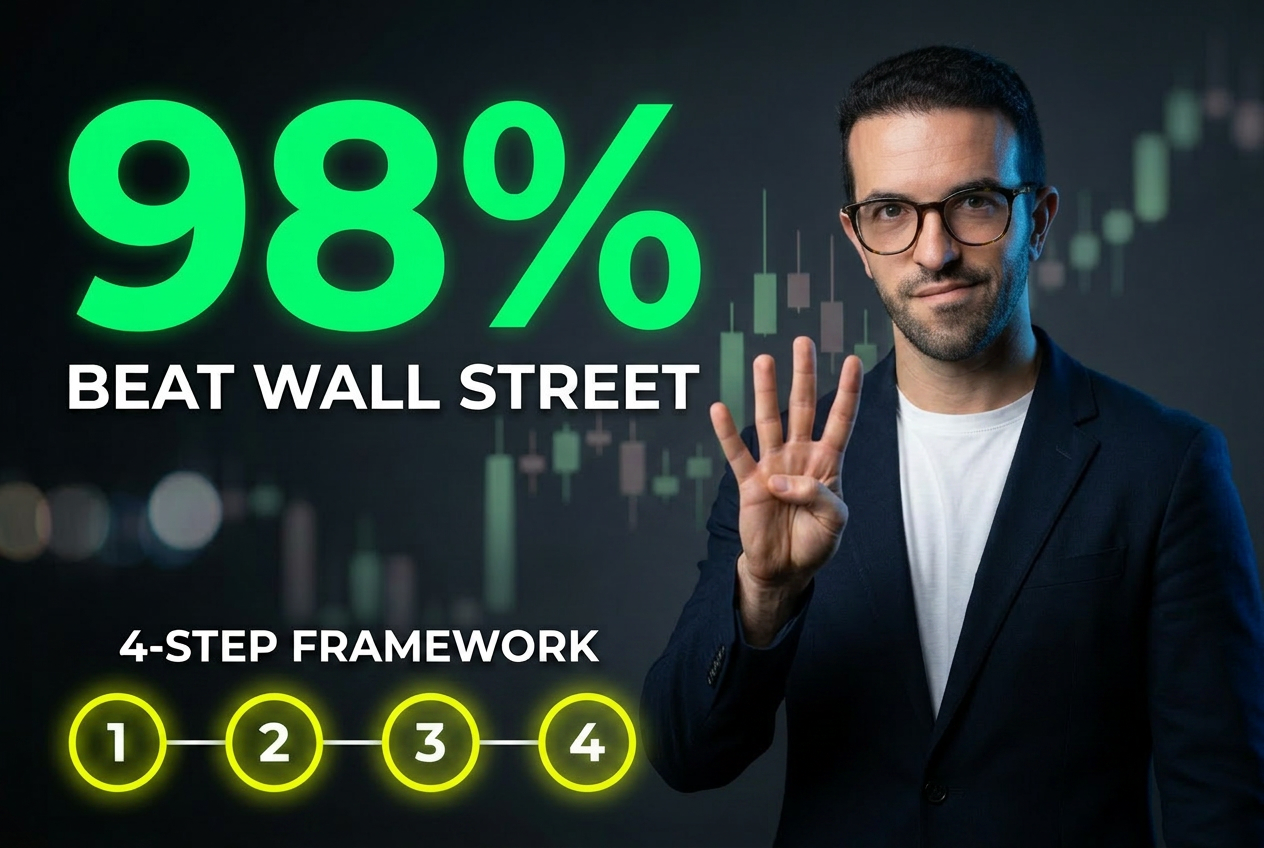
Original photo by me, edited with Nano-Banana 2.
I Beat 98% of Wall Street Funds Last Year. Here’s the Real Strategy I Follow.
A 4-step framework I’ve used for 15 years, with real examples from Meta, Palantir & the one mistake that cost me an Apple fortune.
Over the last two years, my stock portfolio returned 72%!
That was more than double the return of the S&P 500, which tracks the biggest companies in the United States. Enough to outperform the majority of professionally managed investment funds on Wall Street.

Was it luck?
No. The strategy I’ve used for years is surprisingly simple, and it can deliver better returns for anyone investing in the stock market.
After over 20 years of investing and reading ***countless books*** on the topic, it all comes down to just 4 principles:
- Buy great businesses when they are undervalued
- Build positions slowly
- Buy more as the opportunity improves
- Sell only when the original investment thesis breaks
Let’s get into it.
Step 1: Find Great Companies Selling at Bad Prices
Don’t make the same mistake most investors make by focusing on stock prices instead of the business itself. Focus on what you believe are good businesses.
A falling stock price doesn’t necessarily mean it’s a bad company. In fact, some of the best opportunities appear when great companies are temporarily unpopular.
Benjamin Graham explained this perfectly:
“The market is a pendulum that forever swings between unsustainable optimism (which makes stocks too expensive) and unjustified pessimism (which makes them far too cheap)”.
Sometimes investors become so pessimistic that they push stock prices far below what the business is really worth.
That’s where opportunity lives.

Screenshot from my Complete Stock Market Investing Masterclass on Skool.
Our job is to find the stocks whose true value is higher than their current price, to give us a margin of safety.
To do that, we screen the stock market for companies with strong fundamentals but stagnant or declining stock prices.
Meta Was a Perfect Example
In 2022, Meta became one of the most hated stocks in the market. Its stock collapsed, dropping 75% in value. But I looked underneath the surface.
The business remained strong. Revenue was substantial. The company was still generating billions in profits. The stock price had fallen much faster than the quality of the business had.
Fundamental ratios like the PE ratio, PS ratio, and PB ratio were at their lowest levels ever.

Meta fundamental analysis on TradingView.
Unless you thought Meta was about to go bust, this was a screaming buy in 2022.
While most investors saw fear, I saw an opportunity. I applied my strategy, and the stock returned over 500% in about two years.
Your Strategy to Identify These Underpriced Winners
Use Google Finance or TradingView’s stock screener to hone in on the data below. On TradingView’s stock screener, search for:
- Stock price that has dropped or stayed stagnant
- EPS (Earnings Per Share) has grown
- Positive revenue growth
- Positive net income growth
I teach exactly how to use the TradingView screener step by step inside my Complete Stock Market Investing Masterclass at my ***Henrique Wealth Academy*** community.

TradingView’s Stock Screener. Screeshot by the author.
Back to Meta: For this example, we’ll analyze Meta’s stock from late 2022 to early 2023.
- Check the stock price: Review its performance. Meta had declined 75% in one year.
- Check the income statement: Analyze the revenue and income. As you can see, despite a slight decline, the revenue remained stable.
- Check the balance sheet: We typically want to see low liability. In Meta’s case, its liability was low.

Meta’s revenue and net income over time. Screenshot from TradingView.
So if the stock price has declined while revenue and income are still growing, and there isn’t a huge debt load, it’s a good business whose stock is worth buying. It reinforces the idea that your pick is based on value, instead of fear.
Of course, do additional research to see if something else might be impacting the stock prices negatively. If there isn’t anything else apart from negative market sentiment, it’s the perfect opportunity to proceed with buying.
Step 2: Start Small, Then Buy
Don’t rush into it. No one can predict short-term price movements. Not me. Not you. Not Wall Street.
Position sizing matters. I start with a relatively small 5% position on my first buy order.
So how long should you hold a stock? At least one year, if not longer. I’ll elaborate on this more in Step 4.
Step 3: Buy More if It Dips
Let’s say you’ve analyzed the business (like Meta) and decided to buy $1,000 of stock at $200 per share. Then, the price starts to drop.
Don’t panic! Double down and enjoy the bargain!

When Palantir price dropped, I bought more. Screenshot from my brokerage account.
I gradually increase my position as prices decline, provided the business fundamentals remain strong. Remember, lower prices create higher future return potential.
Every time the stock price drops by 5%, I increase my position by 5%. For example, say I initially bought $1,000 worth of shares and the price drops 5%. I’d buy $50 more, and so on.
It’s a strategy similar to DCA (Dollar Cost Averaging), except we only buy when the price declines.
Step 4: When Should I Sell?
This might surprise you.
I bought Apple stock 15 years ago, and sold it after it gained 40%. What was my reasoning? I thought a 40% return was good enough.
Looking back, that was a huge mistake.
These days, I don’t sell just because a stock has doubled or tripled. Instead, I ask myself one question:
“Has the original investment thesis changed?”
If the company is still a good business and the reasons I bought it still hold, then there’s no reason to sell.
The buy-and-hold strategy, when applied to a great business, can compound value for years and create one of the best paths to wealth.
What About Stop-Losses?
This is where my view differs from most investors. Many believe stop-loss orders reduce risk. I disagree.
Remember, you’re buying a stock because you believe in the business, you’ve done your research, and a price drop works in your favor. Automate buy orders for when the price drops, not sell orders!
Read more about why I don’t like ***stop-loss orders***.
What if the Stock Never Stops Dropping?
Only stop buying if the stock’s fundamentals change, even as the stock continues to drop.
That’s exactly what happened to me with Fiverr. I bought it in 2020 during the height of the gig economy boom. But when AI arrived in early 2023, it threatened the entire gig economy and Fiverr’s stock along with it.
The fundamentals had changed, so I stopped buying.
The Real Conclusion
It’s not about finding the perfect stock. It’s about developing the discipline to stick with a sound strategy.
The stock market rewards patience. It rewards conviction. And it rewards those who focus on the business rather than the headlines.
Here’s the framework one more time:
- Stock Selection: Find great businesses trading below their intrinsic value.
- Start Small: Begin buying with a manageable position.
- Buy the Dips: Buy more when prices fall, as long as fundamentals remain strong.
- Sell with Purpose: Only sell when the original investment thesis no longer exists.
The biggest advantage in investing isn’t intelligence. It’s discipline. And discipline compounds just as powerfully as money.
So let me ask you: What are you investing in right now, and why?
These are just a few of the strategies I teach inside my ***Henrique Wealth Academy***. Come check it out — for free.
— Henrique Centieiro 🕺🏻
If you found any value in this article, throw me some love!
🥰 What you can do to support my work: Clap up to 50, leave a message to share your thoughts & be sure to follow. 💌
🌞 Stay in touch:
메타데이터
- post_id
- 08bb57c49a7a
- slug
- i-beat-98-of-wall-street-funds-last-year-heres-the-real-strategy-i-follow-08bb57c49a7a
- url
- https://medium.com/limitless-investor/i-beat-98-of-wall-street-funds-last-year-heres-the-real-strategy-i-follow-08bb57c49a7a
- canonical_url
- https://medium.com/limitless-investor/i-beat-98-of-wall-street-funds-last-year-heres-the-real-strategy-i-follow-08bb57c49a7a
- author_url
- https://medium.com/@henriquecentieiro
- status
- ok
- fetched_at
- 2026-07-12 00:02:18